GPT-6 Luna Degraded and GitHub Copilot Went With It: What a Single-Provider Lane Cost on Nov. 19
OpenAI's gpt-6 Luna API degraded on Nov. 19, 2026, and GitHub Copilot lost the same model lane, blaming an upstream provider. Four status pages, one day.
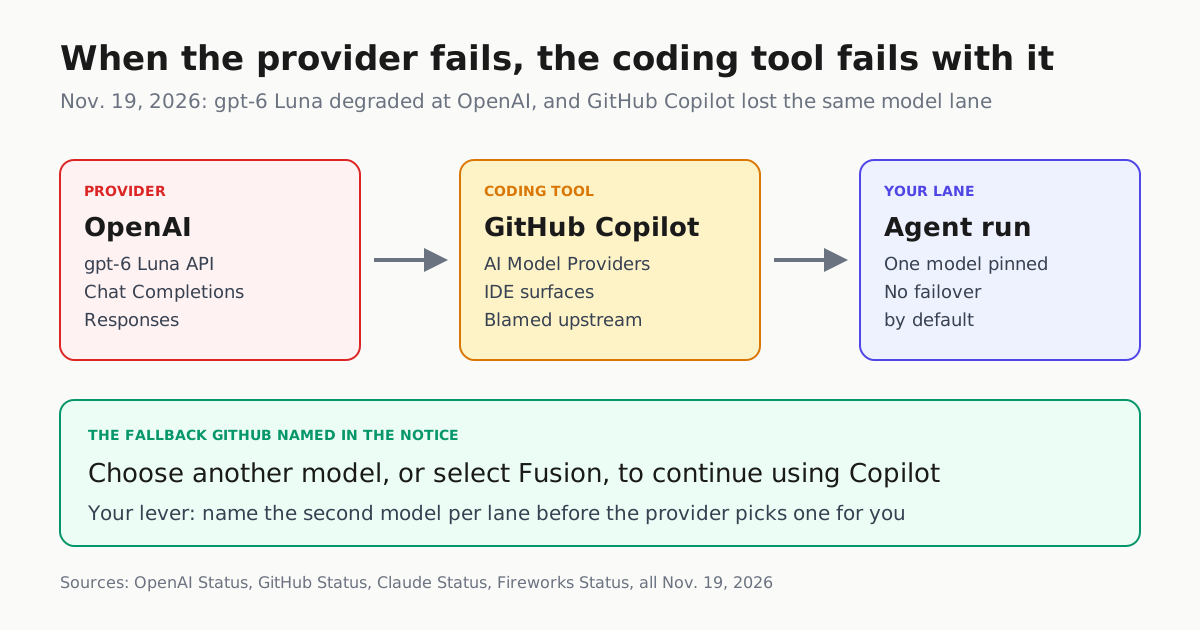
Nov. 19, 2026 was a rough day for the model lanes coding agents run on. OpenAI’s status page documents elevated error rates for gpt-6 Luna API requests, with Chat Completions and Responses listed as affected. The same day, GitHub Status published “Degraded availability for GPT-6 Luna in Copilot,” blamed “an issue with an upstream model provider,” and told users to choose another model or select “Fusion.”
Put those two pages side by side and the story is not “an outage happened.” It is that the model an agent runs on is a lease you do not hold, and when the leaseholder goes dark, the first thing your team sees is a tool that stopped answering.
What the two primary pages actually say
OpenAI’s incident page carries three dated updates: investigating at 11:01 AM, a mitigation applied and monitoring at 11:21 AM, and resolution at 11:58 AM under a “Resolved, Partial outage” banner. It also warns that availability metrics are reported in aggregate across all tiers, models and error types, so a lane can fail while the status page reads green.
GitHub’s page posts in UTC and shows four entries: investigating at 15:56, the degradation notice at 15:57, mitigation at 16:28, and resolution at 16:37 with a promise that “a detailed root cause analysis will be shared as soon as it is available.” The affected component is “Copilot AI Model Providers”; the surface is “Copilot products and IDE surfaces.”
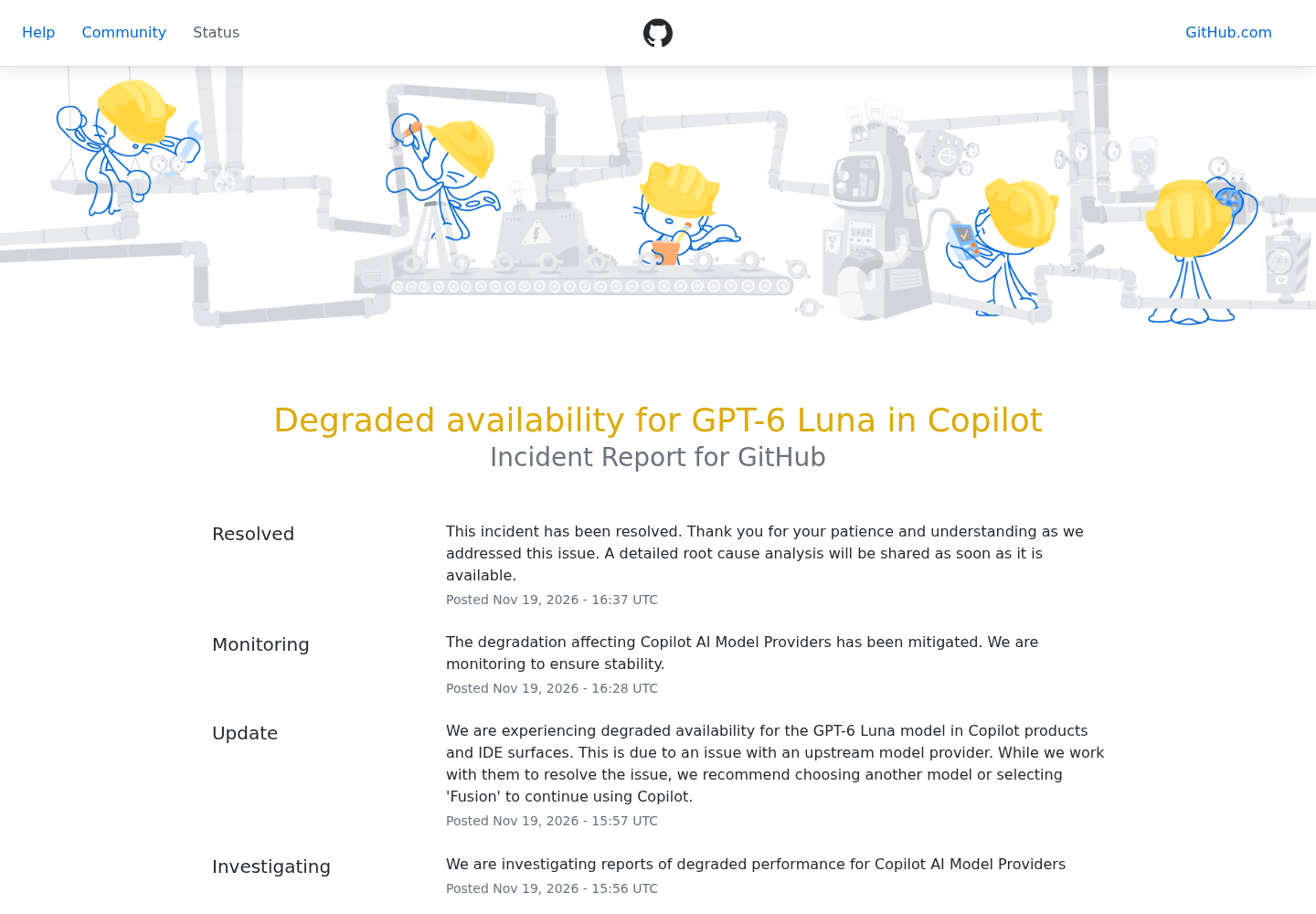
GitHub never named OpenAI. It named the shape of the failure: an upstream provider’s problem, surfaced in the IDE, with the recovery lever sitting inside the tool.
What a single-provider lane costs
For a Copilot user the cost was about 40 minutes of degraded availability and a manual model switch. It lands elsewhere if you run your own agent against a provider API, because nobody ships you a “Fusion” button. A lane pinned to one model identifier inherits that identifier’s error rate.
So a per-lane fallback has to be declared in advance, in config, with a named second model and a trigger:
lane: refactor
harness: claude-code
model_primary: gpt-6-luna
model_fallback: claude-mythos-5.2
fallback_trigger: provider_degraded_or_error_rate_above_threshold
record_served_model: true
Two details matter more than the rest. The fallback needs a task-shaped rule, not a blanket one: linting and summarising can change models mid-incident, while a long refactor you are holding open should not. And log which model actually answered each run. If the transcript cannot tell you a session ran on the fallback, you will not notice output quality moving on the day the provider moved under you; our note on logging the served model when a fallback swaps it covers the mechanics.
If a routing layer does the naming for you, the argument moves to its policy: OpenRouter’s auto code router is the clearest published example, and Copilot’s model-policy APIs and model selectors are the product-side equivalent.
One day, four status pages
Nov. 19 was not a one-provider story. Three model providers and one coding tool published resolved incidents inside a single calendar day.
All four were resolved. Anthropic and GitHub label their posts UTC; the OpenAI and Fireworks pages show a time with no timezone label, so those two windows are not directly comparable to the UTC ones.
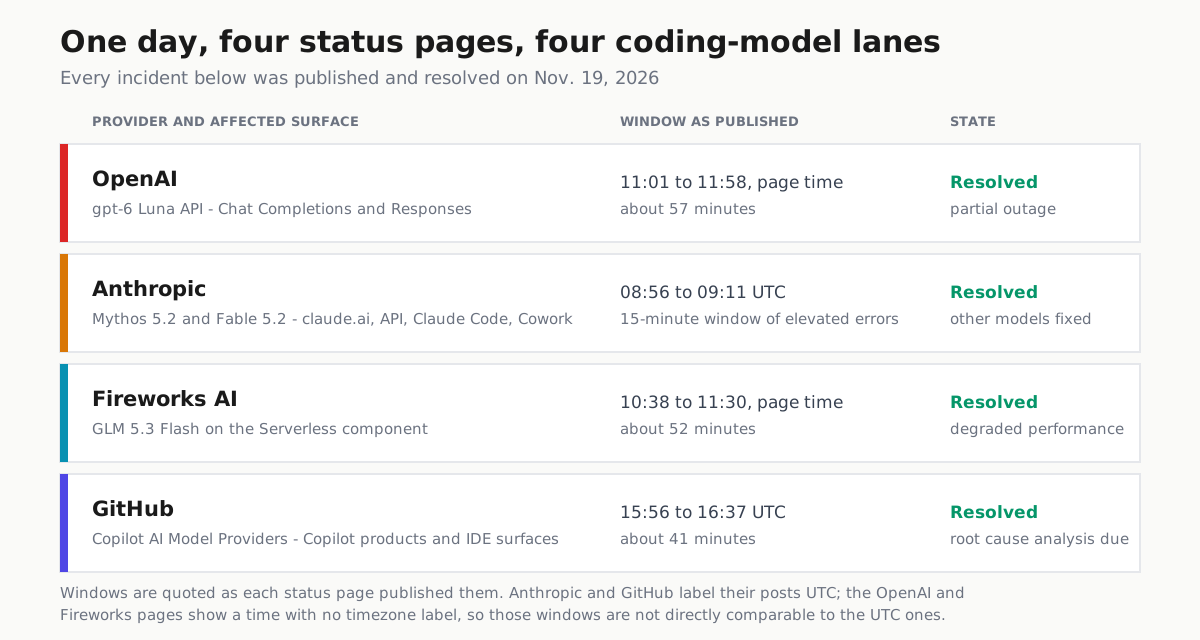
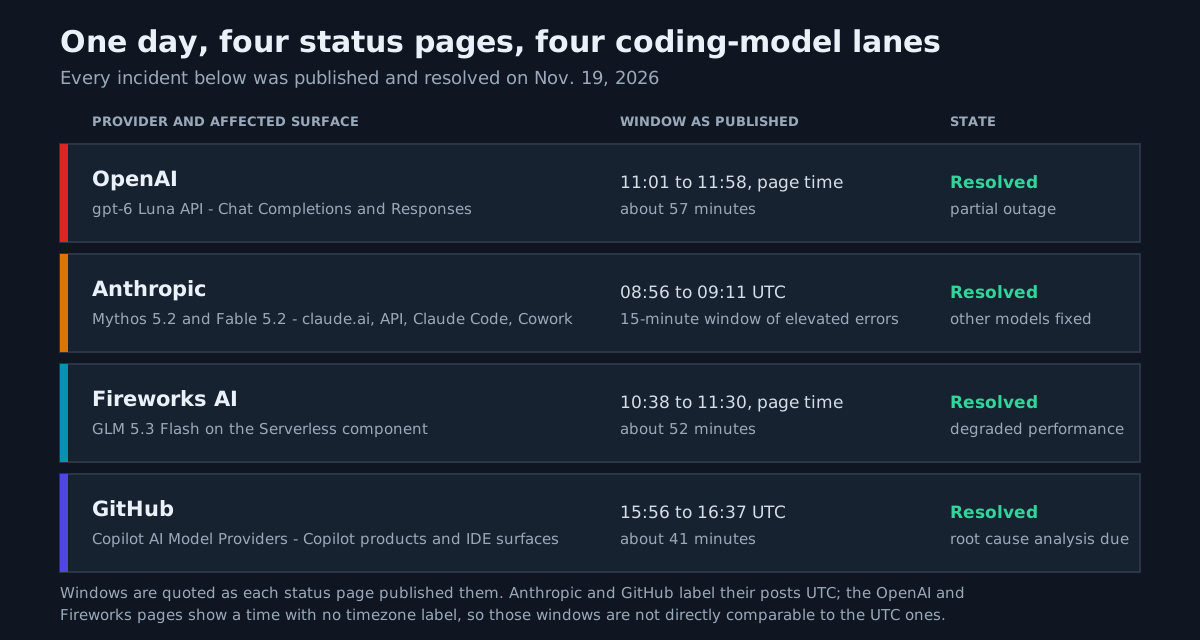
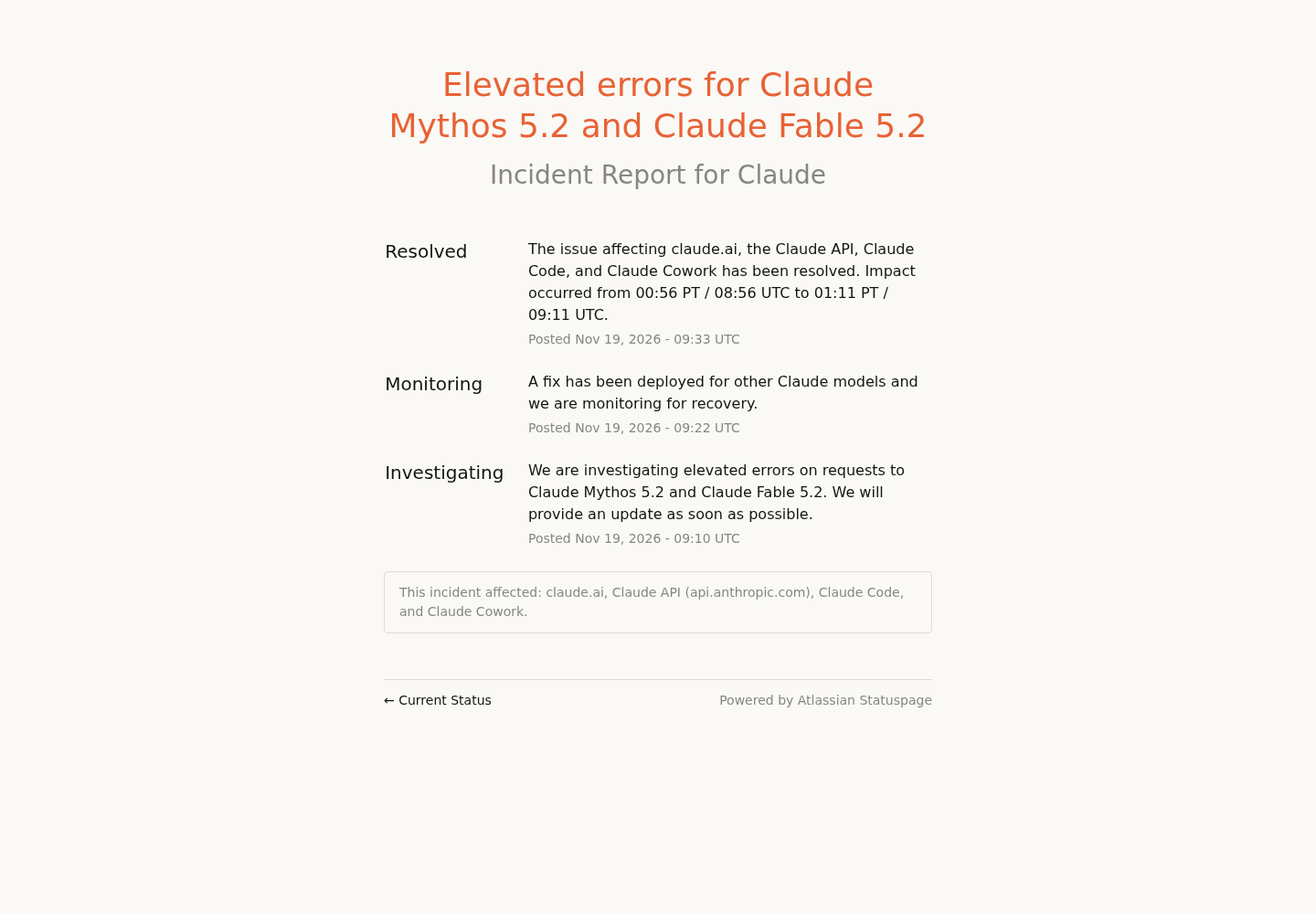
The Anthropic entry has the most direct agent impact. Its status page records elevated errors on Claude Mythos 5.2 and Claude Fable 5.2 across claude.ai, the Claude API, Claude Code and Claude Cowork, from 08:56 to 09:11 UTC: a 15-minute window of elevated errors that included Claude Code. The note that “a fix has been deployed for other Claude models” is the tell: when the failure is one model family and not the platform, a neighbouring model is a mitigation, and a fleet pinned to the failing pair stops.
Fireworks’ incident degraded GLM 5.3 Flash on the Serverless component between 10:38 and 11:30, which matters for anyone serving or reselling that model rather than calling a frontier API.
The pattern is the point. A multi-provider setup is only redundant if you know the state of the provider you are falling back to, and not one of those four pages shipped a fix you could apply to your own fleet. The redundancy has to live on your side.
Three things to change
- Name the second model now. A lane with exactly one model identifier is a single point of failure that no amount of monitoring repairs. The provider-cutoff drill is the cheapest version: cut the primary provider on purpose and see whether the lane still finishes.
- Subscribe to the status pages your lanes depend on, and put the notifications where the person on call will see them. GitHub’s own advice (“choose another model or select Fusion”) is a usable mitigation notice, not just a post-mortem.
- Decide what “degraded” means for an unattended run. If the primary model starts erroring mid-task, does the agent retry on the same model, fail closed, or quietly continue on the fallback? Decided in advance, that choice separates a 40-minute incident from an unexplained change in output.
GitHub’s root cause analysis was still pending at publication time, and none of the four publishers promised a durable fix. We also checked xAI’s third-party models status page; it returned no readable incident content in our fetch, so we are not counting it here. We covered Anthropic’s Nov. 13 degradation of claude.ai, the Claude API and Claude Code here; Nov. 19 was a different shape of failure: the coding tool was the surface that broke, and recovery was a model switch, not a platform restore.