GitHub Copilot CLI, Grok, and Amazon Q: The Other American Harnesses
GitHub Copilot CLI after the June 2026 AI-credit switch, Grok's missing CLI, Amazon Q's blocked signups: one honest review of the second-tier US harnesses.

Go deeper. Build your own.
Below the harnesses everyone argues about sit three American products most power users touch and few actually evaluate: GitHub Copilot’s agent family, including the GitHub Copilot CLI; xAI’s Grok, the coding models without a flagship harness; and Amazon Q Developer, the AWS lane. Each gets pitched constantly — the Copilot seat your employer already bought, the cheap Grok tokens your feed keeps praising, the Q banner in every AWS console — and none gets the honest cross-examination a primary harness would.
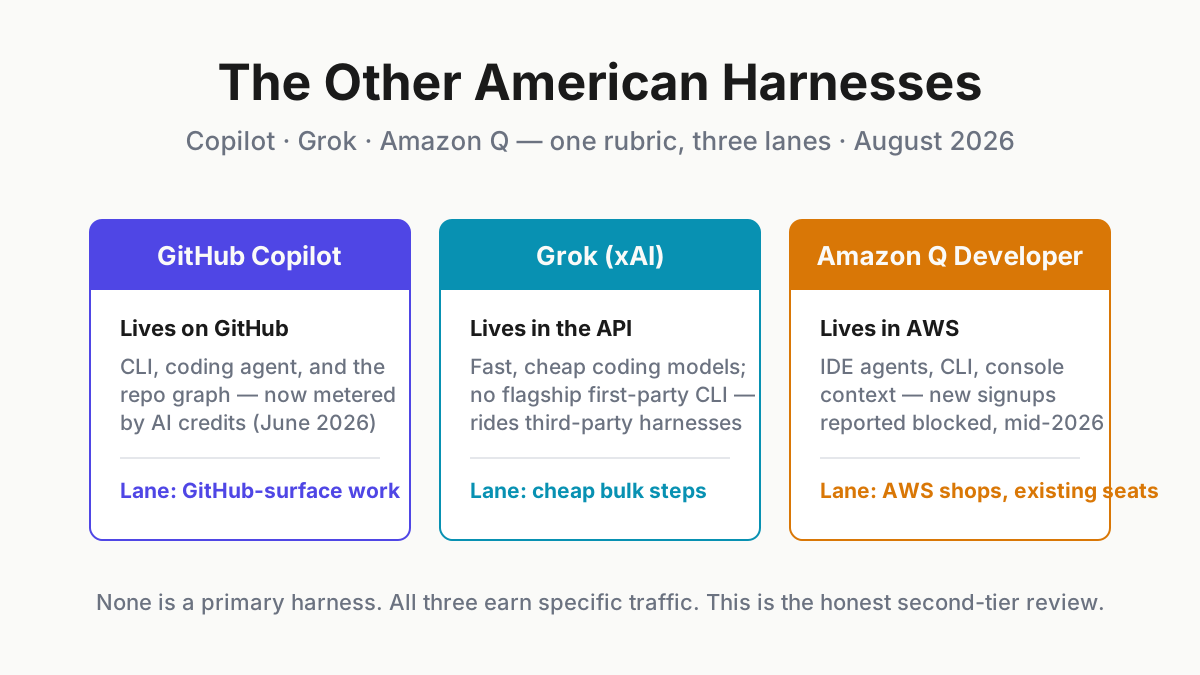
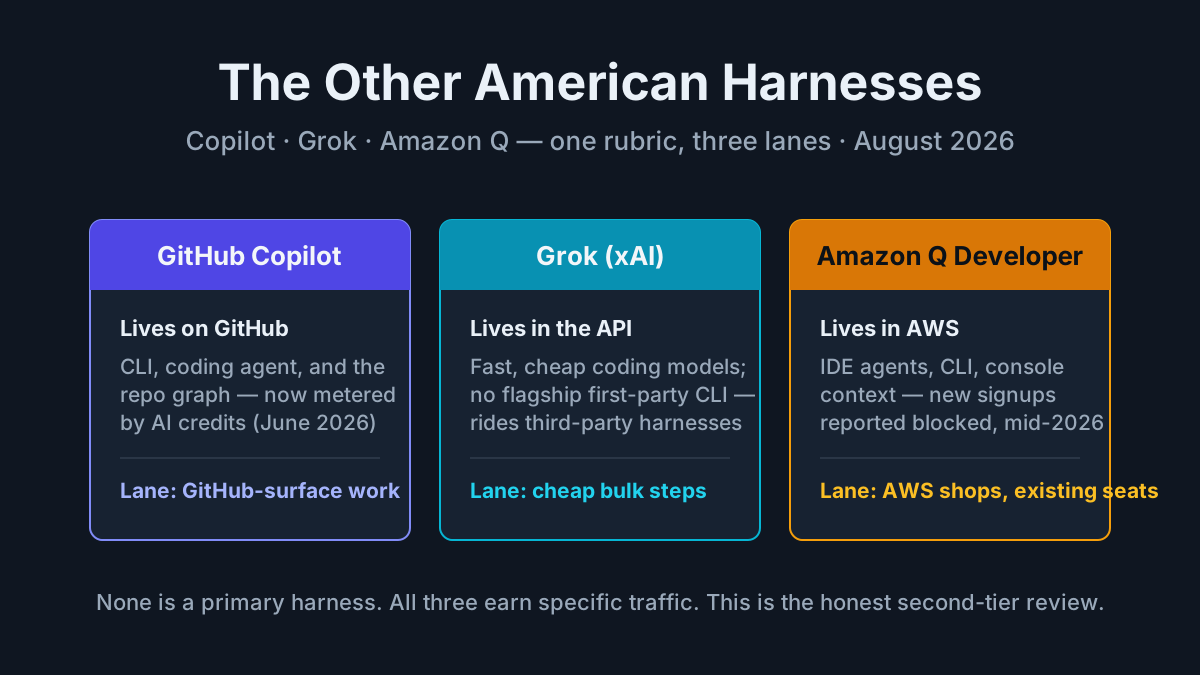
This page is that cross-examination. Our thesis up front: none of these three is anyone’s best primary harness in August 2026, and all three earn specific lanes in a fleet. Copilot’s lane is the GitHub collaboration surface itself. Grok’s lane is cheap, fast bulk steps through other people’s harnesses. Q’s lane is inside AWS, for teams that already hold seats.
The method matches our daily-driver tools roundup: the same questions for each — what it actually is now, what it costs under load, who it genuinely serves. The year demanded the refresh, because the second tier had a loud 2026: GitHub swapped Copilot’s entire metering system on June 1, and Amazon Q reportedly stopped accepting new signups. Second-tier does not mean static.
The three at a glance
| GitHub Copilot | Grok (xAI) | Amazon Q Developer | |
|---|---|---|---|
| Surfaces | IDE agent mode, coding agent on github.com, GitHub Copilot CLI, code review | API-first; third-party harnesses; no flagship CLI | IDE agents, agentic CLI, AWS console, Java transform |
| Models | Broker: OpenAI, Anthropic, Google, xAI menus | grok-code-fast class + Grok 4.x line | Bedrock-served, Anthropic models included |
| Pricing model | Paid tiers + metered AI credits (since June 1, 2026) | Per-token API + SuperGrok subscriptions | Free tier + flat ~$19/user Pro — signups reported blocked |
| Structural advantage | The repo graph and the seat already bought | Speed and per-token price | AWS context, IAM, procurement |
| Honest ceiling | Broker depth; every agent run now meters | No first-party harness; thin docs | Invisible outside AWS; door half-closed |
One-line reads: Copilot is distribution plus the repo graph, now with a meter attached. Grok is speed and price wearing everyone else’s harnesses. Q is AWS gravity with an invisibility problem outside it. What the table teaches is that these three compete on where they sit — GitHub, the API economy, AWS — not on model quality alone, which is precisely why they survive next to better harnesses.
Copilot’s agent evolution: from autocomplete to agent brand
The arc, dated: 2021, autocomplete powered by the original Codex model — the name OpenAI later recycled for its own harness. 2023, the chat era. 2025, agent mode lands in VS Code with multi-step edits and tool use, the asynchronous Copilot coding agent appears on github.com, and the GitHub Copilot CLI brings the brand to the terminal . Somewhere along that line, Copilot stopped being a product and became a brand spanning five surfaces — which is why “is Copilot any good” has no single answer anymore.
The strategic turn underneath is the model brokerage. Copilot fronts OpenAI, Anthropic, Google, and xAI models behind one subscription , betting that developers want a marketplace where OpenAI bets they want a tuned vertical stack. It is the anti-Codex strategy, run from inside the world’s largest code host.
The GitHub Copilot CLI and the coding agent, up close
The CLI, as a harness
The GitHub Copilot CLI runs agentic sessions in your terminal: repo context, multi-step edits, shell use, MCP server support, and — its genuinely native trick — GitHub operations such as issues and pull requests driven from the prompt, per GitHub’s documentation . As a harness it is young. The loop is serviceable, but the extension surface, context-file conventions, and community lore trail Claude Code and Codex CLI by a wide margin . Verdict: a competent GitHub remote, not yet a daily driver.
The coding agent, as a delegate
The Copilot coding agent is the differentiated piece: assign it an issue on github.com, it works in an Actions-powered sandbox, and a draft PR comes back for review . Delegation without leaving the repo is a real workflow, and it compounds. The pattern we like: backlog grooming, where three well-specified good-first-issues go to the coding agent overnight and the CLI handles the review-fix loop in the morning. Note that since June 2026 both halves of that pattern draw from the same metered credit pool, and sandbox time has its own costs . Verdict: the best reason Copilot is on this page.
Copilot pricing decoded: premium requests are dead, long live AI credits
On June 1, 2026, GitHub replaced Copilot’s premium-requests system with usage-based billing built on AI credits — announced on GitHub’s own blog. If you memorized the old multiplier tables, unlearn them; if you are searching “copilot premium requests” to decode a bill, you are reading about a retired system.
What premium requests were, for the record: each paid tier carried a monthly allowance of premium requests, agentic and premium-model actions drew from it with per-model multipliers — base models cheap or free, frontier models at 1x or well above — and overage billed at a flat per-request rate . The system was widely misunderstood, which is roughly why it is gone.
The new system is blunter: paid plans include a monthly AI-credit grant, agentic work and premium models consume credits according to what they actually burn, and spend past the grant is metered . The tier skeleton — Free, Pro around $10, Pro+ around $39, Business around $19 per seat, Enterprise around $39 per seat — survived the switch, but what each tier sustains did not .
Developers saw the shape of the trade early. When the change was announced, Visual Studio Magazine’s reader-reaction piece carried the summary that stuck: “you will get less, but pay the same price”. Same sticker, thinner ceiling — and the heaviest agent-mode users hit that ceiling first, which is exactly the reader of this page.
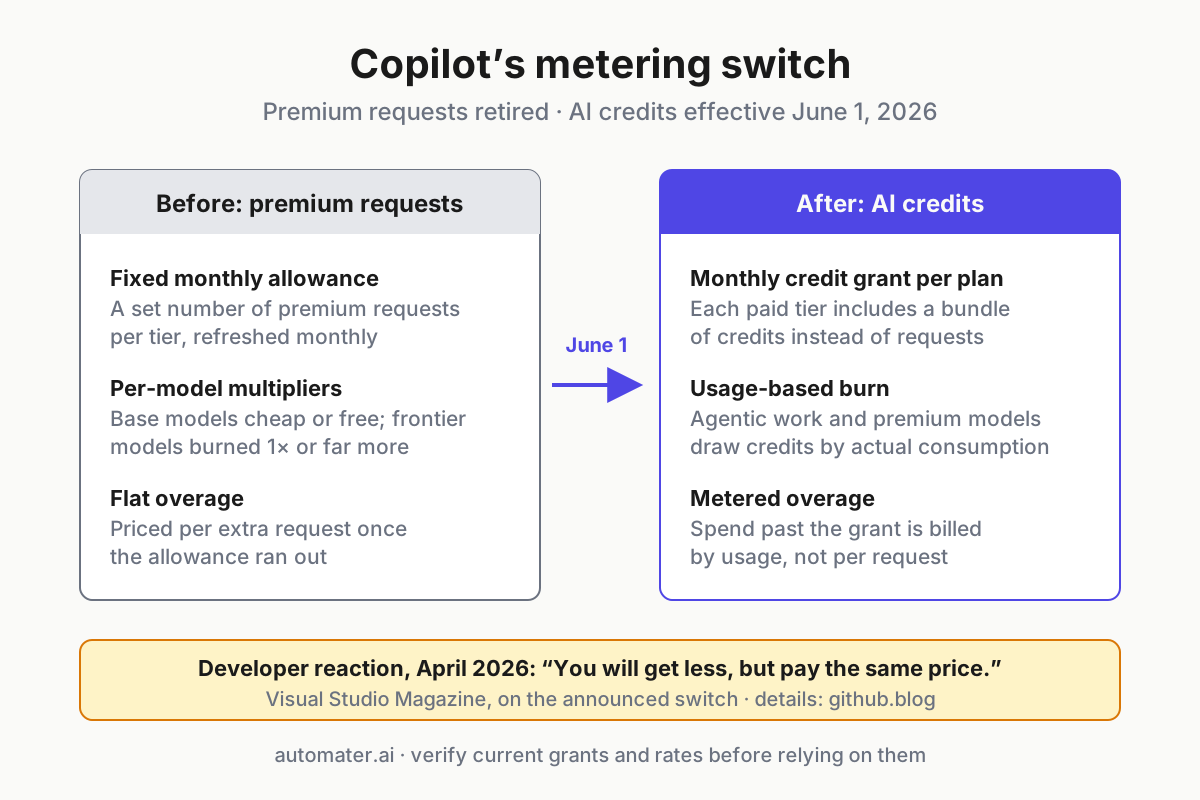
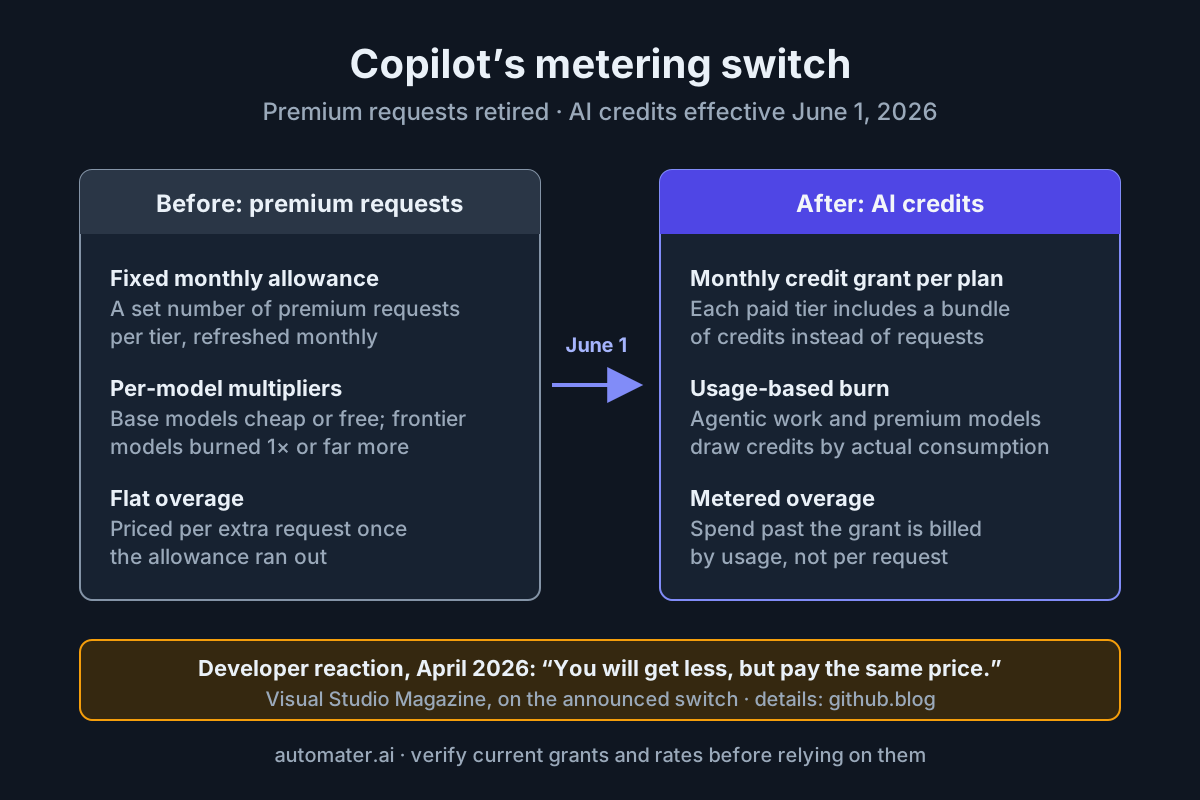 The metering switch: allowances and multipliers out, consumption-based credits in.
Run the heavy-user scenario and the shape of the problem is clear even where exact rates need verifying. A daily agent-mode habit — say two supervised sessions on a frontier model plus a nightly coding-agent run — burns credits on every planning step, tool call, and retry, not per conversation. On the old system that was a countable number of premium requests; on the new one it is a token meter that scales with how verbose your agents are and how large your repos read. Community reports since June describe Pro-tier grants exhausting mid-month for exactly this profile, leaving three options: drop bulk work to cheaper models, upgrade to Pro+, or accept metered overage as a de facto API bill . The honest advice is to measure a normal week before trusting any tier’s marketing.
Two practical consequences follow. First, model choice is now a bill lever twice over — it always set capability, and it now sets burn rate directly, so bulk work belongs on light models as a policy, not a preference. Second, Copilot’s move is one front of a broader retreat from flat-rate AI — the story we track in the subscription squeeze — and it makes cross-vendor comparisons genuinely hard, which is what our token-plan decoder is for.
Copilot’s advantage and its ceiling
The advantage is structural, and no rival matches it: GitHub-native reach. Repos, issues, PRs, Actions, code review — Copilot automates the collaboration surface itself, not just the editing session, and it arrives through procurement your employer already approved. For a large population of developers, Copilot is not chosen; it is present.
The ceiling is just as structural. A broker of many models is deep in none: terminal craft, context-file conventions, and extension ecosystems all trail the dedicated CLIs , and the June metering change means every agentic ambition now runs a tab. Presence without depth defines a lane, and this one is clear. The lane: GitHub-surface automation — review assistance, issue-to-PR delegation, repo hygiene — not primary-harness daily driving.
Grok: the coding models and the price positioning
Everything in this section is stamped August 2026, because Grok moves faster than any vendor here. The line pairs a dedicated fast-and-cheap coding model — the grok-code-fast class — with the frontier Grok 4.x family , sold hard on speed and aggressive per-token pricing through the xAI API .
The price posture deserves one honest complication. Undercutting Western frontier rates by a wide margin was a clean pitch in 2025; in 2026 the cheap lane is crowded, with open-weight competition — DeepSeek V4 Flash at $0.14 per million input tokens and $0.28 out — setting the credible floor. Grok’s bid is being the fast cheap option with US hosting and frontier-adjacent quality, not the cheapest number on any page .
| Model class | Per-token posture (August 2026) | Positioned for |
|---|---|---|
| grok-code-fast class | Cents-per-million input, low single-digit dollars out | High-volume agentic steps |
| Grok 4.x frontier line | Low single-digit dollars in, mid-double-digit out | Harder reasoning steps |
| DeepSeek V4 Flash (floor reference) | $0.14 in / $0.28 out per million | The price Grok is measured against |
| Western frontier flagships | Multiples of all of the above | Quality-dominant work |
Access comes in three flavors: API-key billing through the xAI console, SuperGrok subscription tiers for consumer use, and X Premium bundling that keeps Grok in front of an enormous non-developer audience .
The “grok cli” question: distribution through everyone else
Here is the answer the “grok cli” searcher actually needs, as of August 2026: there is no official first-party Grok coding CLI with the maturity of the harnesses above . xAI’s coding distribution runs through everyone else — API keys dropped into open-source harnesses like Cline and OpenCode (our open-source harness guide covers the pattern), appearances in Copilot’s model menu , and periodic promotional free-access windows that spike usage. Community CLI projects and third-party harness configs exist; a flagship does not.
Read as strategy rather than absence, it is coherent: sell tokens, not harnesses. Let the open-source ecosystem and even rivals be the surface, and compete purely on latency and price per step. In a mid-2026 world where, per reporting, nearly every serious CLI harness accepts an OpenAI-compatible endpoint, a good enough model with a low enough price gets distribution for free — the harness die-off made decoupled models the safest position in the stack.
Grok, honestly: the niche and the open questions
The genuine niche: bulk agentic steps where latency and cost dominate quality ceilings — test scaffolds, lint sweeps, boilerplate expansion, first-pass triage. As the cheap fast lane beside a premium primary, xAI’s Grok coding models earn their keep, and the consumer gravity of X keeps them culturally present well beyond their harness maturity.
The open questions are real and unresolved. Enterprise trust is the big one — data-governance posture and a content-moderation history that procurement teams ask about . Ecosystem depth is thin: docs, integrations, and operational lore all lag. And nobody knows whether the price positioning survives scale, or whether it is promotional spend in the same sense Google’s free tier was. Fair is fair: none of those questions has yet produced a public incident that settles the matter either way.
Amazon Q Developer: the AWS lane with the door half-closed
Amazon Q Developer is AWS’s coding agent family: IDE agents in VS Code, JetBrains, and Visual Studio for feature work, tests, reviews, and docs; an agentic CLI comfortable with natural-language shell work; console integration that answers infra questions with your actual resources in context; and the Java-upgrade transform that quietly became its most-cited enterprise win .
The 2026 news changes the review’s frame: per the mid-2026 harness map, new Amazon Q Developer signups are currently blocked. As of this writing AWS has not framed it as a sunset, and existing seats reportedly keep working — but a product you cannot newly buy is a product on some kind of clock . The one-line context that makes it legible: AWS also ships Kiro, its separate agentic IDE effort, and hedged bets eventually consolidate .
As the tiers stood: a real free tier with monthly agentic limits, and Pro at roughly $19 per user per month — flat-rate simplicity that reads almost quaint next to Copilot’s credit metering . Under the hood, Q serves Bedrock-hosted models with Anthropic’s prominently among them, which makes Q partly a Claude harness wearing AWS branding .
Who Q is actually for (and why you never see it)
The real audience: AWS-heavy shops, where console context, IAM integration, and an existing AWS bill make Q the path of least procurement resistance — plus cost-conscious platform teams that wanted a flat per-seat price they could budget without a spreadsheet.
The invisibility is a marketing-channel artifact. Q lives in the AWS console and on re:Invent stages, not in the terminal-native discourse where power users compare harnesses; absence from the conversation was never absence of users. The capability read, stated plainly: competent inside its lane, rarely anyone’s pick outside it — the harness gap against the dedicated CLIs is real .
The signup block rewrites the recommendation. If your org holds seats: keep using them, and watch the status signals the way you would any product with a frozen front door. If it does not: you cannot currently choose Q anyway, which settles the evaluation with unusual efficiency. The lane: AWS shops with existing seats, eyes open.
The fleet framing: three secondary lanes
Assign the lanes explicitly and the three stop competing with your primary: Copilot for GitHub-surface automation — review assistance and issue-to-PR delegation; Grok for cheap fast bulk steps through whatever harness you already run; Q inside AWS, for as long as its door situation permits. None replaces Claude Code or Codex. Each earns specific traffic.
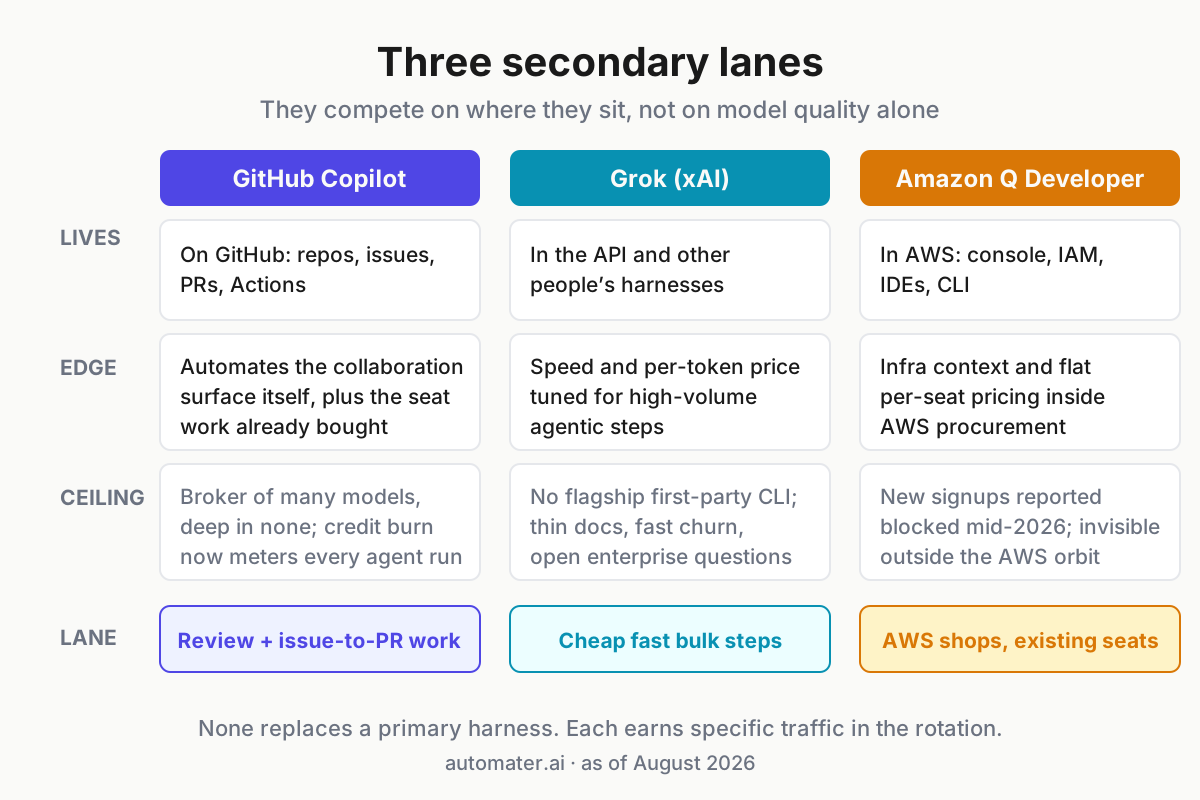
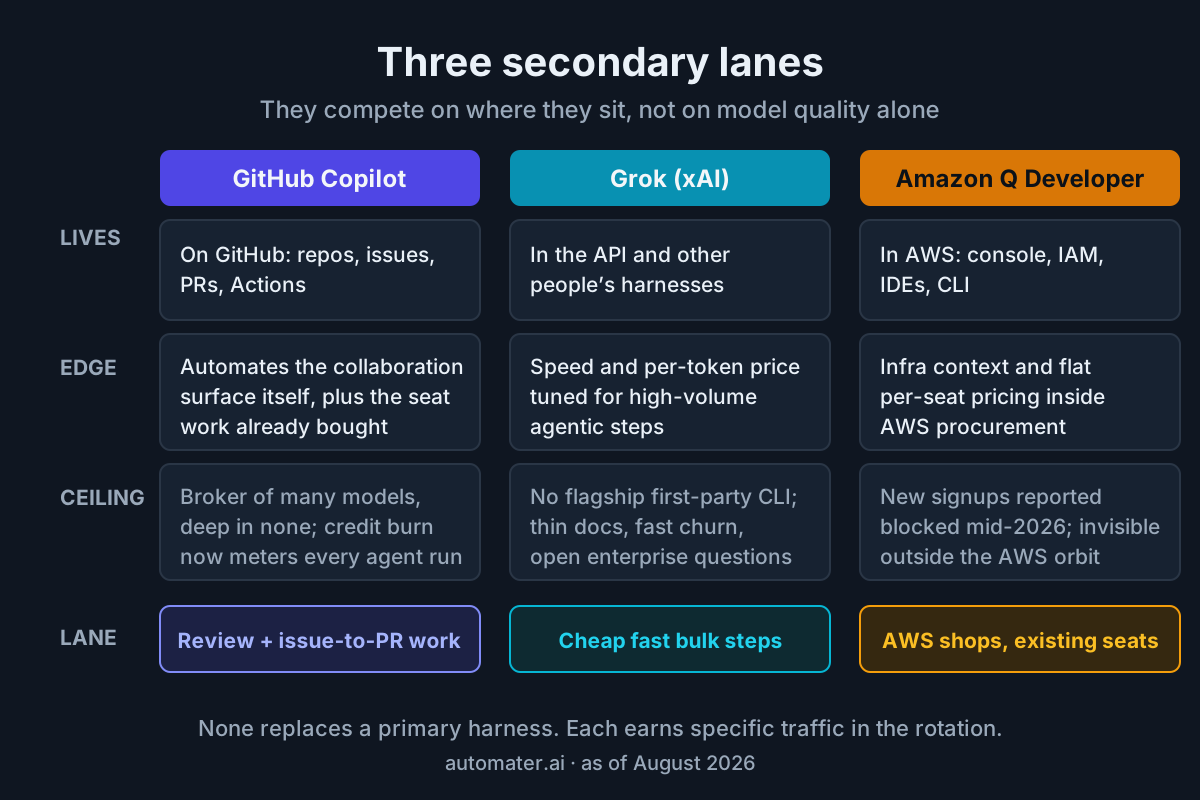 The scorecard, reduced to routing rules: where each one lives is what each one is for.
The pattern that makes lanes pay is rotation and failover, and the rules fit on an index card:
- Route by task type first. GitHub-shaped work (reviews, issue-to-PR) goes to Copilot regardless of model preference; undifferentiated bulk goes to the cheapest competent lane, which is usually Grok; AWS-infra questions go to Q if you have it.
- Route by quota state second. When a primary’s window exhausts or Copilot’s credit grant runs dry mid-month, the rotation absorbs the overflow instead of your overage budget.
- Fail over deliberately. A provider stumble should trigger a config change you rehearsed, not an improvisation — mechanics we formalize in running multiple coding agents.
And carry two warnings into it. Operationally, every added lane multiplies session stores, configs, and billing surfaces; the sprawl compounds faster than the capability. Strategically, the second tier is exactly where shutdowns happen — Gemini CLI died in June, Q’s signups are frozen, and the great harness die-off has a longer casualty list — so pick lanes you can evacuate in an afternoon.
Product note: Rotating across Copilot, Grok, and Q multiplies sessions and spend surfaces fast. Automater Lite gives the fleet one roof — a local archive with full-text search across 10+ CLIs, amber/green agent health, and unified token metering — free, on automater.ai.
FAQ: GitHub Copilot CLI, Grok, and Amazon Q
Is there a GitHub Copilot CLI?
Yes. The GitHub Copilot CLI runs agentic sessions in your terminal with repository context, GitHub-native actions for issues and pull requests, and MCP support. It ships with paid Copilot plans, and since June 1, 2026 its agentic work draws from your plan’s metered AI credits .
What are Copilot premium requests?
The old metering unit, now retired. Until mid-2026, agentic and premium-model actions drew from a monthly premium-request allowance shaped by per-model multipliers. On June 1, 2026, GitHub replaced that system with usage-based AI credits that meter actual consumption, so allowance-and-multiplier math no longer describes any current bill.
Does xAI have a coding CLI?
As of August 2026, no flagship first-party CLI comparable to Claude Code or Codex CLI. Grok’s coding distribution runs through its API inside third-party harnesses such as Cline and OpenCode, plus appearances in Copilot’s model menu. Community projects exist; check for an official release before assuming .
Is Amazon Q Developer free?
It shipped a genuine free tier with monthly agentic limits, plus a Pro tier around $19 per user per month. But per mid-2026 reporting, new signups are currently blocked — existing seats reportedly keep working while newcomers cannot enroll. Verify current status with AWS before planning around it .
Which of these should I add first?
Route by lane, not ranking. GitHub-heavy teams get the most from Copilot’s coding agent and CLI. Cost-dominated bulk work suits Grok’s fast cheap models through a third-party harness. AWS shops with existing seats already have their answer in Q. None of the three should displace a strong primary harness.
Sources
- GitHub Blog — GitHub Copilot is moving to usage-based billing
- Visual Studio Magazine — Devs sound off on usage-based Copilot pricing change: “You will get less, but pay the same price” (April 27, 2026)
- GitHub Docs — Copilot documentation
- dev.to — Coding CLIs in mid-2026: the engineer’s map and what changed in 30 days
- xAI — official site and API
- AWS — Amazon Q Developer