The Subscription Squeeze: Copilot Goes Metered and the Flat-Rate Era Wobbles
The GitHub Copilot pricing change swapped premium requests for metered AI credits on June 1, 2026. Why flat-rate AI plans are wobbling — and how to defend.

Go deeper. Build your own.
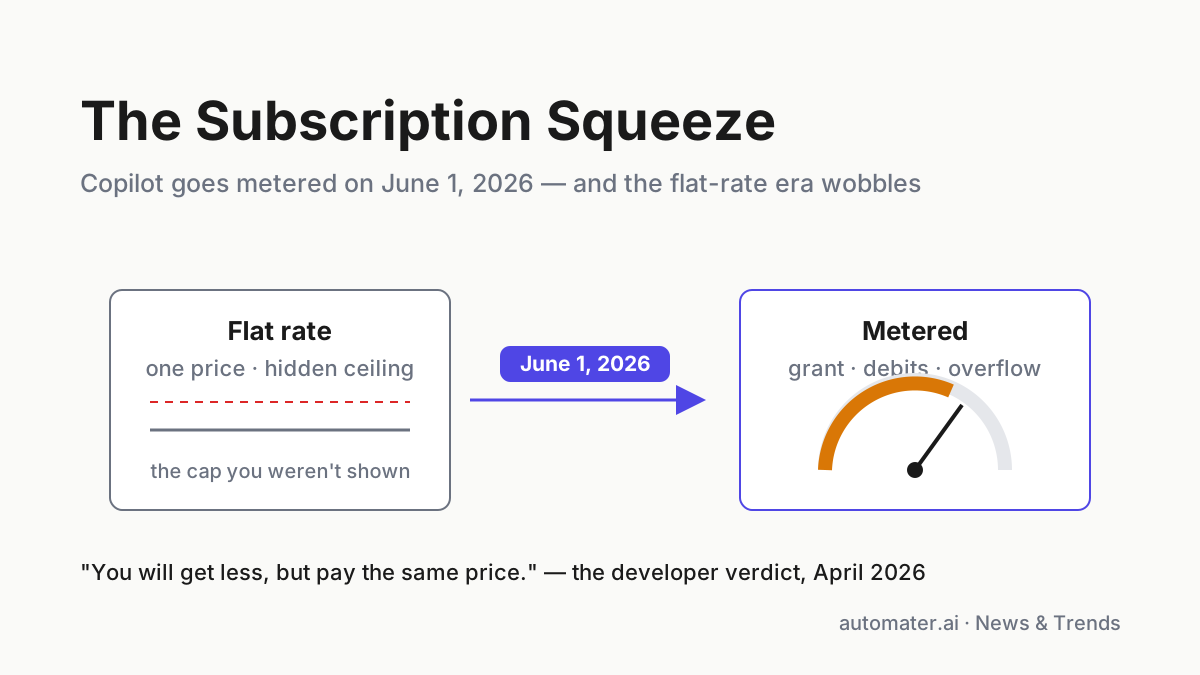
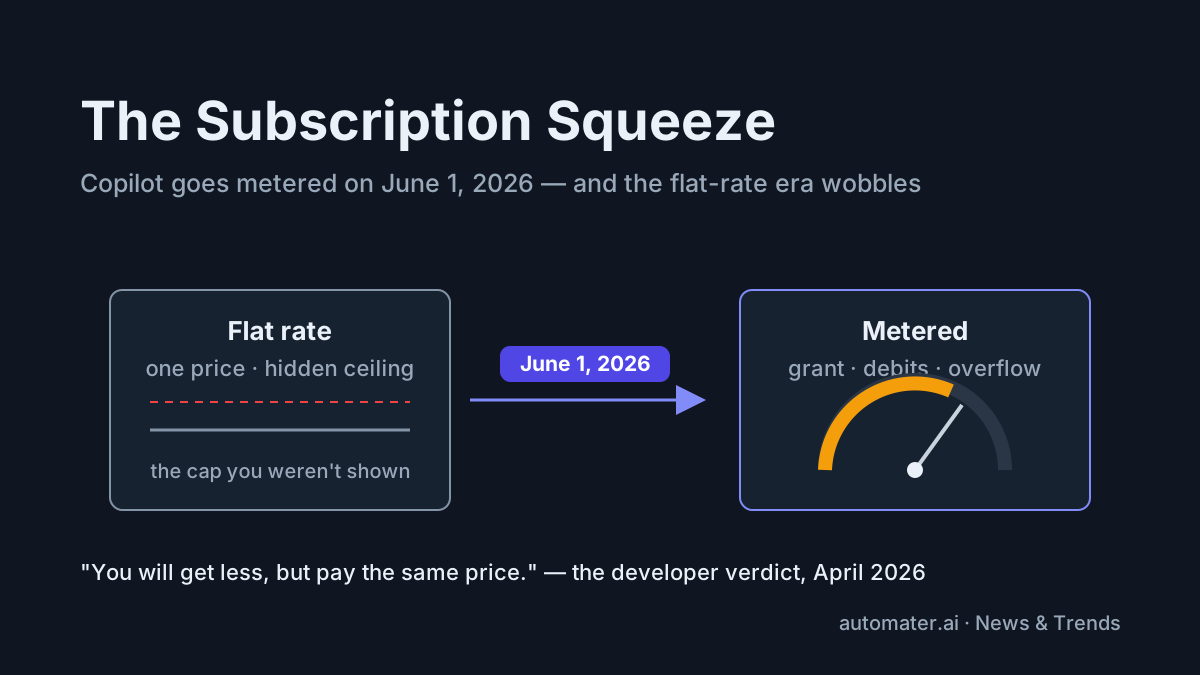
On June 1, 2026, the biggest GitHub Copilot pricing change since the product launched took effect: premium requests died, and every paid plan began metering agent work in AI credits. GitHub framed it as honesty — usage-based billing that charges for what agent sessions actually consume. Developers had coined the blunter summary back in April, when the change was announced: as Visual Studio Magazine’s reaction roundup put it, “you will get less, but pay the same price.”
Both framings are true at once, which is what makes June 1 the reference event for a bigger story. The subscription squeeze is the 2025–2026 repricing wave in AI developer tools: flat monthly plans gaining meters, caps, and credit systems as agent workloads break the cost assumptions those prices were built on. Copilot’s switch is its loudest single event, but the same season ended Qwen’s free tier, repriced Devin, and tightened caps nearly everywhere.
This is the era piece, not the plan-shopping guide. You get the Copilot change decoded, the timeline that shows it was no one-off, the economics of why flat rate wobbles under agents, who wins and loses at each usage shape, an honest pass at whether any unlimited plan can survive, and a four-move defensive playbook for your own stack. When you need vendor-by-vendor plan math down to the mechanic, our token-plan decoder is the deep companion.
Dates and mechanics below were checked on August 27, 2026; specific rates churn monthly and are flagged where they do.
June 1, 2026: the GitHub Copilot pricing change, decoded
What died is worth thirty seconds of history, because the internet still explains it as current. From mid-2025, paid Copilot tiers carried monthly allowances of “premium requests” — roughly 300 on the $10 Pro tier, 1,500 on the $39 Pro+ — with per-model multipliers deciding how fast agentic and frontier-model actions drew them down, and overage near $0.04 a request . It was request counting with exchange rates, and almost nobody could predict a bill from it.
What replaced it is simpler to state and harsher to live with. Every paid plan now includes a monthly grant of AI credits; chat, agent-mode sessions, and premium-model calls debit the grant in proportion to the tokens they actually consume, with heavier models debiting faster; spend past the grant is metered, with budget caps and controls at the org level . The tier skeleton — Free, Pro near $10, Pro+ near $39, Business and Enterprise per seat — survived the switch untouched . The sticker stayed. The ceiling moved.
GitHub’s stated reason deserves a fair hearing, because it is the whole story in miniature. A request was a sane unit when a request meant one autocomplete or one chat reply. Agent mode broke that: one “request” might now read half a repo, run tests, retry twice, and touch thirty files — or it might fix a typo. Costs that vary by three orders of magnitude cannot hide behind one flat unit forever. Token metering prices the work honestly. The developers quoted in the Visual Studio Magazine piece understood that perfectly and objected anyway, because honest pricing is precisely what ends a subsidy, and the people losing the subsidy noticed first.
The practical translation for a heavy user: your bill is no longer a function of how often you ask, but of how much your agents read, write, and retry. Model choice became a spend lever on every step. Verbose agents became expensive agents. And the monthly grant that comfortably covered an autocomplete habit meets a daily agent-mode habit and, per community reports since June, runs out mid-month . Our review of Copilot as a daily harness covers living inside the new meter; here, the point is what the switch signals.
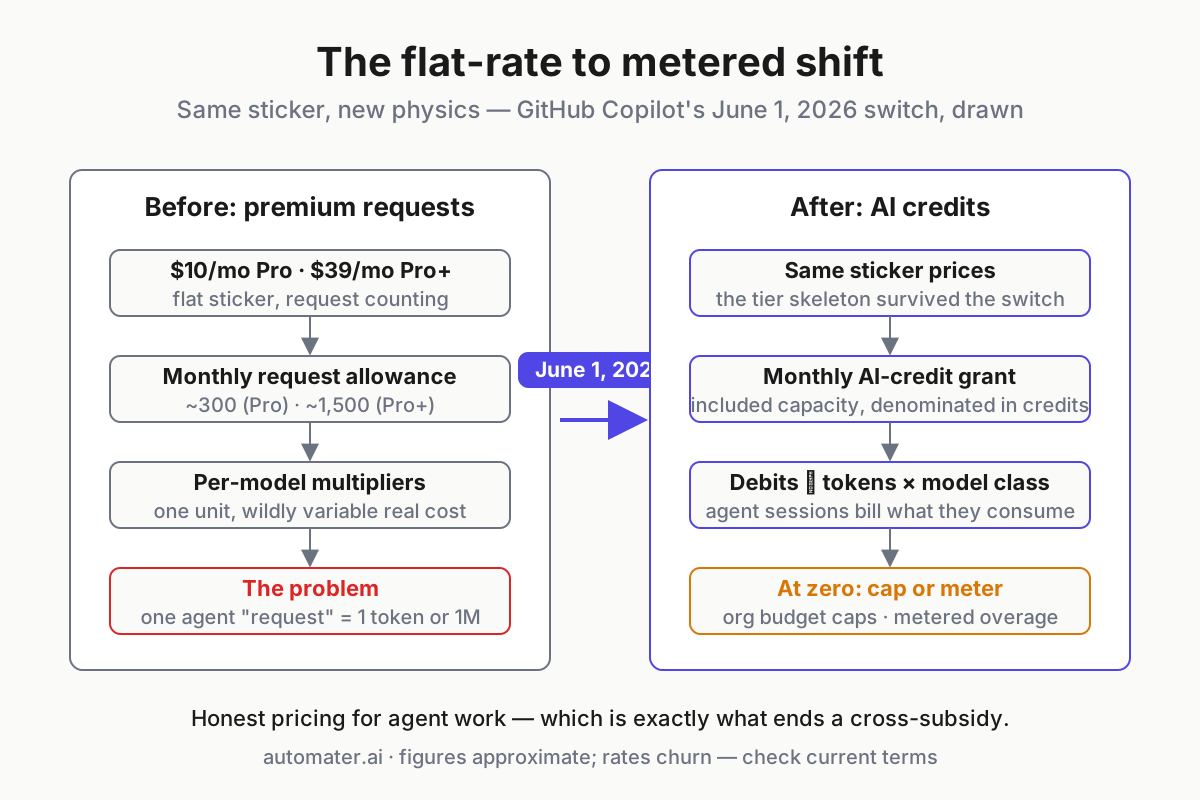
 The shift in one picture: a flat price with a hidden ceiling becomes a grant, a meter, and an overflow lane.
The squeeze beyond Copilot: a timeline of the flat-rate retreat
If June 1 were an isolated event, it would be a Copilot story. The 2026 calendar says otherwise. As of August 2026, the retreat looks like this:
| Date | Event | What it ended |
|---|---|---|
| April 15, 2026 | Qwen Code’s free OAuth tier ends | The category’s most generous free lane |
| Spring 2026 | Devin repriced to ~$20/mo plus usage | The famous $500 flat tier — hybrid billing arrives from above |
| April 2026 | Copilot switch announced; the “get less, pay the same” reaction runs April 27 | The pretense that request counting could survive agents |
| June 1, 2026 | Copilot AI credits go live | Flat-feeling Copilot; metering reaches the largest developer subscription |
| June 18, 2026 | Gemini CLI shut down | The other famous free lane — and the tool with it |
Qwen’s move and Devin’s arrived by the same route — the mid-2026 harness map — so grade them reported rather than gospel . The direction they draw is not in doubt. Devin’s repricing is the interesting mirror image: it dropped its sticker by an order of magnitude and attached a meter, arriving at the same hybrid structure Copilot reached by adding one. From $500 flat and from $10 flat, everyone converged on the same shape: a subscription floor with a metered ceiling.
The frontier vendors had already drifted there quietly. Anthropic’s plans stack weekly caps on rolling windows and sell extra usage at the cap; OpenAI sells credit top-ups when Codex allowances run dry . Nobody at the frontier sells uncapped flat capacity to heavy users anymore. And Gemini CLI’s June 18 shutdown belongs on this timeline too, because a free tier ending is the same economics at a different amplitude — the subject of the great harness die-off, this article’s companion piece. Free lanes died; flat lanes grew meters. One force, two symptoms.
Why flat-rate AI plans wobble: the cross-subsidy agents broke
A flat-rate plan is a bet. The vendor wagers that the average subscriber’s consumption costs less to serve than the subscription price, pockets the spread on light users, and eats the loss on heavy ones. Every subscription business works this way — gyms, buffets, mobile data — and it works as long as the distribution of usage stays put.
Agents moved the distribution. A chat user’s ceiling is their own typing speed; an agent user’s ceiling is their ambition. Harness loops re-send a growing context on every step, so a long session compounds rather than adds — input tokens dominate output by an order of magnitude, and a two-hour agent-mode run can consume what a month of chat once did. How harnesses generate that burn is its own explainer; the billing consequence is that the gap between the median user and the heaviest users stopped being a bell curve’s tail and became a different species. The cross-subsidy that priced the plan cannot survive a P99 that is four orders of magnitude above the median.
A vendor staring at that distribution has three honest options and one dishonest one. Raise the sticker for everyone — punishes the light users who fund the margin. Cap harder — works, but every tightened cap is a public admission, and users learn to hate the invisible wall. Meter — moves the cost onto the people creating it, at the price of killing the simplicity that made subscriptions sell. The dishonest option is to keep the flat price and quietly degrade the product behind it: slower routing, silent model downgrades, deprioritized capacity. The 2026 record shows vendors picking from every honest column — the metering one fastest — while the dishonest option survives mostly as user suspicion, unproven and corrosive. Copilot chose the meter. Anthropic and OpenAI chose caps with metered overflow. More than one free tier chose to stop existing.
Worth saying plainly: the squeeze is not price gouging. Serving costs per token fell all year — per mid-2026 reporting, open-model competition dragged API list prices down roughly 80 percent year over year , the story of the DeepSeek effect on agent economics. Consumption simply grew faster than costs fell, because agents turned every developer into a potential million-token-a-day operation. Cheaper tokens plus vastly more of them is still a bigger bill. Somebody pays it; the era question is who.
Metering mechanics: four questions that decode any credit system
Vendor credit systems differ in vocabulary and rhyme in structure. Four questions extract everything that matters from any of them — Copilot’s is the worked example, and the token-plan decoder runs the same drill across every vendor.
1. What is the grant? The included credits per month, and what unit they are denominated in. A grant sized for last year’s autocomplete usage says nothing about this year’s agent usage — size it against measured burn, not marketing personas.
2. What debits it, at what rate? Whether every agent step meters or only premium-model calls, and how steep the model-class multiplier is. This number is your routing policy in disguise: when a frontier-model step debits several times a base-model step, bulk work on light models stops being a preference and becomes a budget line.
3. What happens at zero? Hard stop, silent degradation to a lesser model, or automatic metered overage — and at what price per unit. This is the difference between a bad afternoon and a surprise invoice. Set the answer yourself where controls exist; Copilot ships org-level budget caps and spend limits for exactly this .
4. Who can see the spend, and when? Real-time visibility per user and per model, or a monthly total after the fact. Metering without observability is how teams discover their agent adoption in the finance channel.
Ask those four of any pricing page and the era’s fine print reads in about ninety seconds. Refuse to adopt any metered plan whose answers to three and four are “overage” and “later.”
Who wins and who loses at each usage shape
Metering redistributes; it does not uniformly raise. Where you land depends on the shape of your usage, not its label.
| Usage shape | Flat-rate era | Metered era | Net |
|---|---|---|---|
| Light: autocomplete + occasional chat | Overpaying to fund the heavy users | Grant barely dented; price unchanged | Wins, invisibly |
| Steady heavy: daily agent-mode driver | The subsidized one | Grant gone mid-month; downgrade models or pay overage | Loses most — by design |
| Bursty: quiet weeks, brutal weeks | Caps bit exactly on the hard weeks | Pays for spikes only; quiet months cost the floor | Often wins, if overflow is priced sanely |
| Org: many seats, mixed usage | Simple per-seat, unpredictable value | Caps, attribution, per-team budgets | Finance wins; the heaviest ICs feel squeezed |
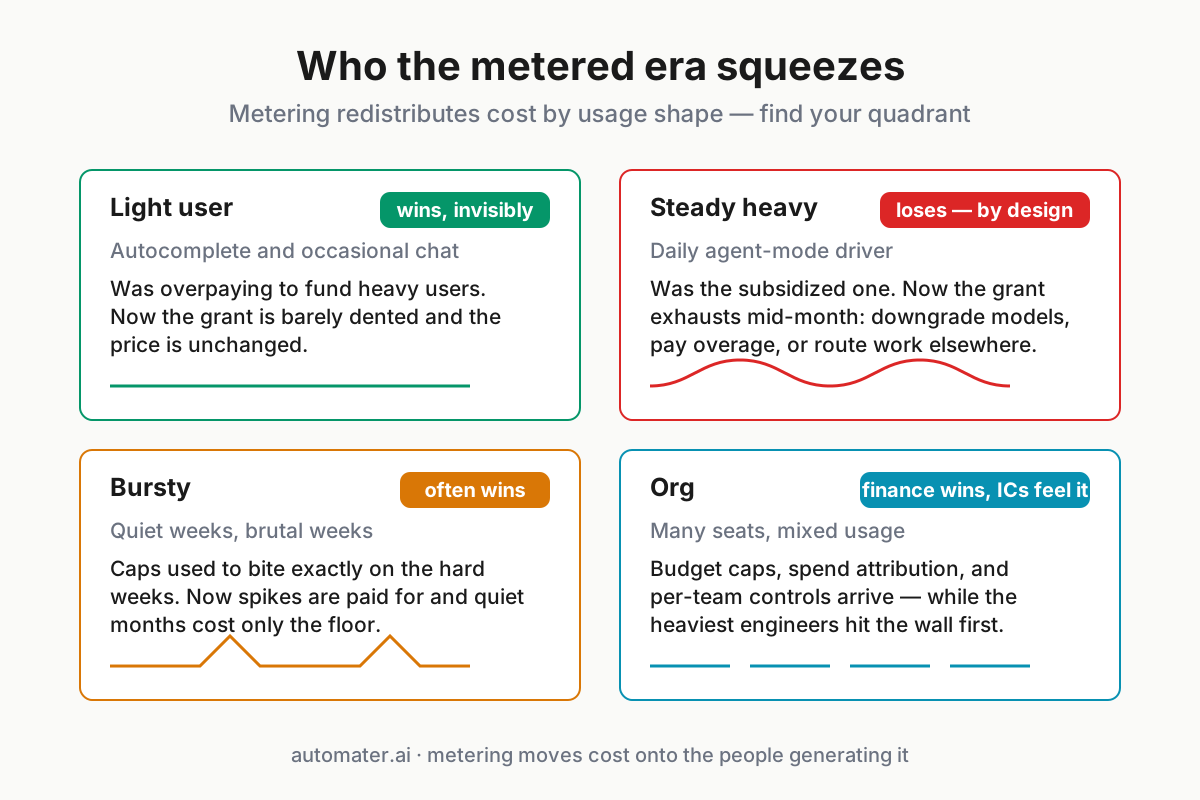
 Metering moves cost onto the people generating it. Whether that is good news depends on which quadrant is you.
The uncomfortable symmetry: the people angriest about the change are the people it prices most accurately. “You will get less, but pay the same price” is the subsidized user’s true lament — the less was always being consumed; someone else was paying for it. That does not make the anger wrong. People planned workflows, teams, and product bets on the subsidized price, and repricing infrastructure mid-lease has real costs even when the new price is fairer. Both things are true, which is why this argument will not end.
One second-order effect is already visible as of August 2026: metering disciplines agent design. When every token debits a visible number, verbose prompts, bloated context, and retry-happy loops stop being aesthetic complaints and start being line items. Teams that tuned context budgets for quality reasons now tune them for invoices. Honest pricing, whatever else it did, made efficiency measurable.
Is any unlimited AI plan sustainable?
The question hanging over every remaining flat plan: if GitHub — with Microsoft’s infrastructure and the largest developer subscription base on earth — could not hold flat pricing against agent workloads, who can?
The strongest counterevidence is the Chinese flat-plan segment, which as of August 2026 has not blinked: Z.ai’s GLM Coding Plan holds an entry tier near $3 a month, Kimi For Coding near $19, MiniMax near $10, all marketed explicitly as flat substitutes for the US plans — the segment our Chinese CLI wave guide covers tool by tool. Three structural reasons let them hold: serving costs an order of magnitude lower on open-weight models they run on their own infrastructure, with DeepSeek V4 Flash’s $0.14 input / $0.28 output pricing marking the credible floor; market-share strategies that treat thin or negative margin as spend; and — read the terms — usage multiples and fair-use ceilings that make “flat” mean generous, not unlimited .
That last clause is the honest answer in miniature. Genuinely unlimited plans do not exist at any price point that matters; there are only caps you hit and caps you do not. “Unlimited” survives as a marketing word exactly as long as its footnotes go unread, and the 2026 pricing pages have mostly stopped using the word at all. The sustainable structures are the ones the market converged on this year: flat-plus-cap where the cap is honest, floor-plus-meter where the meter is visible, and cheap-flat where the serving cost collapsed enough to make generosity affordable.
Three predictions, stated so they can be wrong. Every major remaining flat plan adds or expands a metered overflow lane within twelve months — falsified if a top-five vendor removes one instead. Entry stickers hold near $20, pinned by the Chinese undercut and open-weight APIs — falsified by broad sticker inflation. And the squeeze’s next front is team plans, where per-seat pricing meets wildly per-seat-variable agent usage — falsified if org tiers stay structurally unchanged through mid-2027.
The defensive playbook for the metered era
You cannot vote on vendor pricing, but the metered era is very survivable with four standing moves. None of them requires switching tools today; all of them require knowing numbers most people do not track.
Know your burn. Tokens in and out, per provider, per model, per week — measured locally, because vendor dashboards are silos that end at each vendor’s edge and rarely show token detail in time to act . Every other move in this playbook is arithmetic on top of this number, and every repricing announcement becomes a five-minute calculation instead of a mood.
Product note: The playbook starts with numbers you own. Automater Lite meters token usage locally across every provider you run — Copilot, Claude Code, Codex, Antigravity CLI, and 10+ more — so your real per-model burn is on your screen before any vendor’s meter surprises you, and renewal day is a data decision. Free on automater.ai.
Route by cost. Frontier models for judgment — planning, architecture, review. Cheap lanes for volume — boilerplate, summaries, test grinding. Under metering, the model-class multiplier turns that routing discipline into direct savings on every session, and the credit systems themselves now report which habits cost what.
Keep a cheap lane warm. A configured, tested alternative — a Chinese flat plan, an open-weight API, a local model — that could absorb your bulk work next week. Its value is only half the tokens it serves; the other half is that a credible exit disciplines your negotiation with every meter you live under. If you run several assistants already, running them as one deliberate fleet is what makes the cheap lane a routing decision rather than another browser tab.
Re-run the plan math quarterly. Grants, debit rates, caps, and overflow prices all moved within the last two quarters, and there is no reason to expect stillness. Put renewal-day math on the calendar: measured burn against each plan’s implied capacity, downgrade or stack accordingly. Ten minutes a quarter is the entire cost of never being the person the squeeze surprises.
The flat-rate era is not dead — it is conditional now. Flat prices survive where usage is predictable, caps are honest, or serving is cheap; meters take the rest. June 1 was the day the biggest subscription in the category admitted which condition it was in. The defensible position was never a particular plan. It is knowing your numbers well enough that any vendor’s next announcement is just new input.
FAQ: the GitHub Copilot pricing change and the metered era
What are GitHub Copilot AI credits?
AI credits are Copilot’s usage-billing unit, live since June 1, 2026. Paid plans include a monthly credit grant; chat, agent-mode, and premium-model usage debit it in proportion to tokens consumed, with heavier models debiting faster. Spend past the grant is metered, subject to org-level budget caps and controls.
When did GitHub Copilot pricing change?
GitHub announced the move to usage-based billing in spring 2026 — Visual Studio Magazine’s developer-reaction piece ran April 27 — and the switch took effect June 1, 2026, when AI credits replaced the premium-requests system on every paid plan. Tier prices stayed put; what each tier sustains under agent workloads did not.
Why did GitHub Copilot switch to usage-based billing?
Because agent mode broke request counting: one agentic “request” can read half a repository, run tests, and retry — or fix a typo. Costs varying by orders of magnitude cannot share one flat unit. Token metering charges sessions for what they consume; GitHub called that honesty, and heavy users called it a lost subsidy.
Are flat-rate AI subscriptions going away?
Not away — conditional. Frontier vendors converged on hybrids: a subscription floor with caps and metered overflow. Genuinely flat pricing survives where serving is cheap, notably Chinese plans like the ~$3 GLM Coding Plan, and even those carry fair-use ceilings. Treat “unlimited” as a marketing word with footnotes.
How do I avoid surprise AI credit bills?
Four habits: meter your own token burn locally per provider and model; route bulk work to cheap models and save frontier calls for judgment; set budget caps and alerts wherever the vendor offers them before your first agent-heavy sprint; and re-check grants, debit rates, and overflow prices quarterly, since all of them moved this year.
Sources
- GitHub: Copilot is moving to usage-based billing (github.blog)
- Visual Studio Magazine: Devs sound off on usage-based Copilot pricing change — “you will get less, but pay the same price” (April 27, 2026)
- Coding CLIs in mid-2026 — the engineer’s map and what changed in 30 days (dev.to)
- TechTimes: Gemini CLI shutdown takes effect, CI/CD pipelines break (June 18, 2026)
- Best open-source coding models 2026 — DeepSeek V4 Flash pricing (morphllm.com)
- GitHub Docs: Copilot billing and plans (docs.github.com)