The Great Harness Die-Off: Gemini CLI, iFlow, and How to Pick Survivors
The Gemini CLI shutdown was no one-off: iFlow, Roo Code, Cascade, and Phind died in 2026 too. Get the dated casualty list, survivor traits, and exit checklist.

Go deeper. Build your own.
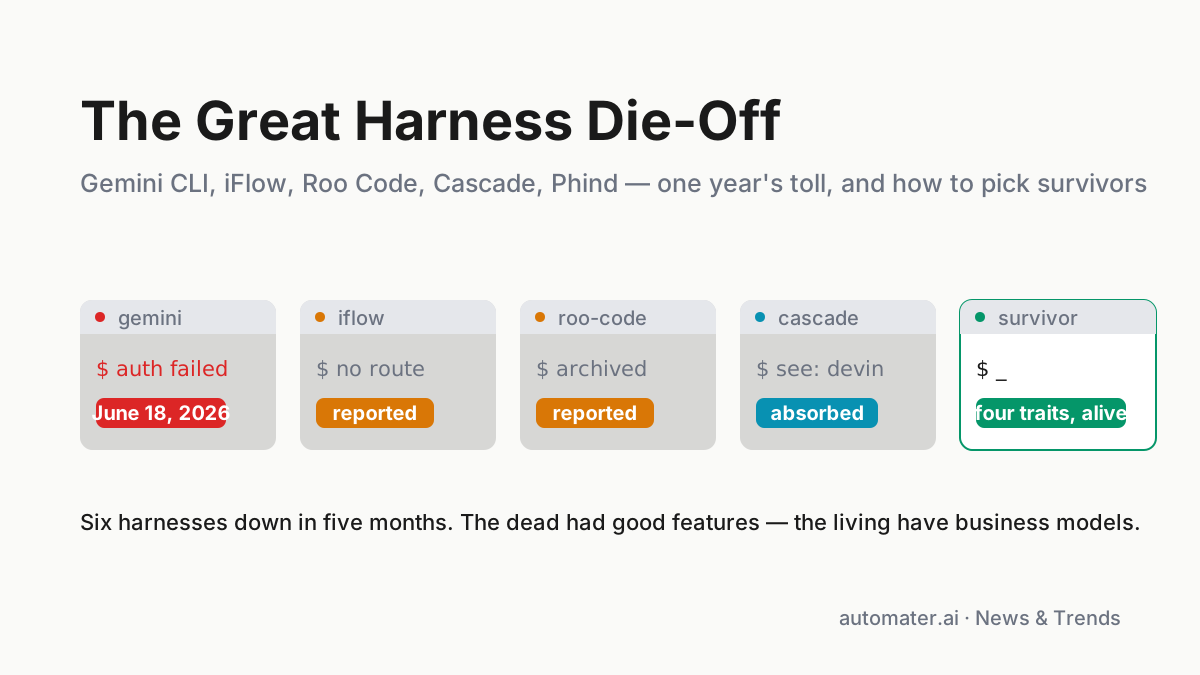
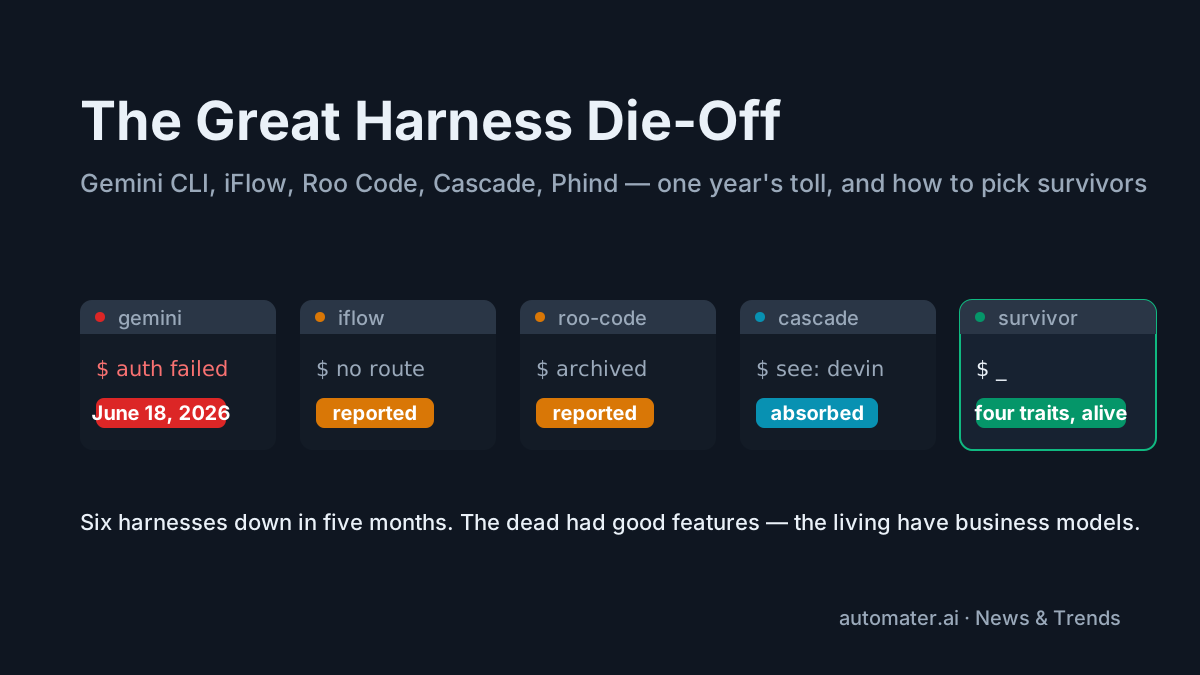
Count the funerals. Gemini CLI: shut down June 18, 2026, with CI pipelines breaking in real time. iFlow CLI: gone. Roo Code: gone. Cascade: end-of-life. Phind: gone. Amazon Q Developer: reportedly closed to new signups. Windsurf: absorbed into Devin Desktop. That is one spring and summer in AI coding tools, and the Gemini CLI shutdown was only the loudest week of it.
The great harness die-off is the 2026 consolidation wave in agentic coding tools: between April and August, at least six harnesses shut down, hit end-of-life, or closed to new users, while several survivors made it through only by repricing or being acquired. The causes are economic, and the casualties were disproportionately free.
This piece is the record and the defense. You get the casualty list with dates and honest evidence grades, the economics of why free harnesses keep dying, the traits the survivors share, an exit checklist you can run in half an hour, migration mini-guides for each casualty, and betting rules for picking tools that will still answer next June. Our 2026 field map of agent harnesses covers who is alive and what they do; this article covers why the dead died and how to avoid standing next to the next one.
One method note before the list. Some of these deaths are confirmed by multiple sources; others rest on credible mid-2026 reporting we have not independently verified. We grade each entry instead of flattening everything into fact — demand the same honesty from anyone selling you a migration.
The casualty list: the Gemini CLI shutdown and everything that died with it
Two evidence grades appear below. Confirmed means multi-source: official announcements, mainstream coverage, or breakage you could watch happen. Reported means the claim traces to credible mid-2026 reporting — principally the engineer’s map of coding CLIs in mid-2026 — which we cite rather than assert. As of August 2026, here is the toll.
| Tool | What it was | What happened | Date | Evidence |
|---|---|---|---|---|
| Gemini CLI | Google’s Apache-2.0 terminal harness | Discontinued; auth hard-failed, CI broke | June 18, 2026 | Confirmed — TechTimes, Hacker News |
| Qwen Code free OAuth | The category’s most generous free lane | Free tier ended; the tool itself lives | April 15, 2026 | Reported — mid-2026 harness map |
| iFlow CLI | Free aggregator of Chinese frontier models | Shut down | Mid-2026 | Reported — mid-2026 harness map |
| Roo Code | Cline fork with custom modes and profiles | Shut down; the code survives in forks | 2026 | Reported — mid-2026 harness map |
| Cascade | Windsurf’s agent line | End-of-life after the Devin Desktop rebrand | ~June 2026 | Reported — mid-2026 harness map |
| Phind | Developer answer engine that grew a coding agent | Gone | 2026 | Reported — mid-2026 harness map |
| Amazon Q Developer | AWS’s coding agent family | New signups blocked; existing seats served | Mid-2026 | Reported — mid-2026 harness map |
| Windsurf | Agentic IDE | Not dead — rebranded Devin Desktop under Cognition | ~June 2026 | Confirmed — vendor rebrand |
Gemini CLI is the anchor case because every part of it is documented. Google’s open-source terminal harness — at launch the loudest free offer in the category, roughly a thousand requests a day on a personal account — was discontinued on June 18, 2026 in favor of the Go-based Antigravity CLI. The binary did not degrade gracefully; authentication hard-failed, so TechTimes documented CI/CD pipelines breaking the same day, and the Hacker News thread became a thousand-author post-incident report of nightly jobs nobody remembered wiring up. We tell the full shutdown story and Antigravity migration separately. Here it serves as the type specimen: a healthy, widely installed tool killed by strategy, not by failure.
The reported wave is smaller in headlines and larger in count. iFlow CLI, the free aggregator that put Qwen, Kimi, DeepSeek, and GLM-class models behind one terminal agent, shut down with no visible business model to save it . Roo Code, the Cline fork that popularized custom modes, shut down as a project, though its ideas and code persist in the Kilo line . Cascade, the agent line inside Windsurf, reached end-of-life after Cognition rebranded the editor into Devin Desktop . And Phind, the developer answer engine that had grown an agentic coding layer, is simply gone from the map . All four per the mid-2026 harness reporting cited above.
Amazon Q Developer shows a different way to die: the half-closed door. Per the same reporting, new signups have been blocked since mid-2026 while existing seats keep working . Nothing was announced as a shutdown, and if you are inside AWS with a seat, nothing changed. But a tool that cannot take new users is dead to everyone who has not already committed — a distinction that matters exactly once, when you recommend it to a teammate. The second-tier US harness review covers what Q still does well for the shops already in.
Then there are the not-quite-deaths, which strand configs and muscle memory all the same. Windsurf was not discontinued; it was absorbed — Cognition’s rebrand made it Devin Desktop, with Cascade’s EOL as the shadow of that transaction. Mistral folded Le Chat’s coding surface into its “Vibe” line per mid-2026 reporting . And Qwen Code is alive and actively developed — but its famous free OAuth tier ended April 15, 2026, which killed the workflow of everyone who treated that free lane as infrastructure. A rebrand or a repricing is not a funeral, but you still wake up with a tool you did not choose. That pricing half of the story is the subscription squeeze.
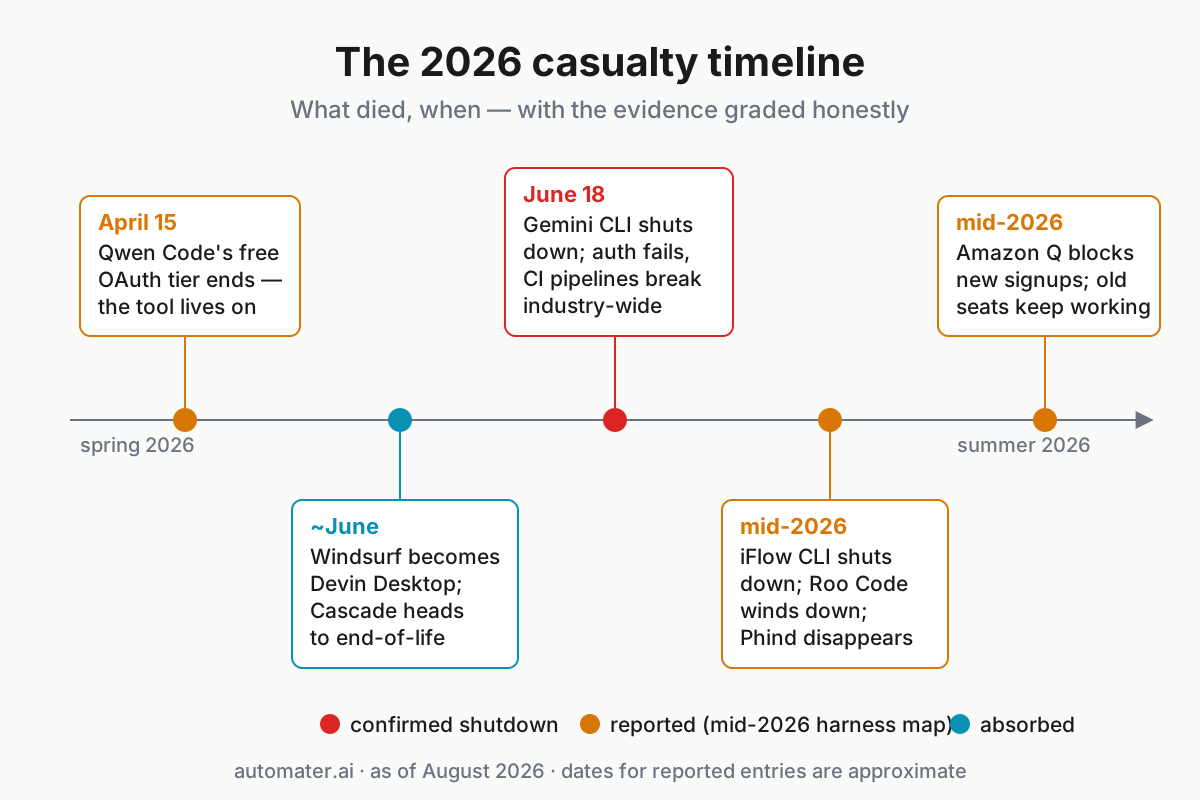
 The 2026 casualty timeline. Confirmed deaths in red, reported ones amber, absorptions blue.
Why free harnesses die: the economics behind the shutdowns
Every agent session costs its operator real money. Harness loops re-send growing context on every step, so one enthusiastic user can burn more inference in an afternoon than a chat user does in a month — tokens are a marginal cost that scales with exactly the users a coding tool most wants. A free harness is therefore always one of three things: customer acquisition, a strategy experiment, or a business that has not started yet. All three run out. The 2026 casualties sort cleanly into three death patterns.
Death by strategy consolidation. Gemini CLI’s free quota was inference spent as marketing — capacity deployed to reset developer defaults toward the Gemini ecosystem. It worked, which is why the shutdown surprised people. When Google’s agentic strategy consolidated on Antigravity in late 2025, the spend moved with the strategy, and the CLI became a budget line without a sponsor. The tool did not fail. The reason for its existence did.
Death by missing business model. iFlow gave away aggregated access to four vendors’ models; Phind gave away answers with an agent attached. Open-model API prices fell roughly 80 percent year over year per mid-2026 reporting , and it still was not enough, because 80 percent cheaper is not free. A tool whose unit economics never worked does not get acquired or consolidated. It just stops.
Death by absorption. Cognition bought the Windsurf editor and folded it into the Devin line; Cascade’s end-of-life is what product-line rationalization looks like from the outside. Roo Code’s arc reads similarly per reporting — a project whose people and ideas moved on while the artifact wound down. In an absorption the product may survive, but its roadmap now belongs to the buyer’s strategy, and your workflow is an externality of someone else’s integration plan.
The connecting thread is uncomfortable but clarifying: you were never the customer of a free harness. You were the funnel, the benchmark audience, or the acquisition asset. Nothing about that is scandalous — venture-backed developer tools have always worked this way — but 2026 is the year the bill for pretending otherwise arrived, and it arrived in CI.
The survivors did not escape the same math; they surfaced it. GitHub moved Copilot to usage-based AI credits on June 1, 2026. Devin repriced to $20 a month plus usage . Anthropic and OpenAI cap and meter their plans. The economics that killed the free tools are metering the paid ones — same force, gentler outcome.
Survivor traits: how to spot a harness that will still exist next year
Line up the tools still standing as of August 2026 — Claude Code, Codex CLI, Copilot, Antigravity CLI, Aider, OpenCode, Goose, Qwen Code, the paid newcomers like Amp — and the pattern is not model quality or feature count. The dead tools had good features. The living ones share four structural traits.
A revenue model you can explain in one sentence. Claude Code sells Anthropic model capacity. Copilot sells seats and meters credits. Amp charges money on purpose from day one. Aider and OpenCode cost their maintainers almost nothing per user, because you bring your own key and the inference bill lands on you. Every one of those sentences describes someone paying for the tokens on purpose. If you cannot write that sentence for a tool you depend on, you are the sentence.
Protocol-native, model-agnostic plumbing. Per the mid-2026 reporting, every serious CLI harness now accepts at least one of OpenAI-compatible or Anthropic-Messages endpoints , and MCP is the shared tool layer. That decoupling is survival insurance in both directions: the harness can outlive any one model deal, and you can swap providers with a base-URL change instead of a migration. A harness that speaks only one vendor’s private API dies with that vendor’s strategy.
Portable configs and data. The survivors keep instruction files in your repo in AGENTS.md-style conventions, write transcripts as plain files on your disk, and let you export what you built. The casualties disproportionately kept context server-side, in proprietary formats, behind accounts that stopped authenticating. Where your data lives is a survival prediction — theirs and yours.
Code that outlives the company. Apache-2.0 could not save Gemini CLI the service, but it saved the harness: Qwen Code began as a Gemini CLI fork and sailed through June 18 untouched. Roo Code’s lineage persists in Kilo Code. Goose moved to the Linux Foundation per mid-2026 reporting — foundation governance being the strongest form of this trait, since it survives even the sponsor losing interest. The whole open-source harness lane is, structurally, the un-killable fallback.
| Survivor trait | The 60-second test |
|---|---|
| Explainable revenue | Write one sentence saying who pays and why. Can’t? That’s your answer |
| Protocol-native | Point it at a different provider’s endpoint. Does anything work? |
| Portable data | Find your sessions and configs on disk. Plain files, or a database only the app reads? |
| Code that outlives | Real license, real external contributors, ideally a foundation — or a repo that dies with the org chart? |
Score a tool three or four out of four and bet on it. Two, plan an exit. Fewer, enjoy it like a free sample, because that is what it is.
The exit checklist: what to export before the next shutdown
Run this today, per harness, while everything still authenticates. The 2026 deprecation windows were measured in weeks, and the assets below divide sharply into what survives a shutdown by default and what evaporates the moment auth dies. Thirty minutes now converts the next funeral from an incident into an errand.
- 1. Export your sessions. Transcripts are the asset a shutdown destroys permanently — decisions, working prompts, the reasoning behind half your codebase. Copy every harness’s session store out of its app directory to storage you control, on a schedule, not once.
- 2. Move instruction files into repos. Global CLAUDE.md/AGENTS.md-style context belongs in version control, written in provider-neutral conventions, so your accumulated project knowledge is a file you diff rather than a setting you lose.
- 3. Version your configs. Dotfiles, MCP server definitions, model routing, permission settings — commit them. A migration is an afternoon when configs are files and a week when they are memories.
- 4. Copy skills and custom commands. Tuned workflows are the new lock-in. Keep a canonical copy outside any one tool’s directory, and sync it across the harnesses you run.
- 5. Inventory keys and auth. Know which tools use API keys you hold versus OAuth grants the vendor holds. Keys outlive shutdowns; device grants die first — Gemini CLI’s did, hours before the binary followed.
- 6. Grep CI for harness binaries. Search your pipelines for every agent CLI invocation and keep the list where the on-call can find it. June 18’s red builds were, at root, an inventory failure.
- 7. Keep your own usage records. Vendor dashboards vanish with the vendor. Local metering of tokens per provider tells you your real exposure — and what a replacement lane must absorb.
- 8. Test a restore. Once a quarter, prove a second harness can pick up a live task using your exported context. An export you never restored is a hope, not a backup.
The mechanical core of items 1–4 fits in one command. Adjust paths to your roster:
# Snapshot every harness's local state while it still exists
tar -czf ai-harness-backup-$(date +%F).tgz \
  ~/.claude ~/.codex ~/.gemini ~/.qwen \
  ~/.config/opencode 2>/dev/null
# Then get it off the machine — the point is surviving anything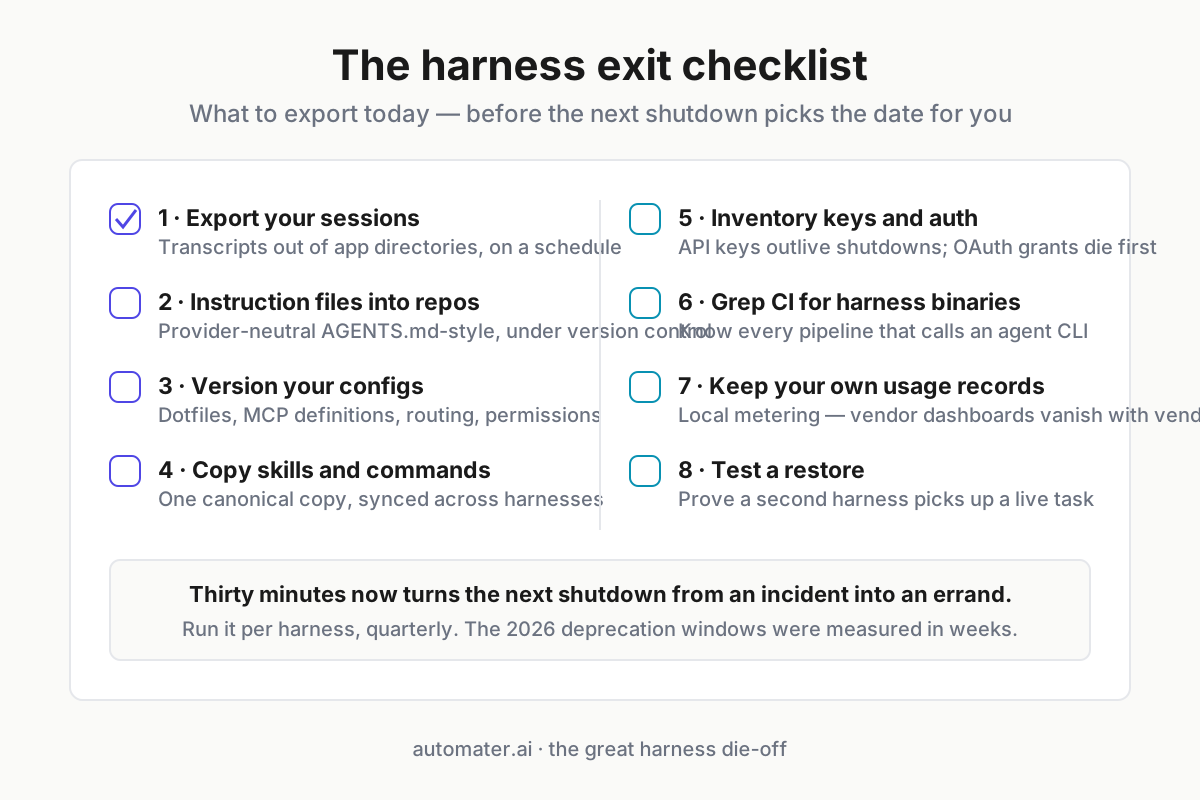
 The exit checklist. Print it, run it quarterly, share it with whoever owns your CI.
Product note: Every CLI forgets. Automater doesn’t — and dead CLIs forget forever. Automater Lite archives sessions from 10+ providers (Claude Code, Codex, Gemini, Qwen Code, Antigravity, and any CLI that writes transcripts) into one local, full-text-searchable library with import/export and Vault redaction, and meters your tokens per provider so you know your exposure before the announcement. Free, on automater.ai.
Migration mini-guides: after the Gemini CLI shutdown, and the rest
Gemini CLI → Antigravity CLI. The big one, and the most complete path: Google shipped a designated successor, so this is a real migration rather than a replacement hunt. Install the Go-based Antigravity CLI, re-authenticate, carry your GEMINI.md content into its context conventions, and re-point every CI step you found in checklist item 6 — then treat its free quota as the promotion it is. The fifteen-minute version lives in our Antigravity guide.
iFlow CLI → keys, not aggregators. iFlow’s job — cheap sampling across Chinese models — is better done now with an open harness plus one API key per vendor you actually use, or an aggregator that charges money and therefore has a reason to persist. The Chinese CLI wave guide maps the current access paths, including what Qwen access costs since the free OAuth tier ended.
Roo Code → Cline or Kilo Code. Return to the parent project, or follow the fork line to Kilo, which carried the custom-modes idea forward . Mode configs port with modest rewriting; this is the gentlest migration on the list because the lineage stayed open source.
Cascade / Windsurf → decide, don’t drift. If Devin Desktop’s direction suits you, staying is a choice — make it deliberately, knowing the roadmap now serves Cognition’s agent strategy. If not, this is the natural moment to exit IDE lock-in for a terminal harness plus the editor you already like.
Phind → split the job. Its answer-engine half is served by any frontier chat with web search; its agent half by whichever harness you already run. Tools that bundled two jobs die into two replacements.
Amazon Q (blocked signups) → no action if you’re in. Existing seats reportedly keep working; build nothing new on it if you are not already inside, and note the precedent for your vendor-risk file.
How to bet on AI coding tools now
Four rules fall out of the year, and they are cheap to follow.
Run two harnesses minimum. Not for the model diversity — for the exit ramp. A warm second harness with your context files already working turns any shutdown into a config change. If you run several already, run them like a fleet rather than a junk drawer.
Price free lanes as spot capacity. Use them enthusiastically and assume a termination date you cannot see. April 15 and June 18 were the same lesson at two vendors: a free quota is a promotion, not a contract.
Weight survivor traits over demo sizzle. The four-trait test above beats any feature comparison for tools you will depend on in twelve months. Apply it hardest to the shiniest things — our daily-driver tool rankings bake this in, and the new-wave harness field report applies it to the post-die-off cohort that filled the empty shelf space.
Re-run the exit checklist quarterly. Exposure drifts: new tools accrete, session stores move, CI grows new dependencies. The checklist is a battery-check ritual, not a one-time cleanup.
The consolidation is not finished. Free lanes keep narrowing, the paid survivors are metering, and at least one tool on today’s field map will not be on next summer’s. As of August 2026, that is not a prediction so much as a base rate. Bet on tools whose existence you can explain, keep your assets where no shutdown reaches them, and the next funeral will be someone else’s incident review.
FAQ: the 2026 harness die-off
Why was Gemini CLI shut down?
Google discontinued Gemini CLI on June 18, 2026 as part of consolidating its agentic coding strategy on Antigravity, pointing users to the Go-based Antigravity CLI. The shutdown hard-failed authentication, which broke CI pipelines that had scripted against the free tier — TechTimes and a large Hacker News thread documented the breakage the same day.
Which AI coding tools were discontinued in 2026?
Confirmed: Gemini CLI (June 18, 2026). Reported, per the mid-2026 harness map: iFlow CLI and Roo Code shut down, Cascade hit end-of-life, Phind disappeared, and Amazon Q Developer blocked new signups. Adjacent: Qwen Code’s free OAuth tier ended April 15, and Windsurf was rebranded into Devin Desktop rather than killed.
Is Windsurf dead?
No — absorbed. Cognition rebranded the Windsurf editor as Devin Desktop around June 2026, and the product continues under the Devin line. Its Cascade agent branding reached end-of-life in the transition, per mid-2026 reporting. Existing users kept a working tool but inherited a roadmap that now serves Cognition’s agent strategy.
What should I export before an AI coding CLI shuts down?
Eight things, ideally today: session transcripts, instruction and memory files (into repos), harness configs and MCP definitions, skills and custom commands, an inventory of keys versus vendor-held OAuth grants, a list of CI jobs calling each harness, your own usage records, and proof that a second harness can restore from your exports.
Which AI coding tools are safe to bet on now?
No tool is safe; some are structurally safer. Favor harnesses with an explainable revenue model, OpenAI- or Anthropic-compatible endpoints plus MCP, plain-file portable configs and transcripts, and open code with a real community or foundation home. Score candidates against those four traits and keep a second harness warm regardless.
Sources
- TechTimes: Gemini CLI shutdown takes effect, CI/CD pipelines break, Go-based Antigravity CLI arrives (June 18, 2026)
- Hacker News: Gemini CLI shutdown discussion thread
- Coding CLIs in mid-2026 — the engineer’s map and what changed in 30 days (dev.to)
- GitHub: Copilot is moving to usage-based billing (github.blog)
- Qwen Code repository — the Gemini CLI fork that outlived its parent (GitHub)
- Goose repository — Block’s open-source agent framework (GitHub)