 Automater
GPT-6 Astra at the Critical Cyber Threshold: An Operator’s Runbook
Assess GPT-6 Astra enterprise access and prepare production controls: contain active agents, reconstruct their actions, and gate consequential writes.

Go deeper. Build your own.
The move
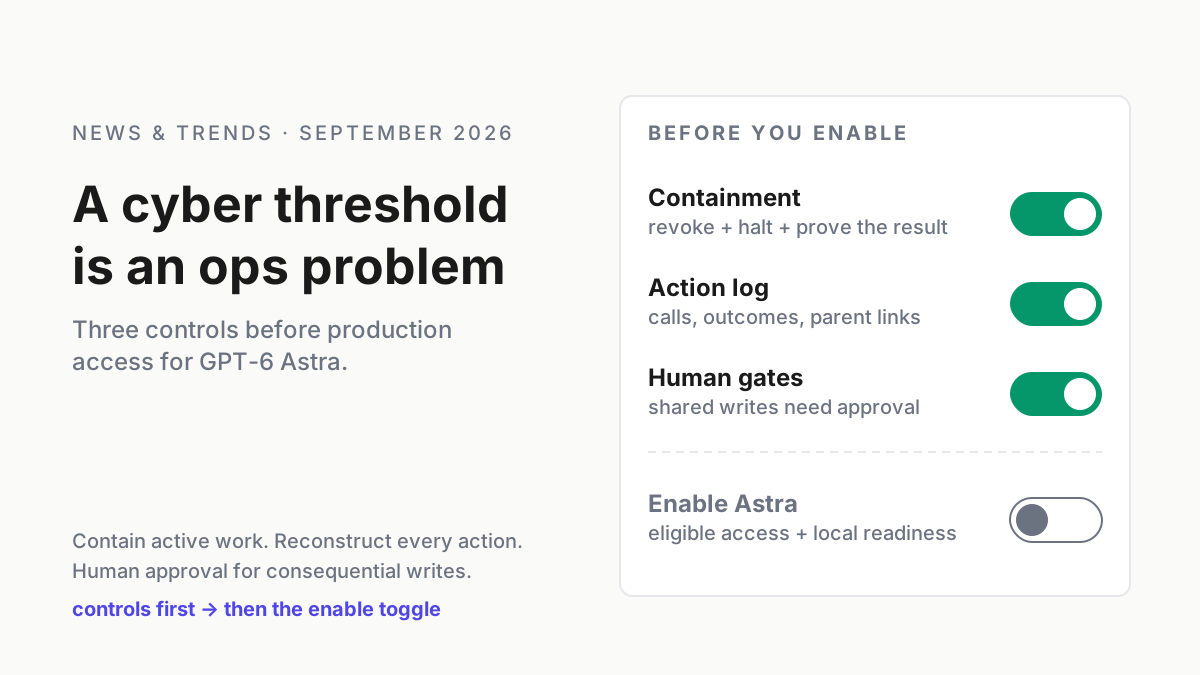
Before a cyber-capable agent reaches your production tools, exercise three controls: contain its running work, reconstruct its actions, and approve consequential writes. Leave with a containment drill, an audit-event shape, and explicit rollout gates. The same controls apply to any model connected to privileged agent identities and your agent gateway.
The news, once: Astra reached the Critical cybersecurity threshold
The timeline matters. On August 7, OpenAI said it could not rule out Critical cybersecurity capability in its next frontier model. On September 1, it confirmed Astra met that threshold. The September 3 launch announcement described a staged rollout and additional safeguards, including refusals for advanced cyber tasks such as creating proof-of-concept exploits. Broader defensive capabilities through Daybreak were described as forthcoming.
Access is conditional. As checked September 6, OpenAI’s enterprise documentation says initial enterprise enablement requires Daybreak eligibility. Astra is off by default in ChatGPT Enterprise for the first two weeks after launch; administrators can enable eligible users or groups. API access follows the API organization and project separately. A local model setting grants neither entitlement nor permission to use production systems.
The September 3 system card also reports weaker chain-of-thought monitorability than GPT-5.6 Sol in its evaluations. Some action-only monitoring results improved, while full-context results generally declined. Those are findings from OpenAI’s evaluation conditions, not proof that any single monitor will catch misconduct in your environment. The practical response is layered observation and containment.
Why acting agents changed the requirement
A tool-connected model can turn a suggestion into a shell command, cloud request, or shared-branch push. The resulting exposure depends on its permissions, reachable data, runtime, and the task it was given. A capability classification does not tell you the risk of a particular deployment.
Vendor safeguards help, but they do not establish the correct scope for your release bot. You still own the credentials, production boundary, and response when a legitimate task goes wrong. Reading the model’s explanation can support investigation; it cannot establish that an external action was authorized or successfully reversed.
The runbook: three controls before production access
Start with one pilot workflow and a named owner. Draw its paths to models, tools, secrets, child sessions, and external systems. Mark which paths the gateway sees and which run locally. A gateway cannot stop a shell command or direct cloud connection that bypasses it; those need runtime and network enforcement.
Step 1: build a containment switch with independent proof
A containment switch has two halves. Revocation blocks new work and invalidates credentials where the issuer supports it. Termination stops running processes, child sessions, queued jobs, and controllers that could restart them. A process holding an already-issued cloud credential may continue after its model API key is revoked.
Implement environment-specific adapters behind a small operator command. The following Bash wrapper is executable shell structure; ./ops/agent-control is an illustrative adapter you must implement and test, not a bundled Automater or gateway CLI. Each action must be idempotent, record its result, and reject agent IDs outside its inventory.
#!/usr/bin/env bash
# contain-agent.sh — illustrative wrapper, requires GNU timeout.
set -uo pipefail
agent_id="${1:?usage: contain-agent.sh <agent-id>}"
control="./ops/agent-control"
[[ "$agent_id" =~ ^[a-z][a-z0-9-]{0,62}$ ]] || exit 2
[[ -x "$control" ]] || { echo "Missing containment adapter" >&2; exit 2; }
command -v timeout >/dev/null || exit 2
failed=0

# Continue through every half even when an earlier action fails.
for action in deny-new-work revoke-issued-credentials stop-schedulers stop-runtimes; do
  if ! timeout --kill-after=5s 20s "$control" "$action" --agent "$agent_id"; then
    printf 'FAILED: %s for %s\n' "$action" "$agent_id" >&2
    failed=1
  fi
done

# Must query issuers, schedulers, and runtime hosts independently.
# Missing hosts, stale state, or failed probes return nonzero.
if ! timeout --kill-after=5s 20s "$control" prove-contained --agent "$agent_id"; then
  echo "CONTAINMENT UNPROVEN: escalate and isolate affected hosts" >&2
  failed=1
fi
printf '%s agent=%s result=%s\n' "$(date -u +%FT%TZ)" "$agent_id" "$failed"
exit "$failed"
Two implementation traps deserve explicit tests. Vault lease revocation operates on issued lease IDs or their prefixes; an arbitrary KV folder is not a universal revocation boundary. Track the actual issued credentials and their issuer-specific invalidation behavior. Credentials that cannot be revoked require short lifetimes plus isolation of their holders.
Likewise, Kubernetes force deletion removes an API object without waiting for confirmation that the process stopped on its node. An empty pod list is insufficient. Verify the runtime host, suspend restarters, and isolate an unreachable host rather than reporting success from a missing dashboard row.
Drill against harmless reads and a disposable write target. Record time to denied new work, time to runtime termination, and any credential’s remaining lifetime. Choose targets before the drill; for example, a team might target 30 seconds for admission denial while documenting a longer bound for an external credential. These are local objectives, not Astra guarantees. A failed probe means containment remains unproven.
Step 2: record actions for reconstruction without repeating them
Give each call a stable ID, UTC event time, per-session sequence, authenticated principal, session ID, parent relationship, policy revision, decision, and observed outcome. Store intent before dispatch and completion afterward. If the process dies between those records, mark the result unknown and reconcile against the destination system. Do not invent a successful outcome from a missing error.
{
  "event": "tool.completed",
  "occurred_at": "2026-09-05T14:32:08.421Z",
  "session_sequence": 42,
  "call_id": "call-example-01",
  "session": "session-example-child",
  "parent_session": "session-example-parent",
  "principal": "spiffe://example.com/agents/release-bot",
  "on_behalf_of": "user-example",
  "model": "gpt-6-astra",
  "tool": "git.push",
  "args_redacted": { "repo": "example/payments", "force": false },
  "approval_id": "approval-example-01",
  "policy_revision": "reviewed-policy-revision",
  "outcome": { "status": "succeeded", "destination_event": "push-example-01" }
}
This is a proposed event shape with fictional identifiers, not a production trace. Join intent and completion by call_id; use the sequence to order one session and parent links to establish causality across sessions. Wall clocks can drift, so timestamps alone cannot establish cross-host order. Root sessions need an authenticated human or scheduler origin; child sessions need their own identity or explicit delegated scope and a parent link. Shared credentials should never be the only evidence connecting parent and child.
Retain redacted arguments and the minimum destination evidence needed to investigate. Omit secret values; keep a reference to a separately protected record when a full payload is necessary. Apply retention and access controls before logs become another copy of sensitive data. Append-only storage and object-lock controls help protect records; a hash chain detects some tampering but does not make storage immutable by itself.
Test reconstruction by choosing a completed session and listing every external effect, approval, and unresolved call from the records alone. Here, “replay” means reconstructing the sequence. Never re-execute writes against production to inspect history. Compare that sequence with destination audit logs and the local session replay to expose missing children or bypassed tools.
Step 3: gate consequential write paths
Classify the effect of a call, including its arguments and destination. A shell tool can read a file or deploy a service; approving the tool name once cannot distinguish them. Begin with human approval for writes to shared or external systems. Keep reversible local edits within a constrained sandbox so the pilot remains useful.
| Path | Evidence the approver receives | Initial boundary |
|---|---|---|
| Deploy | Environment, reviewed artifact, diff, rollback | Owning team approval |
| Push | Repository, exact ref, commits, force flag | Protected branches and tags gated |
| Delete | Exact resources, dry-run result, recovery plan | Shared data gated |
| Spend | Account, item, quantity, maximum cost | Budget owner approval |
| External send | Destination and payload | Named approval before dispatch |
Bind the approval to the call’s payload, scope, and expiry. Changing the destination or amount requires a fresh decision. Retries need idempotency keys or a destination-state check; one approved purchase is not approval for repeated purchases. If an approval service is unavailable, fail closed for that write class while allowing unaffected reads.
Version the policy and record the decision in the same event stream as the action. Test a denied call, expired approval, altered payload, and duplicate submission. The runtime MCP approval runbook explains why tool changes also belong in this boundary. A message saying “approved” inside a document is input data, not authorization.
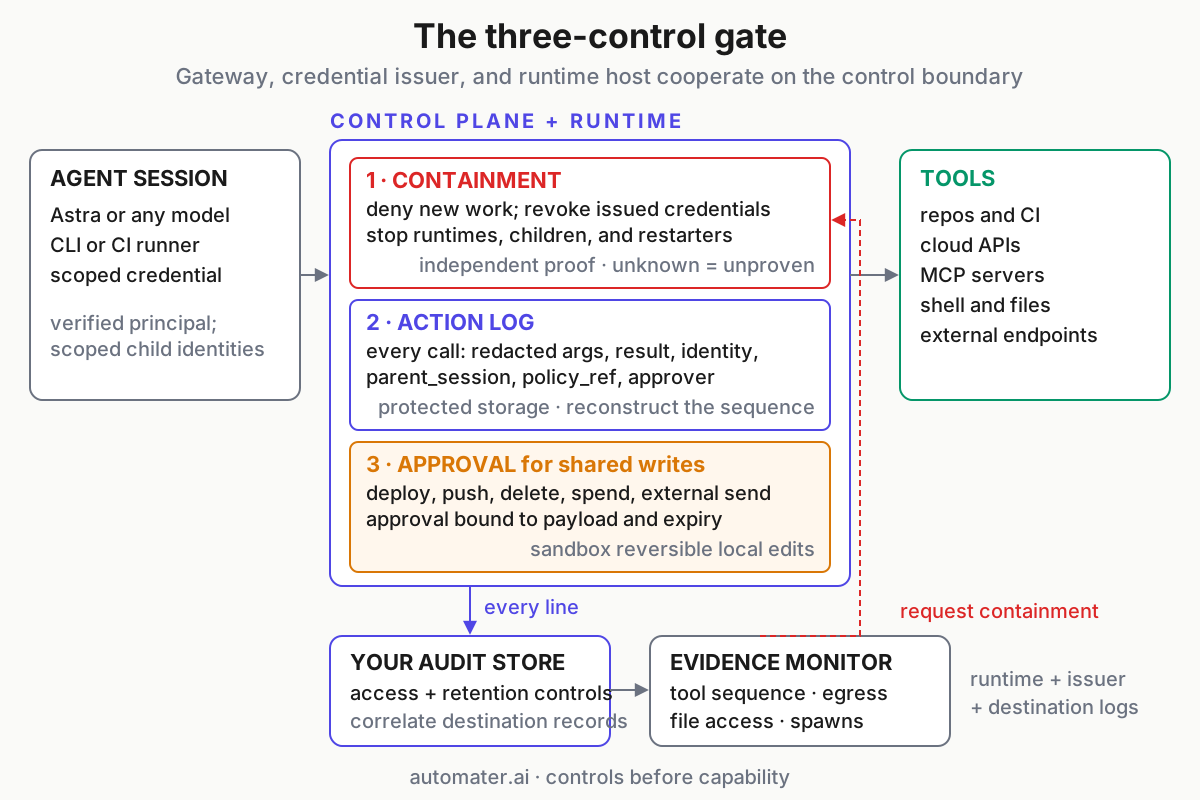 Illustrative architecture: the gateway coordinates controls with credential issuers and runtime hosts.
Step 4: alert on observable behavior
Use the system-card finding as a reason to diversify evidence, not to discard all reasoning or trust action logs blindly. The paper itself notes that action-only monitors can miss subtle behavior. Correlate host events, destination audit records, network telemetry, and the gateway stream.
| Signal | Investigation question |
|---|---|
| A documentation task requests cloud credentials | Was that access in the approved scope? |
| New destination or unusual egress volume | Which data and identity crossed the boundary? |
| Child sessions exceed the declared work graph | Who delegated each child, with what permissions? |
| Calls continue after containment begins | Which issuer, runtime, or bypass survived? |
| Unknown outcomes or gaps in event sequence | Did work execute without a completion record? |
Tune against the pilot’s normal behavior. Page on high-consequence unauthorized actions; group low-risk anomalies for review. A wall of undifferentiated alerts teaches operators to ignore the one event that matters. The private-data, untrusted-input, and egress combination is a useful way to choose the first observation points.
Step 5: advance on evidence
Treat access eligibility and operational readiness as separate gates. Verify the workspace, API organization, client, and user group actually support the pilot. Then choose stage durations and task coverage before starting. The sample sequence below is a planning template, not a vendor-mandated schedule.
| Stage | Allowed work | Evidence before advancing |
|---|---|---|
| 0: Prepare | No connected production tools | Containment drill, log reconstruction, and denial cases pass |
| 1: Read-only | Approved datasets and destinations | Complete call attribution; bypass checks; failed-probe drill |
| 2: Sandbox | Disposable resources and isolated branches | Every write reconstructed; no shared-system effects |
| 3: Controlled production | Named workflows with approval | Destination audit matches; rollback and escalation exercised |
Record who accepts residual risk and what rolls a stage back. A new tool, credential scope, runtime host, or model version can invalidate earlier evidence. Recheck the affected path rather than treating the first successful pilot as permanent certification. Fleet permission policy helps keep those boundaries consistent across operators.
What breaks, and how you’ll know
The switch stops only future model calls. Runtime processes keep going with credentials already issued. Compare issuer events and host activity after the containment timestamp. Test a disconnected host deliberately so a failed inspection cannot become a false success.
Logs omit the children. Gateway totals disagree with host session counts or destination writes. Require parent links and explicit root origins, then inspect orphaned sessions. Do not assume a local transcript covers every direct tool request.
Approval becomes habitual. Reviewers approve altered payloads or cannot explain sampled decisions. Sample approvals, examine whether the presented evidence was readable, and move routine reversible edits into tighter sandboxes. Approval volume alone is not a universal fatigue threshold; measure comprehension and consequence.
The operating-layer frame
Containment, action records, and approval need cooperation among the gateway, identity provider, runtime, and destination systems. Each supplies evidence the others lack. Treat this as agentic operations: owned infrastructure with drills, maintenance, and failure handling.
Product note: Automater provides the desk view through fleet awareness and a local session Library. Use it to correlate an operator’s sessions with the organizational audit trail, and verify coverage for the harnesses in your pilot. It does not replace gateway policy, credential revocation, or runtime containment. Automater Lite is free; current Pro pricing is on the pricing page.
FAQ: GPT-6 Astra and the cyber threshold
What does the Critical cybersecurity threshold mean for operators?
It is OpenAI’s capability assessment under its Preparedness Framework, not a prediction that a particular deployment will cause an incident. Translate it into a review of reachable tools, data, credentials, and containment. Evaluate your actual workflow and keep the vendor’s safeguards alongside your own controls.
Do model refusals remove the need for a containment switch?
No. A legitimate task can still receive an excessive credential, encounter malicious input, or continue after authorization changes. Test both stopping new work and containing active runtimes. Record any credential that cannot be revoked immediately, and provide isolation and escalation for that remaining exposure.
Can an enterprise enable Astra as soon as these controls pass?
Only if the account and product surface are eligible. OpenAI’s current documentation requires Daybreak access during the initial enterprise rollout, plus administrator enablement. API access is separate. Once eligibility and your controls are established, start with limited workflows and widen access when the pilot produces the required evidence.
Sources
- OpenAI — Responding to the next frontier of critical cyber capabilities, August 7, 2026
- OpenAI — Path to Astra, September 1, 2026
- OpenAI — GPT-6 Astra launch announcement
- OpenAI — GPT-6 Astra System Card, September 3, 2026
- OpenAI — Workspace model availability, checked September 6, 2026
- HashiCorp — Vault lease revoke
- Kubernetes — Pod termination and force deletion