Claude Fable 5 and Mythos 5: Inside Anthropic's Mythos-Class Era
Anthropic split the frontier in two on June 9, 2026: public Claude Fable 5, gated Mythos 5. What Mythos-class means for agent builders, minus the hype.

Go deeper. Build your own.
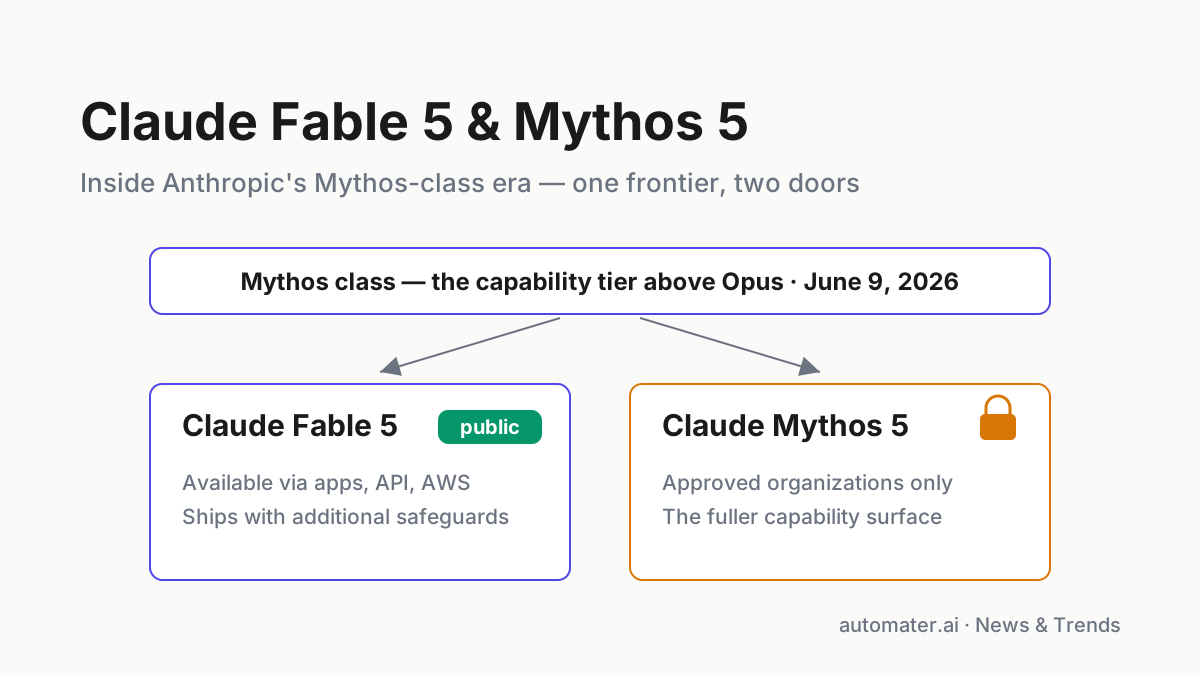
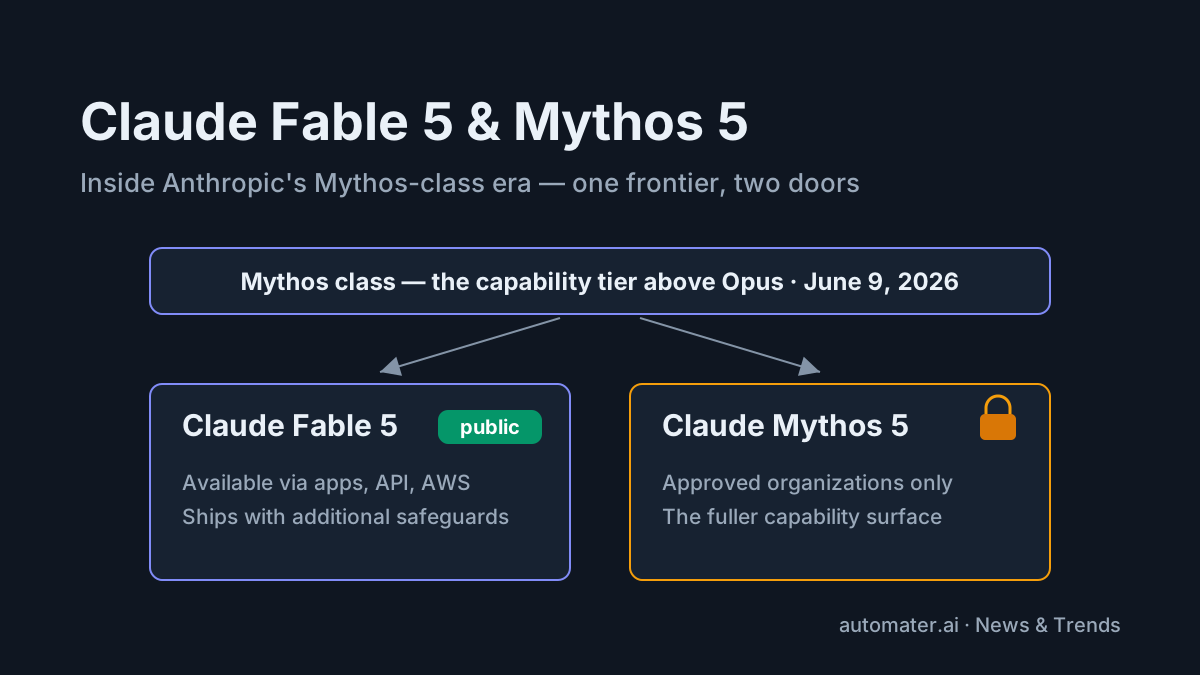
On June 9, 2026, Anthropic shipped two models and one policy decision. Claude Fable 5 is the model you can use today: a new flagship in what Anthropic calls the Mythos class, a capability tier above Opus, released publicly with additional safeguards. Claude Mythos 5 is the model most of us cannot: the same class without the public wrapping, restricted to organizations Anthropic approves.
TechCrunch compressed the whole structure into its headline — Claude Fable 5 “is a version of Mythos the public can access today.” That sentence does a lot of work. It tells you the interesting release is not really a model. It is an access architecture: the clearest case yet of a frontier lab splitting one capability class into a public tier and a gated one on launch day.
This is the analysis for people who run agents for a living. You get what actually shipped and where it runs, what “Mythos-class” means, why the two-door structure matters more than any benchmark chart, what changes for your harness, how the release reset the frontier race inside ten weeks, and what to test the day you get access. Verified facts carry sources; unknowns are flagged, not improvised.
What Anthropic shipped on June 9, 2026
The facts, from Anthropic’s announcement: two models introduced together, forming a new top tier — the Mythos class — positioned above Opus in the Claude lineup. Claude Fable 5 is generally available and carries additional safeguards. Claude Mythos 5 is limited to approved organizations. The platform documentation introduces both models on a single page, which is itself informative: they are documented as siblings in one class, not as a model and its successor.
Distribution came fast. Beyond Anthropic’s own apps and API — the Fable 5 product page is the canonical reference — AWS announced availability on its own blog, framing the release as “Mythos-class capabilities with built-in safeguards, now available.” For teams already running Claude through cloud marketplaces, the new tier arrived where their billing already lives.
The business press treated it as a business story, correctly. CNBC’s same-day coverage ran the release straight to the market desk: frontier capability, packaged as a two-door product, from the lab that has staked its whole strategy on agents.
One more lineup note for orientation: the Mythos class sits above the everyday tiers, and Anthropic’s mid-2026 lineup also includes Claude Sonnet 5 as the workhorse model, per reporting. Fable 5 is not the model you route everything to. It is the model you route up to — more on that below.
What “Mythos-class” actually means
Mythos-class is Anthropic’s name for the capability tier above Opus, introduced June 9, 2026 with Claude Fable 5 and Claude Mythos 5. Fable 5 is the publicly available Mythos-class model, shipped with additional safeguards; Mythos 5 is the restricted version, available only to organizations Anthropic approves.
The naming is worth a beat. Anthropic did not call this Opus 5. A new class name signals a durable rung, the way Haiku, Sonnet, and Opus long ago stopped being versions and became sizes. If the pattern holds, “Mythos” is not one release but a shelf — and future frontier releases may keep arriving as pairs, one Fable-style public model and one gated sibling per generation. That is reading tea leaves, but the tea leaves were arranged deliberately.
What a tier above Opus buys is, structurally, about ceilings. The tasks where Opus-class models plateau are the ones practitioners actually feel: multi-hour autonomous runs that decay, cross-repo changes that lose the plot, plans that survive three steps out of eight. A new top tier is aimed at exactly that band of work, and the announcement’s positioning leans on frontier capability for sustained, high-stakes tasks. Treat any specific number as vendor-reported until independent referees publish runs.
Two doors, one class
Here is the access model as documented, side by side:
| Claude Fable 5 | Claude Mythos 5 | |
|---|---|---|
| Availability | Public — Anthropic apps, API, AWS | Approved organizations only |
| Safeguards | The class plus additional safeguards | The fuller capability surface |
| Who can benchmark it | Anyone — now the open-model reference point | Almost nobody outside the gate |
| Documentation | Product page + platform docs | Introduced on the same platform docs page |
The safeguards are the load-bearing distinction. The public framing — echoed in AWS’s “built-in safeguards” headline — is that Fable 5 delivers the class’s capability with an added safety layer around misuse-relevant, dual-use surfaces, while ordinary engineering work passes through unaffected. How well that calibration holds under real workloads is an empirical question, and we treat it as one in the skeptic’s section.
Then there is the question the TechCrunch headline raises without answering: if Fable 5 is “a version of Mythos,” what exactly is the delta? The framing suggests a safeguarded deployment of one class rather than a smaller sibling model. Whether the two share weights, and where they diverge — training, fine-tuning, or deployment-time controls — is not public.
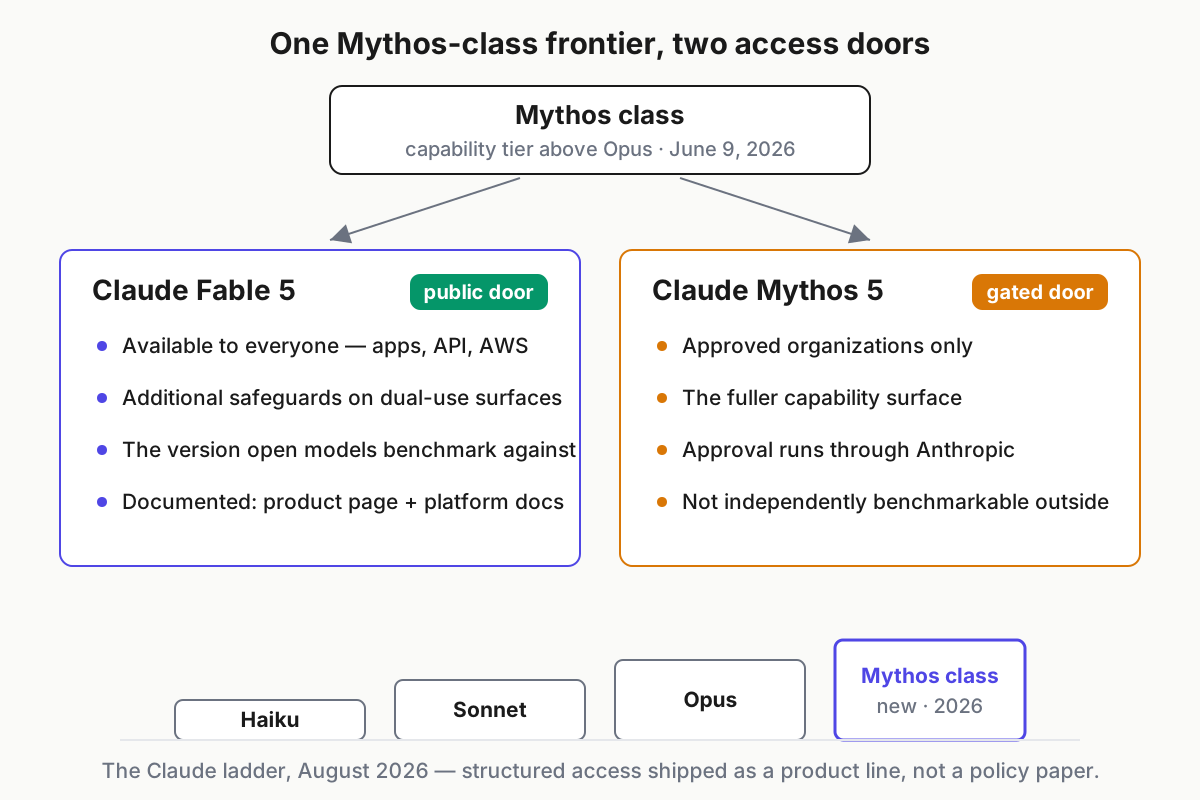
 The Mythos-class access model: one capability class, a public door with added safeguards, and a gated door that runs through Anthropic’s approval.
As for who gets Mythos 5: approved organizations, with the approving done by Anthropic. Public detail on criteria and process is thin. The observable fact is that the fullest version of the strongest Claude is now something you apply for.
The policy experiment hiding in a product launch
For most of the frontier era, labs had two deployment options: ship the model to everyone, or sit on it. Structured access — the idea that the riskiest capability slice should reach vetted parties while a safeguarded version ships broadly — lived mostly in policy papers. On June 9 it became a product line.
The move rhymes with Anthropic’s Responsible Scaling Policy, the framework that ties capability thresholds to deployment controls. A two-door launch is the deployment-side answer to a threshold crossing: instead of delaying the class or shipping it uniformly, release the safeguarded variant to the world and hold the full surface behind a gate. Whatever you think of the execution, this is the safety framework showing up in the price list rather than the PDF — which is consistent with everything else about the company, as we covered in our profile of Anthropic’s all-in agentic bet.
Three readings of the signal, all of which can be partially true at once:
- The safety reading. Anthropic concluded Mythos-class capability crosses lines where uniform public access is not defensible, and built the access structure its own framework prescribes.
- The commercial reading. Gated tiers are also a sales motion. Scarcity prices well, enterprise procurement loves an approval process, and skeptics will note that safety language and price discrimination can wear the same coat.
- The precedent reading. If the structure works — commercially and politically — it becomes the template. Watch whether the next OpenAI and Google flagships ship with gates of their own.
There is also a quieter audience: regulators. A tiered launch hands policymakers a legible pattern — “ship with safeguards, gate the rest” — at exactly the moment governments are asking what responsible frontier deployment looks like in practice. Whether that pattern ages as genuine risk management or as regulatory theater will depend on evidence nobody outside the gate currently has.
What Claude Fable 5 changes for agent builders
The honest version of “what changes” splits into four practical shifts.
The ceiling moves — verify by how much. The pitch of a tier above Opus is fewer capability-shaped failures in long-horizon work: refactors that span an afternoon, migrations that span repos, plans that survive contact with step six. That is the claim to test, not to assume; the day-one plan below is built around it. What is already clear is that the frontier ceiling and the everyday workhorse tier are now further apart than they have ever been in the Claude lineup.
Routing math changes more than habits do. A flagship above the flagship slots in as an escalation tier: the model for the gnarly 10% of tasks, while Sonnet 5 or an open model grinds through the bulk. Pipe everything to the top tier by default and your invoice will run the experiment for you, with worse controls.
The harness matters more, not less. A stronger model raises the return on everything around it — context assembly, permission tiers, evals, transcript review. The native pairing is Claude Code, and our Claude Code power guide covers how to set that up properly; most harnesses that speak Anthropic-Messages endpoints can point at Fable 5 too. For who speaks what, see the 2026 field map of coding harnesses.
Safeguard friction is now a workflow variable. If your legitimate work brushes dual-use territory — security tooling, malware analysis, infrastructure automation with real credentials — the additional safeguards may surface as refusals or confirmation stalls mid-loop. Measure that before you commit pipelines to the new tier, and remember the blast-radius rule: the more capable and autonomous the model, the more load-bearing your boring permission controls become.
Ten weeks that reset the frontier race
The release did something beyond its own capability: it became the unit of measurement. When Moonshot’s Kimi K3 took #1 on a frontend-code arena in July — the first open model to lead one ahead of Claude Fable 5 — the story was written against Fable 5, right down to the headline. Same for K3’s 93.4% SWE-bench Verified figure from Vals AI’s independent run. “Beats Fable 5” is now the sentence every open-model launch wants to earn.
The compressed timeline tells it best. June 9: the Mythos class lands. June 16: Zhipu’s GLM-5.2 ships under MIT and takes the #1 open-model slot on the Artificial Analysis index. July 16: K3 arrives and claims that arena lead. July 19: DeepSeek V4 hits general availability with a Flash tier priced at $0.14 per million input tokens. Six weeks from “new tier above Opus” to “open models within a few benchmark points at a fraction of the price.”
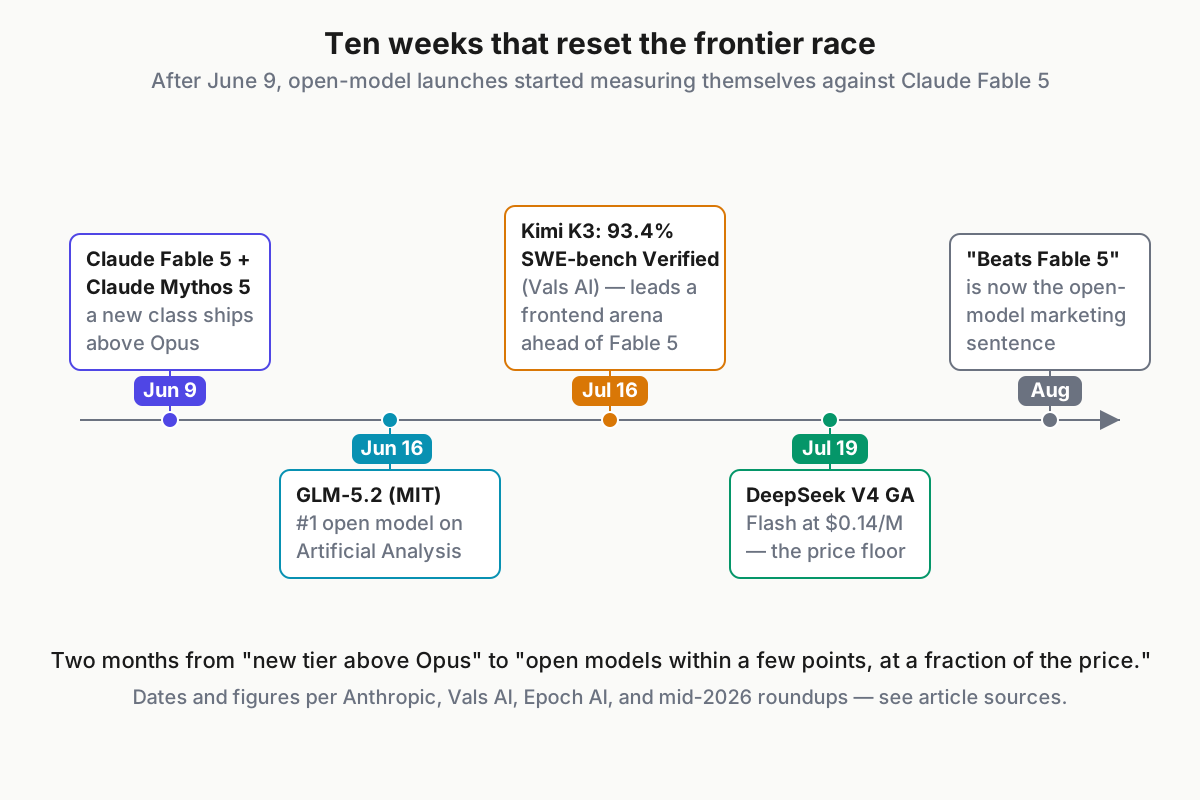
 Ten weeks in 2026: the Mythos class ships, and the open-weight wave immediately starts measuring itself against Fable 5.
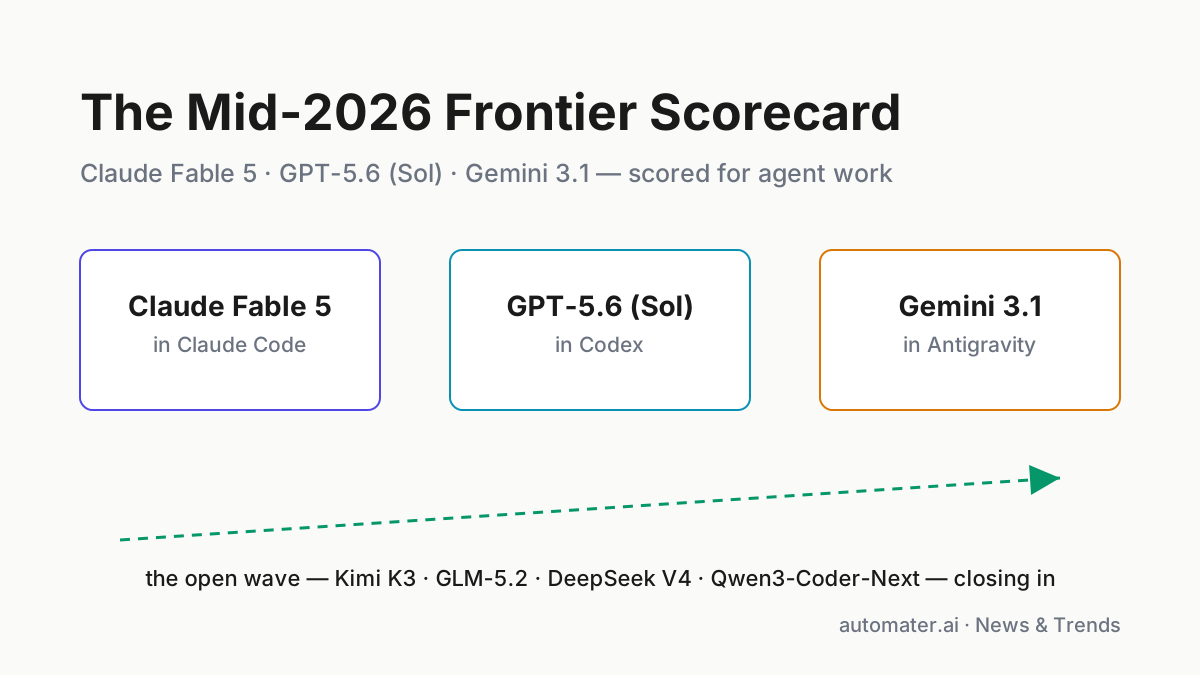
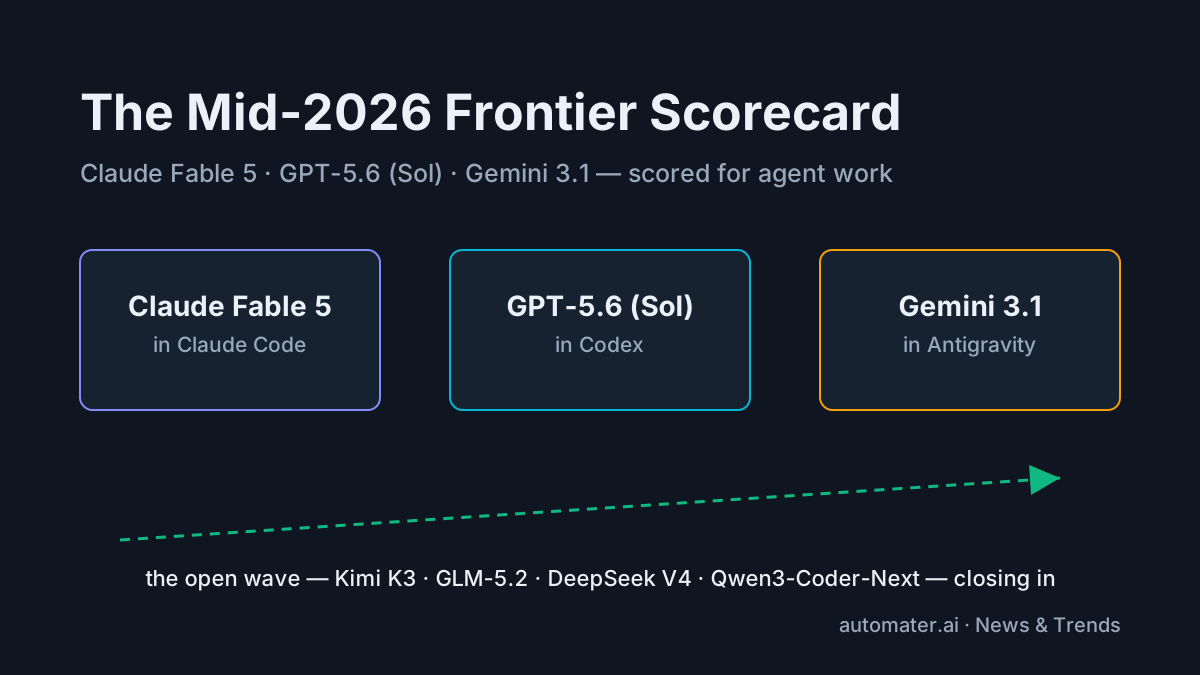
The flagship counterparts complete the picture. OpenAI’s current flagship is GPT-5.6 (Sol); Google’s line is Gemini 3.1, per mid-2026 reporting. How the three compare for agent work — and why “frontier” now describes a price band rather than a capability monopoly — gets its own treatment in our mid-2026 frontier scorecard. For the challengers, the open-weight scorecard covers K3, GLM-5.2, DeepSeek V4, and Qwen3-Coder-Next in depth.
Pricing and access, as verified
What we can verify as of August 2026: Claude Fable 5 is publicly available through Anthropic’s apps and API, and through AWS per the availability announcement above. Claude Mythos 5 requires Anthropic’s approval. That is the confirmed access picture.
What we will not quote, because we have not verified it: per-token API pricing, subscription-plan placement, context-window size, and rate limits. Check the product page and platform docs before you model costs — flagship pricing pages have a way of being revised more often than articles about them.
What is verifiable is the shape of the market underneath. DeepSeek V4 Flash sells agentic-grade tokens at $0.14 per million input and $0.28 out, and open-model API pricing broadly fell around 80% year over year, per mid-2026 reporting. Whatever Fable 5 costs, the spread between frontier pricing and good-enough pricing has never been wider — which makes routing discipline, and actually measuring what each model costs you per completed task, the difference between a controlled experiment and an expensive habit.
Product note: Flagship churn is quietly a metering problem. When Claude Fable 5 lands next to GPT-5.6 and Gemini 3.1 in your daily rotation, cost per task shifts under you, and each provider’s dashboard shows you a fifth of the picture. Automater Lite meters tokens locally across every provider you run — Claude Code, Codex, Antigravity, and the rest — so you can see what the new tier actually costs before the invoice teaches you. Free, local-first, at automater.ai.
Skeptic’s corner: what the safeguards cost
Every claim in the launch deserves its stress test, so here is ours.
The safeguards tax. Added safety layers on a public frontier model have historically meant friction: false-positive refusals in security work, hesitation in agent loops, confirmation prompts where you wanted momentum. Whether Fable 5’s safeguards are well-calibrated is not answerable from the announcement — it is answerable from your transcripts, which is why the test plan below exists. A top-tier model that stalls on your actual work is a mid-tier model with better marketing.
Who audits the gate? External evaluators can pound on Fable 5 all day; almost none of them can touch Mythos 5. That means class-level claims are only partially verifiable from outside, and the gap between “what the class can do” and “what the public can measure” is now a permanent feature of the frontier. For a lab that argues transparency matters, that is an uncomfortable structural fact — one the approved-access model accepts as a trade.
Moat or mission? The two-door structure concentrates the fullest capability with parties Anthropic selects, under criteria that are not fully public. The safety logic is coherent. So is the reading that gated scarcity is excellent business. Both things being true at once is the most likely world, and pretending otherwise in either direction is spin.
And the branding. “Mythos-class” is a capability claim and a marketing exercise in one phrase. The ladder grew a rung; assume the price ladder grew with it. The proof, as always, is in the sessions — not the launch page.
Balance where it is due: two-door beats the alternatives it replaced. Sitting on capability serves nobody, and uniform release of everything is a bet nobody sane wants frontier labs making on their behalf. This structure at least makes the trade-offs explicit and inspectable — partially.
The day-one test plan
When Fable 5 access lands in your stack — or when you finally route real work to it — run this before forming opinions:
- Re-run your private eval set first. Your archived real tasks, not public leaderboards; by mid-2026, reading agent benchmarks mostly means distrusting saturated ones. Twenty representative tasks from your own history beat any vendor chart.
- Give it one genuinely long-horizon job. A multi-hour refactor with a test suite as the referee, run under Claude Code. You are watching for decay at hour two, not brilliance in minute five.
- Probe the safeguard surface with your legitimate edge work. Security tooling, credentialed automation, anything dual-use-adjacent you actually ship. Count refusals and confirmation stalls per session; that number decides whether the tier fits your pipeline.
- Measure cost per completed task, not per token. Retries, tool calls, and context reloads included, compared against your current default on the same tasks.
- Write the routing rule. Decide what escalates to Fable 5 and what stays on the workhorse or open lane — then enforce it in config, not in vibes.
- Run the fleet comparison honestly. Same tasks through Fable 5, GPT-5.6, and whatever else you drive daily, side by side; if that sounds like a lot of terminals, that is exactly the workflow we describe in running multiple AI coding agents without the chaos.
The Mythos-class era started with a policy decision wearing a product launch’s clothes. The capability story will be settled by referees and transcripts over the next quarters. The access story — one frontier, two doors — is already the most consequential thing Anthropic shipped in 2026, and it is the part every other lab is now studying.
FAQ: Claude Fable 5 and Mythos 5
What is Claude Fable 5?
Claude Fable 5 is Anthropic’s publicly available frontier model, released June 9, 2026 as part of the new Mythos class — a capability tier above Opus. It ships with additional safeguards on top of the class’s capability and is available through Anthropic’s apps, the API, and AWS.
What is Claude Mythos 5 and who can access it?
Claude Mythos 5 is the restricted sibling of Fable 5: the same Mythos-class capability without the public model’s additional safeguards. Access is limited to organizations Anthropic approves. Public detail on the approval criteria is thin, so treat specifics beyond “approved organizations” as unverified until Anthropic documents them.
What does “Mythos-class” mean at Anthropic?
Mythos-class is the capability tier above Opus in Anthropic’s lineup, introduced June 9, 2026. It currently contains two models: Claude Fable 5, the public version with additional safeguards, and Claude Mythos 5, the gated version for approved organizations. The class name signals a durable tier rather than a one-off release.
Is Claude Fable 5 available on AWS?
Yes. AWS announced availability on its own blog at launch, framing Fable 5 as Mythos-class capabilities with built-in safeguards. Teams already running Claude through AWS can adopt the new tier inside existing cloud billing. Verify current region and service specifics against AWS documentation before planning a deployment.
How is Claude Fable 5 different from Claude Opus?
Fable 5 sits in the Mythos class, a tier above Opus — aimed at the long-horizon, high-stakes work where Opus-class models plateau. It is a flagship for escalation rather than an everyday default: most teams route bulk work to a workhorse tier and reserve Fable 5 for tasks that justify frontier capability.
Sources
- Introducing Claude Fable 5 and Claude Mythos 5 — anthropic.com
- Claude Fable 5 product page — anthropic.com
- Introducing Claude Fable 5 and Claude Mythos 5 — platform.claude.com model docs
- TechCrunch: Anthropic’s Claude Fable 5 is a version of Mythos the public can access today (June 9, 2026)
- CNBC: Anthropic’s Mythos and Claude Fable 5 launch coverage (June 9, 2026)
- AWS: Anthropic Claude Fable 5 on AWS — Mythos-class capabilities with built-in safeguards, now available
- OpenAI: GPT-5.6 — openai.com
- Best open-source coding models, 2026 — morphllm.com