Claude Code After September 14: The 17% Cut You Will Feel
Claude Code limits change September 14: the +50% boost ends and settles at +25%, a 17% reduction from the temporary allowance. See the math and checklist.

Go deeper. Build your own.
The Claude Code limits change has a date: September 14. The temporary allowance ends then, and the number circulating online — a 17 percent reduction — is arithmetically correct when measured against that temporary level. It is not a reason for panic. It is a reason to measure usage before the allowance changes.
Here is the change in one table, how it appears in Claude Code’s current usage screen, and the operational response: model routing, subagent discipline, context passengers, a meter that sees the whole fleet, and a checklist for September 13. The broader Claude Code field guide already exists; this is cost operations for one dated event.
Two controls run underneath everything below: a tray that watches the fleet and stall flags that expose sessions waiting without useful progress. A tighter cap changes both how much work fits and how much waste an operator can afford.
The new Claude Code weekly limit, in one table
The facts, dated and sourced. On August 27, the official Claude Developers account said Claude Code’s weekly limits had received a temporary 50 percent boost through September 14 and would then settle at a permanent 25 percent increase over the old, pre-boost baseline.
Index the old baseline at 100 and the whole argument fits in three rows:
| Point in time | Weekly allowance (indexed) | vs. old baseline | vs. today |
|---|---|---|---|
| Old baseline (before the boost) | 100 | — | −33% |
| Temporary period (through September 14) | 150 | +50% | — |
| September 14 onward (permanent +25%) | 125 | +25% | −17% |
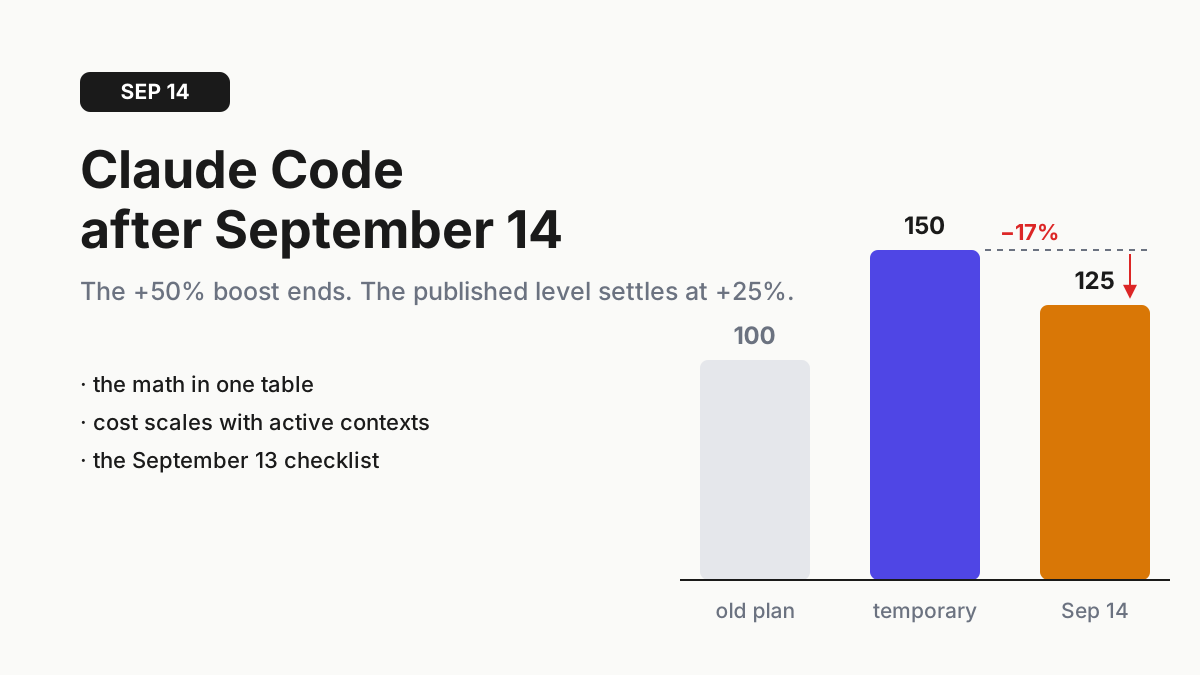
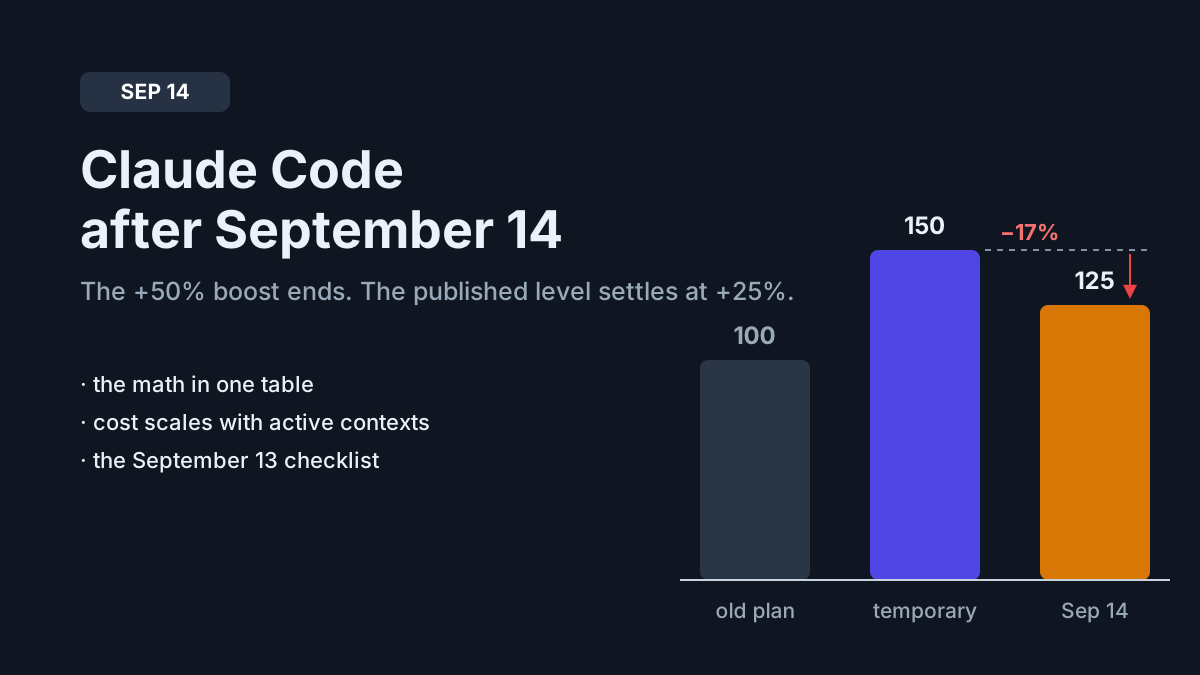
The felt number comes from the last column: 125 divided by 150 is 0.833, a 16.7 percent reduction from what you are running right now, rounded to 17 percent. Both descriptions are true. “Anthropic raised weekly limits 25 percent” measures from the plan you originally bought. “Claude Code drops 17 percent on September 14” measures from the temporary allowance active now.
The operative question is whether a September workload fits inside 125 when habits were tuned to 150. The days before September 14 are the measurement window.
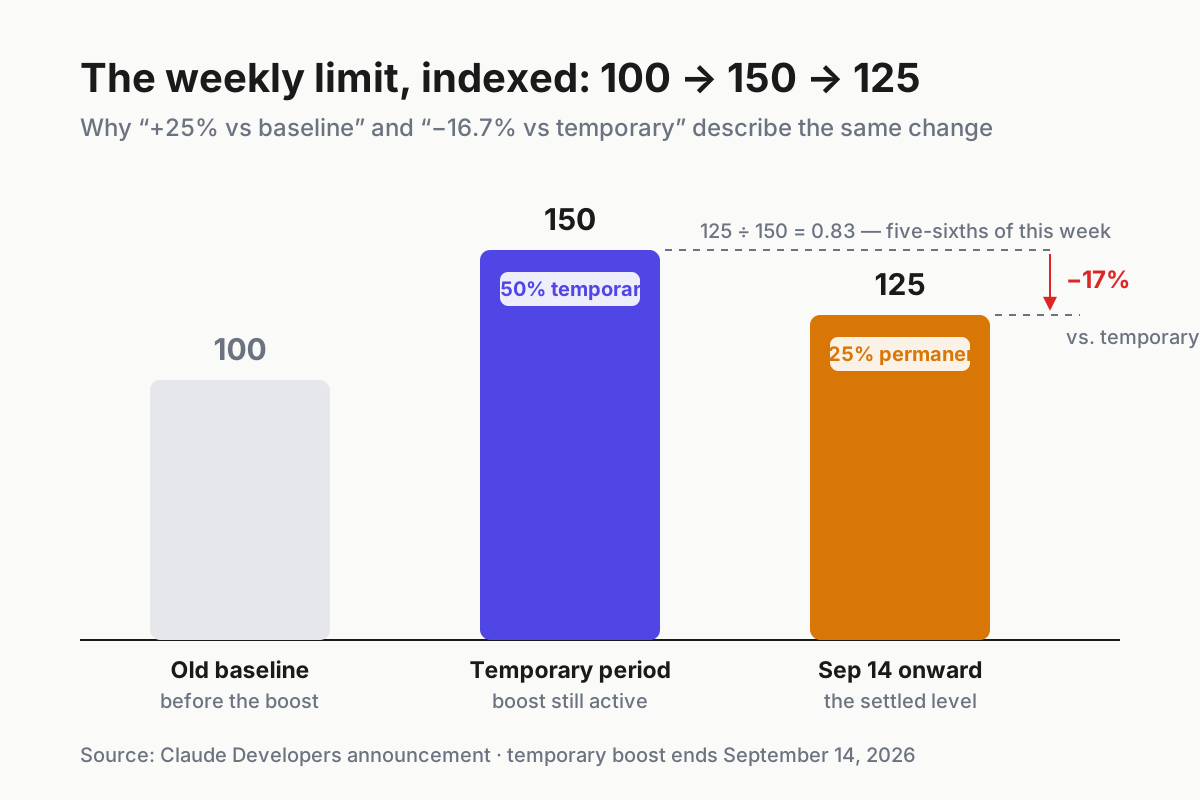
 The whole argument in three bars. 125 against 150 is the only comparison your week will feel.
How the Claude Code usage cut shows up: /usage, not a banner
There will be no dramatic moment on September 14. You will feel the cut the way weekly caps are usually felt: a wall that used to arrive Friday evening, if it arrived at all, can arrive earlier with a task half-finished. The window-plus-weekly-cap mechanics mean a couple of spiky days can do most of the damage.
The instrument to watch is /usage. Anthropic’s current cost and usage documentation says subscription users see plan-usage bars plus seven-day attribution for skills, subagents, plugins, MCP servers, cache misses, and other costly behavior. Recent Claude Code releases also put prompt-cache statistics in the same screen: request count, the share of input served from cache, misses, and whether the main conversation’s cache is warm. /cost is no longer the right instruction here; its dollar estimate is aimed at token-billed API usage and is not the subscriber’s plan bill.
So the first move costs nothing: for the next two weeks, capture /usage after each heavy day. Record the weekly bar, the seven-day attribution view, and any cache-miss flags. You are building the baseline you will wish you had on the fifteenth.
The subagent multiplication effect
There is no defensible universal “7× subagent tax.” The multiplier depends on team size, task overlap, context, and how long each worker stays alive. Anthropic’s own guidance says each active teammate runs a separate context window and that token use is roughly proportional to the number of active teammates. The mechanism is straightforward: workers load instructions and tools independently, may read overlapping files, and then report results back into the coordinating session.
At 150, it is easy to pay that multiplication cost casually. At 125, it deserves an explicit decision. Separate contexts can be worth the cost for a genuinely large review or a long exploration of an unfamiliar subsystem, where isolation keeps the main window focused.
When it is usually a tax: anything a search answers, a single-file change, or a habitual fan-out that spawns three reviewers on a 40-line diff. Before the fourteenth, audit .claude/agents with one question: does this isolate substantial work, or create duplicate context without improving the answer?
The standing charge beside it is memory layers and always-on context injectors that re-feed a growing blob into every turn. That burn does not buy exploration; it buys the same paragraphs repeatedly. Memory that burns quota deserves the same September 14 audit.
What to move off the default lane
Anthropic’s current guidance treats Sonnet as the default lane for most coding, recommends Opus for difficult architecture and multi-step reasoning, and suggests Haiku for simple subagent work. The exact models available to an account can change, so /model is the source of truth on the machine. At 125, choose the model per task rather than inheriting an old default.
Opus is the candidate for planning, architecture decisions, a final review before merge, and debugging that has resisted a smaller model. This is the work where the flagship’s judgment may justify the larger share of the allowance.
What moves down a tier: mechanical refactors, test grinding, migrations that follow a written recipe, doc chores. The recipe is the intelligence; the model just has to follow it without drama.
What leaves Claude Code entirely: formatting, renames, bulk boilerplate, and the long dumb loops. Those go to a cheaper lane in the fleet — more on that in a moment — because spending a shrinking flagship cap on renames is how you end up rationing on Thursday.
The trick that makes this stick is writing it down. A short model policy in CLAUDE.md — which lanes exist and what belongs in each — turns the default from an accident back into a choice, and it survives the version bump where a new default quietly appears.
A local meter beats the in-product view
Here is the structural problem with planning entirely inside Claude Code: Anthropic’s usage view answers “how much Claude has this account used?” The operating question for a multi-CLI machine is “where did this week’s work go?” Anthropic sees its slice. So does every other vendor. No single in-product view can show whether a 17 percent trim on one lane matters to the whole machine.
This is the split between the operating bill and the token bill: each hosted vendor reports its own slice, while the operator manages the whole week across paid, local, and stalled lanes.
A local meter can supply that cross-provider view. Automater Lite, the tray companion for Windows, macOS and Linux, exposes usage signals for supported agent providers beside its session Library and stall flags. The archive and usage processing stay local by default; leaderboard participation and uploads are opt-in. Honest limits: it cannot raise a provider’s cap, infer a private quota, or normalize a transcript format it does not support. It can expose an imbalanced week while there is still time to reroute. Automater Lite is a free download for Windows, macOS and Linux at automater.ai/downloads.
Fleet, not chat
“Fleet, not chat” means treating Claude’s weekly cap as one lane’s budget inside a larger operation. Chat mode is one assistant and one window until the limit arrives. Fleet mode assigns work across several suitable lanes. When one lane shrinks 17 percent, the operator can reroute suitable work instead of accepting 17 percent less output.
In practice, bulk edits, routine test loops, and boilerplate can move toward lower-cost local or hosted lanes whose current price and capability have been verified. Claude keeps the work where its judgment materially improves the result, which is why its lane is worth protecting from renames.
The second half of fleet mode is waste control. A session parked behind a permission prompt or looping on a broken test can consume scarce operator time and, depending on the loop, tokens without delivering useful work. At 125, stall visibility and carefully bounded keepalive automation become budget instruments. A fleet an operator cannot see is difficult to budget.
The September 13 checklist
Sunday the thirteenth, about thirty minutes, coffee optional:
- Baseline the meter. Pull
/usageafter a normal heavy day and record the weekly bar, seven-day attribution, and prompt-cache line. The after-math needs a before. - Find the week’s true shape. Which days spike, which repo eats the most, which CLI carried the load. The in-product views cannot answer this across the fleet; a local meter can.
- Write the model policy. Three lanes in
CLAUDE.md: what earns Opus, what stays on Sonnet or Haiku, and what leaves Claude entirely. Make the default a decision. - Audit
.claude/agents. Keep the subagents that isolate real exploration. Delete the ones that exist out of habit. Use/usageattribution to price the actual multiplier instead of copying a folklore number. - List the context passengers. Memory layers, always-on MCP servers, a bloated
CLAUDE.md— everything injected into every turn. Cut what does not pay rent. - Pick the overflow lane now. Extra usage at metered rates, API billing for spillover, or a second vendor’s plan — chosen calmly on the thirteenth, not angrily at the wall on a Thursday.
- Name what leaves Claude. An actual written list of task types now routed elsewhere. If you cannot name them, you have not decided anything.
Then September 14 can be routine. The 17 percent figure is correct against the temporary level, but the operating problem is allocation. An operator who knows where the week goes can treat the change as a routing constraint rather than discover it halfway through a task.
FAQ: Claude Code limits after September 14
How much are Claude Code limits being cut in September?
Measured from today, about 17 percent. The temporary +50 percent weekly boost ends on September 14 and settles at a permanent +25 percent over the old baseline — indexed, 150 drops to 125. It is a cut against what you run now and an increase against the pre-boost plan; both descriptions are accurate.
When do the new Claude Code weekly limits take effect?
September 14, 2026. Until then the temporary boost remains active, creating a short window to baseline usage and adjust routing. The official announcement describes a change to weekly limits; it does not announce a change to the separate rolling usage window.
Do subagents count against the Claude Code weekly limit?
Yes. Each subagent or agent-team member consumes tokens in its own context. Anthropic says team token use is roughly proportional to the number of active teammates, but there is no universal multiplier. After September 14, spawn workers deliberately, keep prompts focused, and shut them down when their part is done.
Sources
- Claude Developers on X — the temporary +50% boost, September 14 end date, and permanent +25% level
- Claude Code: manage costs effectively —
/usage, prompt-cache statistics, attribution, model routing, and agent-team token guidance - Models, usage, and limits in Claude Code — plan-limit behavior and model selection
- How Claude Code uses prompt caching — cache lifetime and invalidation behavior