Understanding Anthropic: The Company Betting Everything on Agents
Anthropic explained for builders: the founders, the safety strategy, Claude Fable 5 and Mythos 5, MCP, real critiques, and how to bet on the agent-first lab.

Go deeper. Build your own.
Picking a model provider in 2026 works the way picking a cloud provider did in 2012: the logo matters less than the roadmap, the pricing curve, and the failure modes you inherit. If you run Claude Code every day or ship on the Anthropic API, you have already placed a bet on Anthropic. The open question is how big that bet should get. This is a company profile written for that decision — the history that explains the strategy, the strategy read as a product thesis, the critiques that survive contact with daily use, and a decision framework at the end. It is deliberately not a Wikipedia rewrite.
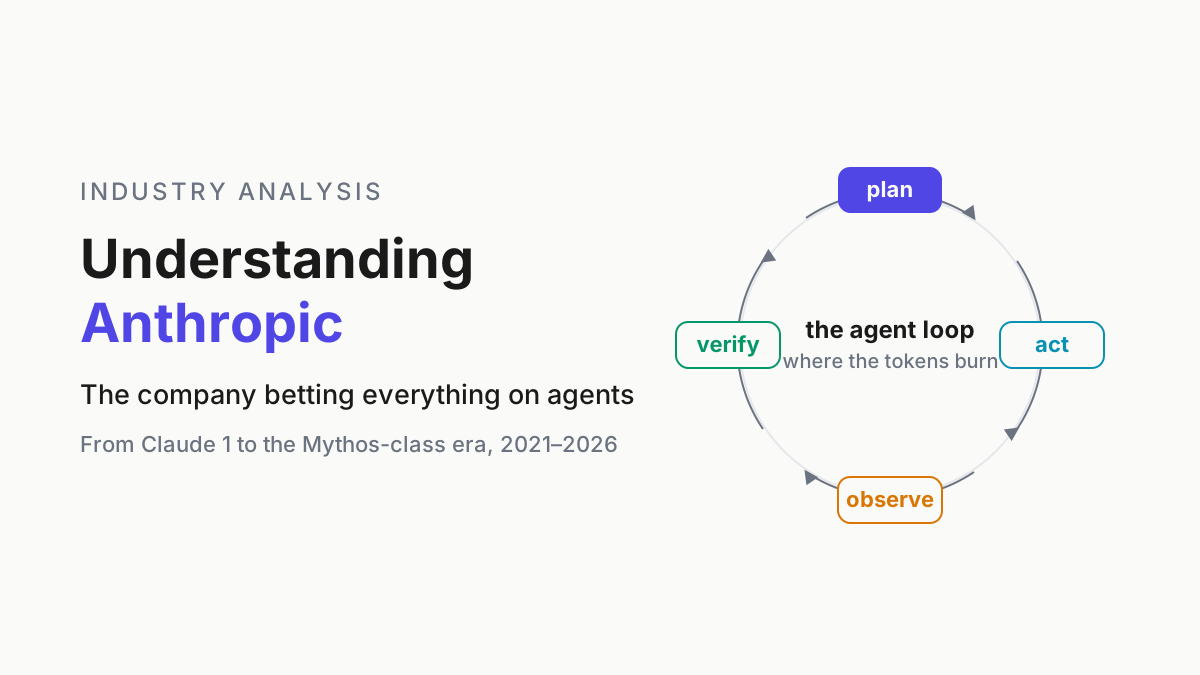
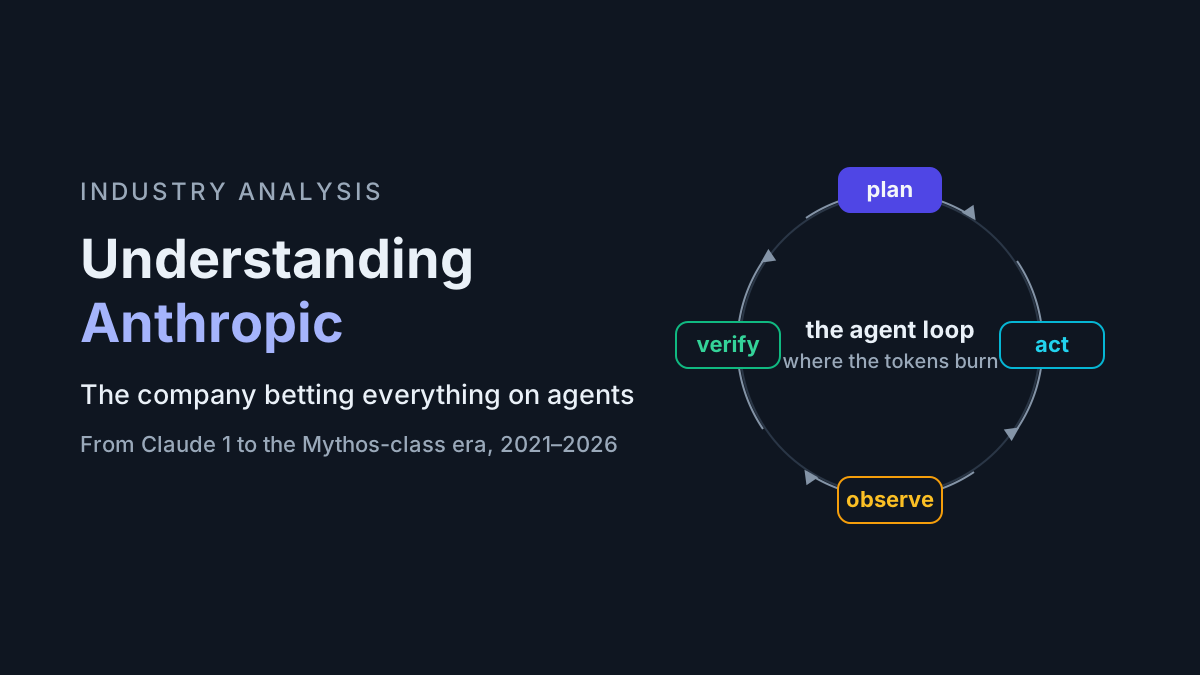
The thesis is simple to state. Every major Anthropic move since 2024 — Claude Code, the Model Context Protocol, computer use, the Agent SDK, Skills — expresses one bet: value accrues to whoever runs the agent loop, not to whoever owns the chat window. Chat is a demo surface. The loop — plan, call tools, observe results, verify, repeat — is where tokens get burned and where work actually ships. If that distinction feels fuzzy, start with agentic AI vs generative AI; this piece assumes you already build or run agentic software.
The bet reached its logical endpoint on June 9, 2026, when Anthropic split its own flagship in two: Claude Mythos 5 for vetted organizations, Claude Fable 5 for everyone else. We will get there. Origin story first, because the strategy makes no sense without it.
Who is Anthropic? The origin story, compressed
Anthropic is an AI safety and research company founded in 2021 by siblings Dario Amodei (CEO) and Daniela Amodei (president) together with a group of former OpenAI researchers. It builds the Claude model family and the agent tooling around it — Claude Code, the Model Context Protocol, the Agent SDK — and earns most of its revenue from businesses via API and cloud partners.
The founding group left OpenAI over disagreements about direction and the pace of commercialization; safety-first was the founding premise, not a rebrand bolted on later. The co-founders include Tom Brown (who led the GPT-3 effort), Jack Clark (policy), Jared Kaplan (scaling laws, now chief science officer), Sam McCandlish, Chris Olah (interpretability), and Ben Mann.
Structure is strategy here. Anthropic is a Delaware public benefit corporation, with a Long-Term Benefit Trust empowered to appoint part of the board. Enterprise buyers read that two ways — as a stability signal (mission-locked governance, less palace-intrigue risk) or as a control risk (a trust that can overrule commercial logic). Both readings are correct, which is rather the point.
| Fact | Detail |
|---|---|
| Founded | 2021, San Francisco |
| Founders | Dario Amodei, Daniela Amodei, Tom Brown, Jack Clark, Jared Kaplan, Sam McCandlish, Chris Olah, Ben Mann |
| Structure | Delaware public benefit corporation + Long-Term Benefit Trust |
| Known for | Claude models, Claude Code, MCP, constitutional AI, the Responsible Scaling Policy |
| Headcount | Low thousands, per reporting |
| Flagship today | Claude Fable 5 (public) / Claude Mythos 5 (restricted) — released June 9, 2026 |
Safety as strategy, not PR
Constitutional AI, the lab’s signature training method, is two sentences of practitioner knowledge: instead of relying purely on human raters, the model is trained to critique and revise its own outputs against an explicit written constitution — a published list of principles — using AI feedback (the 2022 research; the constitution itself was published in 2023 and has been revised since, all on Anthropic’s research index). The practical consequence is that behavior is inspectable and steerable via a document you can read, which makes it a product property, not just an ethics posture.
The second pillar is the Responsible Scaling Policy: AI Safety Levels modeled on biosafety tiers, where crossing defined capability thresholds triggers escalating security and deployment requirements. ASL-3 protections were activated for the Opus-class models in 2025.
Here is the strategic reading most coverage misses: safety productizes as reliability. An enterprise granting a model write access to its systems buys from the vendor whose refusal behavior, audit story, and escalation thresholds are legible documents rather than vibes. In regulated industries, the RSP is a sales asset wearing a lab coat.
The tension deserves naming too. Anthropic positions itself as the safety-first lab while shipping the most autonomous agent tooling any consumer can buy — a terminal agent that edits files, runs commands, and manages long tasks with minimal supervision. Dario Amodei’s answer is the “race to the top” argument: ship capably and safely, and force competitors to match the safety bar rather than ceding the market to labs that won’t. Judge that argument yourself. What is no longer deniable is that in June 2026 the company put it in the price list — but that belongs to the model story.
From Claude 1 to Claude Fable 5: the model line in five minutes
If you searched for Claude 2: it shipped in July 2023 as the first model behind the public claude.ai, with a then-startling 100K context window. It was superseded within a year and retired in mid-2025. The nearest everyday equivalent today is Claude Sonnet 5; the flagship is Claude Fable 5.
| Model | Released | What it changed |
|---|---|---|
| Claude 1 | Mar 2023 | First Claude, API-first; the “helpful, honest, harmless” pitch |
| Claude 2 | Jul 2023 | claude.ai opens to the public; 100K context |
| Claude 2.1 | Nov 2023 | 200K context; early tool-use beta |
| Claude 3 (Haiku / Sonnet / Opus) | Mar 2024 | The three-tier lineup that still organizes pricing; vision |
| Claude 3.5 Sonnet | Jun 2024 | The release where coding mindshare flipped to Anthropic |
| Claude 3.7 Sonnet | Feb 2025 | Extended thinking; ships alongside the Claude Code research preview |
| Claude 4 (Opus 4, Sonnet 4) | May 2025 | Launch marketed on SWE-bench and long-horizon agent tasks, not chat |
| Claude 4.5 wave (Sonnet, Haiku, Opus 4.5) | H2 2025 | Computer use and multi-hour agent runs become headline claims |
| Claude Sonnet 5 | 2026 | The current everyday workhorse tier |
| Claude Fable 5 + Claude Mythos 5 | Jun 9, 2026 | The Mythos class: a tier above Opus, split across two access levels |
Read the launch posts in order and a pattern emerges: through early 2024 Claude releases were sold on chat quality and general benchmarks; from Claude 3.5 Sonnet onward they were sold on SWE-bench, tool use, and how long the model can run unsupervised. That marketing shift is evidence for the thesis, not an accident of copywriting.
The line’s current climax is the June 9, 2026 release of Claude Fable 5 and Claude Mythos 5 — the first “Mythos-class” models, a designation Anthropic places above Opus. The structure is the news: Claude Mythos 5, the unconstrained frontier model, is restricted to approved organizations that pass a vetting process, while Claude Fable 5 is the same class with additional safeguards, available to everyone — TechCrunch’s framing was “a version of Mythos the public can access today,” with CNBC covering the launch the same day. This is the Responsible Scaling Policy turned into a SKU: capability access gated by trust, not just by price. The model documentation spells out the split; our Claude Fable 5 and Mythos 5 breakdown covers what changed for daily drivers.
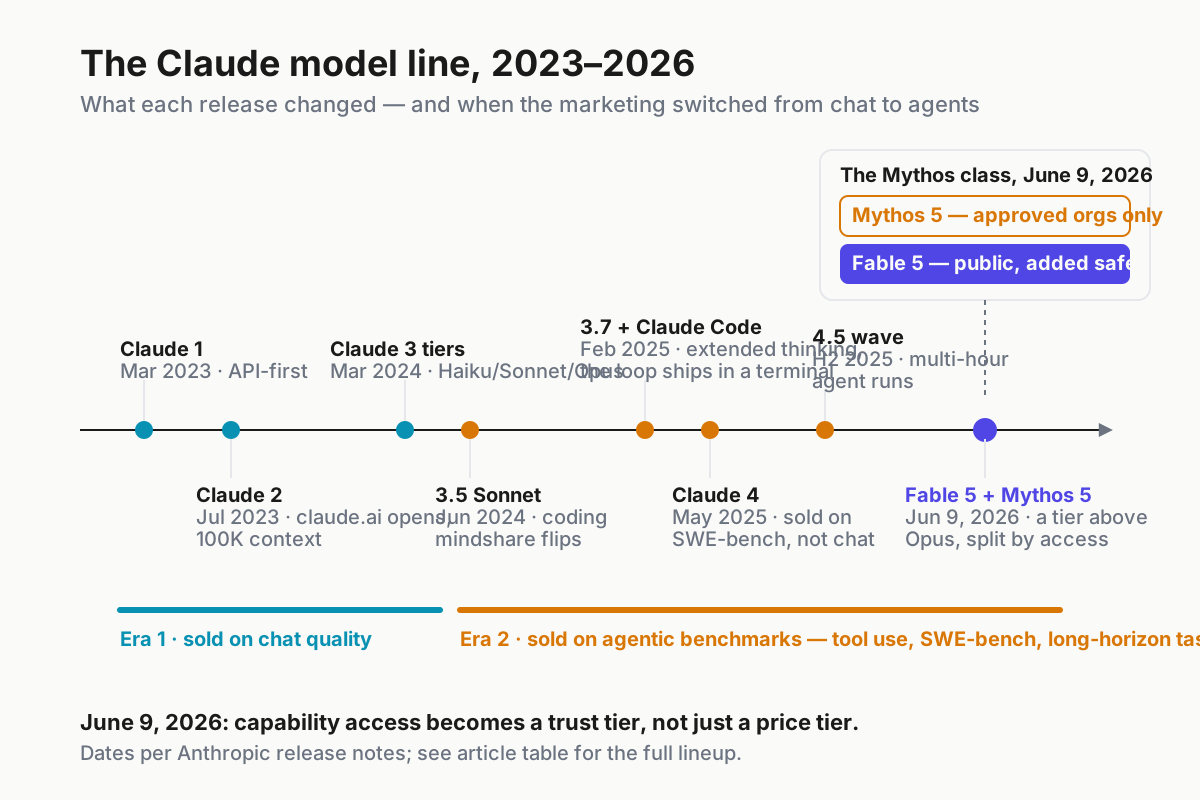
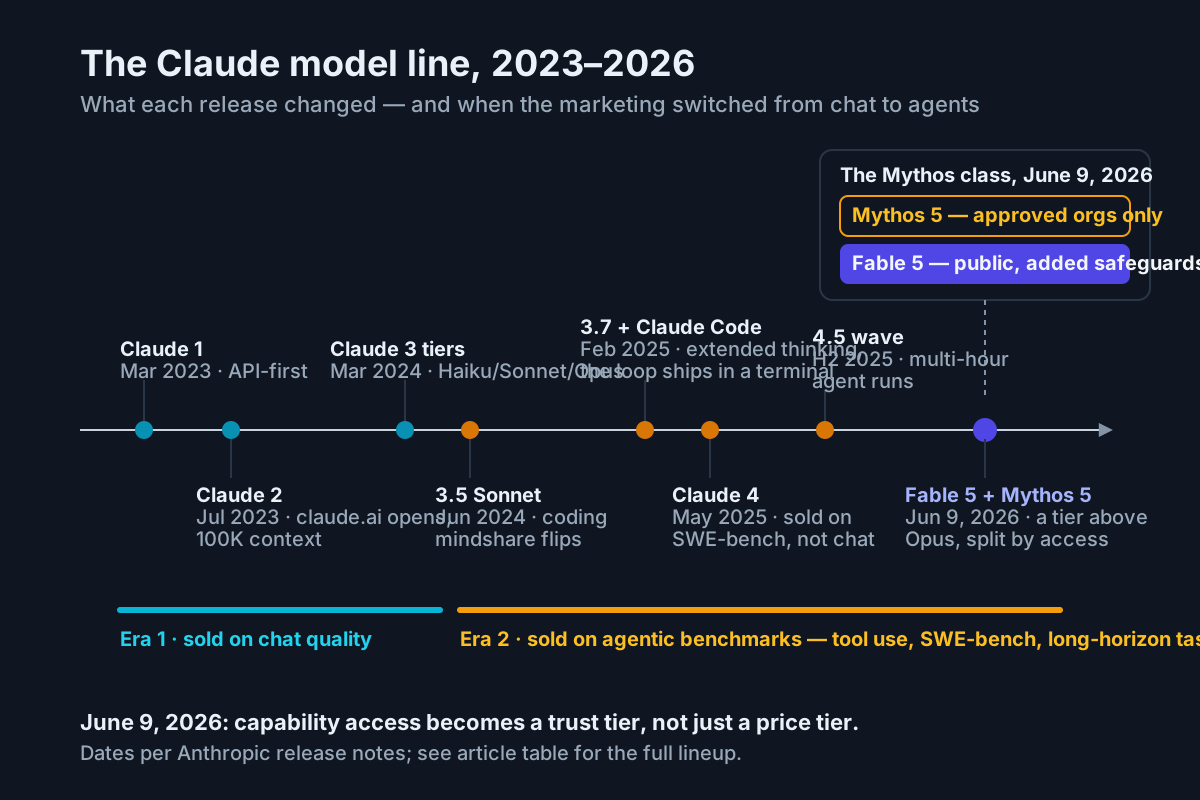 Three eras in one line: sold on chat, then sold on agentic benchmarks, then split by access tier.
The agentic bet: reading the roadmap as a thesis
State the bet plainly: Anthropic is positioned for a world where value concentrates in the agent loop — planning, tool calls, memory, verification — rather than in chat interfaces or consumer subscriptions. Every durable product decision since 2024 lines up behind it:
- Claude Code — the loop in your terminal, sold as a daily driver.
- MCP — the loop’s plumbing: a standard way to feed it tools and context.
- Computer use — the loop pointed at GUIs no API ever covered.
- Agent SDK — the loop as a library you embed in your own product.
- Skills — the loop’s procedures, packaged as portable files.
The revenue logic matches the product logic. An agent task burns one to two orders of magnitude more tokens than a chat exchange, because the loop re-sends context on every step. Anthropic’s revenue mix skews heavily toward enterprise and API usage rather than consumer subscriptions, per reporting — so the business model and the bet share a shape: more autonomous work per task means more tokens per task means the P&L compounds with agent adoption, not with signups.
The Mythos-class split is this bet made explicit. You do not build an organizational vetting process for a chatbot; you build one because you expect the top of your model range to do consequential autonomous work, and you want deployment gates you can defend.
Honesty requires a falsification condition, so here are two. The bet fails if agent capability plateaus at the supervised-assistant level — humans approving every step forever — because then the premium loop is a luxury. And it fails if value migrates up to orchestration layers that treat every model as a swappable commodity. The second is partly happening already, which is exactly why Anthropic ships the harness and the protocol too, not just the model.
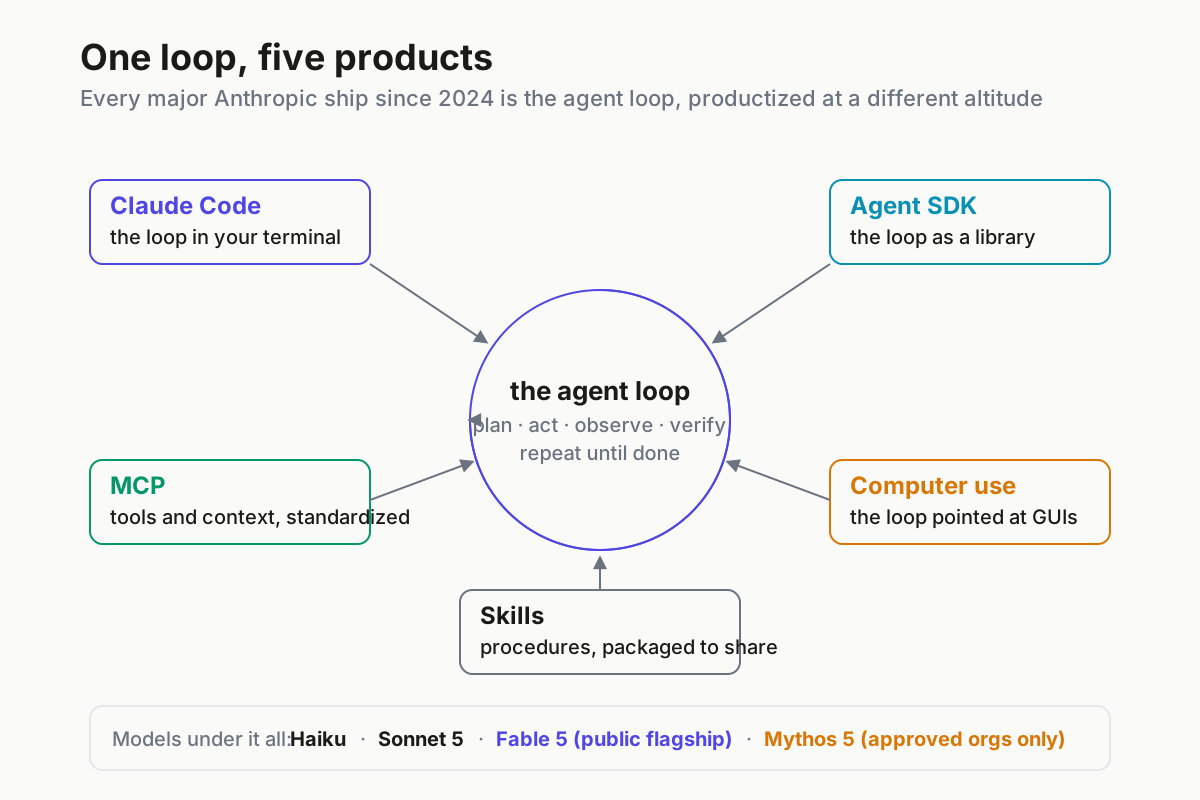
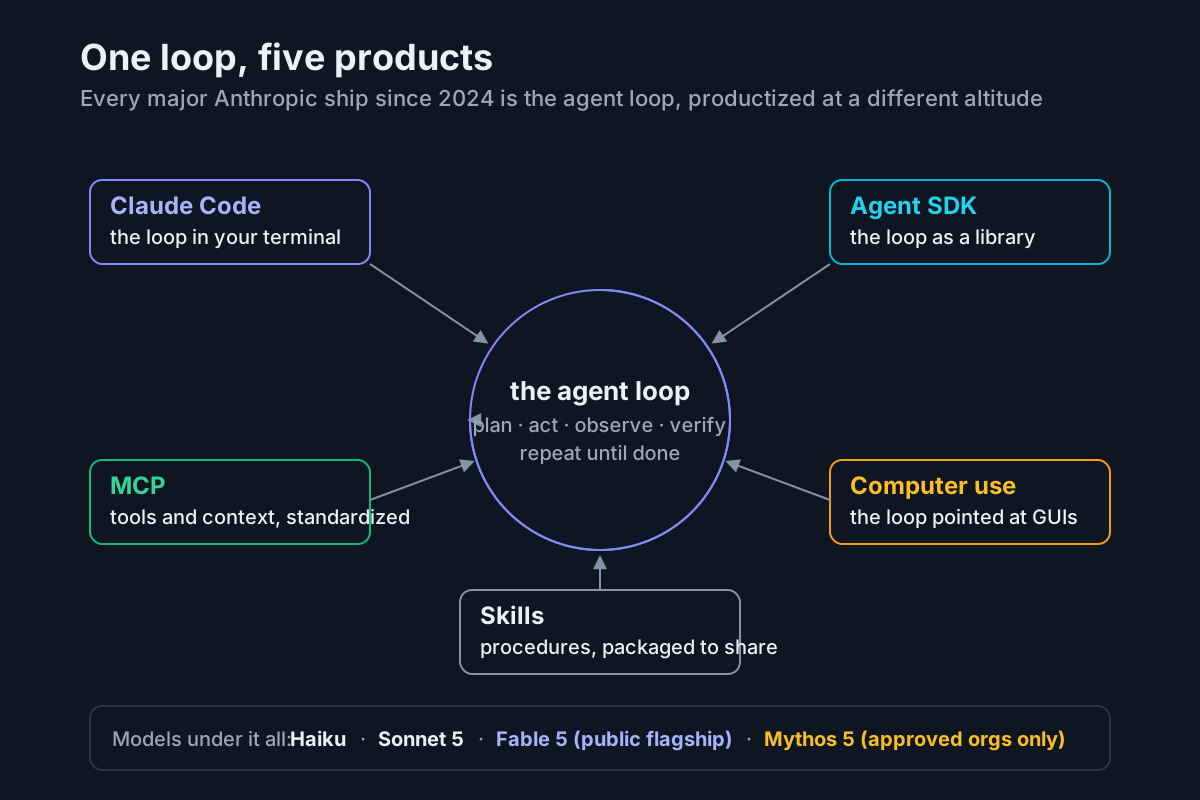 One loop, five products around it. The models underneath are the only layer with a public access gate.
Claude Code and the ecosystem around it
Claude Code shipped as a research preview in February 2025 and went GA in mid-2025 alongside the Claude 4 launch. Terminal-first was contrarian at the time — the industry consensus was IDE plugins and autocomplete — and it won the power-user cohort anyway, because a terminal agent is composable: it pipes, it scripts, it runs in CI, and it doesn’t care which editor you love. Our Claude Code power user’s field guide covers the daily practice; here the interesting part is reading the features as strategy.
- CLAUDE.md — persistent project memory: standing instructions the agent loads every session.
- Hooks — policy enforcement around tool calls: what runs, what gets blocked, what gets logged.
- Subagents — delegation: fan work out to scoped workers with their own context.
- Plugins and Skills — packaged procedures your whole team shares.
- Headless mode and the SDK — the same loop, driven by scripts and pipelines instead of a person.
None of these are chat conveniences. They are agent-operations primitives, and they quietly teach a generation of developers to run agents rather than prompt models. The commercial signal followed: reported revenue attributed to Claude Code crossed a $500M annualized run-rate within months of GA, per reporting.
Position it honestly, though: Claude Code normalized a category that others now contest hard — Codex CLI, Antigravity CLI, OpenCode, Goose, and a long tail of open-source harnesses. The modal reader of this article runs at least two of them, and switching costs at the harness layer are lower than any vendor would like.
Product note: Most Claude Code power users run it alongside Codex CLI, Antigravity CLI, and others — and every CLI keeps its own history in its own format. Automater Lite is the neutral layer above all of them: one local archive with full-text search and per-provider token metering across 10+ CLIs. Free on automater.ai.
MCP: giving the protocol away to win the ecosystem
The Model Context Protocol is the open standard for connecting models to tools and context, released by Anthropic in November 2024; our MCP deep dive covers the mechanics. This section is about the strategy, which was giving it away.
Open-sourcing the protocol invited competitor adoption, and competitors accepted: OpenAI announced MCP support in early 2025, with Google and Microsoft following across the year. That move commoditized the integration layer — the connectors everyone was building bilaterally — while leaving Anthropic holding the design center of the standard everyone now implements. The closest precedent is Microsoft’s Language Server Protocol: build the plumbing standard, and every editor benefits, but the author shapes the roadmap.
By 2026 the protocol has visibly outgrown its parent, which is the success condition, not a loss of control. The 2026-07-28 spec revision rebuilt the core around stateless request/response, and the adopter list on the project site now includes Amazon Bedrock AgentCore, Cloudflare, Figma, Google Cloud, Microsoft Foundry, Netlify, and Supabase, with governance running through the open project’s maintainer structure rather than one company’s roadmap.
The builder conclusion is underappreciated: MCP is the strongest anti-lock-in argument inside Anthropic’s own stack. A tool server you write today runs against any compliant vendor tomorrow. That changes the risk math of committing — which Anthropic understands, and bets it wins on model quality anyway.
Computer use, the Agent SDK, Skills, and the rest of the stack
The rest of the platform, component by component, with an honest maturity note on each — full builder detail lives in our Anthropic API and Console guide.
- Computer use. Screenshot-and-act GUI control, in public beta since late 2024 and measurably better every generation since, but still not production-grade for arbitrary interfaces. Good today for: form-filling against known apps, legacy-software glue, and QA walkthroughs with a human nearby.
- Agent SDK. The loop Claude Code runs, exposed as a TypeScript/Python library — renamed from the Claude Code SDK. This is internal architecture productized rather than guarded; mature for coding-shaped agents, younger for everything else.
- Skills. Portable folders of instructions, scripts, and resources a model loads on demand. A bid to own the format in which agent know-how gets written and shared — useful now, still consolidating as a standard.
- The API workhorse features. Prompt caching (cache reads at a small fraction of input price), batch processing at a deep discount, long context in the 200K–1M range depending on model, files, and code execution. These matter more to agent economics than headline model quality; details in docs.claude.com.
No roadmap speculation here — the components above are shipping today, and each one is another organ of the same animal: the loop, productized at a different altitude.
Claude’s character: why the persona is engineered
“Claude character” is a real research query with a real answer: the persona is deliberately engineered, and Anthropic documents the process. Character training is post-training work that shapes traits — curiosity, directness, warmth without sycophancy — on purpose, described in the lab’s published research and in the constitution documents on anthropic.com/news.
The agent-relevant argument is the one that matters here: a stable persona is a reliability feature. When a model runs for six hours with tool access, you care less about charm and more about predictable pushback, a consistent refusal style, and honest uncertainty handling. A model that says “I couldn’t verify this” the same way every time is easier to build systems around than a brilliant improviser.
Anthropic is also unusually transparent about it — system prompts and the reasoning behind persona decisions get published rather than treated as trade secrets. And a company that names its top tier Fable and Mythos is telling you, in the naming itself, that it considers character part of the product.
Different company: Character.AI is an unrelated consumer roleplay-chatbot company; it has no connection to Anthropic or the Claude models. If you searched “character ai models” looking for that product, this is not it — this section is about how Anthropic engineers the character of Claude.
The business reality
Figures as of August 27, 2026 — treat every number here as decaying, and re-check before you rely on it.
Revenue is the enterprise-weighted mirror image of OpenAI’s consumer gravity. Reported run-rate crossed $5B annualized by mid-2025 and, per later reporting, reached several multiples of that by the Claude Fable 5 launch, with the large majority coming from API and business products rather than consumer subscriptions. Claude Code is repeatedly cited in reporting as a material and fast-growing line inside that mix.
Capital and compute run through the two clouds. Amazon has invested a reported $8B total and is the primary training partner, with large Trainium commitments; Google has invested multiple billions across rounds. The underrated part of both deals is distribution: Bedrock and Vertex put Claude inside enterprise procurement paths that never touch anthropic.com — Claude Fable 5 was available on AWS Bedrock at launch, safeguards included.
Valuation has climbed in step: a $61.5B post-money round in March 2025, then a reported $13B raise at a $183B valuation in September 2025. The burn is enormous and mostly compute, which deserves an evenhanded frame: frontier training is the price of admission to the bet, not a scandal. The question for a builder is not whether Anthropic spends heavily — it is whether the capital structure (two hyperscaler patrons, deep-pocketed later-stage investors) keeps the roadmap funded through your commitment horizon. As of mid-2026, it visibly does.
The fair critiques
No praise sandwich. Four critiques, each with a severity call and a “matters to you if.”
1. Premium pricing compounds brutally at agent scale. Severity: high for bulk workloads. Fable-class list prices sit an order of magnitude or more above the open-weight floor , and agent loops multiply every gap — at hundreds of thousands of steps a month, the delta is a budget line, not a rounding error. Matters to you if high-volume, low-stakes steps dominate your workloads; see the DeepSeek effect on agent costs for the arithmetic. Where a cheaper model clears your eval bar, the premium needs a per-workload justification, and sometimes it won’t have one.
2. Capacity and surprise limits. Severity: medium, with a long trust tail. The 2025 episode — weekly usage caps added to Claude Code’s heavy plans on short notice after a summer of around-the-clock usage — was a case study in demand outrunning supply. The limits were defensible; the surprise was the damage. Matters to you if Claude Code is your daily driver and you have no warm fallback.
3. Safety friction — which now includes an access gate. Severity: low for everyday coding, high if you need the top tier and can’t get it. Conservative refusals still occasionally obstruct legitimate work, though field reports suggest false-refusal rates improved across the 4.x-to-5 generations — we won’t assert more than the evidence supports. The 2026 twist is that friction moved up a level: the most capable model, Claude Mythos 5, requires organizational approval, so for unvetted teams the ceiling is Claude Fable 5. A safety story you can plan around, but also a queue you might wait in.
4. Competition is real on every flank. Severity: structural, permanent. OpenAI’s agentic stack pairs consumer gravity with Codex; Google prices Gemini 3.1 aggressively on context and cost; open-weight models keep absorbing the bulk steps of agent pipelines. This one matters to you as leverage: a credible multi-vendor posture is what keeps any premium honest.
What betting on Anthropic’s stack means for you
Strengths worth banking on, stated plainly: frontier agentic-coding performance , the MCP ecosystem it seeded, enterprise availability through Bedrock and Vertex, consistently good documentation, and the strongest harness-plus-model pairing in the market today.
Inventory the lock-in precisely, because it is not uniform:
- Portable: MCP servers, most prompting, your eval definitions, your repo conventions (CLAUDE.md is markdown any harness can read).
- Sticky: Claude Code workflows (hooks, subagents, plugin configs), Agent SDK patterns in product code, caching economics (a warm cache is a per-request discount you lose on switch day), and — new for 2026 — a Mythos-class approval, which is a trust relationship you cannot port to another vendor.
The hedges are the ones power users already run: abstract at the model boundary so a provider is a config value; keep a second provider warm enough that failover is boring; make your eval suite cross-model so switching costs stay measurable instead of mythical.
Recommendations by reader type:
- Solo power user: standardize on Claude Code as your primary, keep one alternate CLI current, meter your own usage. Confidence: high.
- Agent-product startup: build on the Agent SDK if velocity matters more than portability, but wrap it behind your own interface and ship every tool as an MCP server. Confidence: medium-high.
- Enterprise platform team: buy through Bedrock or Vertex for procurement and data-boundary reasons, negotiate capacity in writing, and start Mythos-class vetting early if you expect to need it. Run the fleet through one pane — see running multiple AI coding agents. Confidence: medium, pending your workload evals.
How to follow Anthropic like an analyst
Skip the commentary and read the primary sources — this is the curated list “anthropic blog” searchers actually want:
- The newsroom and research index at anthropic.com/news — announcements, research, and policy updates in one stream.
- The engineering blog, model pages, and release notes on docs.claude.com — where deprecations and API changes land first.
- System cards and model cards on release day; RSP updates whenever they ship; and the pricing page, which you should diff monthly rather than read.
Signal beats noise in predictable ways. A model-card delta on agentic benchmarks precedes product features (computer-use score jumps foreshadowed the GUI tooling). A deprecation notice tells you lifecycle discipline (Claude 2’s retirement set the pattern). An enterprise case study tells you where sales is focused, which tells you where reliability investment goes.
Cadence reads as strategy too. Anthropic ships agent primitives API-first and consumer features rarely and late — the inverse of OpenAI. And naming leaks intent: when the ladder stopped adding numbers above Opus and a named class appeared instead, the two-tier access model was legible before the press release spelled it out. Fifteen minutes of setup — newsroom RSS, docs changelog watch, monthly pricing diff, system cards on release day — and you will be ahead of most coverage. The same monitoring playbook, pointed at the competition, is in our OpenAI analysis.
FAQ: Anthropic
Who founded Anthropic?
Anthropic was founded in 2021 by siblings Dario Amodei (CEO) and Daniela Amodei (president), alongside former OpenAI researchers including Tom Brown, Jack Clark, Jared Kaplan, Sam McCandlish, Chris Olah, and Ben Mann. The group left OpenAI over disagreements about direction and the pace of commercialization.
What is Anthropic known for?
Anthropic is the agent-focused AI lab: builder of the Claude model family (currently Claude Fable 5 and the restricted Claude Mythos 5), Claude Code, and the Model Context Protocol, plus safety research such as constitutional AI and the Responsible Scaling Policy. Its revenue skews toward enterprise API usage rather than consumer chat.
Is Claude 2 still available?
No. Claude 2 launched in July 2023, was superseded by the Claude 3 family in 2024, and has been retired from the API. For an everyday equivalent today use Claude Sonnet 5; for frontier work, Claude Fable 5 is the publicly available flagship.
Is Anthropic the same as Character.AI?
No. Anthropic is an AI safety company that builds the Claude models and developer tooling like Claude Code and MCP. Character.AI is an unrelated consumer company focused on roleplay chatbots. The similar-sounding “Claude character” research refers to how Anthropic engineers its model’s persona, not to Character.AI.
Is Anthropic publicly traded?
No — Anthropic is private. Its last widely reported raise valued the company at $183B in September 2025, following a $61.5B round that March. It makes money primarily from enterprise API usage, cloud-marketplace distribution through AWS and Google, and paid Claude plans.
Sources
- Introducing Claude Fable 5 and Claude Mythos 5 — Anthropic
- Claude Fable 5 product page — Anthropic
- Introducing Claude Fable 5 and Claude Mythos 5 — Claude platform model docs
- Anthropic’s Claude Fable 5 is a version of Mythos the public can access today — TechCrunch
- Anthropic launches Mythos-class Claude models — CNBC
- Anthropic Claude Fable 5 on AWS: Mythos-class capabilities with built-in safeguards — AWS News Blog
- Anthropic newsroom and research index
- Claude developer documentation
- MCP spec revision, 2026-07-28 — Model Context Protocol blog
- Model Context Protocol project site