Databricks and the Enterprise Agent Platform Race
What Databricks is, who owns it, and whether the lakehouse can own enterprise agents: the data-gravity thesis, the MCP counter-case, and a verdict by workload.

Go deeper. Build your own.
Why a data platform is in your agent reading list
Databricks — the company most practitioners know for Spark jobs and lakehouse plumbing — now says the enterprise agent era runs through its platform. That is either the most natural claim in enterprise software or a category error, and this piece exists to work out which. First the company, explained fast; then the thesis at full strength, the counter-thesis at equal strength, and a verdict by workload.
Two readers are served here. One works at, or is evaluating, a Databricks shop and wants the strategic read. The other just searched the company name and wants it explained without a sales deck — the facts a Wikipedia skim gives you, then the analysis it can’t. The preview of where this lands: the data-gravity argument is real but not decisive, and open protocols — MCP above all — are the wildcard that could flatten it.
What Databricks does, in one section
Databricks is a cloud data and AI platform: one place where enterprises store, process, govern, and analyze their data — and, increasingly, build and serve AI on top of it. It is best known for commercializing Apache Spark and for the lakehouse architecture, which merges the data lake and the data warehouse into a single governed system.
The lakehouse deserves its two sentences. Instead of keeping cheap, messy object storage (the lake) separate from fast, governed SQL (the warehouse), a lakehouse runs both on one copy of the data — Delta Lake as the storage and table layer, Unity Catalog as the governance layer that knows who may see what. That governance layer is where the agent story begins, so keep it in view.
Day to day, practitioners touch the platform as notebooks and jobs on managed Spark, SQL warehouses for BI, pipeline tooling, and — since the AI turn — model serving endpoints and Genie, the natural-language BI interface . If your company “runs Databricks,” some subset of those is what it actually runs.
The company was founded in 2013 by the UC Berkeley team behind Apache Spark — Ali Ghodsi (CEO), Matei Zaharia, Ion Stoica, Reynold Xin, Patrick Wendell, Andy Konwinski, and Arsalan Tavakoli-Shiraji . Selling Spark support was the original business; the lakehouse, and now the AI platform, are what it grew into.
| Databricks Inc., at a glance | |
|---|---|
| Founded | 2013, San Francisco (HQ still there) |
| Status | Private |
| CEO | Ali Ghodsi, co-founder |
| Headcount | Roughly 8,000–9,000 |
| Revenue | $3.7B+ annualized run rate, last widely reported mid-2025 |
| Known for | Apache Spark, Delta Lake, MLflow, Unity Catalog, the lakehouse |
Who owns Databricks
Databricks is privately held. Ownership is spread across the founders, employees, and a long roster of venture and growth investors: Andreessen Horowitz and NEA from the early rounds; Thrive Capital, Insight Partners, GIC, and crossover funds in the later ones; Microsoft and NVIDIA among the strategic backers .
| Round | Date | Reported valuation | Reported leads |
|---|---|---|---|
| Series I | September 2023 | ~$43B | T. Rowe Price, with NVIDIA participating |
| Series J | December 2024 | ~$62B | Thrive Capital, ~$10B raise |
| Series K | Announced August 2025 | $100B+ | Co-led by Thrive and a16z, per reporting |
Read the curve honestly: a jump from $43B to a reported $100B-plus in under two years tracks the AI story — agent and GenAI workloads landing on governed data — more than it tracks steady data-platform growth. The repricing is a bet on exactly the thesis this article examines.
On the IPO question, the honest answer is the one the company keeps giving: eventually. Leadership has said for years there is no urgency, tender offers have handled employee liquidity, and as of August 2026 there is no public filing . Treat any specific date you read as speculation.
One structural note for the cap-table minded: unlike Snowflake, which went public in 2020 and reports quarterly, Databricks discloses only what it chooses — run-rate milestones in press releases, growth percentages without denominators. Every figure in this section is reported, not audited, and should be read that way.
The AI arc: from MosaicML to Agent Bricks
The acquisition spine tells the strategy better than any keynote. MosaicML (June 2023, ~$1.3B ) bought model-training infrastructure and the team that became Mosaic AI. Tabular (June 2024, reported near $1–2B ) bought the creators of Apache Iceberg, ending the table-format war by hiring the other side of it. Neon (May 2025, ~$1B ) bought serverless Postgres aimed explicitly at agent workloads — databases an agent can spin up in seconds — which resurfaced as the platform’s transactional layer . Smaller buys (Arcion, BladeBridge, Tecton ) filled gaps around the edges.
DBRX, in March 2024, is the honest chapter. It proved Databricks could train a competitive open model — briefly the strongest open-weight LLM on standard benchmarks — and then frontier labs lapped it within months, and it faded without a successor . The company visibly internalized the lesson: don’t race the frontier; sell the governed platform the frontier runs on.
Hence the current posture. The tooling sits under the Mosaic AI umbrella — Model Serving, Vector Search, the Agent Framework, Agent Evaluation, and stewardship of MLflow, whose current generation added agent-grade tracing . Agent Bricks, announced in mid-2025, is the flagship pitch: describe the agent you want over your governed data, and the platform assembles it, generates evaluations, and auto-tunes cost against quality . And the frontier models are other people’s, served natively: Anthropic’s Claude models since early 2025, OpenAI’s GPT-5-era models following later that year, with Google models alongside . DBRX taught Databricks to be the venue, not the headliner.
The partnership economics stay mostly undisclosed — reporting has put real money behind the OpenAI arrangement — but the product fact is checkable: frontier models from rival labs, served inside the customer’s governance perimeter, billed on the platform. That is the venue business, operating.
The thesis: whoever governs the data owns the agents
Steelman first — the argument at full strength, before anything touches it.
Enterprise agents are only as good as their governed access to enterprise data. The hard part of deploying an agent inside a company was never the loop; loops are a commodity. The hard part is permissions, lineage, and audit — and Unity Catalog already holds all three: who may see which table, which columns are PII, where every number came from. If governance is the bottleneck, the agent layer accrues to the catalog that already solved it.
The retrofit problem supports the claim. Bolting row-level ACLs, PII handling, and audit trails onto a standalone agent stack is the expensive path — months of security engineering per data source, repeated for every source. An agent built inside the platform inherits all of it, nearly free.
Distribution seals it. Databricks has already cleared procurement, security review, and compliance at more than ten thousand customers, by its own count . An agent shipped inside an approved platform skips a year of sales friction that a standalone agent vendor has to eat — for a startup selling a standalone agent stack, that funnel is the hardest feature to replicate.
Make it concrete. An agent answering “why did EMEA revenue dip in Q2?” must respect exactly the ACLs of the analyst asking — no extra rows, no unmasked columns. A catalog-native agent gets that by construction: it queries as a governed principal, row filters and column masks apply to it as they apply to the analyst, lineage records what it read, and the audit log records what it answered. A standalone agent has to rebuild every piece of that, correctly, before its first useful answer.
Notice what the example does not require: a better model. The thesis’s quiet strength is that it wins even in a world of commodity frontier models — especially in that world, since governance becomes the only scarce input left.
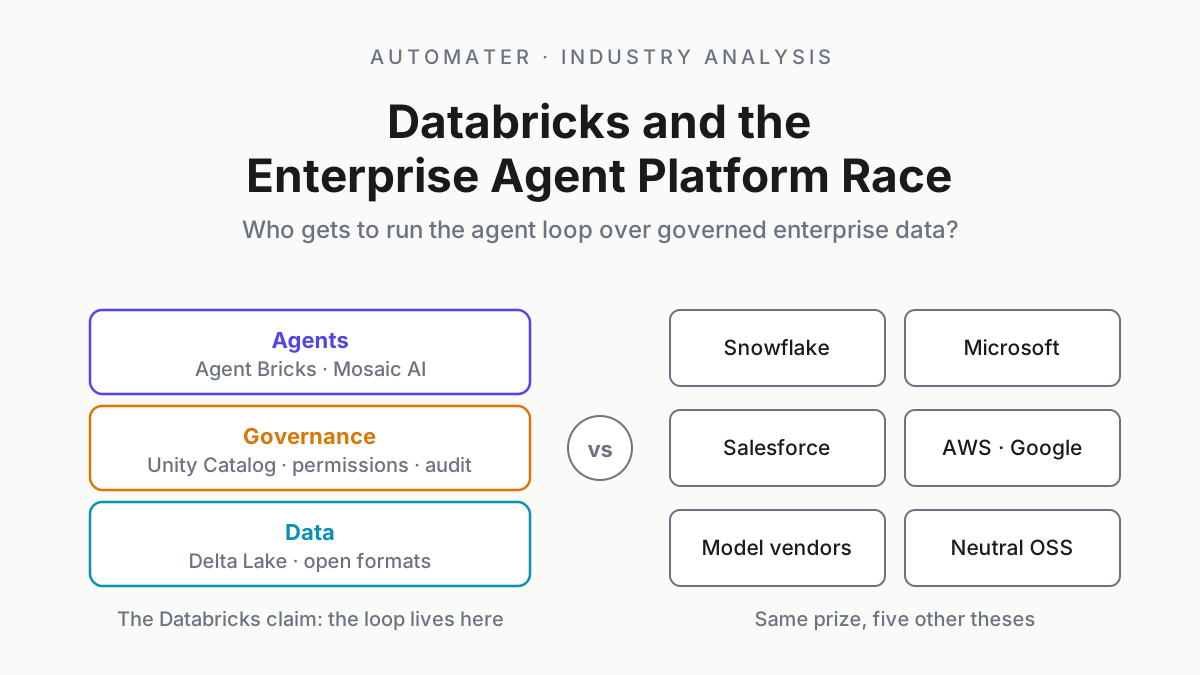
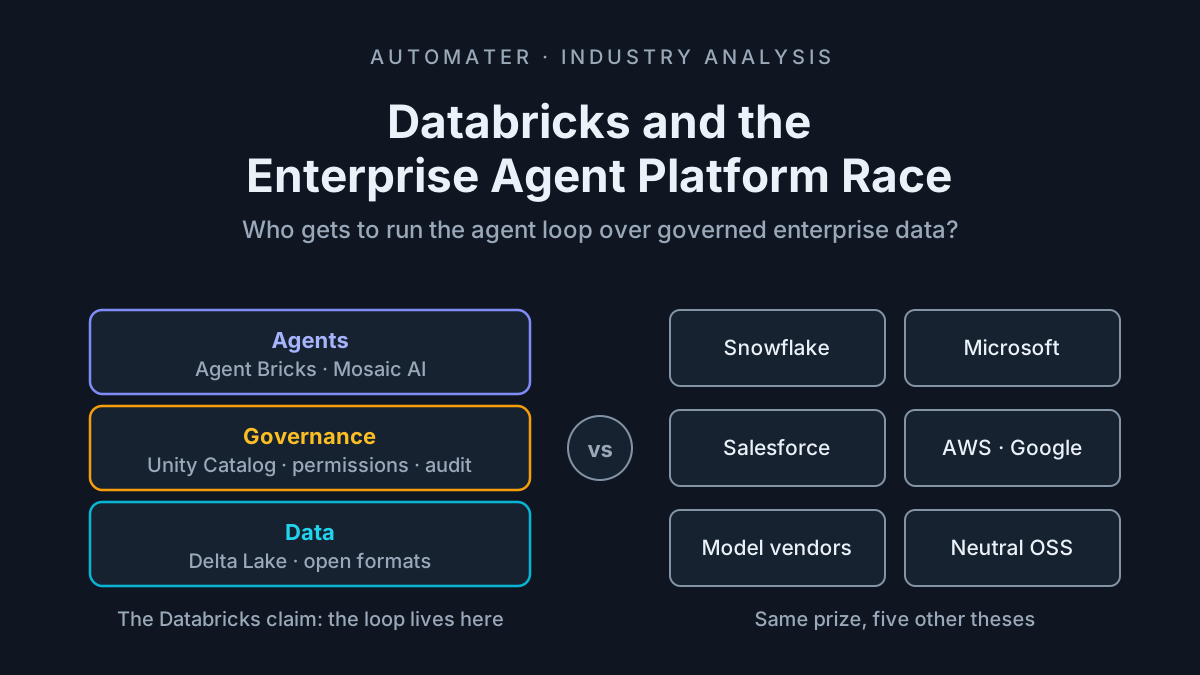
It is a strong argument. It is also, word for word, Snowflake’s argument — which is the first thing the competitive map below tells you.
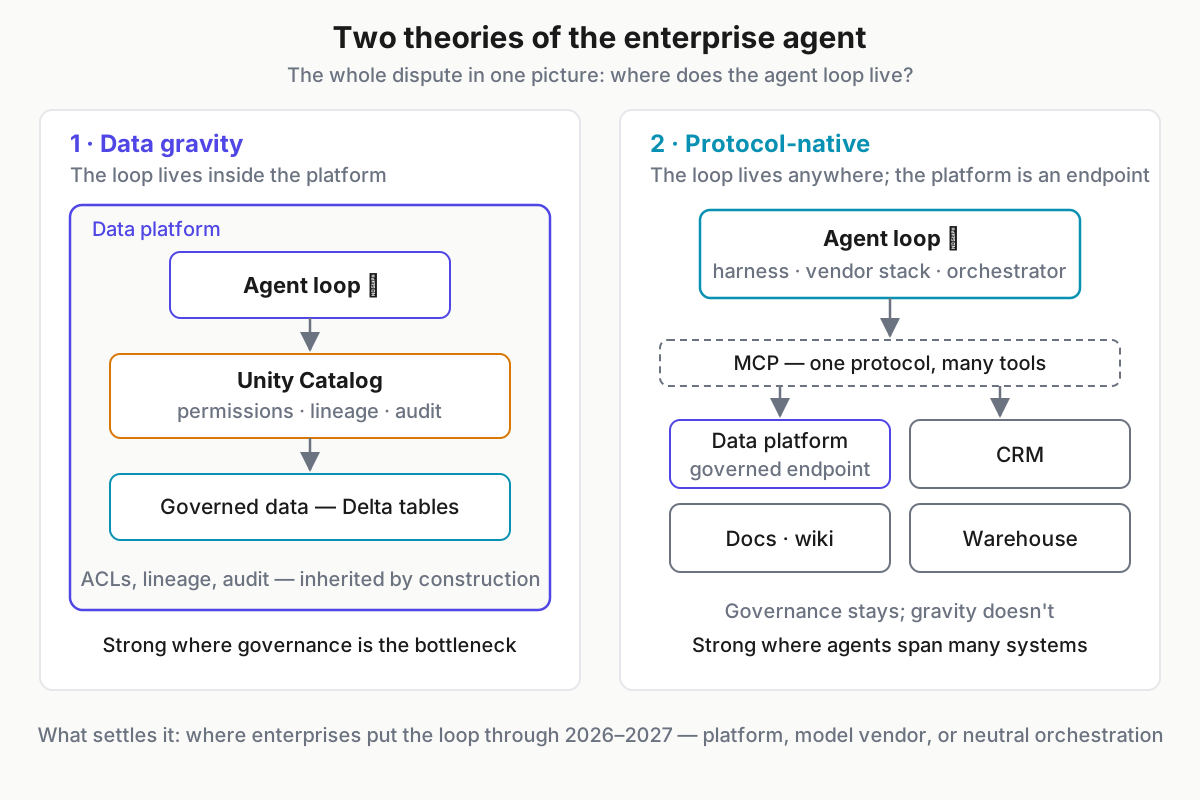
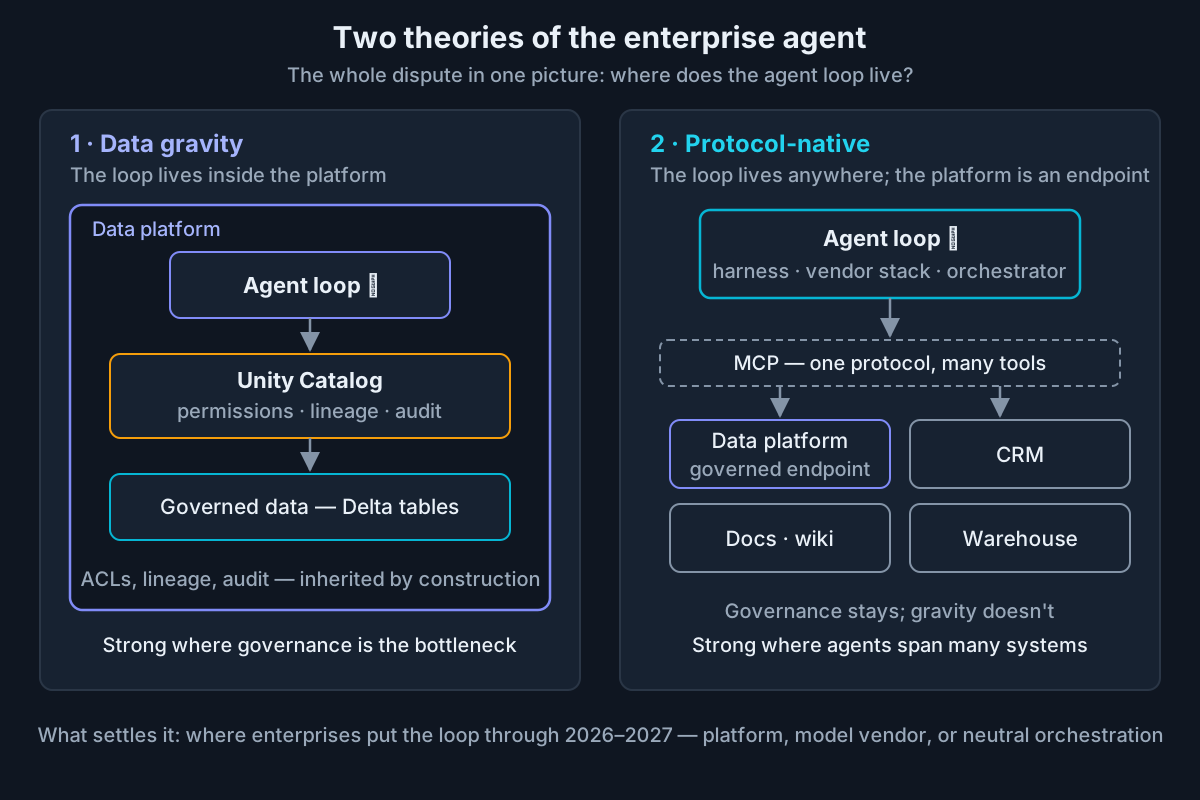 The whole dispute in one picture: does the agent loop live inside the governed platform, or anywhere, with the platform as one MCP endpoint?
The counter-thesis: the platform as one tool call among many
Now the other side, at equal strength.
Agents are going protocol-native. The Model Context Protocol makes any governed data source one tool call away, and Databricks itself ships MCP servers exposing its catalog and tools . The moment governed access is available over a protocol, the agent loop can live anywhere — a model vendor’s stack, a workflow platform, a developer’s harness — and treat the data platform as an endpoint. Governance stays; gravity doesn’t.
Model portability cuts both ways, too. If frontier models are interchangeable commodities inside the platform, the platform risks becoming a commodity inside the model vendors’ own agent stacks — OpenAI and Anthropic both sell agent platforms that reach into enterprise data directly, and they own the models that make those platforms worth using.
The historical rhyme deserves a hearing without being overclaimed. “Own the data, own the apps” was the warehouse-era thesis too, and the apps still ended up everywhere; the warehouse became an integration point, not the center of gravity. That was still a great business. It just wasn’t the application layer.
What would settle the question is observable: where enterprises put the agent loop itself through 2026–2027. Inside the data platform — watch Agent Bricks adoption disclosures. Inside a model vendor’s stack — watch enterprise Claude and GPT agent deployments touching governed data. Or in neutral orchestration — watch MCP-first architectures showing up in reference deployments. All three exist in production today; none is yet the default.
The honest reading of mid-2026 deployments is mixed on purpose: the same enterprise often runs a catalog-native analytics agent, a vendor-stack coding agent, and an orchestrated cross-system workflow. Three loops, three homes, one company — which is itself evidence that no single thesis has closed the argument.
The competitive map
| Player | Their thesis, in one line | Strongest workload |
|---|---|---|
| Databricks | Govern the data, inherit the agents | Analytics and data-pipeline agents |
| Snowflake | The same thesis, mirror image | The same, for Snowflake shops |
| Microsoft | Own every layer plus the contract: Fabric, Copilot Studio, Azure AI Foundry | Wherever the enterprise agreement already is |
| Salesforce | Agents live where the workflow lives (Agentforce) | CRM and service workflows |
| AWS and Google | Infrastructure-up: Bedrock agent offerings, Vertex agent tooling | Teams assembling custom stacks |
| Neutral startups and OSS | The loop should belong to no vendor | Cross-system orchestration |
Three notes the table can’t hold. Snowflake differs from Databricks less on thesis than on posture — managed simplicity on its own engine and credit model, against Databricks’ open-formats, bring-your-own-everything pitch. Salesforce’s claim is the app-platform version of data gravity — the agent belongs where the workflow lives, not where the data lives — and UiPath runs the process-automation variant of the same argument. And the hyperscalers are betting hard on the protocol layer: Amazon’s Bedrock AgentCore was among the named adopters of the stateless 2026-07-28 MCP revision at launch.
The absence worth naming: nobody neutral has enterprise distribution. The startups and open-source orchestrators with the cleanest protocol story sell to engineering teams, not procurement — which is why every prediction in this piece routes through the incumbents’ adoption speed rather than the challengers’ elegance.
If your company runs Databricks: skills worth learning
Analysis is nice; employability is nicer. If your employer already standardized on Databricks, this is the priority list, with an honest transferability rating per item.
- Unity Catalog’s permission model — grants, row filters, column masks, lineage. Transferability: medium. The concepts — least privilege, lineage-aware access — travel to every agent stack you will ever touch; the specific DSL does not.
- MLflow tracing and agent evaluation — instrument, trace, and score agent runs. Transferability: high. MLflow is open source, and eval discipline is the single most portable skill in the agent economy.
- Vector search and retrieval design — chunking, hybrid search, retrieval evals. Transferability: high. Every platform has a version of this; the judgment transfers wholesale.
- The Agent Bricks and Agent Framework toolchain — declarative agent building over governed data. Transferability: low to medium. Learn it to ship at work; don’t mistake it for architecture knowledge.
- Spark and SQL, still. The unglamorous substrate everything above runs on. Transferability: high, and it is not going anywhere.
The career signal worth noticing: enterprise “AI engineer” postings increasingly decode to “agents over governed data.” This stack is that job description in vendor-specific form. Allocate hours accordingly: the transferable three — evals, retrieval, governance thinking — compound across employers, while platform DSL depreciates on the vendor’s schedule, not yours.
Product note: Enterprise platforms govern your company’s agents; your personal fleet still needs an operating layer. Automater Lite archives, meters, and monitors the CLIs you run yourself — locally, alongside whatever your employer standardizes on. Free on automater.ai.
Two worlds: governance-first platforms vs speed-first CLIs
We write from the other world — the harness landscape of Claude Code, Codex, and their peers — and the honest comparison is that both worlds are correct for their contexts. Enterprise agent platforms optimize for audit, permissions, and repeatability. The power-user CLI world optimizes for iteration speed and capability-per-hour. Same agentic foundations, opposite constraints.
They are already converging. Evals became the shared discipline on both sides of the wall. MCP is becoming the shared plumbing — the 2026 spec revision was written for exactly the gateway-and-governance deployment pattern enterprises need . And observability expectations flow in both directions: platform teams want CLI-grade traces; CLI users increasingly want platform-grade session records.
The direction of travel shows up in job ads and roadmaps alike: “agent observability” went from CLI-world hobby to enterprise line item in about a year, while skills files — packaged procedures an agent carries between tools — are moving the opposite way, from harness culture toward platform catalogs.
The bridge between the worlds is a person, not a protocol. The same developer ships governed agents at work and runs five ungoverned CLIs at home; patterns migrate through that person — harness ergonomics and skills files flowing into the enterprise, eval and audit habits flowing out.
One falsifiable prediction: enterprise platforms will absorb CLI-world ergonomics faster than CLIs absorb governance, because capability envy moves budgets faster than compliance envy. Nobody demos an audit log. Everybody demos an agent closing a ticket.
Who wins which workloads: the honest verdict
The single-winner frame is wrong, and refusing it is the analytical position, not a hedge. Ruling by workload class:
| Workload | Favorite | Confidence | What changes the call |
|---|---|---|---|
| Analytics Q&A over governed data | Data platforms (Databricks, Snowflake) | High | Model vendors shipping credible native governance |
| Pipeline repair and data maintenance | Data platforms | High | Little — this is home turf |
| Workflow and CRM agents | App platforms (Salesforce and peers) | Medium-high | A data platform buying a serious app layer |
| Developer and coding agents | The model vendors’ stacks | High | Nothing currently visible |
| Cross-system orchestration | Genuinely contested; protocols favor neutral layers | Low-medium | MCP maturity, and who ships the trusted registry |
The two high-confidence data-platform calls deserve their reasoning on the record: analytics Q&A and pipeline repair are workloads where the agent’s every action is a governed query, so the platform’s advantage is structural, not situational. The coding-agent call is structural in the opposite direction — the loop lives in the developer’s harness, the data is a git repo, and no catalog governs it.
Two hedges, stated plainly rather than buried. One major acquisition could reshuffle any row of this table . And MCP maturity is the single biggest variable in it — protocol depth is what keeps the last row neutral and what could slowly erode the first.
Signals to watch through 2026
A date-stamped watchlist, from late August 2026. Each item: the signal, and why it matters.
- Agent Bricks GA and disclosed adoption — the thesis’s commercial proof or its absence. Keynote demos don’t count; customer counts do.
- Unity Catalog’s MCP surface area — Databricks was not among the named launch adopters of the stateless 2026-07-28 spec revision; how quickly its MCP servers track the new revision shows how seriously it takes the protocol channel .
- The security bar rising around MCP — the June 2026 US government MCP security guidance made MCP hardening a procurement question; platforms that answer it in writing inherit deals.
- EU AI Act Article 50, in force since August 2, 2026 — transparency obligations mean agents interacting with people must disclose they are AI, with duties falling on deployers; platforms with built-in audit and disclosure tooling just gained a compliance selling point.
- Partnership depth with OpenAI and Anthropic — whether the native-model deals deepen into co-engineering and committed capacity, or stay at model residency .
- Snowflake parity announcements — every Databricks agent claim has drawn a mirror within a quarter or two; a sustained divergence in either direction would be actual news .
- IPO movement — a filing would force the first audited answer to whether AI products are a disclosed share of revenue .
The practitioner tripwires, as if-then rules: if model vendors ship credible native enterprise governance, the counter-thesis strengthens and platform lock-in deserves a rethink. If Unity Catalog’s full governance surface lands cleanly over MCP, the thesis wins — but in a form that no longer requires the loop to live on-platform, which would be the quietly radical outcome.
FAQ: Databricks and enterprise agents
What does Databricks do?
Databricks sells a cloud data and AI platform — the lakehouse — where enterprises store, process, govern, and analyze data, and increasingly build and serve AI on it. The core pieces: Delta Lake storage, Unity Catalog governance, Spark-based compute, and the Mosaic AI toolchain for models and agents.
Who founded Databricks?
Seven UC Berkeley researchers behind Apache Spark founded Databricks in 2013 — Ali Ghodsi (now CEO), Matei Zaharia, Ion Stoica, Reynold Xin, Patrick Wendell, Andy Konwinski, and Arsalan Tavakoli-Shiraji . Commercializing Spark was the original business; the lakehouse and the AI platform came later.
Who owns Databricks?
Databricks is privately held. Ownership spreads across the founders, employees, and investors including Andreessen Horowitz, NEA, Thrive Capital, Microsoft, and NVIDIA . The last widely reported valuation crossed $100 billion with the Series K announced in August 2025 ; no controlling shareholder has been disclosed.
Is Databricks publicly traded?
No. Databricks remains private, and as of August 2026 there is no public IPO filing . Leadership’s long-standing line is “eventually, with no urgency.” Late-stage rounds and employee tender offers have substituted for public-market liquidity, so treat any specific IPO date you read as speculation.
What is a lakehouse?
A lakehouse is a single governed data system combining warehouse reliability — transactions, fast SQL, access control — with data-lake economics: cheap object storage and open formats. Databricks popularized the term; Delta Lake and Apache Iceberg are the open table formats that make the combination work.
What is Agent Bricks?
Agent Bricks is Databricks’ agent-building product: you describe the task, and the platform assembles an agent over your governed data, generating evaluations and tuning cost against quality automatically. Announced in 2025 and still maturing as of mid-2026 , it is the company’s main claim on the enterprise agent layer.