The Open-Source AI Agent Stack Serious Builders Run in 2026
What open source artificial intelligence really means, and the agent stack that runs on it in 2026: models, runtimes, orchestration, MCP, and three recipes.

Go deeper. Build your own.
Search interest in open source artificial intelligence is really two questions wearing one phrase. The first is definitional — is any of this actually open source? — and it has a precise answer most explainers fudge. The second is practical: which open models and tools can replace the closed APIs your agents run on today, and at what cost in capability? This guide answers both, in that order.
We’re writing for the builder who already ships agentic software on closed APIs and wants to know what open buys — lower cost, real privacy, operational control — and what it still gives up. First the definition, settled with the OSI’s own text rather than vendor marketing. Then the case for why openness matters more for agents than it ever did for chatbots. Then the stack, layer by layer — models, runtimes, orchestration, protocol, evals — ending with three reference recipes you can copy.
Is AI actually open source? Open weights vs open source
Open source artificial intelligence, per the Open Source Initiative’s Open Source AI Definition (OSAID), is an AI system you are free to use, study, modify, and share for any purpose — which requires the weights, the source code, and sufficiently detailed information about the training data for a skilled person to recreate a substantially equivalent system. The OSI published OSAID 1.0 in October 2024, and it remains the closest thing the industry has to a referee.
Most of what gets called open source AI does not meet that bar. What most labs actually ship is open-weight: you can download the parameters and run them, usually under a permissive or custom license, but the training data and full methodology stay private. The distinction sorts the current field cleanly:
- Open source (OSAID-qualifying): fully open releases in the OLMo mold — weights, code, and data documentation together. Rare, and mostly research-led.
- Open-weight, permissive license: DeepSeek V4 and GLM-5.2 (MIT), Qwen3-Coder-Next (Apache-2.0). Free to use commercially, fine-tune, and redistribute — but not reproducible from scratch, so not open source in the OSAID sense.
- Open-weight, custom license: Llama’s community license, with usage thresholds and acceptable-use terms. Downloadable, not open.
- Fair-code / source-available: tools like n8n whose license permits self-hosting but restricts competing commercial use. Useful, and honestly not OSI open source.
This is not pedantry. Reproducibility, independent audit, fine-tune rights, and redistribution rights all hinge on which tier you’re in — and so does what happens to your product when a vendor changes its mind. For the rest of this article we’ll say open-weight where that’s what we mean, and open source only where it’s earned.
Why open matters more for agents than chatbots
Unit economics. A chatbot answers a question and stops; an agent loops. A single overnight batch — say 200 triage tasks at ~300K tokens each — burns 60 million tokens before breakfast. On DeepSeek V4 Flash’s $0.14 per million input / $0.28 per million output pricing, that night costs roughly $10. At frontier rates it’s a line item someone asks about in the Monday meeting. Per-token pricing compounds in loops the way it never did in chat, which is the whole thesis of the DeepSeek effect on agent economics. Open-model API pricing has fallen roughly 80% year over year, per mid-2026 harness reporting.
Privacy. Agents read your private code, production logs, and internal docs as a matter of course — that’s the job. Weights on your own hardware mean that context never leaves the building, which turns a legal review into a shrug. For regulated codebases, this is frequently the deciding argument, ahead of cost.
Customization. Agent reliability lives in unglamorous details: tool-call formatting, stop behavior, schema adherence, when the model gives up versus retries. With open weights you can fine-tune those behaviors and control sampling all the way down — grammar-constrained decoding, logit bias, custom stop sequences. Closed APIs expose a fraction of that surface, and the fraction shrinks whenever a provider simplifies its API.
Operational control. No rate limits mid-incident, no deprecations mid-quarter, no upstream model swap silently changing your agent’s behavior. This stopped being hypothetical on July 24, 2026, when DeepSeek deprecated V3 and R1: API users had a migration deadline, while anyone running the same weights locally kept working without a change. The cheapest API in the world can still delete your model on a Thursday. Your GPU can’t.
Layer 1 — models: the open-weight families that matter
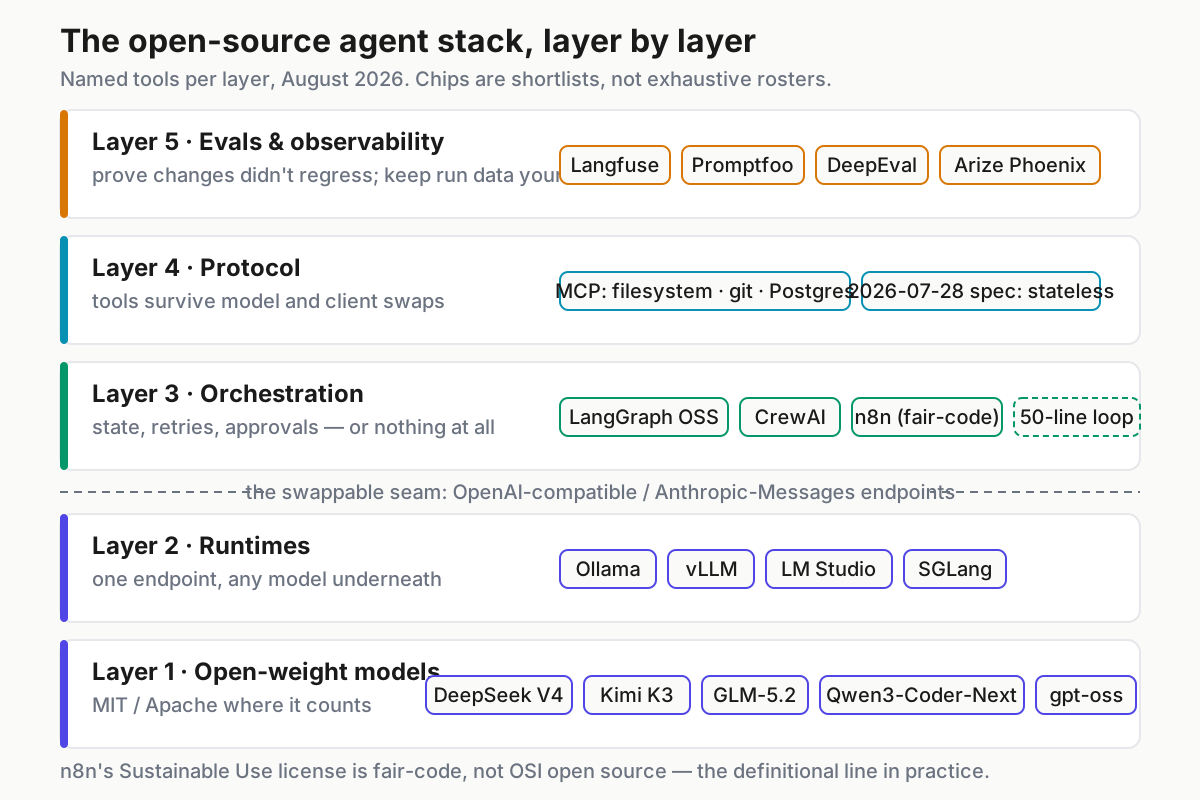
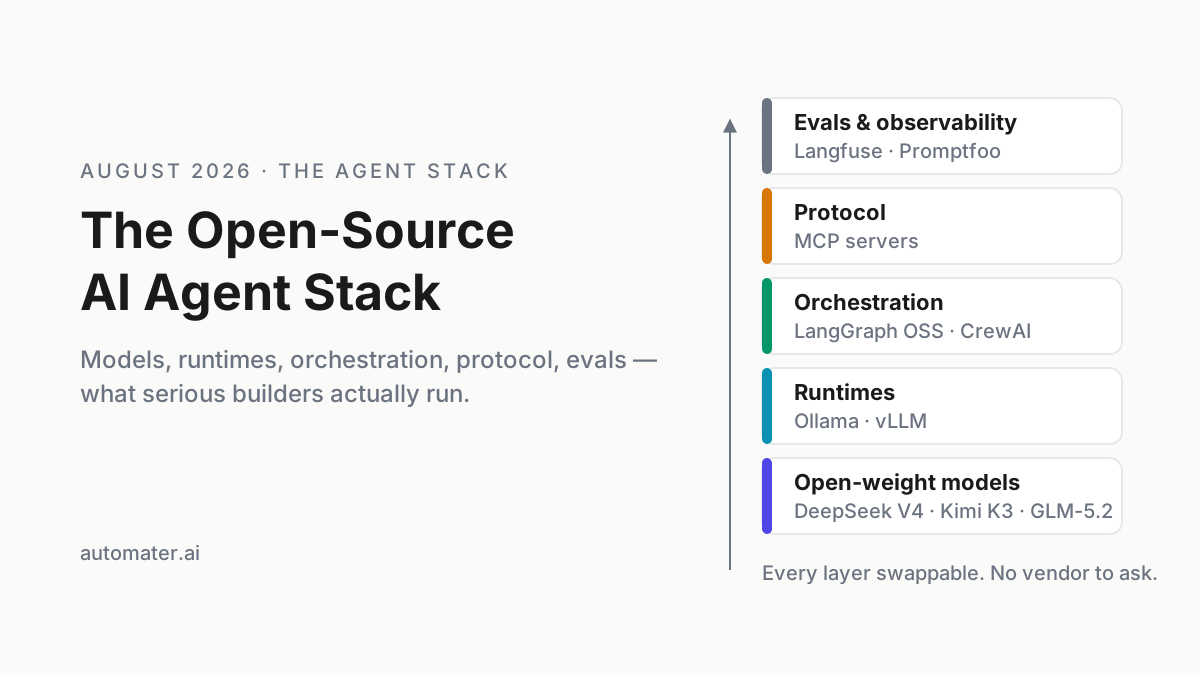
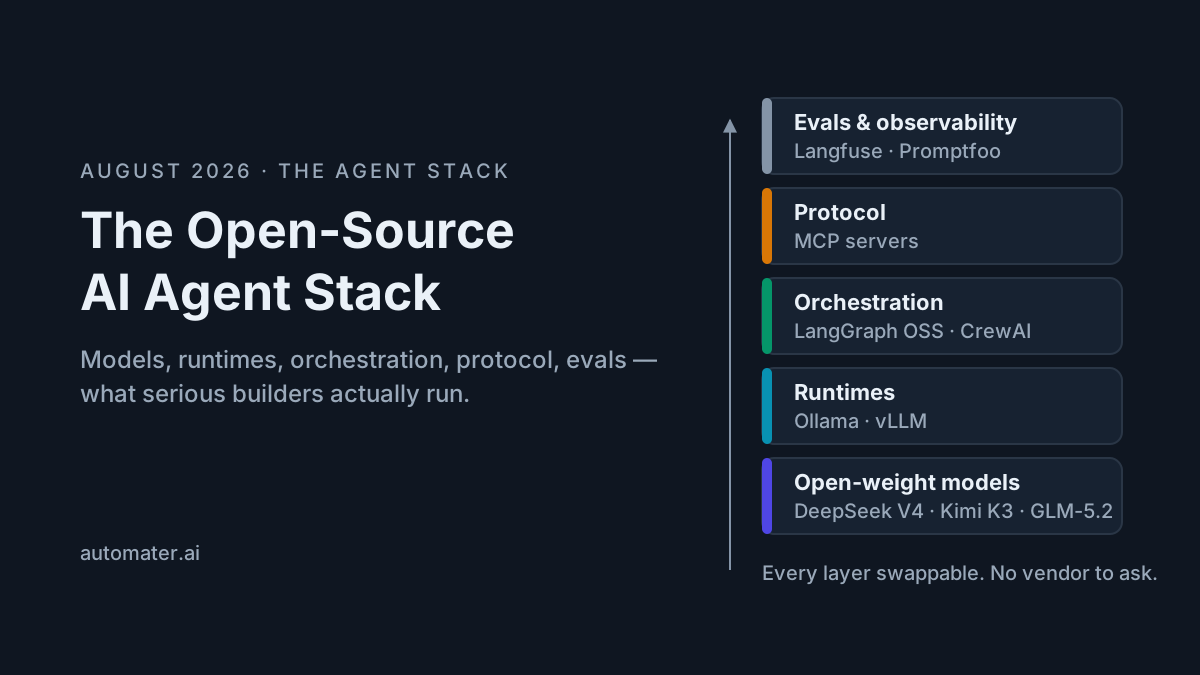
 The five layers, with the tools we’d actually shortlist at each one. OpenAI-compatible endpoints are the seam that makes every layer swappable.
The August 2026 shortlist is stronger than anything the open side has fielded before. Four releases this year reset the conversation, per the mid-2026 open-model scorecard:
| Model | Shape | License | SWE-bench Verified | Agent niche |
|---|---|---|---|---|
| Kimi K3 (Moonshot, Jul 2026) | 2.8T MoE | modified-MIT expected; weights staged after API launch | ~93.4% (Vals AI) | Frontier-class coding; first open model to lead a frontend arena ahead of Claude Fable 5 |
| DeepSeek V4 Pro / Flash (Apr–Jul 2026) | 1.6T / 49B active; Flash 284B / 13B | MIT | ~80.6% (vendor, Pro) | Flash is the credible price floor: $0.14 / $0.28 per M tokens |
| GLM-5.2 (Z.ai, Jun 2026) | 744B / 40B active | MIT | ~78.7% (Epoch AI) | Balanced daily driver at ~a quarter of frontier output price |
| Qwen3-Coder-Next (Alibaba) | 80B / ~3B active | Apache-2.0 | ~70.6% (vendor) | The one-box model: ~46GB unified memory; $0.11 / $0.80 per M via API |
| gpt-oss (OpenAI) | 20B / 120B | Apache-2.0 | — | Commodity fallback with the broadest tooling support |
| Llama 4.x (Meta) | various | community license | — | Ecosystem breadth; read the license section below first |
Kimi K3, GLM-5.2, and DeepSeek V4 all advertise 1M-token contexts. Note what’s not on the list: DeepSeek V3 and R1, deprecated July 24, 2026 — don’t start new builds on them. Mistral’s Devstral line remains worth a look for smaller coding agents.
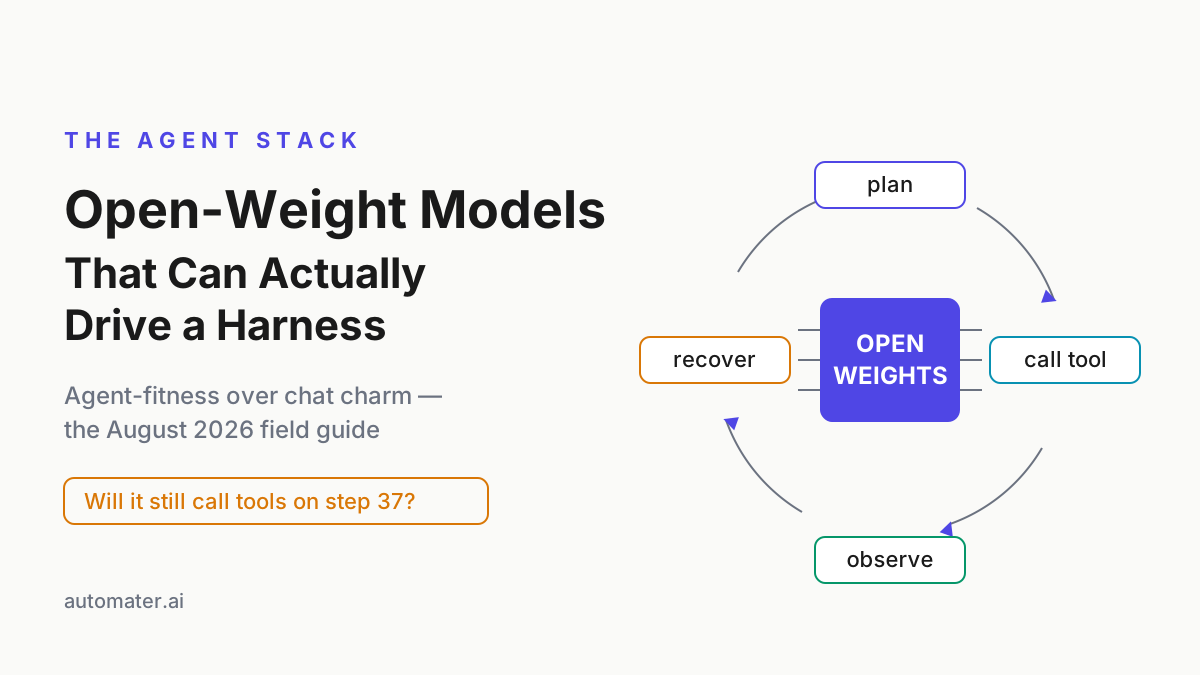
Selection heuristics for agent work differ from chatbot shopping. Weigh tool-call reliability and instruction adherence over chat benchmarks; test long-context behavior under multi-step accumulation, not a single needle-in-haystack query. And read MoE shapes carefully: Qwen3-Coder-Next activates ~3B parameters per token, which is why an 80B model decodes at laptop speed — but all 80B must sit in memory. Size tiers, roughly: 7–14B handles scoped single-tool agents; ~30B-class is the competent single-GPU tier; the big MoEs (GLM-5.2, V4) are serious production engines; K3 plays at the frontier. For the full model-by-model treatment, see open-weight models that can drive a harness.
Layer 2 — runtimes: Ollama, vLLM, LM Studio
Ollama is the developer default: one-command model pulls, sane quantization defaults, and an OpenAI-compatible endpoint on localhost. For single-user agent work on a workstation it is genuinely good enough, which is why it’s everywhere.
vLLM is the production answer. Continuous batching and paged attention turn one GPU into a real multi-tenant server — the difference shows up the first time three agents hammer the same box concurrently. If you’re serving a team or a fleet, this is the tool. SGLang is the credible alternative in the same slot.
LM Studio is the GUI on-ramp: browse models, compare quantizations, click a toggle to expose a local OpenAI-compatible server. Where it stops: headless automation and serious throughput. Fine for evaluation, not for the fleet.
The routing rule is one line: laptop and dev machines get Ollama or LM Studio; any shared box or production workload gets vLLM. Everything speaks the OpenAI-compatible API, which is what makes runtimes swappable under your harness — per mid-2026 reporting, every serious CLI harness now accepts OpenAI-compatible or Anthropic-Messages endpoints, and the open-source harness bench — Aider, OpenCode, OpenHands, Crush, and Goose, now under the Linux Foundation per that same reporting — runs happily against any of them. Pointing a harness at local weights looks like this:
ollama pull qwen3-coder-next          # ~46GB for the 80B-A3B build; 30B variant fits 24GB GPUs
export OPENAI_API_BASE=http://localhost:11434/v1
export OPENAI_API_KEY=ollama          # any non-empty string
aider --model openai/qwen3-coder-next
For the shared box, the vLLM equivalent is vllm serve Qwen/Qwen3-Coder-Next-80B-A3B-Instruct --max-model-len 262144, and every agent on the team points at that one endpoint.
Layer 3 — orchestration: LangGraph OSS, CrewAI, n8n
LangGraph OSS (MIT, from the LangChain team) models agent workflows as graphs with durable state, checkpointing, and human-in-the-loop interrupts. Choose it when runs must survive restarts and approvals arrive hours later; our full LangGraph review covers where it earns its abstraction and where it doesn’t.
CrewAI (MIT) assembles role-based crews fast — the shortest path from idea to a working multi-agent demo. Choose it for linear, collaborative pipelines you want running this week; it’s lighter than LangGraph on persistence and replay.
n8n self-hosted brings agent nodes to visual workflow automation, with hundreds of integrations attached. One honest flag: its Sustainable Use License is fair-code, not OSI open source — a live example of this article’s definitional point. Choose it when the agent step sits inside a broader automation and the people maintaining it aren’t all engineers.
And the null option, which we mean sincerely: for many workloads, orchestration is a 50-line loop and a queue. Frameworks earn their keep at durable state, fan-out, and approval flows — not at “call model, run tool, repeat.” Don’t adopt one to feel serious; the framework decision guide is the longer version of that argument.
Layer 4 — protocol: MCP as the open connective tissue
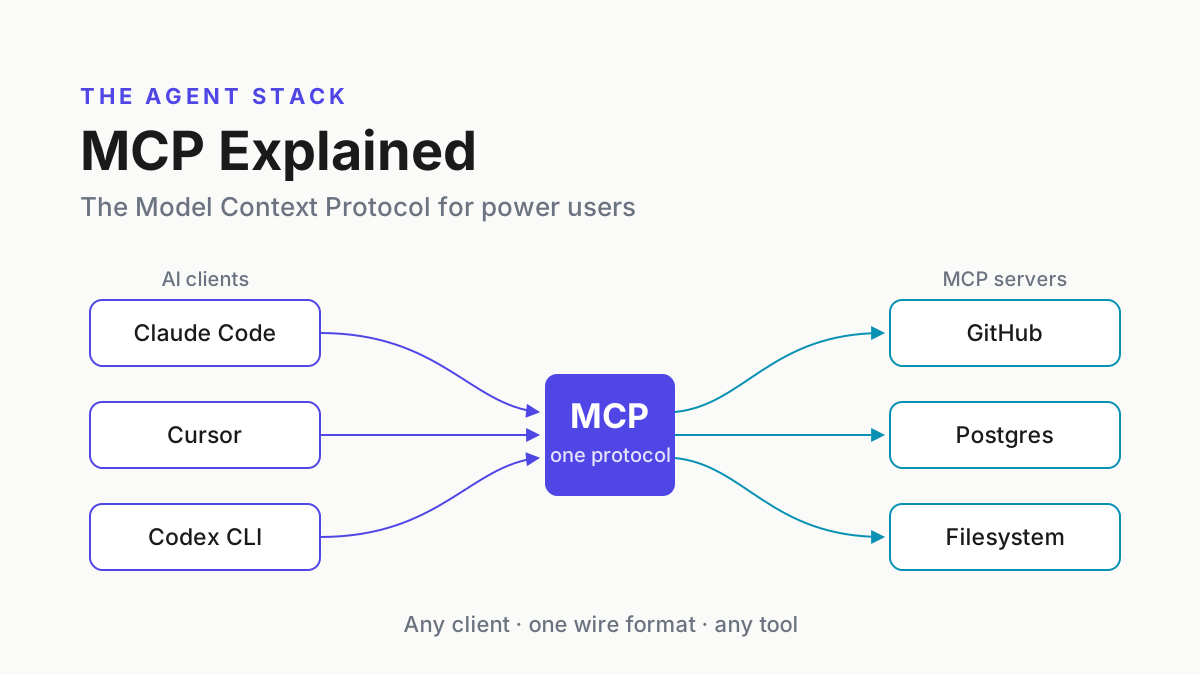
MCP is where the open stack stops being a pile of parts. The spec is open, the server ecosystem is largely open source, and the 2026-07-28 MCP spec moved the protocol to a stateless request/response core that’s far friendlier to self-hosted gateways and horizontal scaling.
- The practical win: the same filesystem, git, and Postgres MCP servers work whether the client is Claude Code driving Claude Fable 5 or a local Qwen3-Coder-Next behind an OpenAI-compatible bridge. Tool integrations survive model swaps and client swaps.
- The audit habit: open code is auditable code, but only if someone reads it. Skim every community server’s tool definitions and outbound calls before granting it credentials — five minutes, every time.
- The honest caveat: parts of the surface stay proprietary in practice. Some flagship clients are closed even though the protocol is open; the stack can be open at the seams and closed at the surface.
We keep this section short deliberately — the MCP power-user guide covers the protocol and its security posture in depth.
Layer 5 — evals and observability, OSS edition
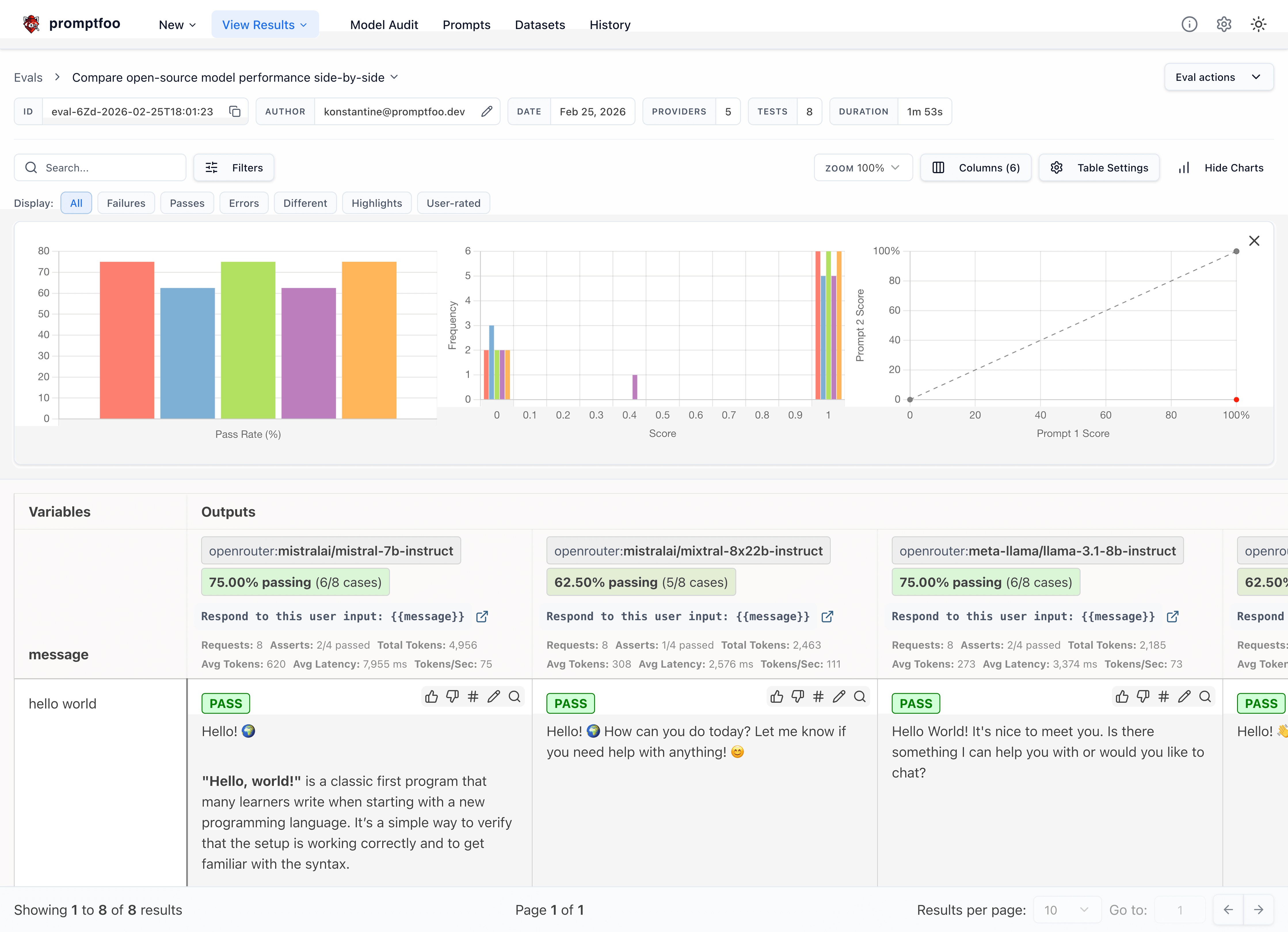
The working set, one line each: Langfuse for self-hostable tracing and session analytics; Promptfoo for config-driven evals that run in CI; DeepEval or Ragas for LLM-as-judge and RAG metrics; Arize Phoenix for traces and drift detection. All self-hostable, so run data stays yours. The standards angle matters more than any single tool: OpenTelemetry’s GenAI semantic conventions mean traces outlive whichever dashboard you pick this year.
The minimal open eval loop for an agent:
- Trace every run — inputs, tool calls, tokens, outcome.
- Promote every interesting failure to an eval case the same day.
- Run the suite in CI before any prompt or model swap ships.
Honesty about maturity: OSS eval tooling still lags hosted platforms on UI polish and team features. The data-ownership trade is the point, and the workflow itself — covered in evals for AI agents — is identical either way.
The honest capability gap in open-source AI
As of August 2026, the frontier is Claude Fable 5, GPT-5.6 (Sol), and Gemini 3.1 — and on the benchmarks that predict real agent work, closed models still lead where it’s hardest: long-horizon planning, tool-use reliability across dozens of steps, and recovery from mid-task surprises.
But the shape of the gap has changed. On single-patch coding benchmarks, the distance is nearly gone: Kimi K3 posts ~93.4% on SWE-bench Verified (Vals AI) and became the first open model to lead a frontend-code arena ahead of Claude Fable 5. The spread reappears on harder suites — GLM-5.2 scores ~78.7% on Verified (Epoch AI) but ~62.1% on SWE-bench Pro (vendor-reported) — and widens further on multi-hour autonomy. The residual gap concentrates in step 40 of a 60-step task, not step 1.
The practical read: open models are past the bar for scoped agent jobs — issue triage, summarize-and-file, test fixing, bounded refactors — and still below it for open-ended, multi-hour autonomous work. Plan deployments on that line, and treat vendor-picked evals with symmetric suspicion: they overstate closed leads and open parity alike. The only benchmark that settles anything is a task-level eval suite on your own workloads.
Licensing gotchas that bite later
- Community licenses (Llama-style). User-count thresholds, attribution and naming requirements, and acceptable-use terms. Fine for most teams; a landmine if you’re hyperscale or reselling model access.
- Research-only clauses. Some lab releases — parts of Mistral’s catalog historically among them — ship under research licenses. Discovering this after launch is an expensive way to learn to read.
- Output and distillation clauses. Some licenses restrict training competing models on outputs — directly relevant if you’re building synthetic-data pipelines.
- Staged or pending weights. “Open” announcements sometimes precede the weights. Kimi K3’s weights were staged after its API launch, with a modified-MIT license expected; until the text is final, it isn’t a license.
The five-minute check that prevents all of this, before any model enters your stack:
1. License name — the actual SPDX ID or full text, not the blog post.
2. Commercial use — permitted, and above what scale?
3. Redistribution — can you ship weights to customers or bundle them?
4. Fine-tune rights — can you train on it, and who owns the result?
5. Output rights — any restriction on what you do with generations?
This is diligence, not legal advice; for unusual deployments, ask an actual lawyer.
Three reference stacks (recipes)
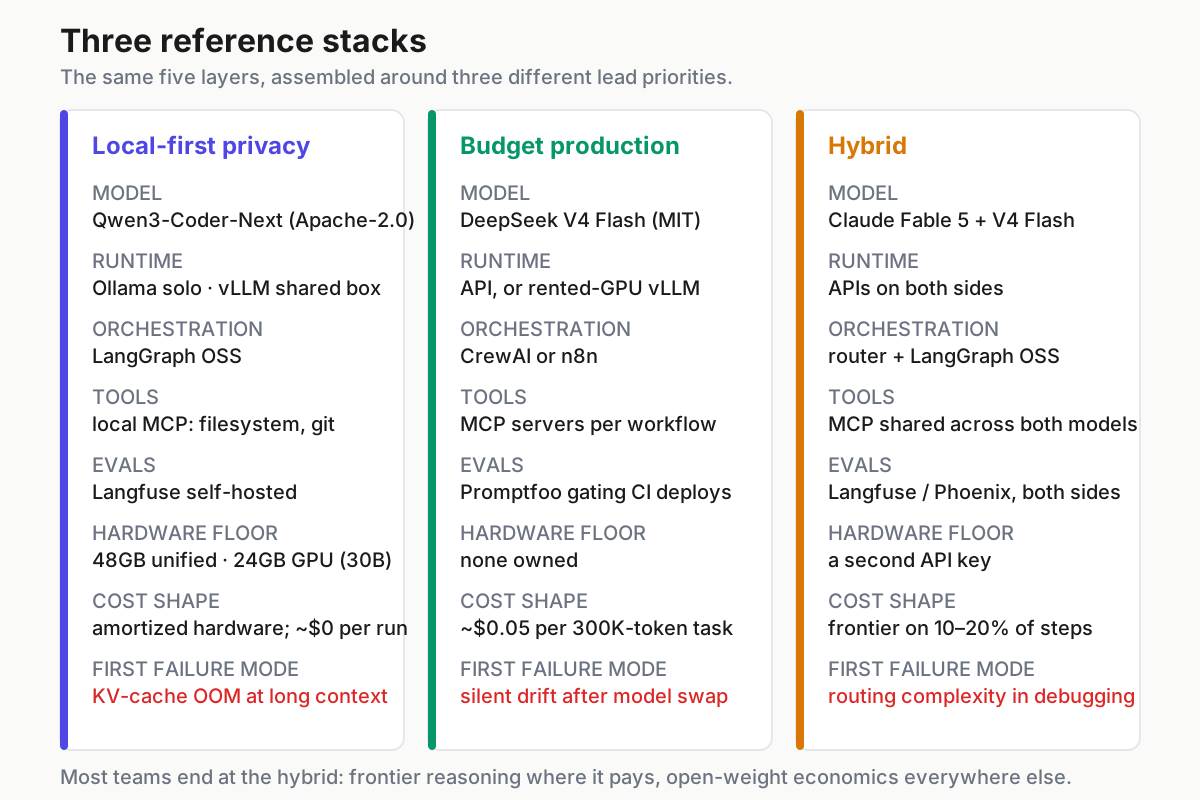
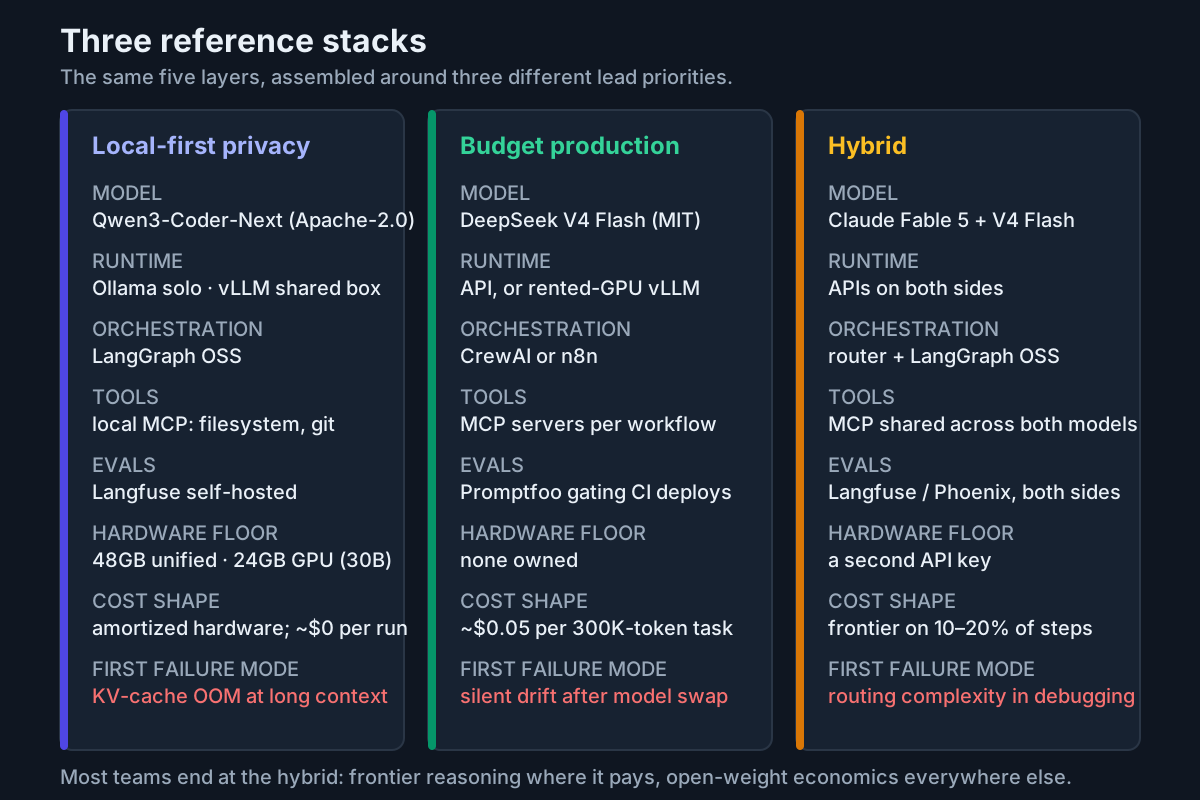 Three ways to assemble the same five layers, depending on whether privacy, cost, or capability leads.
The local-first privacy stack.
- Components: Qwen3-Coder-Next (Apache-2.0) quantized; Ollama solo or vLLM on a shared box; LangGraph OSS; local MCP servers (filesystem, git); Langfuse self-hosted.
- Hardware floor: ~48GB unified memory (M-series, Ryzen AI Max, DGX Spark-class) for the 80B-A3B build; a 24GB GPU runs the ~18GB 30B variant.
- Cost shape: hardware amortization plus electricity; marginal cost per run rounds to zero.
- First failure mode: KV-cache OOM as agent context grows mid-run — cap context or drop a quantization level before blaming the model.
The budget production stack.
- Components: DeepSeek V4 Flash via API ($0.14/$0.28 per M) where its hosting is acceptable, or V4/GLM-5.2-class weights on rented GPUs behind vLLM where it isn’t; CrewAI or n8n for orchestration; Promptfoo gating deploys in CI.
- Hardware floor: none owned — an API key, or a rented multi-GPU node for self-hosted weights.
- Cost shape: cents per completed task. A 300K-token triage task on V4 Flash costs about five cents; the eval gate is what keeps cheap from becoming sloppy.
- First failure mode: silent quality drift after a model hot-swap — exactly the regression the CI eval suite exists to catch.
The hybrid stack.
- Components: a closed frontier model (Claude Fable 5 or GPT-5.6) for planning and the hardest steps; V4 Flash or Qwen3-Coder-Next for bulk steps; MCP as the glue so tools stay portable across both; Langfuse or Phoenix tracing both sides.
- Hardware floor: whatever the open half runs on — often just a second API key.
- Cost shape: frontier spend compressed to the 10–20% of steps that need it.
- First failure mode: routing complexity — a bad run now implicates two models and a router. Keep routing rules dumb: model per step type, decided in config, not per-token cleverness.
Most teams land on the hybrid. It’s also where running several agents side by side stops being a novelty and starts needing management — the subject of running multiple AI coding agents without the chaos.
Running agents fully local: what one GPU buys you
| Tier | Typical hardware | What runs well | Agent reality |
|---|---|---|---|
| 12–16GB VRAM | RTX 4060 Ti 16GB, older 12GB cards | 7–14B quantized | Scoped single-tool agents: grep-and-summarize, log triage |
| 24GB VRAM | RTX 3090 / 4090 | ~30B dense or 30B-A3B MoE (Q4) | Competent scoped coding agents; the sweet spot per dollar |
| 48–128GB unified | M-series Max/Ultra, Ryzen AI Max 395, DGX Spark | Qwen3-Coder-Next 80B-A3B (~46GB) | The one-box, frontier-adjacent tier |
| Multi-GPU server | 2–8× 24–80GB | GLM-5.2 / V4 quantized, vLLM | Shared team box; batch throughput |
Four hard-won notes. First, the hidden constraint is KV cache: context growth eats VRAM alongside the weights, and a model that fits comfortably at 4K context can OOM at 64K in the middle of a long run — budget headroom for the contexts agents actually accumulate. Second, MoE arithmetic cuts both ways: ~3B active parameters means fast decode, but all 80B must load, so “active params” never tells you the memory bill. Third, throughput changes what’s viable, not just how it feels — at 15 tok/s a loop that takes ten minutes on an API takes an hour locally, which quietly kills interactive workflows and leaves batch jobs. Fourth, scope honestly: local models hold the jobs the capability-gap section says they can hold. Frontier-grade overnight autonomy is not yet one of them, no matter what the GPU cost.
Product note: The local-first principle applies to your sessions too. Automater Lite archives, searches, and meters every agent session on your own disk — local token metering across providers, local GPU speech-to-text — kin to everything else in this stack. Free on automater.ai.
FAQ: open source artificial intelligence
Is AI open source?
Some is. Most released models are open-weight — you can download and run the parameters — but few meet the OSI’s Open Source AI Definition, which also requires code and enough training-data information to recreate the system. Treat “open source” claims as marketing until you’ve read the actual license.
What is open source AI?
Under the Open Source AI Definition (OSAID), open source AI is a system you’re free to use, study, modify, and share for any purpose, with access to weights, source code, and sufficiently detailed training-data information. Permissively licensed weights alone — DeepSeek V4, GLM-5.2 — don’t clear that bar.
What is the best open-source AI model for agents?
There’s no single answer as of August 2026. Kimi K3 leads open coding benchmarks; GLM-5.2 balances quality against price; DeepSeek V4 Flash is the budget floor at $0.14 per million input tokens; Qwen3-Coder-Next is the strongest model you can run on one machine.
Can I run AI agents locally?
Yes, within tiers. A 24GB GPU runs quantized ~30B-class models well enough for scoped agents; ~48GB of unified memory runs Qwen3-Coder-Next, the current one-box ceiling. Budget for context growth — KV cache consumes memory beyond the weights, and long agent runs need that headroom.
Is open-source AI safe for commercial use?
That depends on the license text, not the marketing. MIT and Apache-2.0 releases — DeepSeek V4, GLM-5.2, Qwen3-Coder-Next — are commercially safe; community and research licenses carry thresholds and restrictions. Run the five-point check: license name, commercial use, redistribution, fine-tune rights, output rights.
Sources
- Open Source Initiative — the Open Source AI Definition
- Best open-source coding models, 2026 scorecard — Morph
- Coding CLIs in mid-2026: the engineer’s map — dev.to
- MCP specification update, 2026-07-28 — Model Context Protocol blog
- Ollama
- vLLM documentation
- LangChain / LangGraph OSS
- CrewAI
- n8n
- Goose — block/goose on GitHub