Agentic CI/CD: Self-Healing Pipelines and Git When Machines Commit
Agentic CI/CD runs both ways: agents heal failing pipelines, and pipeline gates govern machine commits. Get the playbook, git rules, and adoption plan.

Go deeper. Build your own.
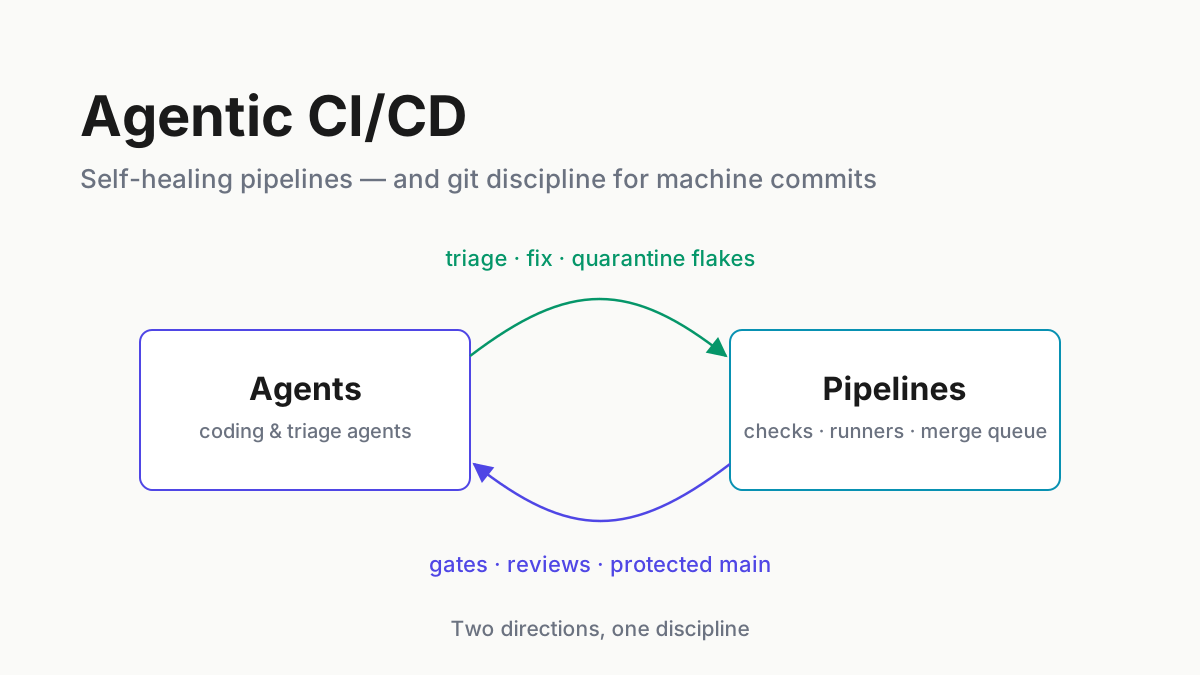
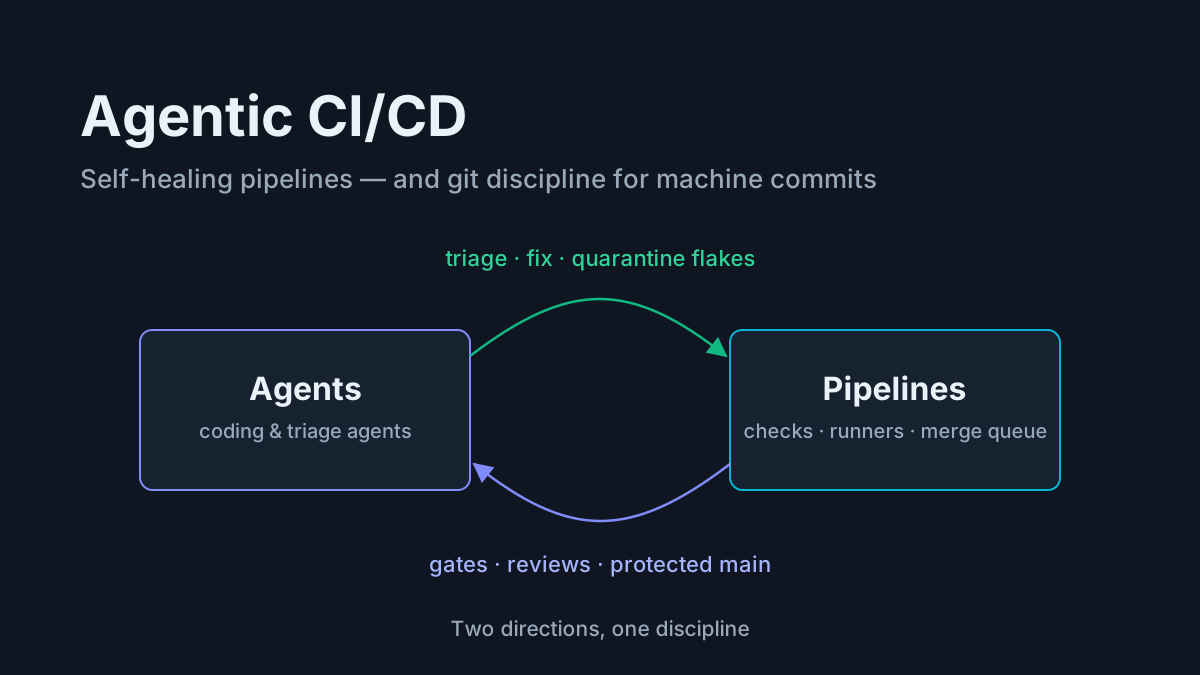
Agentic CI/CD runs in two directions at once, and most teams build only one of them. In the first direction, agents work on the pipeline: triaging failed runs, quarantining flakes, pinning the dependency that broke the nightly. In the second, the pipeline works on the agents: required checks, protected branches, and merge queues are the gates machine-written code cannot talk its way past. Miss the first direction and you keep paying the CI toil tax by hand. Miss the second and, one of these mornings, an unreviewed agent merge becomes your incident.
This piece assumes your team already runs coding agents locally and is deciding how much of the delivery loop to hand them. CI is where that output meets production discipline — the enforcement layer of the whole agentic software stack. We will cover why pipelines suit agents, the self-healing mechanics with a full walkthrough, the vendors by their real August-2026 names, the git rules that change when machines commit, the guardrails, the failure modes, and a phased adoption runbook you can paste into a proposal.
Why CI/CD is the natural habitat for agents
Most writing about AI in CI/CD stops at “summarize the log with an LLM.” The stronger claim is structural: pipelines are the best-instrumented place in your stack to let an agent act, for four reasons.
- Structured triggers. Webhooks, cron schedules, PR events, failed-run notifications — invocation is an event with a payload, not a vibe in a chat window. Agents behave best when “when to act” is decided for them.
- Verifiable outcomes. Exit codes, test results, and diffable artifacts give the agent — and its human supervisor — ground truth that conversational contexts never have. “Did it work” is a rerun, not an opinion.
- Logs as context. A failed run arrives carrying its own evidence bundle: build logs, stack traces, timing data, the triggering commit. That is precisely the input LLMs triage well.
- Bounded blast radius by construction. Runners are already sandboxed, ephemeral, and credential-scoped, because CI needed containment before agents did. The cage was built; the agent moves in.
Self-healing pipelines: what the agent actually does
Self-healing pipelines have been a vendor slide for a decade. The agentic version is concrete and worth defining as a loop:
- Watch — subscribe to failed-run events.
- Classify — flake, infrastructure, or real regression, with a confidence score.
- Act within scope — only moves from a named allowlist.
- Escalate with evidence — when unsure or out of scope, produce a triage artifact, not silence.
The allowlist is the load-bearing part. Every safe action is named, narrow, and reviewable:
| Allowlisted action | Trigger pattern | Why it is safe |
|---|---|---|
| Retry with backoff | transient network/runner error | idempotent, attempt-capped |
| Quarantine a flaky test | intermittent failure on unchanged code | reversible; opens a tracking issue |
| Pin a dependency or runner image | failure correlates with an upstream release | narrow diff, easy human review |
| Fix a cache key | cache-restore miss or corruption | config-only change |
| Bump a timeout (bounded) | consistent timeout pattern, zero assertion diffs | capped increase, flagged for review |
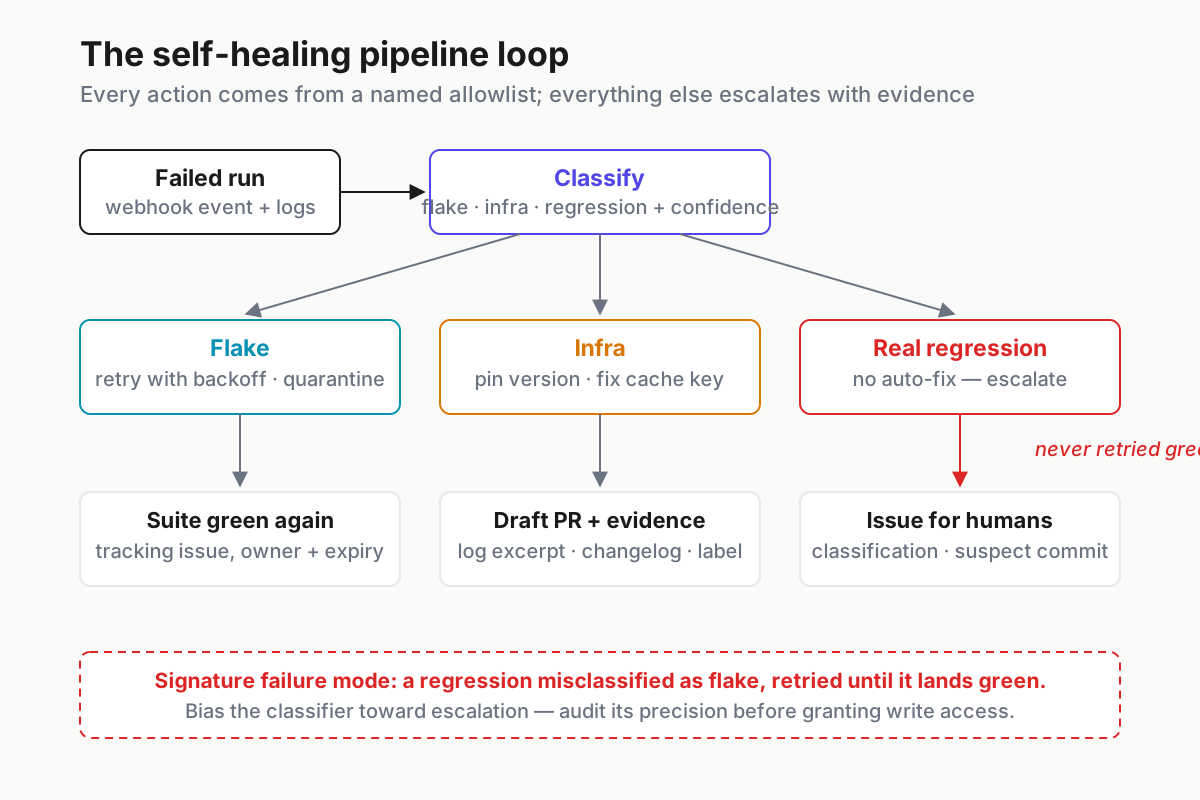
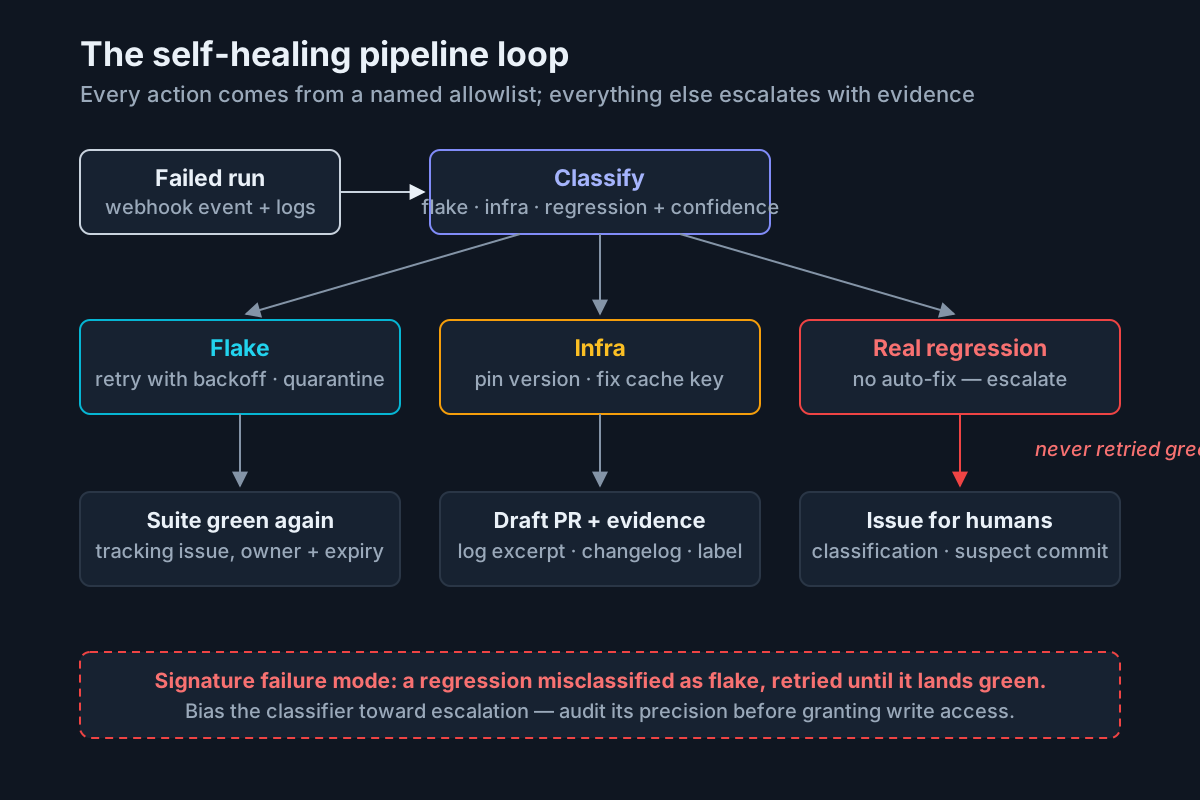 The self-healing loop. The red edge is the rule that keeps it honest: regressions are never retried green.
Classification is the hard part, and honesty about it matters: the signature failure mode of self-healing pipelines is misclassifying a real regression as a flake and retrying it until it lands green — automation that manufactures false confidence. Bias the classifier toward escalation, and audit its precision against human judgment before granting it any write access (the runbook below makes that Phase 1).
Escalation is not failure. When the agent cannot fix, it opens an issue or PR comment carrying the classification, confidence, a log excerpt, and the suspected commit. That artifact alone — failure pre-chewed into evidence — is worth the setup cost even if the agent never writes a line.
Walkthrough: one failed nightly, start to merged fix
The incident: your nightly integration suite fails after a runner image update silently bumps the browser version, and a Playwright suite starts timing out on two specs. The agent’s night, from its own log:
02:14  nightly-integration #4127 failed (2 of 214 specs)
02:15  agent: pulled logs for job e2e-checkout
02:15  agent: pattern = TimeoutError waiting for selector; 0 assertion diffs
02:16  agent: runner image 20260824.2 changelog → Chromium 145 → 147
02:16  agent: classification = infra (confidence 0.87)
02:18  agent: branch agent/pin-playwright-browser-4127; pinned browser build
02:29  agent: re-ran the 2 failed specs in sandbox — 3/3 green with pin
02:31  agent: opened draft PR #5233, label agent-generated
The PR it opens is the template for every agent PR your team will ever merge:
## What

Pin Playwright's browser build to Chromium 145 in nightly-integration.

## Why

Run #4127 failed on 2/214 specs, both TimeoutError, zero assertion diffs.
The 2026-08-24 runner image bumps Chromium 145 → 147 (changelog linked).
Both specs pass 3/3 in sandbox re-runs with the pin.

## Evidence

- Failed run: ci/runs/4127 · Log excerpt: TimeoutError: selector "#pay-now" (×2)
- Runner image changelog: <link>

## Scope

One workflow file, +2/−1 lines. No test or application code touched.
The reviewer approves in about two minutes, because the PR carries its own proof. The counterfactual is the familiar morning: twenty-five minutes of log scrolling, a “is nightly broken for anyone else?” thread, a fix after lunch. Elapsed agent time: 17 minutes, unattended, overnight. The follow-up work — updating the specs so the pin can come out — gets filed as an issue, by the agent, in the same pass.
The agentic CI/CD vendor landscape, honestly
Four credible paths as of August 2026. If you searched for “harness software” or “Harness AI” and landed here, the first profile is the non-marketing version.
Harness (harness.io). The software delivery platform that has spent years positioning as AI-native: assistants for pipeline troubleshooting, Test Intelligence that selects only the tests a change can affect, and packaged DevOps agents across its modules. Its July 2026 release added a rebuilt CLI 3.0 plus an “Agent DLC” — downloadable agent capabilities layered onto the platform, per Harness’s own shipped-in-July notes. The honest caveat: these capabilities assume your delivery runs on Harness — this is a platform bet, not a bolt-on. And to head off a genuinely confusing name collision: Harness the company is unrelated to the agent harness sense of the word (Claude Code and peers), which we map in the agent harness landscape. Choose Harness when you want one vendor to own the whole delivery loop and the buy-in is acceptable.
GitHub Actions plus coding agents. The incumbent path most teams try first. Assign an issue to GitHub Copilot’s coding agent and it works in an Actions-powered environment, then opens a draft PR for human review; since June 1, 2026, that consumption is metered under GitHub’s usage-based AI-credits billing, so treat agent runs as budgeted spend. Claude Code runs as a GitHub Action triggered by failure events or PR mentions, with headless mode for scripting. Choose this when you live on GitHub and want incremental adoption with per-repo scoping — the GitHub Actions docs cover the permission primitives you will lean on.
GitLab Duo. Root-cause analysis of failed jobs inside the product, and an agent platform direction that extends toward pipeline-aware agents; see the GitLab docs for the current feature set. Choose this when you are a single-vendor GitLab shop, especially self-managed and compliance-heavy.
DIY: webhooks plus headless CLIs. A failure webhook invokes a headless agent — claude -p or codex exec — inside a locked-down job. Maximum control, and every line of the safety work is yours; the Claude Code power guide covers the headless flags and permission scoping this depends on. A minimal triage job:
# triage.yml — fires only on failure; read-mostly by design
on:
  workflow_run:
    workflows: [nightly-integration]
    types: [completed]
jobs:
  triage:
    if: github.event.workflow_run.conclusion == 'failure'
    permissions: { contents: read, issues: write }
    steps:
      - run: |
          claude -p "Classify this failed run and comment with evidence. No pushes." \
            --allowedTools "Bash(gh run view:*)" "Bash(gh issue comment:*)"
One caution from recent history: teams that hardwired Gemini CLI into CI learned about vendor dependency on June 18, 2026, when the shutdown broke pipelines mid-week and forced migrations to Antigravity CLI — the full story is in our Gemini CLI post-mortem. Pin CLI versions and keep the invocation behind one wrapper script you own. Choose DIY when control is non-negotiable and you have platform engineers to pay for it.
Git when machines commit: branches and worktrees
Now the second direction: the discipline your repo needs once agents write to it. The base rule is absolute — agents never touch a shared branch directly. Every agent task gets its own branch under a recognizable namespace: agent/<task>-<id>. Everything else follows from making agent work visible, disposable, and reviewable.
For parallel work, git worktrees let several agents share one clone without checkout collisions — the pattern behind most local multi-agent setups:
# one clone, three parallel agents, zero checkout collisions
git worktree add ../wt-a -b agent/fix-cache-key-4127    origin/main
git worktree add ../wt-b -b agent/pin-browser-4127      origin/main
git worktree add ../wt-c -b agent/quarantine-flaky-891  origin/main
git worktree list
git worktree remove ../wt-a   # after merge; TTL cleanup catches strays
Branch hygiene has to run at machine speed, because agents create branches faster than humans garbage-collect them:
- TTL and auto-cleanup: any
agent/*branch with no push in 7 days and no open PR gets deleted by a scheduled job. - No force-push to anything shared, enforced by ruleset, not by convention.
- Rebase before PR, so reviewers see a clean diff against current main rather than a merge archaeology dig.
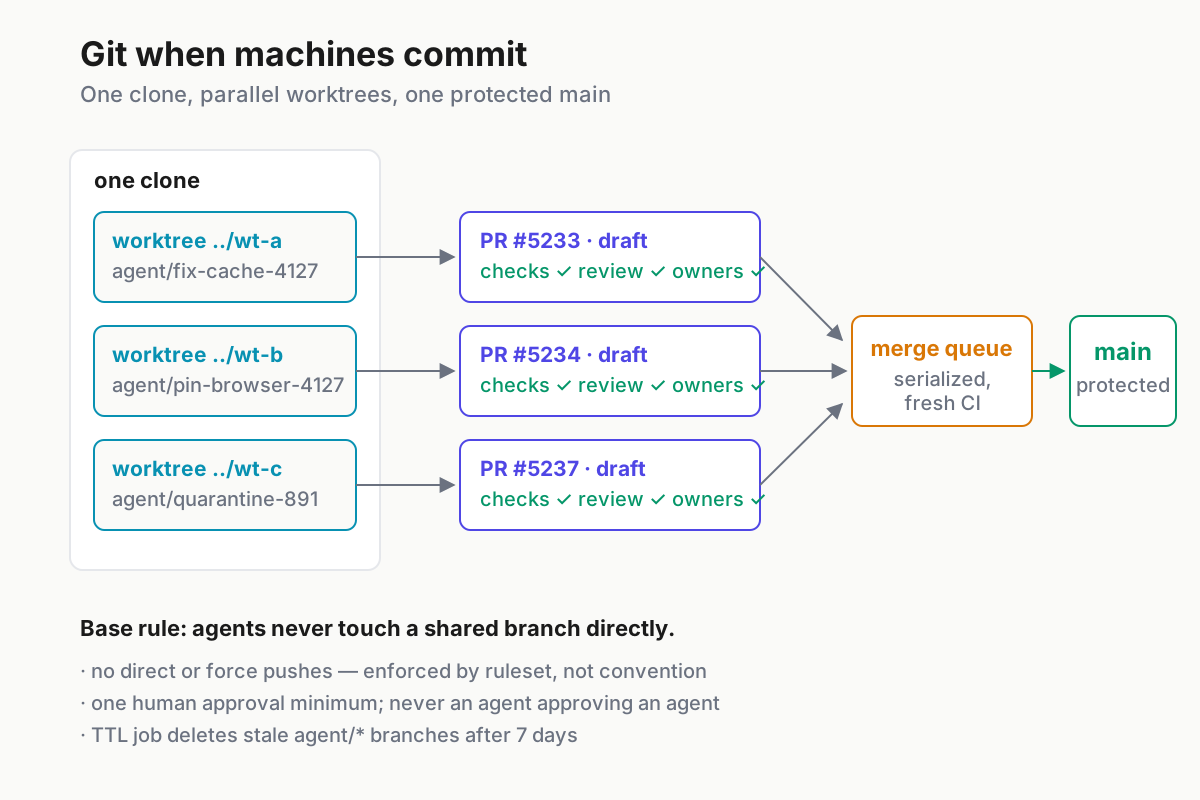
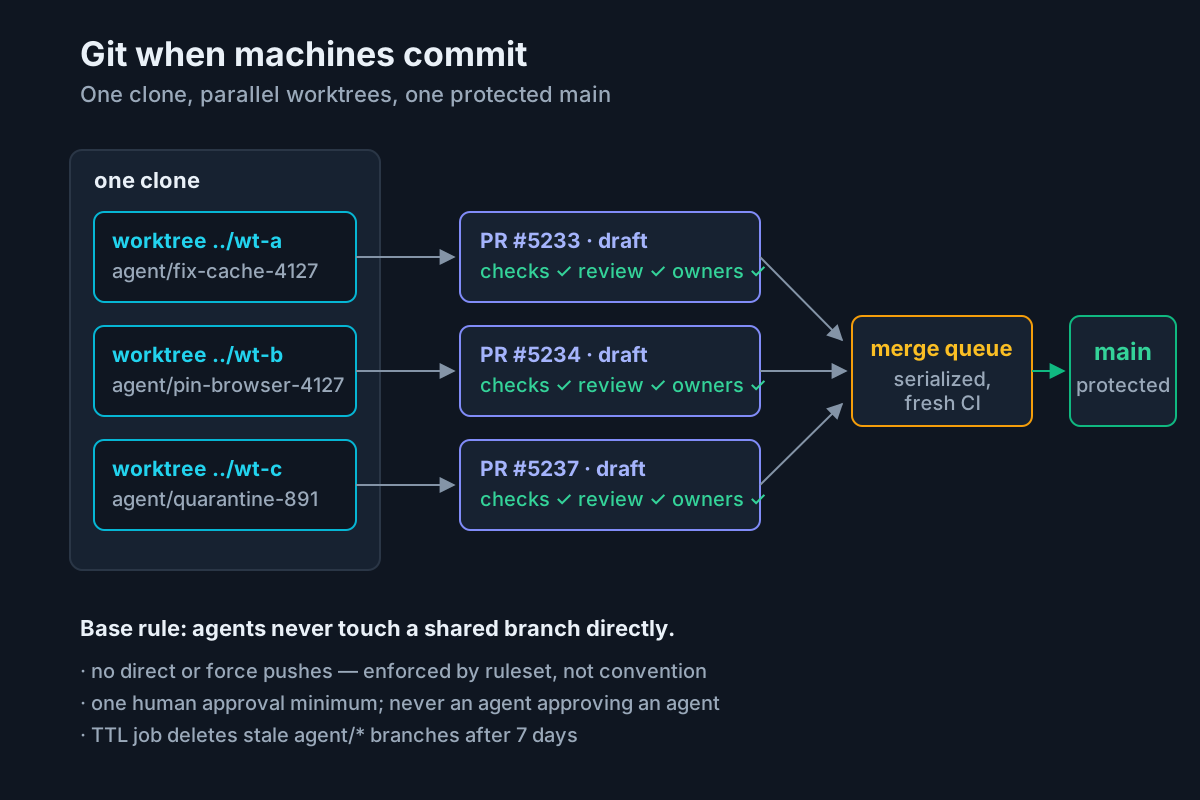 One clone, many worktrees, one protected main. Every agent branch passes the same gates.
Name the problem this creates before it names itself: three agents on three branches across two repos is a fleet, and knowing who is doing what where becomes its own task — the multi-agent command center problem, one branch column at a time.
Product note: Three agents on three branches is nine things to track. Automater Lite’s fleet view shows every session with its git branch and status (Toolbelt), and archives every session locally so you can reconstruct any run later — free on automater.ai.
Commit attribution and PR etiquette for agent work
Attribution is not ceremony; it is what makes agent work auditable in six months. A convention set a team can adopt verbatim:
- Co-Authored-By trailers naming the agent on every commit a human initiated; dedicated bot identities and emails for autonomous commits, so
git log --authorseparates the lanes. - Greppable tags: a trailer like
Agent-Run: nightly-triage/4127ties every commit back to its triggering event. - Small, single-concern PRs: cap agent diffs (300 lines is a defensible default) and reject drive-by refactors — one concern per PR.
- Disclosure in the body: reviewers deserve to know what they are reviewing; every agent PR states what generated it and carries the evidence block from the walkthrough above.
- The social contract: agent PRs never ping reviewers at chat-speed cadence. Batch them, label them
agent-generated, and let humans set the review rhythm.
The commit message, in full:
fix(ci): pin Playwright Chromium build to 145

Nightly #4127: two specs timing out after the runner image bumped
Chromium 145 → 147. Pin until the specs are updated; see PR #5233.

Co-Authored-By: pipeline-agent <agents+pipeline@yourco.dev>
Agent-Run: nightly-triage/4127
Protecting main when the PR volume goes up
Agents raise PR volume; volume stresses every merge control you have deferred configuring. Four controls, each mapping to a concrete setting:
Required reviews. At least one human approval on every agent PR, and — hard rule, no exceptions — never an agent approving another agent’s work. Approval authority is the one thing you never delegate to the same class of system being reviewed.
CODEOWNERS as the scoping mechanism. Sensitive paths route to named humans regardless of author:
/auth/**              @security-team
/billing/**           @payments-leads
/.github/workflows/** @platform-eng
/infra/**             @platform-eng
Merge queues. When PR volume climbs, a merge queue serializes landings against fresh CI, killing the classic failure where two logically conflicting PRs are each green against a stale main. GitHub’s merge queue and GitLab’s merge trains both do this.
Branch protection and rulesets. Required status checks, signed commits, no direct pushes, no force pushes, no deletions. This is the settings audit most repos fail before their first agent ever commits — agents just make the gap expensive faster.
The pipeline as guardrail: CI is the eval gate
Reframe the pipeline for the agent era: it is the one set of checks an agent cannot talk its way past. Prompts plead; gates are deterministic. The gate stack, in the order it runs:
- Tests — the suite, at the bar you enforce for humans. (every PR)
- Static analysis — Semgrep- or CodeQL-class scanning. (every PR)
- Secret scanning with push protection — blocks the credential before it lands. (every PR)
- Dependency review — new packages are a decision, not a side effect. (every PR)
- Coverage ratchet — coverage never drops below its high-water mark. (every PR)
- Diff-size limit — oversized agent diffs fail and come back smaller. (agent PRs)
- Protected-path check — agent-labeled PRs cannot touch auth, billing, or workflow files. (agent PRs)
- Policy-as-code — OPA/conftest rules that encode agent scope as executable policy. (agent PRs)
The agent-scope gate, concretely:
- name: Agent scope gate
  if: contains(github.event.pull_request.labels.*.name, 'agent-generated')
  run: |
    git diff --name-only origin/main...HEAD > changed.txt
    conftest test changed.txt -p policy/agent-scope.rego   # denies /auth, /billing, workflow edits
    test "$(git diff --shortstat origin/main...HEAD | grep -o '[0-9]*' | paste -sd+ | bc)" -le 300
This is where the two directions meet the rest of the stack: CI gates are the production cousin of agent evals, and the sandboxed scenario suites that run upstream of merge live in the agentic test harness. Same philosophy at three altitudes — measure, gate, enforce.
What goes wrong: the risk ledger
Four incident shapes we keep seeing, each with its mitigation attached.
- The auto-merge disaster. A green-but-wrong change lands unreviewed because someone enabled auto-merge on agent PRs; the compounding version is agents approving agents until the audit trail is machines all the way down. Mitigation: auto-merge only for the narrowest proven fix classes, behind full gates, with a kill switch — and the never-agent-approves-agent rule in the ruleset, not the wiki.
- Credential scope in runners. Agent jobs inherit whatever secrets the runner holds, and a triage agent with a deploy key is an incident on a timer. Mitigation: OIDC-federated short-lived credentials, per-job
permissions:blocks, and no long-lived PATs in any env var an agent can read. - Injection via repo content. Agents read commit messages, branch names, issue text, and logs as context — so attacker-controlled text becomes candidate instructions, the agent-era analog of
pull_request_targetabuse. Mitigation: treat repo text as untrusted input, keep secrets out of triage jobs entirely, and require human review when instructions-looking content appears in the evidence; the broader threat model is in securing AI agents. - Silent scope creep. The agent allowed to pin versions starts editing test assertions to get green. Mitigation: allowlists enforced by diff-path checks in CI — enforcement, not documentation — plus weekly review of what agent PRs actually touched, which is an AgentOps habit, not a one-time config.
An adoption runbook for a mid-size team
Expansion is earned, not assumed. The phasing that works:
| Phase | Weeks | Permissions | Metrics watched | Exit criteria |
|---|---|---|---|---|
| 1 — Triage only | 1–4 | read logs; comment on runs/issues | classification precision vs human judgment | ≥90% precision over 50 real failures |
| 2 — Suggest only | 4–10 | draft PRs for allowlisted fix types; humans merge | PR acceptance rate; reviewer minutes per agent PR | ≥70% acceptance; reviewer load flat or down |
| 3 — Scoped auto-fix | 10+ | auto-merge for narrowest proven classes (lockfile pins, cache keys, flaky-test quarantine) behind full gates | MTTR delta; false-classification rate | monthly review; kill switch documented and tested |
The standing metrics — MTTR delta, false-classification rate, PR acceptance rate, reviewer minutes per agent PR — get reviewed monthly, and every scope expansion cites them. Teams running agentic CI/CD well in 2026 did not start with an autonomous pipeline; they started with one triage agent that had to prove, in numbers, that it deserved a second permission.
Start where the toil is worst: one triage agent on your flakiest workflow, one branch namespace, one merge queue. Both directions grow from there — and each makes the other safer to extend.
FAQ: agentic CI/CD
What is agentic CI/CD?
Agentic CI/CD is the two-way integration of AI agents and delivery pipelines. Agents operate inside the pipeline — triaging failures, proposing fixes, quarantining flakes — while the pipeline’s required checks, protected branches, and merge queues govern what agent-written code can land. Teams need both directions; either alone is half a system.
What are self-healing pipelines?
Pipelines where failures are automatically classified — flake, infrastructure, or real regression — and remediated within an allowlisted action set: retries, dependency pins, cache-key fixes, flaky-test quarantine. Everything else escalates to humans with evidence. Example: an agent pins a browser version after a runner-image update breaks Playwright specs overnight.
What is Harness AI?
Harness AI is the AI capability set of Harness (harness.io), the software delivery platform: pipeline troubleshooting assistants, intelligent test selection, and packaged DevOps agents, extended in July 2026 by its CLI 3.0 and “Agent DLC” release. It is unrelated to agent harnesses such as Claude Code.
Should AI agents be allowed to merge code?
Only within narrow, proven fix classes — lockfile pins, cache keys, flaky-test quarantine — behind required checks, protected paths, and a documented kill switch, after weeks of measured suggest-only performance. Everything else requires human approval, and no agent should ever approve another agent’s pull request.
How do you attribute commits made by AI?
Use Co-Authored-By trailers naming the agent, dedicated bot identities and emails for autonomous commits, and greppable trailers linking each commit to its triggering run. Disclose generation and attach evidence in the PR body, and label agent PRs so reviewers and future auditors can filter them instantly.
Sources
- Harness — Shipped in July 2026: CLI 3.0 + Agent DLC
- GitHub Copilot is moving to usage-based billing (GitHub Blog)
- GitHub Actions documentation
- GitLab documentation
- Claude Code and Claude Agent SDK documentation
- Gemini CLI shutdown takes effect, CI/CD pipelines break (TechTimes, June 18, 2026)
- Git — official site and worktree documentation
- Open Policy Agent