AI Agent Frameworks in 2026: How to Actually Choose
Skip the listicles. A working decision guide to AI agent frameworks in 2026: a taxonomy, an eight-check rubric, a decision tree, and when to use none at all.

Go deeper. Build your own.
Most teams choose an AI agent framework the way they choose a conference talk: by crowd size. GitHub stars, a colleague’s demo, whatever orchestration layer is trending this month. Then the prototype meets production, the framework’s opinions meet your requirements, and one of them has to give. Usually it’s you, three months in, holding a migration ticket.
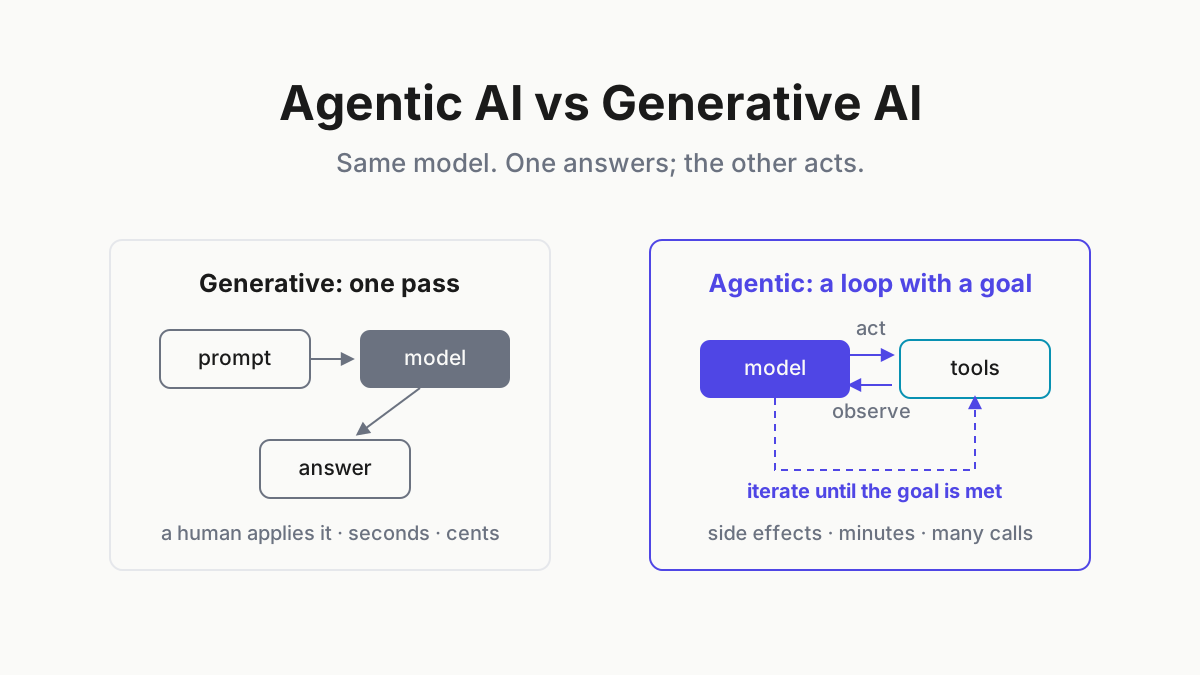
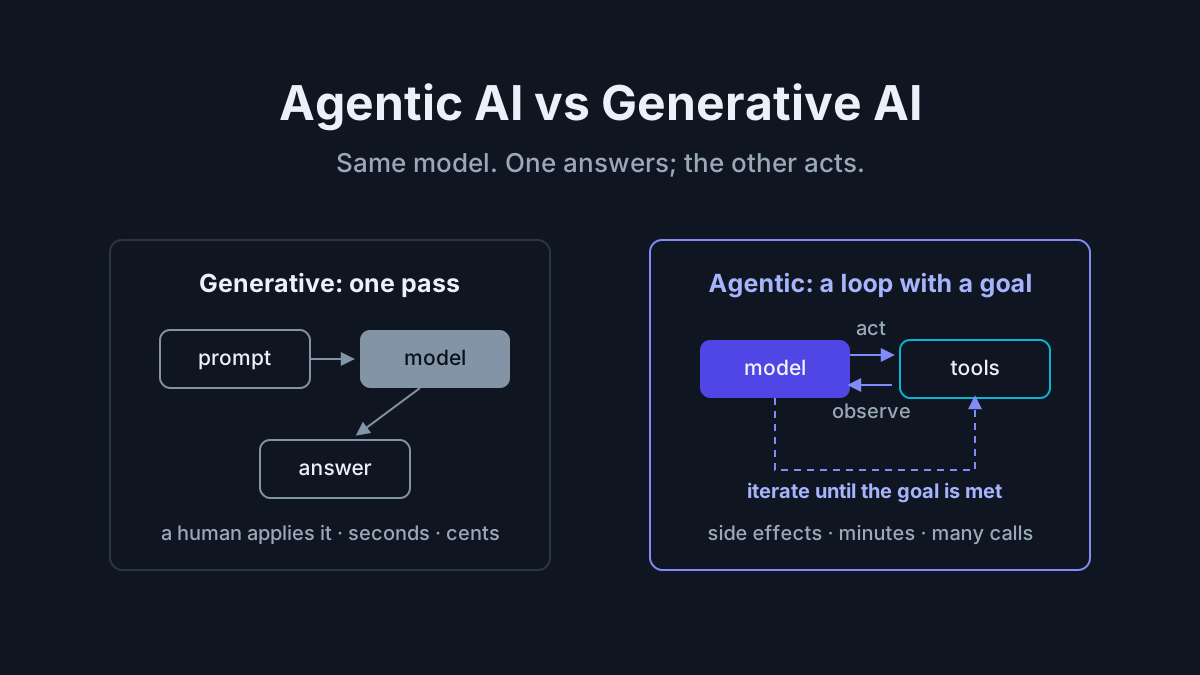
An AI agent framework is the scaffolding that runs a language model’s loop: it dispatches tool calls, persists state between steps, controls the flow of a multi-step run, and exposes the oversight hooks — interrupts, traces, checkpoints — that let humans supervise the result. LangGraph, CrewAI, the OpenAI Agents SDK, Microsoft Agent Framework, and Temporal each sell some version of that sentence, packaged around very different opinions.
This is a decision guide, not another top ten. If you want rankings, the roundup lives here. What follows is a method: what frameworks actually provide, a taxonomy organized by control model, an eight-check evaluation rubric, a decision tree, and the migration and cost realities the READMEs skip. It’s written for people building systems other people will depend on. If you’re hacking on weekends, the honest answer is shorter: pick whichever you can learn fastest, and stop reading here.
What an AI agent framework actually provides
Strip the marketing and a framework delivers seven concrete things. Each one has a build-it-yourself cost, and pricing that cost is the only honest way to know what you’re buying.
- The agent loop — model call → tool dispatch → append results → repeat until done. Self-build: an afternoon. This is the least valuable thing a framework sells, despite being the thing on the diagram.
- Tool registry and schemas — declaring tools once, validating arguments, formatting results. Self-build: a day, plus recurring arguments about JSON Schema.
- State management and checkpointing — runs that survive a process restart and resume from the last good step. Self-build: a real engineering week. Serialization, storage, replay semantics, and the bugs that live between them.
- Memory — carrying context across sessions, beyond the window. Self-build: days to weeks depending on ambition, and most ambition here is misplaced.
- Human-in-the-loop interrupts — pausing mid-run for approval and holding state, possibly for days, until a person answers. Self-build: two to three days to do properly, because “paused” means “persisted.”
- Streaming — token-level and event-level output while the run executes, including mid-tool-call progress. Self-build: a day or two up front; a rewrite if retrofitted.
- Observability hooks — every model call and tool call captured as a structured trace. Self-build: a day for logs you’ll regret; a week for traces you’ll actually use.
Notice what’s missing from that list: intelligence. None of this makes the agent smarter. Frameworks are plumbing, and plumbing gets judged on reliability and inspectability, not on vision decks. The model does the reasoning; the framework routes it.
Also notice what frameworks don’t provide: eval quality, prompt quality, and product judgment — the things that actually determine whether your agent is any good. A framework will happily orchestrate a terrible agent at scale. That half of the job is covered in our guide to evals for AI agents.
One more 2026 correction to the list: tool integration used to be a framework selling point, and it’s fading as one. Since the 2026-07-28 MCP spec moved the Model Context Protocol to a stateless request/response core, tool servers are increasingly a standard commodity that any orchestrator can consume — see our MCP power-user guide. The framework’s job is shrinking toward control flow and state, which is exactly where this article focuses.
SDK, framework, or platform: settle the vocabulary first
“Agent framework,” “agentic framework,” and “agentic AI frameworks” get used loosely for three different layers of the stack. Disambiguate once and the rest of the decision gets easier.
| Layer | What it is | Exemplars | What you trade |
|---|---|---|---|
| Provider SDK | A thin client for a model API; you own the loop | Anthropic and OpenAI client libraries | Nothing — maximum control, maximum homework |
| Agent framework | A library that owns your control flow: loop, state, handoffs | LangGraph, CrewAI, OpenAI Agents SDK, Microsoft Agent Framework | Control for structure; moderate lock-in |
| Hosted platform | A managed runtime for agents, wired to one vendor’s cloud | Amazon Bedrock AgentCore, Vertex AI Agent Builder, Copilot Studio | The most control, for the most convenience; the deepest lock-in |
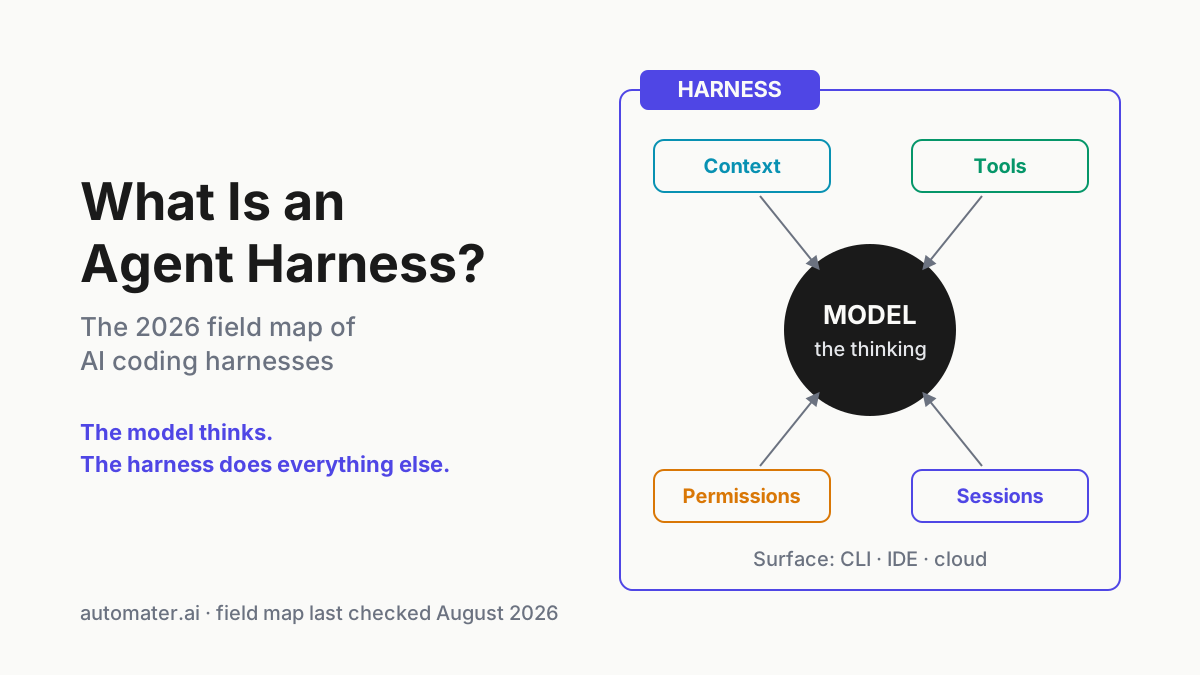
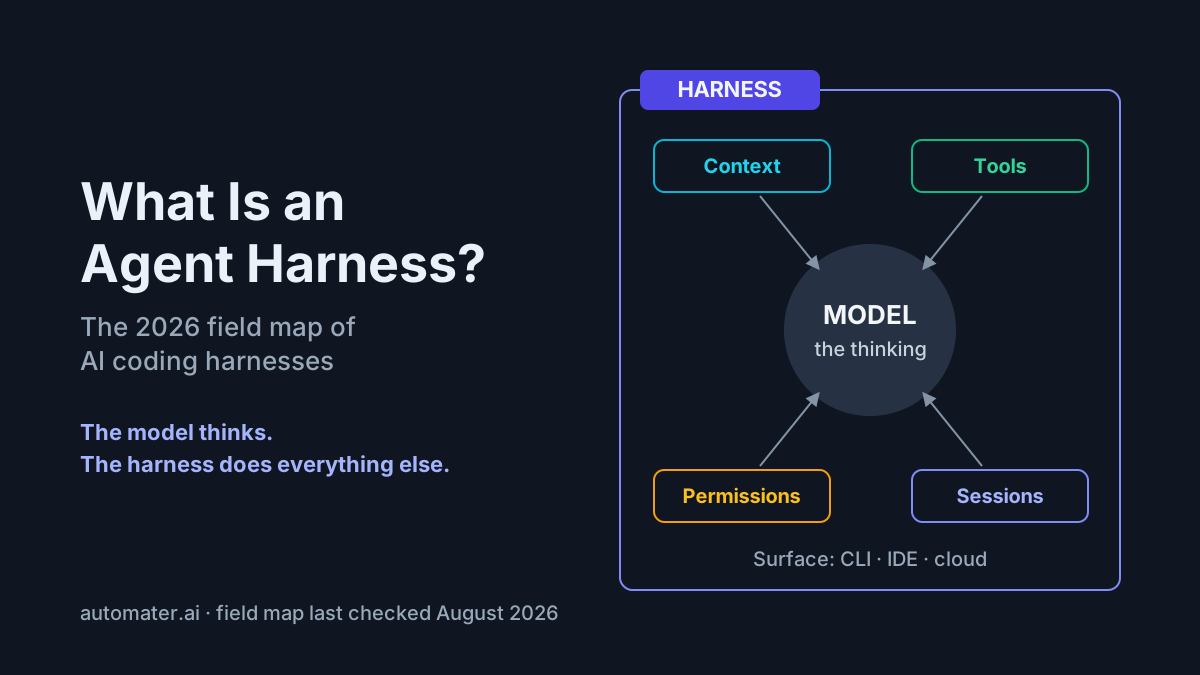
Two clarifications worth pinning to the wall. First, classify by behavior, not by name: the OpenAI Agents SDK is a framework wearing an SDK’s name — it owns your control flow, which is the defining trait. Second, none of these are the same thing as an agent harness like Claude Code or Codex CLI — a harness is a finished product you drive, not a library you build on. The distinction gets a full treatment in our agent harness field map.
Each layer up the table trades control for convenience and deepens lock-in. The platform tier trades the most: your prompts, tools, and orchestration all live inside someone’s console. Sometimes that’s the right call — the decision tree below says when — but make it a decision, not a default.
Do you need an agent framework at all?
Often, no — and it’s worth drawing the line precisely instead of treating this as a rhetorical feint. Anthropic’s “Building Effective Agents” guidance makes the argument on the record: the most successful agent implementations use simple, composable patterns, and many production agents are a model, a loop, and a set of tools.
Here is the entire trick, in about thirty lines:
import anthropic

client = anthropic.Anthropic()
TOOLS = [...]  # JSON Schemas for run_tests, read_file, apply_patch

def dispatch(name, args):
    impl = {"run_tests": run_tests,
            "read_file": read_file,
            "apply_patch": apply_patch}
    return impl[name](**args)

def run_agent(task: str, max_turns: int = 20):
    messages = [{"role": "user", "content": task}]
    for _ in range(max_turns):
        resp = client.messages.create(
            model="claude-fable-5",
            max_tokens=4096,
            tools=TOOLS,
            messages=messages,
        )
        messages.append({"role": "assistant", "content": resp.content})
        if resp.stop_reason != "tool_use":
            return resp  # the model decided it's done
        results = []
        for block in resp.content:
            if block.type == "tool_use":
                out = dispatch(block.name, block.input)
                results.append({"type": "tool_result",
                                "tool_use_id": block.id,
                                "content": str(out)[:20_000]})
        messages.append({"role": "user", "content": results})
    raise RuntimeError("hit max_turns without finishing")
That loop, a provider SDK, and a dispatch table cover single-agent tool use completely. No magic was harmed in its omission.
Frameworks earn their keep above three specific thresholds: durable state (runs that must survive restarts and resume mid-task), multi-agent coordination (an orchestrator delegating to workers with separate contexts), and human-approval flows (pausing for sign-off without losing the run). Below those thresholds, a framework mostly adds debugging surface — one more layer between you and the prompt when something goes wrong at 2 a.m.
The inverse failure is just as real, and teams that quote this section love to commit it: they “just write a loop,” then spend a quarter reinventing checkpointing, retries, and tracing — badly, one incident at a time. The point isn’t framework aversion. The point is choosing deliberately, with the thresholds in view.
A taxonomy of agentic AI frameworks
Organize the field by control model — who decides what runs next, and how — rather than by popularity, and five approaches cover essentially everything. One exemplar each:
- Graph-based — LangGraph. You declare nodes, edges, and checkpointers; execution is a walk through the graph with replay and time-travel debugging. Fits complex, stateful workflows where you must see and control every transition.
- Role/crew-based — CrewAI. Agents get roles, tasks, and a process; the framework improvises the coordination. The fastest path from nothing to a working demo, with opinionated defaults you will spend production time managing.
- Handoff/lightweight — the OpenAI Agents SDK. Agents, handoffs, guardrails, and deliberately little else; the production successor to the Swarm experiment. Minimal surface, most natural for single-provider shops.
- Event/actor-style — Microsoft Agent Framework and Dapr Agents. Message-passing agents in the AutoGen and Semantic Kernel lineage, converged into one framework. Feels immediately familiar to distributed-systems teams; overkill below genuine concurrency.
- Durable-execution engines — Temporal, with Restate and Inngest in the same family. Workflows that survive crashes with native retries and full history, now applied to agents. Increasingly the boring, load-bearing answer for long-running production runs.
Every framework you’ll be pitched this year is one of these five wearing different clothes. For the graph-based deep dive, see LangGraph in 2026: review and alternatives; for how these slot into a full toolchain, the open-source AI agent stack covers the field.
The evaluation rubric: eight checks before you commit
Run every shortlisted candidate through the same eight checks. Each line is a concrete test, not a vibe — copy the list into your evaluation doc as-is.
- Control granularity — can you override any single step of the loop (swap a prompt, veto a tool call) without forking the framework?
- Debuggability — can you print the exact prompt sent to the model, byte for byte, without reading framework source?
- State persistence —
kill -9the process mid-run: does it resume from the last checkpoint, and can you replay the run up to the failure? - Streaming — token-level and event-level, including progress mid-tool-call, or only a final-answer firehose?
- Multi-agent support — orchestrator-plus-subagents without a plugin’s worth of glue code?
- Ecosystem — are the integrations you need first-party and maintained, or community PRs last touched in 2024?
- Lock-in — count the modules that import framework types. Prompts, tools, and business logic should import none.
- Licensing and governance — permissive license, a history free of relicensing surprises, and more than one vendor’s hands on the wheel?
The lock-in check deserves its quantitative teeth. Run the import count on your prototype today: if framework types have leaked into your tool implementations and prompt assembly, you’ve already started paying the exit tax — you just haven’t been invoiced yet.
Take the licensing check equally seriously. Open-source relicensing has burned this audience before, in adjacent infrastructure categories, and an agent framework sits deeper in your product than a database driver. Check the license history and the single-vendor concentration of every candidate before betting a product on it.
Decision tree: from use case to shortlist
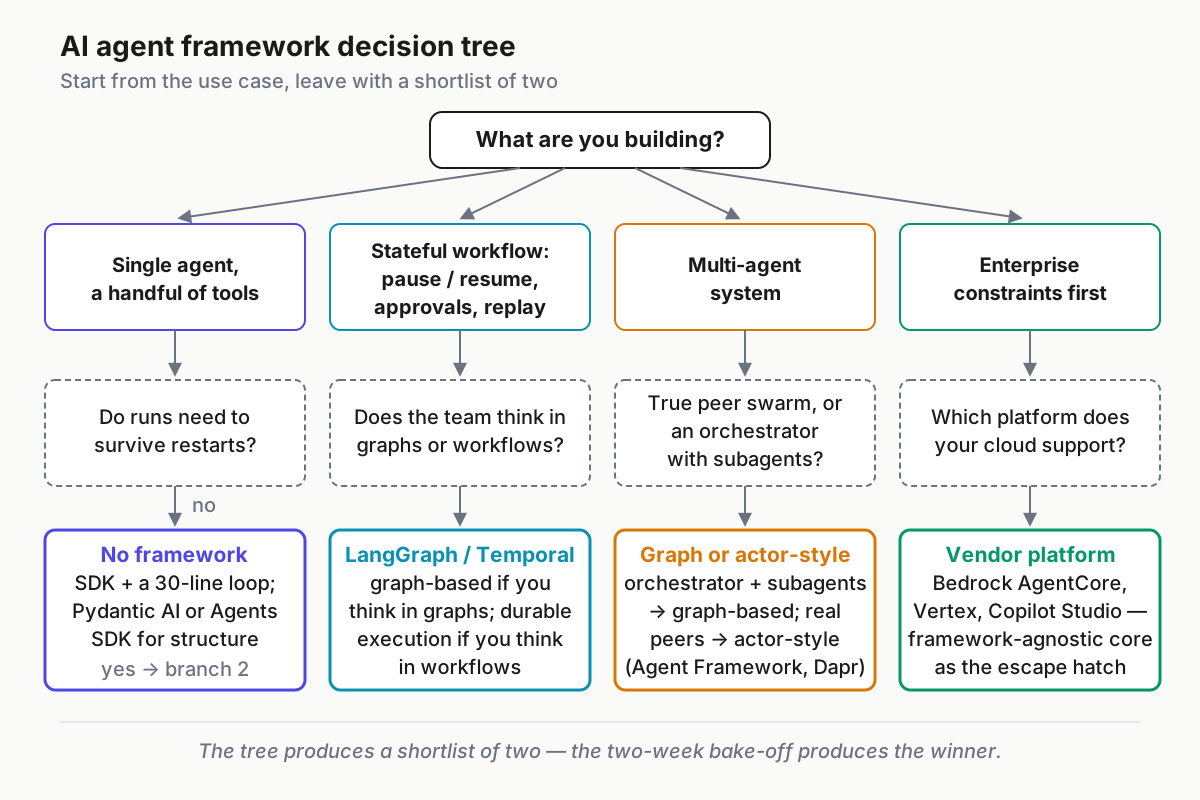
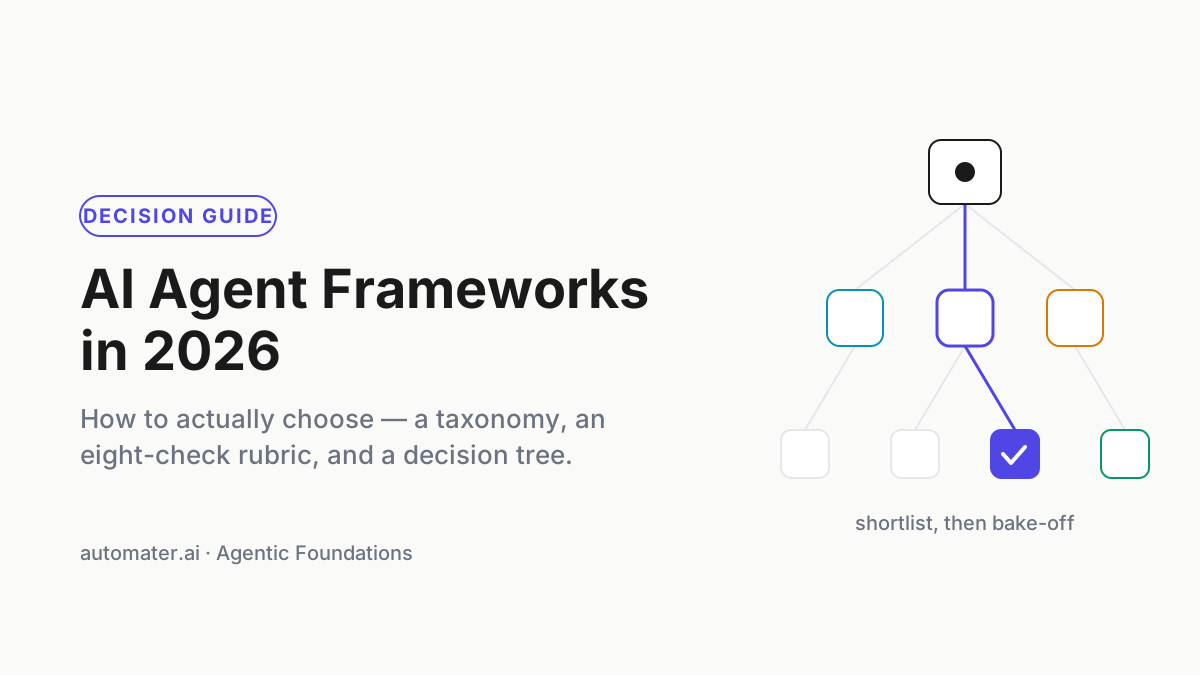
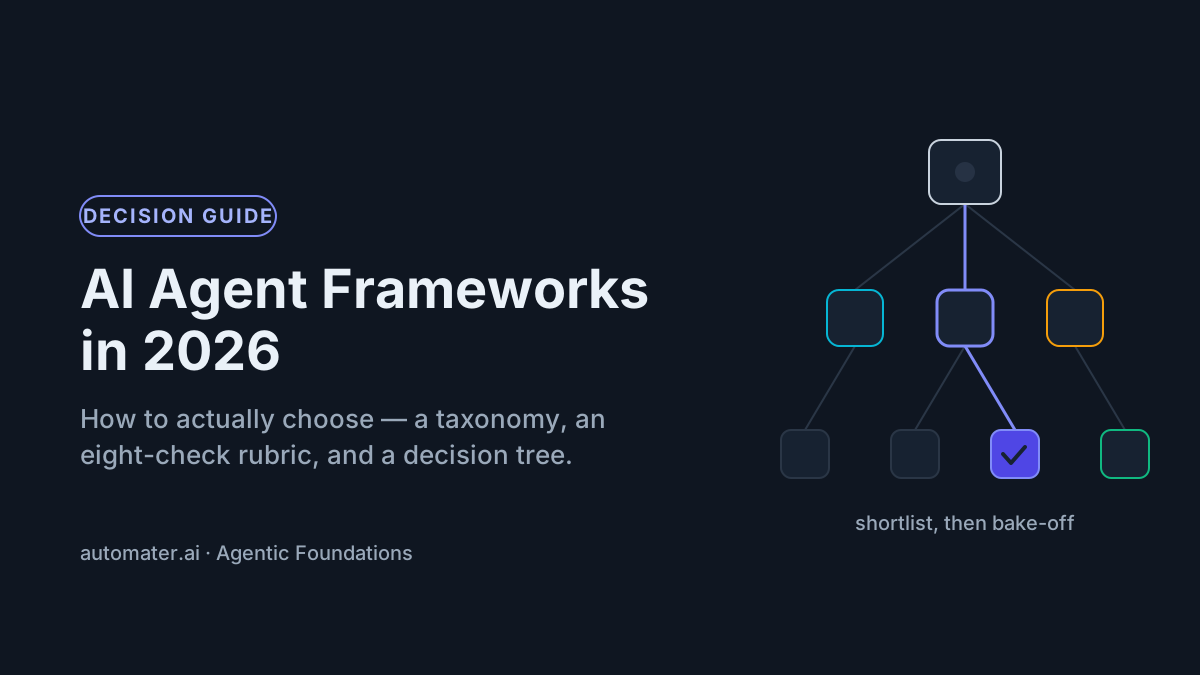
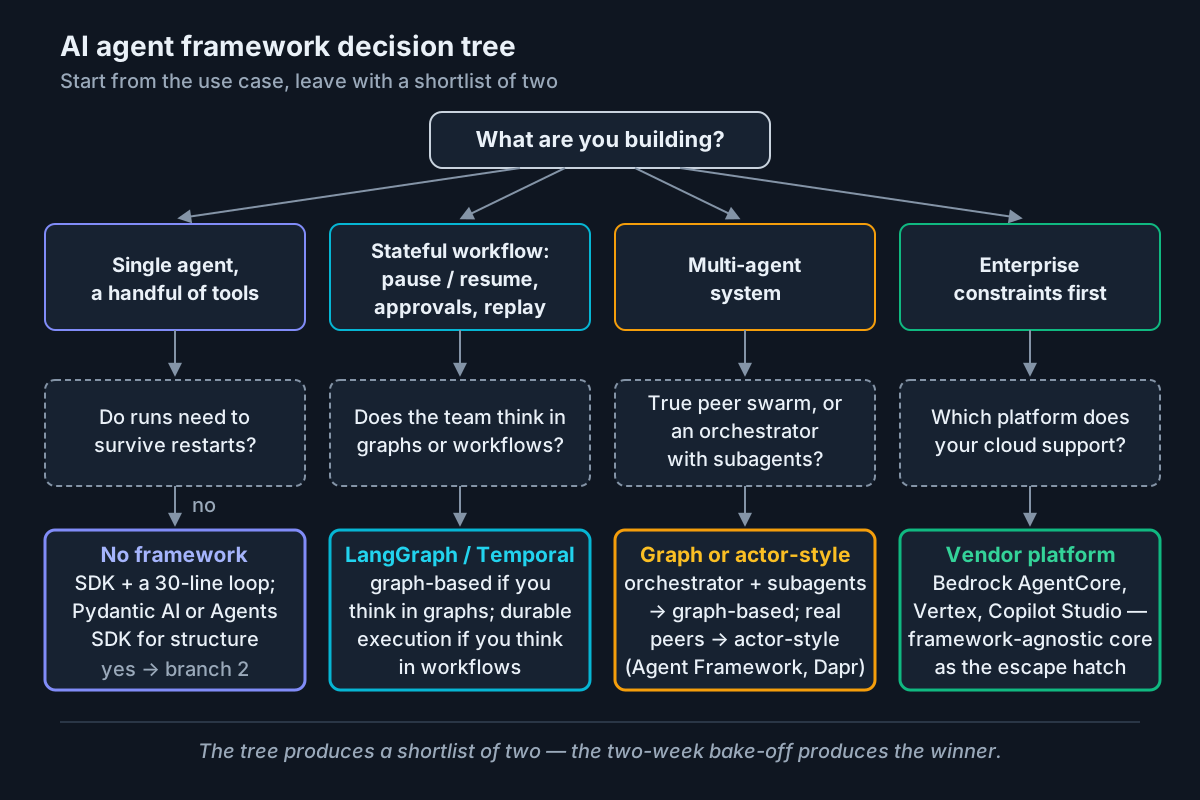 Four branches, three questions deep. The tree produces a shortlist; the bake-off produces the winner.
The same logic as a table, for the copy-paste inclined:
| Your situation | The deciding question | Shortlist |
|---|---|---|
| Single agent, a handful of tools | Do runs need to survive restarts? | No framework — SDK plus the loop above. Want typed outputs and a bit of structure: Pydantic AI or the OpenAI Agents SDK |
| Stateful workflow — pause/resume, approvals, replay | Does your team think in graphs or in workflows? | Graphs → LangGraph. Workflows → Temporal or another durable-execution engine |
| Multi-agent system | Is it truly peers, or an orchestrator with subagents? | Orchestrator → graph-based. Genuine event-driven peers → actor-style (Microsoft Agent Framework, Dapr Agents) |
| Enterprise constraints dominate — compliance, cloud commitments, existing observability | Which platform does your cloud vendor support? | That platform — with framework-agnostic core logic negotiated in as the escape hatch |
One honesty check before you buy swarm infrastructure: most “multi-agent” requirements, inspected closely, are one orchestrator plus short-lived subagents — a pattern a graph or even a good harness handles today, as covered in our subagent orchestration playbook. Peer swarms are real in research and rare in production. Check which one you actually have; the answer usually removes a branch.
And the caveat that keeps the tree honest: it produces a shortlist of two, not a winner. The bake-off section below produces the winner.
Migration realities: the abstraction churn tax
The record, stated without heat: Swarm was superseded by the Agents SDK. AutoGen and Semantic Kernel folded into Microsoft Agent Framework. LangChain’s early abstractions were rewritten out from under their users on the way to LangGraph. Most readers of this article have lived through at least one of these migrations; plenty have lived through two.
The churn is structural, not a character flaw. Frameworks abstract a moving target: every time models gain native capabilities — structured output, computer use, built-in tools, standardized MCP connections — a layer of yesterday’s framework becomes dead weight, and the maintainers rationally cut it. Pricing this in beats performing outrage about it.
The insulation pattern, then:
- Keep prompts as data you own — files in your repo, not framework objects.
- Keep tool implementations as plain functions with typed inputs and outputs; adapters at the edge translate them into whatever the framework wants.
- Keep evals independent of the orchestrator, so they can judge any framework’s output — including the next one’s.
- Let the framework own orchestration only. That’s the part you’re renting.
When a migration does come, run it as a strangler: stand up the new orchestrator beside the old one, point both at the same eval suite, switch when parity is proven, and delete the old one within a sprint. Teams that keep both “temporarily” keep both forever.
Total cost of ownership beyond the framework
The framework’s README shows you the quickstart. It never shows you the invoice, which has five other lines on it:
- Eval infrastructure — the largest line, and the one that gates everything else. Mitigation: build it first; it’s framework-agnostic by design, and our evals guide linked above is the companion piece.
- Tracing and observability — LangSmith, Langfuse, Braintrust, or Arize Phoenix, plus the wiring. Mitigation: emit OpenTelemetry-style traces so the data outlives the orchestrator.
- State storage and hosting — checkpoint databases, queues, and the pager duty for them. Mitigation: price the managed tier against your own ops honestly.
- Upgrade engineering — the churn tax from the previous section, paid in sprints. Mitigation: budget for it annually instead of discovering it quarterly.
- Team learning curve — graph thinking and actor thinking are real onboarding costs. Mitigation: weight the rubric toward models your team already thinks in.
In our experience, the framework itself ends up being maybe a fifth of total system cost; evals and observability dominate the rest. Treat that as a proportion to sanity-check your plan against, not a law — but if your evaluation spreadsheet spends ninety percent of its rows comparing orchestrators, the spreadsheet is measuring the wrong thing.
One cost category deserves its own paragraph because it defaults to total loss: persistence. Switch frameworks and your run history, session context, and cost baselines typically reset to zero — every trace in the old tool’s format, every budget number denominated in the old stack. Design history and metering to live outside the framework from day one. Per-provider token metering across everything you run is also what makes any framework comparison honest in the first place: you can’t compare what you never measured.
Product note: Frameworks churn; your history shouldn’t. Automater Lite keeps a local, searchable archive of sessions across 10+ providers and meters token spend per provider — the layer that stays constant while you swap orchestrators underneath. Free on automater.ai.
How to run a two-week bake-off
The decision tree gave you a shortlist. This produces the winner.
- Pick exactly two finalists (half a day). With three, nobody finishes and the loudest opinion wins by default.
- Build the same thin slice in both (three days each). One real workflow with your real tools, one human-approval interrupt, one forced crash-and-resume. Explicitly not the quickstart demo — the quickstart is the one path every framework has polished.
- Score both against the rubric (one day). The eight concrete tests above, pass/fail, no partial credit.
- Run the timed bug hunt (half a day per framework). Plant a bug in a tool — a swapped argument, a silent empty return — and measure wall-clock time to diagnosis in each. Debuggability differences that look small in docs show up brutally on a stopwatch.
- Write the exit plan, then commit (one day). Document how you would leave the winner — what gets rewritten, what survives — as part of choosing it. If the exit plan is unwritable, that’s a finding too.
Two weeks, one decision, and a written record of why — which future-you will thank present-you for during the next migration.
Common selection mistakes power users still make
Each of these is a pattern from real teams, compressed to symptom → cause → corrective:
- Chose in an afternoon, fighting it by month three → picked by stars and demo speed → demos measure onboarding, not production; run the bake-off’s crash test before committing.
- Adopted a framework to fix a flaky agent → the failures were prompt and eval problems → orchestration can’t rescue an agent that fails on individual steps; diagnose the layer before buying a new one.
- Bought swarm infrastructure for one agent and three tools → built for imagined scale → apply the taxonomy’s honesty check; most “multi-agent” is an orchestrator plus subagents, and plenty of that is just a loop.
- Retrofitting streaming the week before launch → deferred it as polish → in some frameworks streaming is architectural, which is why the bake-off tests it on day one.
Choose late, choose small, keep the exit
The method in one breath: confirm you need a framework at all, classify the use case, apply the eight-check rubric, run the two-framework bake-off, and commit with a written exit plan. Every step exists to replace a social decision with an evidential one.
The deeper point outlasts any framework named here. Your durable assets are the prompts, tools, evals, and run history — the framework is replaceable orchestration around them, and in this market it will need replacing on someone else’s schedule. The one-line answer: start frameworkless; adopt graph-based or durable-execution orchestration when durable state, approvals, or multi-agent pressure become real.
From here: the LangGraph review and its alternatives, the open-source agent stack, and the wider picture of agentic software that all this orchestration serves.
FAQ: choosing an AI agent framework
What is an AI agent framework?
An AI agent framework is software scaffolding that runs a language model’s loop: it dispatches tool calls, persists state across steps, controls multi-step flow, and exposes oversight hooks like interrupts and traces. Examples include LangGraph, CrewAI, the OpenAI Agents SDK, and Microsoft Agent Framework.
Which AI agent framework is best?
There is no best, only best-fit. Classify your use case — single agent, stateful workflow, multi-agent, enterprise-constrained — shortlist two candidates with a decision tree, then run a two-week bake-off including a crash-and-resume test. For tool-by-tool coverage, see our best agentic AI tools roundup, linked in the introduction.
Do I need a framework to build an AI agent?
For a single agent calling a handful of tools, no — a provider SDK, a while loop, and a dispatch table cover it. Frameworks earn their keep at durable state, multi-agent coordination, and human-approval flows. Below those thresholds, they mostly add debugging surface.
Is LangChain the same as LangGraph?
No. LangChain is the original chain-and-integration library; LangGraph is the same company’s lower-level graph runtime for stateful agents, and the one it now points production agent builders toward. New agent projects today generally start with LangGraph rather than with the classic chain abstractions.
What is the difference between an agent framework and an agent platform?
A framework is a library you run: it structures your code, but you own deployment, storage, and upgrades. A platform — Amazon Bedrock AgentCore, Vertex AI Agent Builder, Copilot Studio — hosts the runtime for you: less operational work, less control, and the deepest lock-in in the stack.