UiPath and the Agentic Pivot: What RPA's Reinvention Means for Automation
What is UiPath in 2026? The RPA leader's agentic pivot explained: Agent Builder, Maestro, an honest RPA-vs-agents comparison, and who should buy — or skip.

Go deeper. Build your own.
UiPath built one of the decade’s most valuable enterprise software companies by teaching robots to click through user interfaces — years before language models could read a screen. Now the RPA category leader is rebuilding itself around AI agents under the banner of “agentic automation,” while the agent-native world grows up largely without it. Both readers of this piece can be served at once: “what is UiPath” deserves a straight answer, and people who build agentic software directly deserve an honest read on what the pivot signals.
The thesis up front: the interesting story is not RPA versus agents. It is the hybrid — deterministic bots on stable rails, agents where inputs are ambiguous, humans on exceptions. And a disclosure that doubles as a promise: Automater doesn’t sell anything in this market, so read this as analysis, not a teardown or a pitch.
What UiPath is: the RPA category leader, honestly told
UiPath is the category leader in robotic process automation (RPA): software robots that automate repetitive, rules-based tasks across enterprise applications by operating them the way a person would — reading screens, filling forms, moving data between systems — now extended, since its pivot, with AI agents orchestrated alongside those robots under one governance layer.
The history explains the company better than any product page. Founded in Bucharest in 2005 by Daniel Dines and Marius Tîrcă as DeskOver, it spent a decade as an outsourcing and automation-library shop with deep screen-scraping expertise before renaming itself UiPath around 2015, just as enterprise demand for RPA ignited. It rode the 2015–2019 boom to category leadership, listed on the NYSE in April 2021 at a valuation around $35 billion — one of the largest US software IPOs to that date — then repriced hard in the 2022 software correction and spent the LLM era facing an existential question: what happens to screen-clicking robots when models can read screens?
The classic platform is a triad the rest of this article keeps referencing: Studio (build automations in a visual designer), Orchestrator (schedule, deploy, govern, and log the fleet), and Robots (execute — attended, beside a human at a desktop, or unattended in a data center).
Ground it in the canonical use case: an invoice arrives by email as a PDF, extraction pulls the vendor, amount, and PO number, and a robot posts it into SAP — thousands of times a day, every run logged for audit. That one sentence is most of RPA’s value proposition, and most of its constraint.
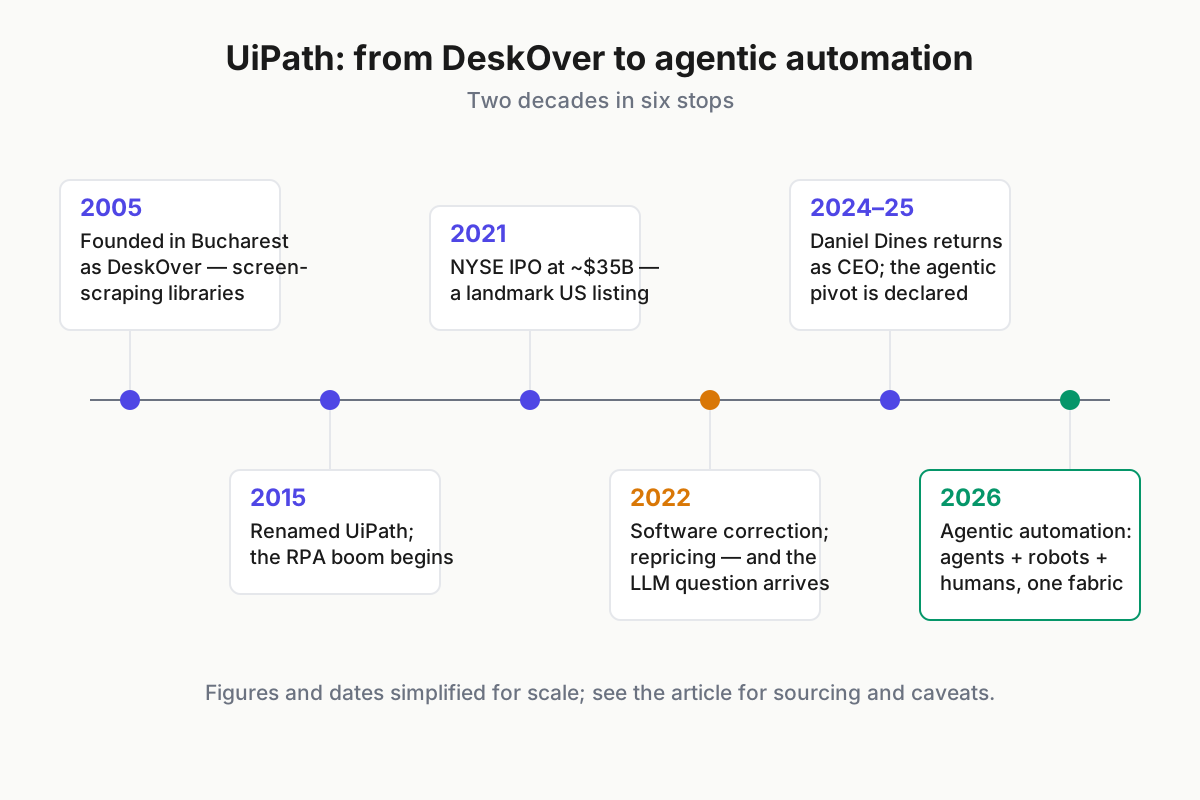
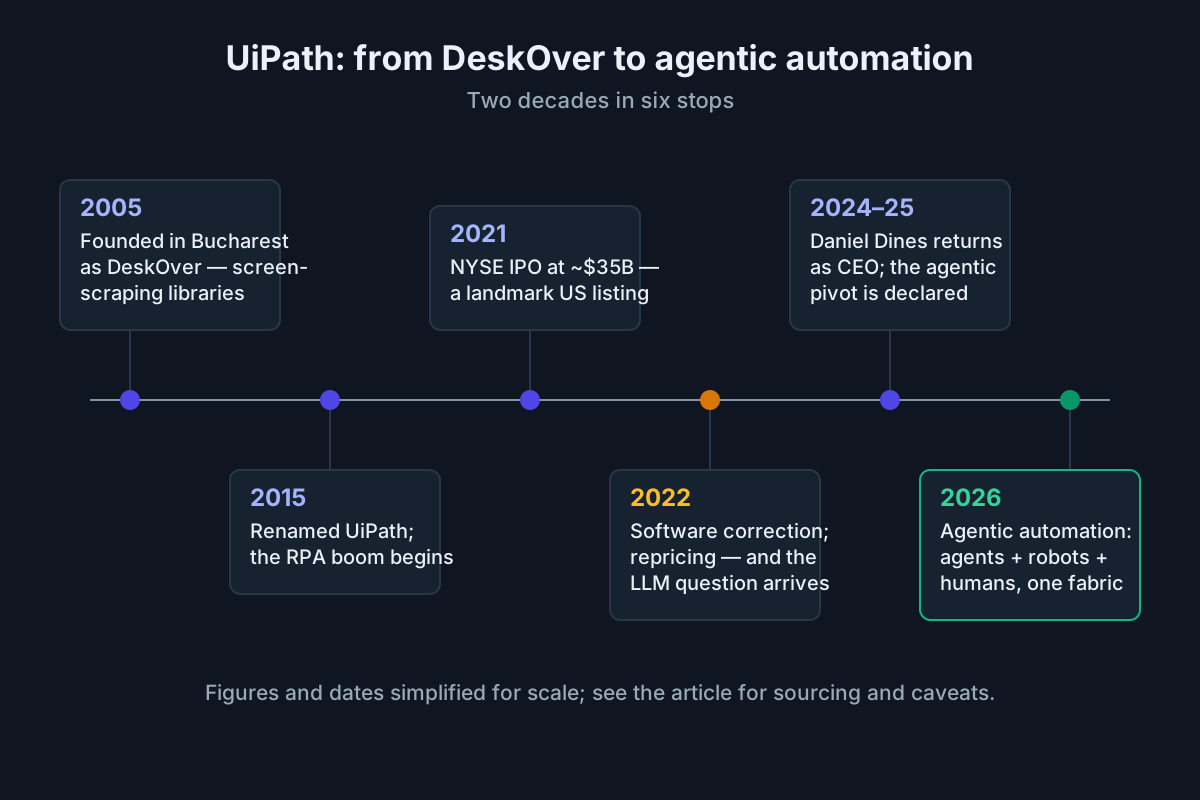 Two decades in six stops: automation library, RPA boom, IPO, correction, re-founding, agentic pivot.
Why classic RPA hit a ceiling
RPA’s boom years were built on a genuinely clever trick: if an application had no API, the robot used the application’s UI as one. The ceiling came from the same trick, in four ways.
- Brittle selectors. Bots bind to UI element trees. When a vendor ships a redesign that moves the login button or renames a field, the selector breaks and the bot stalls. Multiply by every app in the estate and you get the change-breaks-bot maintenance treadmill that quietly ate RPA’s ROI story.
- Deterministic-only. Every branch had to be specified in advance. An invoice with a handwritten discount, a novel email phrasing, a scanned form at an angle — anything requiring judgment fell into exception queues staffed by humans, which meant the “automated” process was often a funnel into manual work.
- The org chart around the bots. Centers of excellence, per-bot licensing, and process-mining consultants to find automatable work: automation that required an organization to keep running, with costs that scaled alongside the savings.
- The honest counterpoint. For stable, high-volume, compliance-heavy processes, determinism was — and remains — a feature. “The same steps, every time, fully logged” is exactly what an auditor wants to hear, and no agent stack says it as convincingly yet.
That ceiling, not any single competitor, explains the pivot.
The agentic pivot: what UiPath is actually claiming
The repositioning is explicit: UiPath now presents itself as an agentic automation company — orchestrating AI agents, robots, and humans in one governed fabric, rather than selling RPA as the product. The framing matches where analysts have pushed the category: Gartner and its peers now talk about business orchestration and automation platforms rather than standalone RPA.
The strategy, stripped of the language:
- The bull case is real. UiPath already owns the enterprise process rails — connectors into SAP, mainframes, and legacy UIs — and the governance surface auditors have accepted for years. Adding agents to that base is a more credible move than an agent startup adding enterprise governance later.
- The leadership subtext is loud. Founder Daniel Dines is back as CEO after the co-CEO era ended, with explicit re-founding rhetoric around the agentic shift — the move a company makes when it considers the pivot existential, not incremental.
- Shipped and marketed are different lists. Some of what carries the “agentic” label is genuinely new; some is existing AI features relabeled, and the most autonomous demos are still demos. The claims deserve the same scrutiny we would give any vendor.
- The business model is pivoting too. Per-bot licensing fits robots that run forever; agents meter more naturally by consumption, and UiPath’s packaging has been shifting toward platform and unit-based pricing to match. For buyers, that means the commercial conversation at renewal changes as much as the architecture does.
The product surface: Agent Builder, Autopilot, and Maestro
Three product names carry the pivot. A single use case — loan-document intake at a bank — tests all of them.
- Agent Builder. Define agents inside the UiPath stack — prompts, tools, guardrails, evaluations — and deploy them beside robots with the same governance. In the loan case: the agent reads the messy incoming bundle, classifies each document, and extracts fields from the ones no template ever fit.
- Autopilot. The assistant layer across Studio and end-user surfaces: natural language in, workflows and expressions out. In the loan case: a developer describes the intake flow in plain English and gets a scaffolded workflow to refine rather than a blank canvas.
- Maestro. The orchestration layer for agents, robots, and humans together — routing work among all three, escalating, and keeping one audit trail across the whole flow. In the loan case: Maestro routes each document to agent or robot, escalates low-confidence extractions to a human, and logs every hop.
The test to apply as an evaluator is the same for all three: ask which parts run in production at reference customers today, and which parts are keynote footage.
RPA vs AI agents: the technical comparison
This table is the core of the piece — six dimensions, concrete cases in every cell.
| Dimension | Classic RPA bots | AI agents |
|---|---|---|
| Determinism | Fixed flowchart: step 7 always follows step 6, or the bot throws an exception | Goal-driven loop: the agent chooses its next action each run, so two runs can differ |
| Resilience to app change | Brittle: an SAP screen update that moves one field breaks the selector and the bot | Adaptive: a model reading the screen or an API response usually survives cosmetic change |
| Auditability | Step-level logs by design; Orchestrator run histories have passed regulator review for years | Probabilistic traces: a transcript shows what happened, not reliably why, and replay isn’t deterministic |
| Cost profile | Per-bot licenses plus a maintenance team — predictable and heavy | Tokens plus evals plus engineering time — cheap to start, unbounded without budgets |
| Skills required | RPA developers and a center of excellence trained on vendor tooling | Software engineers fluent in prompts, APIs, and eval harnesses |
| Failure mode | Silent breakage: the bot stalls on a changed screen and the queue backs up overnight | Confident wrongness: the agent completes the task incorrectly and reports success |
Two rules for reading it honestly:
- It cuts both ways. Agents lose on auditability and determinism today; RPA loses on change-resilience and anything requiring judgment. Anyone who shows you this comparison with one column winning every row is selling something.
- The decision heuristic: if you can flowchart the process completely and it rarely changes, RPA-style determinism wins. If inputs are ambiguous or the surface keeps shifting, agents win. The deeper version of that split is our workflow-versus-agent framing.
The hybrid pattern is the real takeaway
State it plainly: deterministic bots for the stable rails — system-of-record writes, compliance steps — agents for ambiguity — classification, extraction, drafting — and an orchestration layer routing between them with humans on exceptions.
Worked end to end in claims processing: a claim arrives as photos, adjuster notes, and a scanned form. An agent reads the mess, classifies the claim, and drafts the assessment with extracted fields. A robot executes the mainframe transaction that actually moves money — the same audited step it has run for years. A human signs off on anything above a $10,000 payout or below a confidence threshold. Every hop lands in one log.
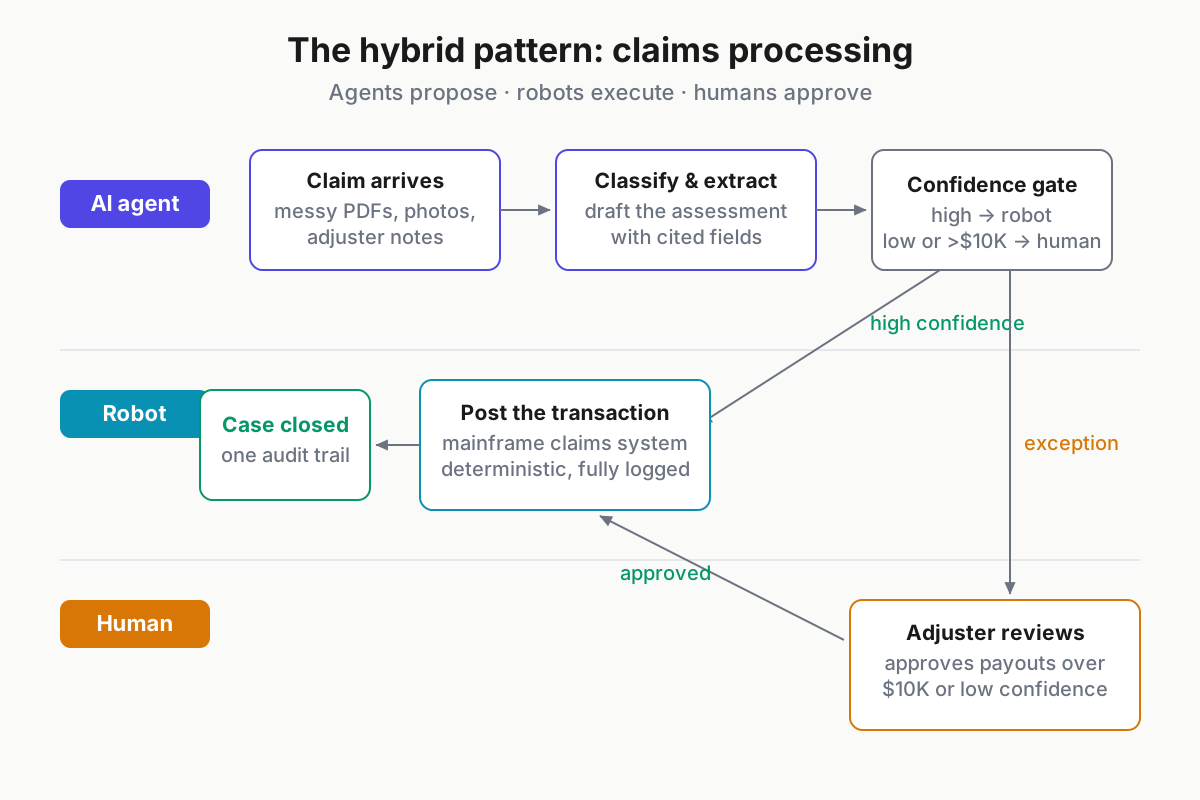
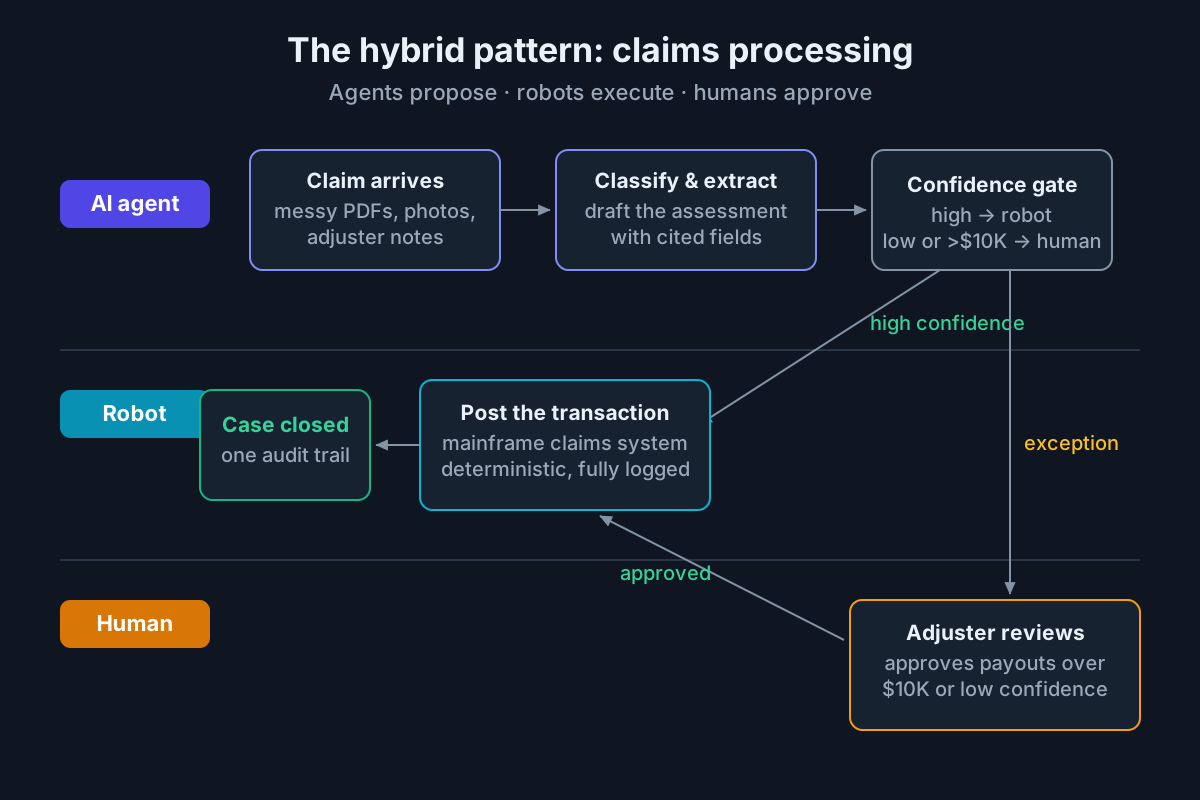 The hybrid pattern: judgment upstream, determinism downstream, humans on the expensive exceptions.
What makes this the takeaway rather than a vendor talking point is the convergence: UiPath’s bet and the agent-native world are landing on the same shape independently, and for the same reason. Error economics force it. Letting a probabilistic system write to a system of record means every hallucination is a financial event; letting a deterministic bot handle ambiguity means every novel input is an outage. Split the work by what each is bad at, and both failure modes shrink.
In a code-first stack the identical pattern reads as: the LLM plans, typed tools execute, and a test harness gates the merge. Agents without deterministic rails re-create RPA’s maintenance hell with worse logs.
The line worth pasting into your team channel: agents propose, deterministic systems execute, humans own the exceptions.
For enterprises with a big RPA estate: wrap, don’t rip
Rip-and-replace is negative ROI on a multi-year clock. Working unattended bots encode years of process knowledge and pass audits today; burning that for agent purity buys risk, not capability. The sequence that works:
- Inventory the estate by fragility and exception volume. Rank every bot by how often it breaks and how much lands in its exception queue. That ranking is your roadmap.
- Put agents on the exception queues first. Highest ambiguity, lowest blast radius: the exceptions are already reviewed by humans, so an agent drafting their resolution is supervised by default.
- Replace the brittle screen-scraping tier last, and only as APIs appear or measured agent reliability clears your bar — not on a keynote schedule.
- Watch for double-spend. Agentic add-ons priced on top of existing licenses stack quietly; consolidate SKUs at renewal instead of accreting them mid-term.
- Re-evaluate yearly against measured reliability — your own exception-queue metrics, not vendor announcements.
What code-first builders should steal from UiPath
Credit where due: the RPA world is genuinely ahead of most agent stacks on three things. Human-in-the-loop is a first-class workflow object, not an afterthought bolted on with a Slack ping. Role-based access control applies to every automation, not just the deploy pipeline. And the audit trails pass regulator review — every bot run logged with inputs, actions, outcome, and approver, replayable years later.
Contrast that with the default agent stack in 2026, where the transcript is the only record and it lives wherever the CLI happened to drop it. That gap is a compliance problem for enterprises and a debugging problem for everyone.
The translation into code-first practice is direct, and it is the heart of the AgentOps discipline: log every agent session, keep transcripts searchable, and attach explicit approval events to irreversible actions so “who signed off” has an answer. Concretely: when an agent proposes a production database migration, the approval should be a recorded event — who, when, what diff — not a “y” typed into a terminal that scrolled away. None of this requires buying a platform; it requires deciding records matter before the incident, not after.
And it applies at personal scale, not just enterprise scale. A developer running five coding CLIs has an audit-trail problem too — which session touched the billing code, which agent got told what — just without a compliance team to flag it.
Product note: Audit trails apply at personal scale too. Automater Lite keeps a local, searchable archive of every AI session across 10+ CLIs — the individual developer’s flight recorder. Free, on automater.ai.
Competitive context: who else is at this table
- Microsoft Power Automate. The bundling threat: good-enough RPA plus Copilot Studio agents inside the Microsoft 365 estate most enterprises already pay for. Threat level: the highest, because “included-ish in the existing bill” beats “better” in most procurement meetings.
- Automation Anywhere and the classic RPA field. Automation Anywhere is running the same pivot with the same story and less platform gravity; the rest of the old RPA roster is consolidating or fading. Threat level: modest — they split the legacy market more than they threaten the pivot.
- Code-first stacks eating from below. Python plus Playwright plus LLM APIs, computer-use models that drive GUIs directly, and open agent frameworks now do “RPA tasks” without RPA licensing — the field we survey in the best agentic AI tools. Threat level: structural, because it caps what the license can cost wherever engineering talent exists.
- The open question. UiPath’s claimed moat is orchestration plus governance. The unresolved bet is whether that stays a product or becomes a feature of the platforms underneath — the hyperscalers and data platforms are all adding agent governance of their own.
Who should choose UiPath today — and who shouldn’t
- Choose it: regulated enterprises with an existing estate, organizations with heavy legacy-UI surface and no APIs coming, and anyone who weighs governance and auditability above velocity.
- Skip it: engineering-led teams building agent-native products, startups with no legacy estate, and anyone whose targets are API-reachable — a code-first stack is cheaper and less constrained.
- The middle path: if you already run UiPath, pilot Agent Builder against one exception queue and measure it like you would any agent eval — resolution rate, error rate, human-minutes saved — before any platform-wide commitment.
The closing read: the pivot is rational and partially shipped. UiPath’s moat is governance plus installed base, not model capability — the models are the same ones everyone rents, so the differentiation has to live in what surrounds them. That is a defensible position if orchestration stays a product, and a shrinking one if it becomes a feature. Either way, the direction of travel is settled: automation platforms are becoming places where agents, deterministic systems, and humans get routed and audited together, and the RPA world reached that conclusion from one side while agent builders reached it from the other. For the heavyweight running an adjacent version of this bet from the data side, read our analysis of Databricks and the enterprise agent platform race.
FAQ: UiPath and agentic automation
What is UiPath used for?
UiPath automates repetitive business tasks with software robots that operate applications the way a person does — reading screens, filling forms, moving data between systems — now extended with AI agents for judgment steps. The canonical example: lifting invoice data from email and PDF into SAP, thousands of times a day, fully logged.
What does UiPath stand for?
“UI Path” — the path through a user interface. The name comes from the company’s core trick: automating the sequence of clicks, keystrokes, and reads a human performs across application screens. Searchers typing “path ui” or “ui path” are looking for the same company and platform.
Is UiPath an AI company?
Historically no — UiPath led robotic process automation, which is deterministic scripting, not machine learning. Since 2024 it has repositioned around agentic automation: LLM-driven agents built, deployed, and governed beside its robots. The AI is increasingly real; the durable asset is still orchestration and governance.
Is RPA dead?
No. RPA is becoming the deterministic execution layer inside agentic systems: agents handle ambiguous inputs and judgment, robots execute the stable, auditable transactions, humans clear exceptions. Pure screen-scraping RPA is shrinking, but the pattern — reliable rails under probabilistic reasoning — is more relevant than ever.
What is agentic automation in UiPath?
UiPath’s term for orchestrating AI agents, software robots, and humans in one governed workflow: agents take the judgment steps, robots execute deterministic transactions, humans approve exceptions, and the platform routes, logs, and audits all three. It is the company’s post-RPA positioning, anchored by Agent Builder and Maestro.