The Mid-2026 Frontier Scorecard: Fable 5 vs GPT-5.6 vs Gemini 3.1
Which is the best AI model in 2026? Claude Fable 5, GPT-5.6 (Sol), and Gemini 3.1 scored for real agent work — plus the open models closing the gap fast.

Go deeper. Build your own.
Ask five working engineers to name the best AI model in 2026 and you will get three answers, four qualifiers, and at least one lecture about harnesses. The three answers are Anthropic’s Claude Fable 5, OpenAI’s GPT-5.6 (Sol), and Google’s Gemini 3.1. All three are defensible. None survives without the qualifiers.
The lecture about harnesses is the important part. Nobody consumes a frontier model raw anymore; you consume it through Claude Code, Codex, Antigravity, or whatever else owns your terminal, and the harness moves results as much as the model does. Meanwhile 2026 added a twist no earlier scorecard had to handle: open-weight models posting coding-benchmark numbers within a few points of the flagships, at a fraction of the price.
So this is the scorecard we actually wanted: what each flagship optimizes for, the native harness pairings, access and pricing posture with unknowns flagged instead of invented, the open-model twist, routing guidance by task, and the quarterly re-test loop that keeps any of it true. Where a number is not verified, we say so. The listicles inventing benchmark tables for models they have never run can keep the traffic.
What “best AI model” means in 2026
The question changed shape while nobody was looking. In 2024 it meant “which chatbot writes the best answer.” In 2026, for anyone who ships software, it means: which model completes multi-step work reliably, inside a harness, under a budget. That decomposes into task shape, harness fit, and price — three axes, and no single winner across all of them.
Concretely: a model that aces one-shot bug fixes can still be the wrong choice for a three-hour migration if it loses the thread at turn forty. A model that is a few points better and several times pricier is the wrong default and the right escalation lane. And a model whose best harness does not fit your workflow will underperform its own benchmark numbers on your machine. Scorecards that ignore those axes produce clean rankings of the wrong thing.
Frontier model, as the term is used in mid-2026: a model at or near the top of published capability for reasoning, agentic coding, and tool use — today Claude Fable 5, GPT-5.6 (Sol), and Gemini 3.1. With open-weight models now scoring within a few points on coding benchmarks, “frontier” increasingly describes a price band and an access posture rather than a capability monopoly.
One reading rule before the cards: vendor benchmark tables are marketing collateral until an independent referee reproduces them. Where we cite a number below, we name who ran it — and when only the vendor has, we say “vendor-reported.” For why that distinction started mattering so much this year, see our guide to reading agent benchmarks after SWE-bench saturation.
The three flagships, briefly
Claude Fable 5 — the safeguarded top of a two-door tier
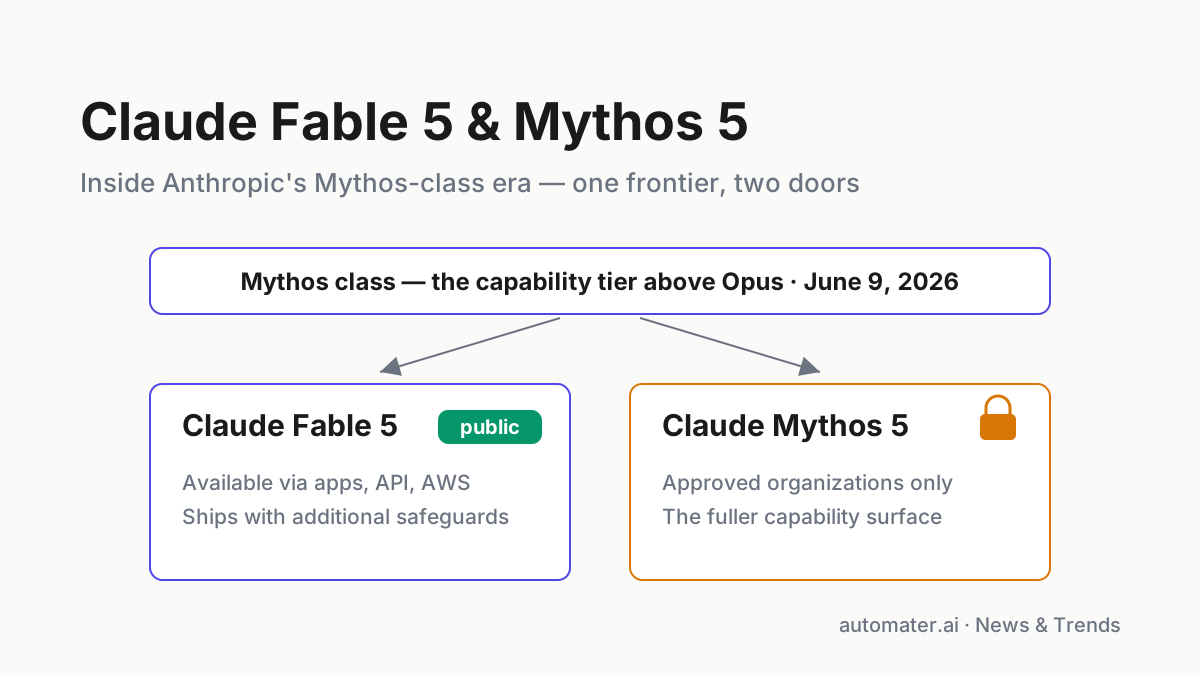
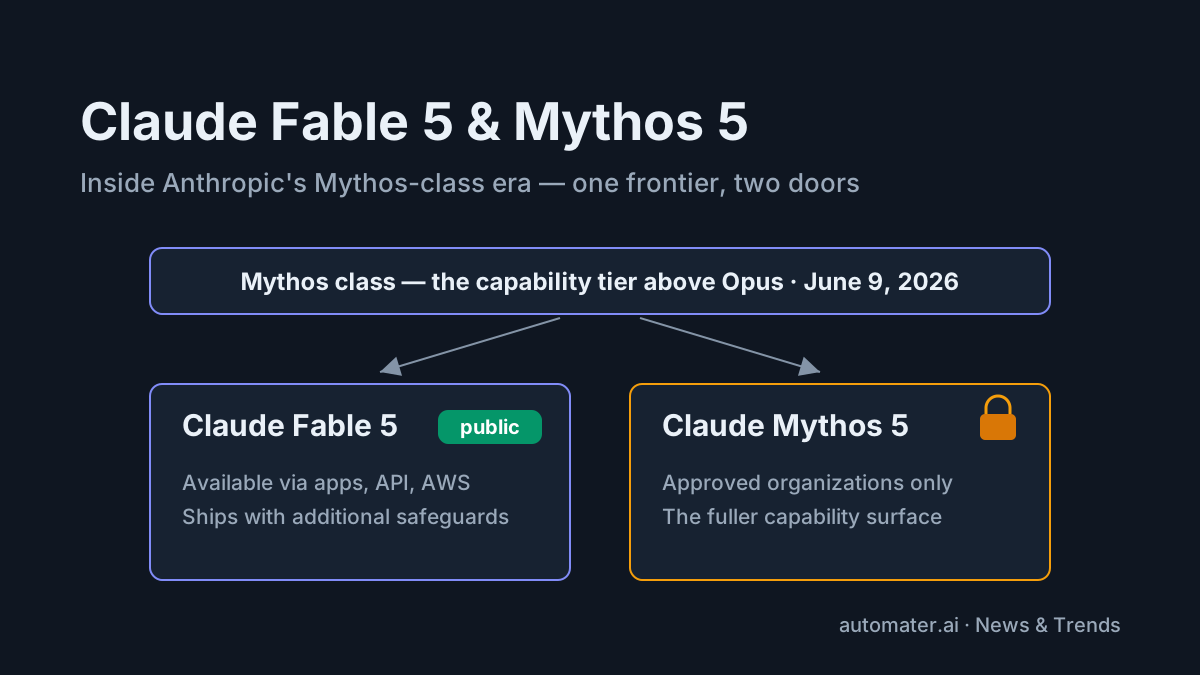
Anthropic released Claude Fable 5 and Claude Mythos 5 on June 9, 2026: a new Mythos class above Opus, with Fable 5 publicly available under additional safeguards and Mythos 5 restricted to approved organizations. The platform docs introduce both on one page; the access structure gets a full teardown in our Mythos-class analysis.
What it optimizes for, per positioning: long-horizon, high-stakes agentic work — the band above where Opus-class models plateau. Under it sits Claude Sonnet 5 as the everyday workhorse, per mid-2026 reporting. The practical shape: Anthropic sells an escalation tier and a bulk tier, and expects you to route between them.
GPT-5.6 (Sol) — the broad-availability flagship
OpenAI’s current flagship is GPT-5.6, codenamed Sol. It capped a year of rapid point releases — 5.3, 5.4, and 5.5 preceded it, per reporting — which tells you something about the cadence OpenAI has chosen: continuous flagship refresh over big-bang generational leaps.
Posture-wise, GPT-5.6 is the opposite of a gated tier: one flagship pushed across consumer and developer surfaces. For agent work its home field is Codex — both the CLI and the async cloud lane — which we reviewed at daily-driver depth in the Codex deep dive.
Gemini 3.1 — the ecosystem flagship with a rebuilt harness
Google’s current line is Gemini 3.1, per mid-2026 reporting , with model documentation living at ai.google.dev. The best-documented part of Google’s 2026 is actually the harness story: Gemini CLI was discontinued on June 18, 2026, breaking CI pipelines on its way out, and the Go-based Antigravity CLI arrived as its replacement.
What Gemini 3.1 optimizes for, by structural position: the Google ecosystem — Workspace, Cloud, Android — plus the multimodal and long-context strengths the Gemini line has always led with. The migration mess and what Antigravity means for Google’s agentic ambitions get the full story in our Antigravity-era teardown.
The harness is half the model
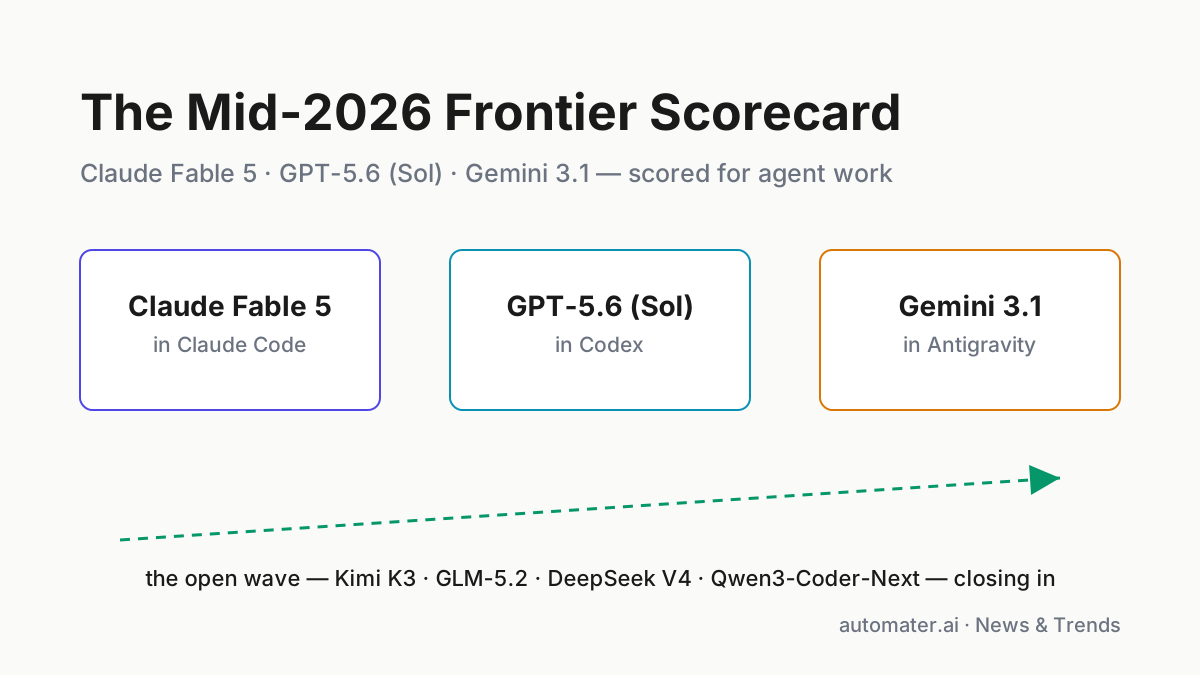
Each flagship now ships with a preferred body: Fable 5 in Claude Code, GPT-5.6 in Codex, Gemini 3.1 in Antigravity. That pairing is where the vendor’s own engineering attention goes — prompts, tools, and context handling tuned to the house model — and it is the configuration their demos, and increasingly their pricing plans, assume. If you want the most from Fable 5 specifically, the Claude Code power guide is the manual.
What a native pairing buys is mundane and decisive: system prompts tuned to the model’s instruction-following quirks, tool schemas the model has been trained against, context compaction matched to its window behavior, and failure-recovery heuristics learned from the vendor’s own telemetry. Third-party harnesses reverse-engineer that; first-party harnesses ship it. The delta shows up not in demos but at hour two of a long session — which is where agentic work actually lives.
The pairings are defaults, not walls. Per the mid-2026 harness map, every serious CLI harness now accepts at least one of OpenAI-compatible or Anthropic-Messages endpoints, so cross-wiring a flagship into a third-party harness is routine. Which harness deserves the wiring is its own question — that is what our field map of AI coding harnesses is for.
The uncomfortable implication for scorecards like this one: same model, different harness, different results. Harness effects on agentic benchmarks are large enough that “GPT-5.6 vs Claude Fable 5” without naming the harnesses is an underspecified question. When you compare, compare pairs.
Access and pricing posture
The postures diverge more than the capabilities. Anthropic runs a two-door experiment: public Fable 5 with added safeguards, gated Mythos 5, with availability through its own surfaces and product page plus AWS. OpenAI ships one broadly available flagship. Google bundles its flagship into an ecosystem. Three different answers to the same question: who should hold frontier capability, and at what markup.
Posture predicts behavior, which is why it belongs on a scorecard at all. A two-door vendor will keep gating its strongest capability and pricing for escalation. A broad-availability vendor will keep the flagship near the default tier and iterate fast. An ecosystem vendor will make the model cheapest wherever it keeps you inside the ecosystem. Plan your dependencies against the posture, not the press release.
On per-token numbers we are deliberately quiet. We have not verified current pricing for any of the three flagships, and mid-2026 price sheets revise faster than articles do — check each vendor’s pricing page the week you model costs.
Two price facts we can anchor, both from the open side: DeepSeek V4 Flash sells at $0.14 per million input tokens and $0.28 out — the credible floor for agentic-grade inference — and open-model API pricing fell roughly 80% year over year, per reporting. Whatever the flagships charge, that is the gravity underneath them. The mechanics of what heavy users actually pay across plans and providers is its own rabbit hole; we mapped it in Token Plans Decoded.
Product note: If you run all three — Fable 5 in Claude Code, GPT-5.6 in Codex, Gemini 3.1 in Antigravity — no single vendor dashboard will ever tell you what a week of work cost. Automater Lite meters tokens locally across 10+ providers and puts usage in one view, so your routing decisions run on your numbers instead of vibes. Free, and the data never leaves your machine.
The 2026 twist: the frontier is a price band
Every scorecard before this year could stop at three models. This one cannot, because the open-weight wave spent the summer closing the distance.
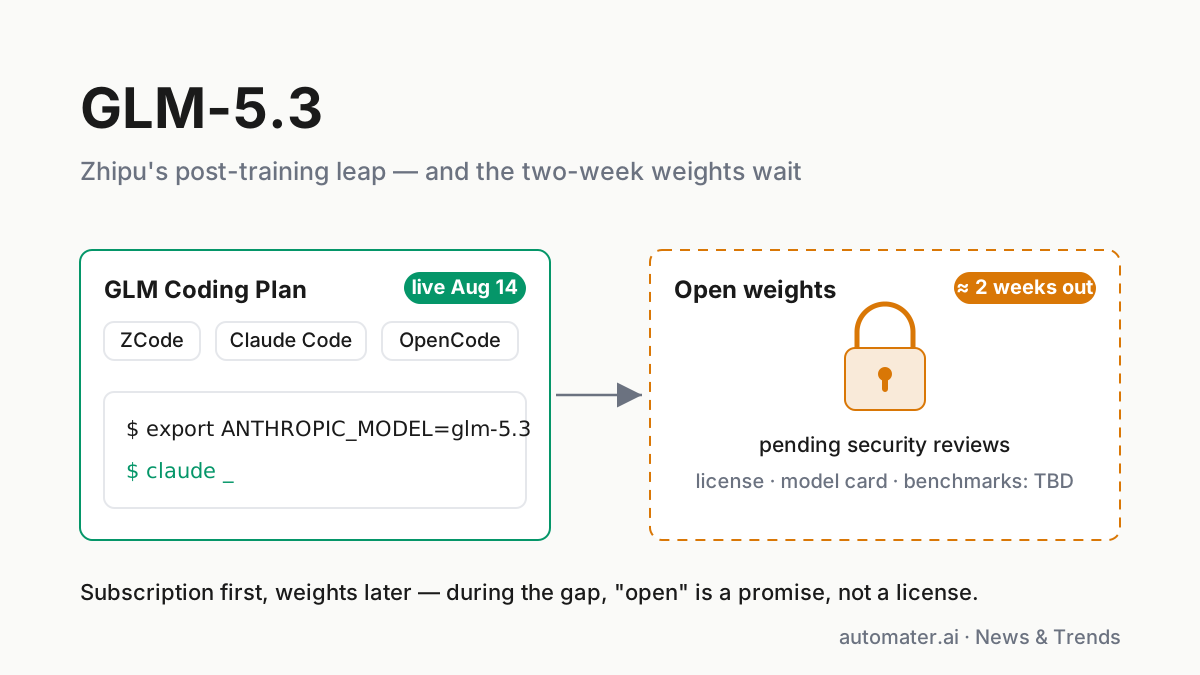
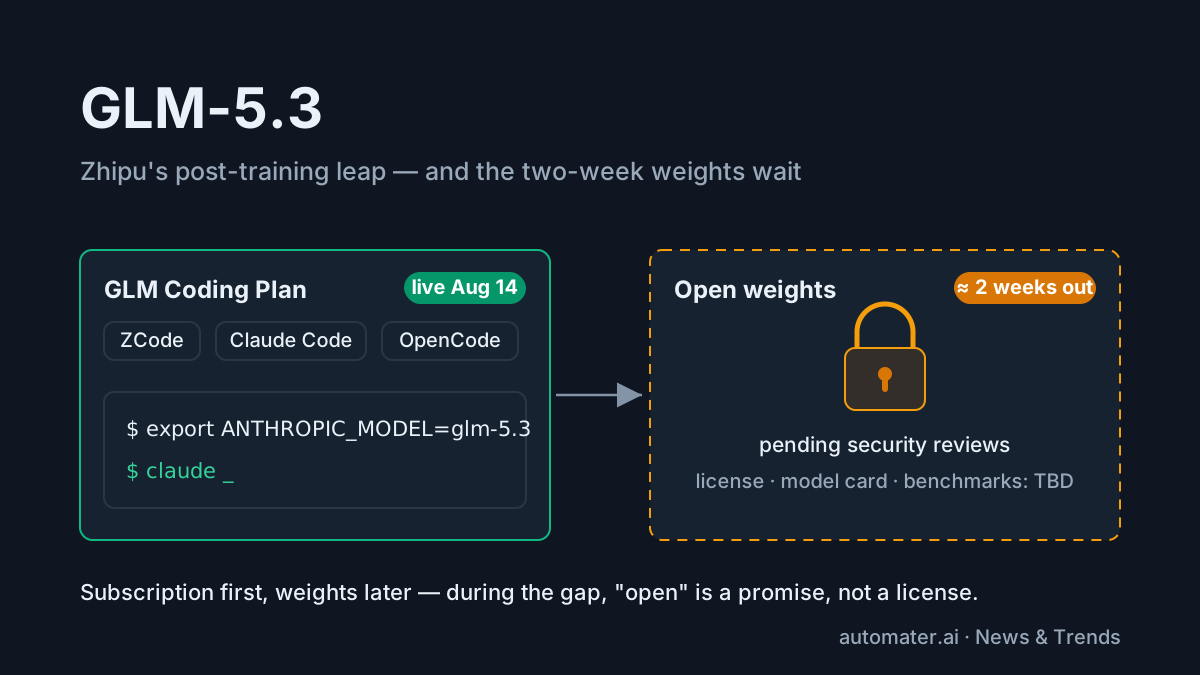
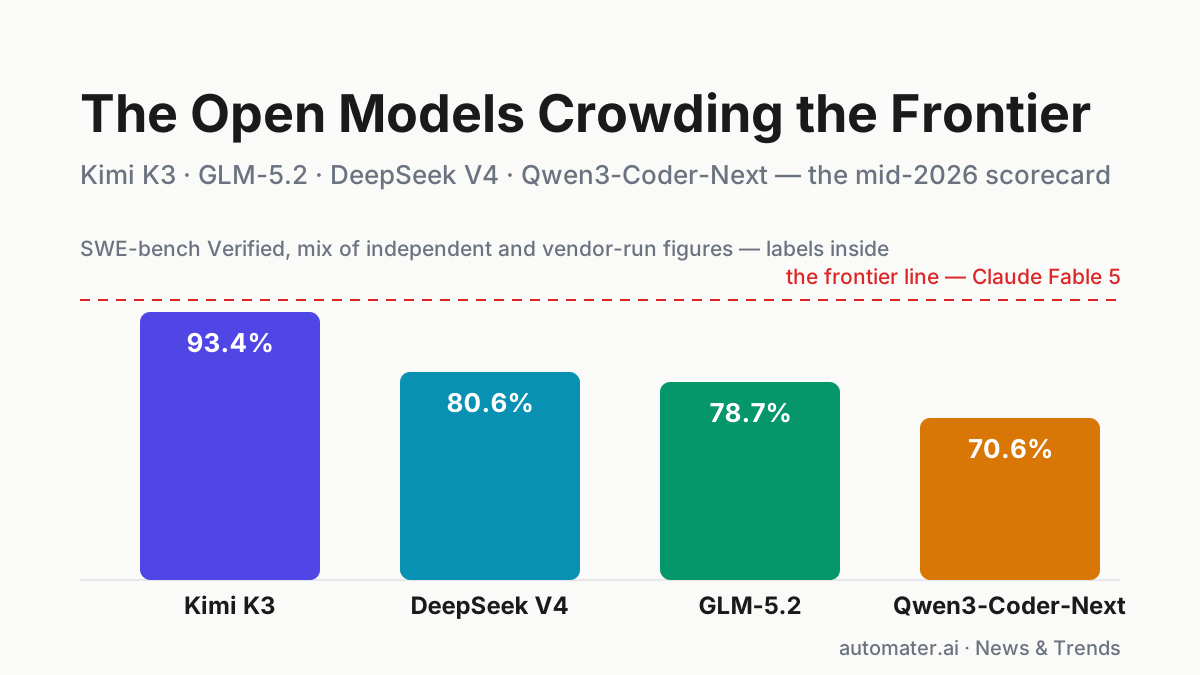
The headline case is Moonshot’s Kimi K3, released July 16: 93.4% on SWE-bench Verified in Vals AI’s independent run, and #1 on a frontend-code arena — the first open model to lead one ahead of Claude Fable 5. Behind it: Zhipu’s GLM-5.2 (MIT-licensed, 78.7% Verified per Epoch AI, around a quarter of frontier output pricing), DeepSeek V4 Pro (80.6% Verified, vendor-reported) with the $0.14 Flash floor below it, and Alibaba’s Qwen3-Coder-Next (70.6% vendor-reported) running on a single ~46GB machine.
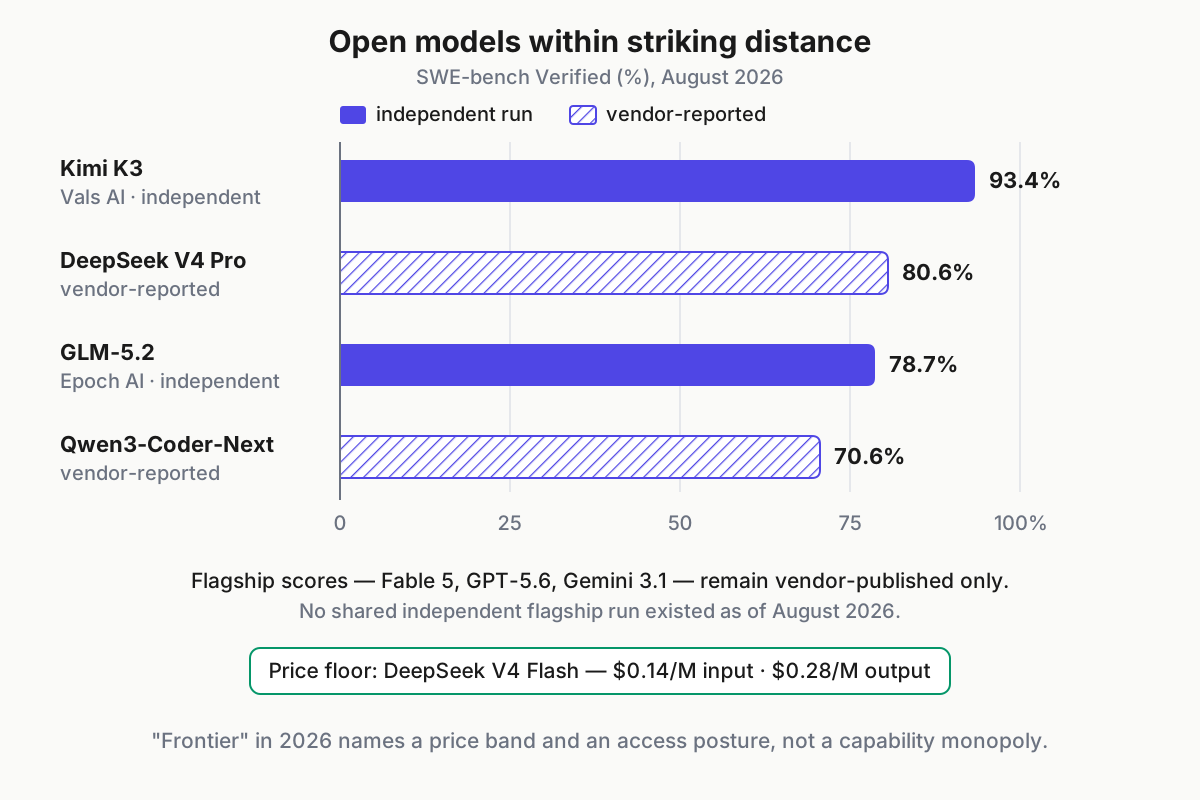
 Independent and vendor-reported SWE-bench Verified scores for the open wave. Flagship numbers are vendor-published only — which is itself part of the story.
Read the K3 arena result carefully. One arena, one domain — frontend code — and arena leads move monthly. It does not mean open models beat Fable 5 across the board, and nobody serious claims it does. What it does mean: the capability monopoly is over. For a growing set of well-specified coding tasks, the flagship premium buys you little that a top open model does not deliver at a tenth of the spend.
So “frontier” in late 2026 mostly names a price band and an access posture: the flagships still own the hardest long-horizon work, the multimodal breadth, and the enterprise wrapping — and they charge accordingly, while the band below them gets crowded and cheap. The full open-side story, deployment lanes and trust notes included, is in our open-weight scorecard.
There is a second-order effect worth naming: leverage. Even teams that never route a token to an open model benefit from the band below the flagships, because it is the only credible check on frontier pricing. The most persuasive line in your next enterprise renewal is a working DeepSeek V4 Flash config in your back pocket.
The scorecard
The table below is the honest version: verified numbers carry their referee, vendor numbers say so, and cells nobody outside a vendor can fill say that too.
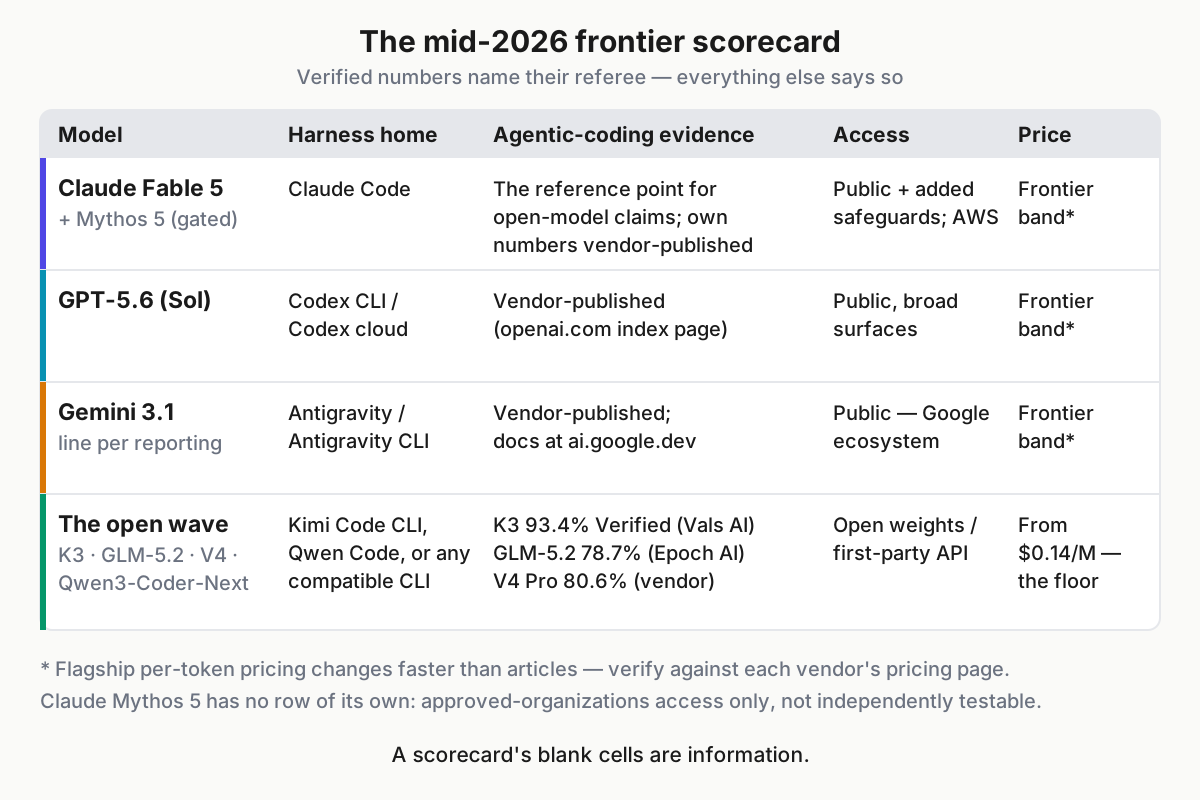
 The mid-2026 scorecard at a glance. Empty cells are honest — not everything is public.
| Model | Harness home | Agentic-coding evidence (Aug 2026) | Access | Price posture |
|---|---|---|---|---|
| Claude Fable 5 | Claude Code | The reference point open models benchmark against; own numbers vendor-published | Public, with added safeguards; AWS | Frontier band |
| Claude Mythos 5 | — | Not independently testable | Approved organizations only | Not public |
| GPT-5.6 (Sol) | Codex CLI / Codex cloud | Vendor-published on the index page | Public, broad surfaces | Frontier band |
| Gemini 3.1 | Antigravity / Antigravity CLI | Vendor-published; line status per reporting | Public, ecosystem-bundled | Frontier band |
| Kimi K3 | Kimi Code CLI; any compatible harness | 93.4% SWE-bench Verified (Vals AI); #1 on a frontend-code arena | API now; weights staged, modified-MIT expected | Undercuts flagships |
| GLM-5.2 | Z.ai GLM Coding Plan; any compatible harness | 78.7% Verified (Epoch AI); 62.1% SWE-bench Pro (vendor) | Open weights, MIT | ~¼ of frontier output price |
| DeepSeek V4 Pro / Flash | Any compatible harness | 80.6% Verified (vendor, Pro) | Open weights, MIT | Flash: $0.14/$0.28 per M — the floor |
| Qwen3-Coder-Next | Qwen Code; local one-box rigs | 70.6% Verified (vendor) | Open weights, Apache-2.0 | $0.11/$0.80 per M; self-host at ~46GB |
Three things the table refuses to do: rank the flagships against each other on benchmarks none of them has submitted to a shared independent run , quote pricing we have not verified, and pretend Mythos 5 is evaluable from outside the gate. A scorecard’s blank cells are information.
The best AI model in 2026, by task
Routing is where the scorecard becomes a decision. Our defaults, stated plainly and revisable quarterly:
- Long-horizon, high-stakes work — the multi-hour refactor, the cross-repo migration, the change you would assign your best senior: Claude Fable 5, treated as an escalation tier rather than a default.
- Everyday agentic coding: your harness’s workhorse pairing — Sonnet 5 under Claude Code or GPT-5.6 under Codex — with escalation rules written down, not improvised per task.
- Async and background delegation — fire-and-forget branches, batch fix-ups, overnight runs: Codex cloud with GPT-5.6, the most developed async lane of the three.
- Google-stack and multimodal-heavy work: Gemini 3.1 in Antigravity, especially where Workspace and Cloud integration do real lifting.
- Bulk, cost-dominated tasks — triage, test generation, mechanical edits at volume: DeepSeek V4 Flash at the floor, with K3 the pick where frontend quality is the point.
- Local and privacy-bound work: Qwen3-Coder-Next on your own hardware; frontier-adjacent capability with zero tokens leaving the building.
Run the bake-off before you write the routing table, not after. Pick ten tasks from last month’s real work — the mix you actually ship, not the demos you wish you shipped — and run each through the two or three pairings shortlisted above. Score completion without intervention, wall-clock time, and total token cost, then read the transcripts for the failure shapes benchmarks hide. Half a day of this beats any published scorecard, including ours.
If reading that list made you count the terminals involved: yes, the realistic answer to “which model” in 2026 is “several, routed deliberately.” That is a fleet-management problem more than a model-choice problem, and it is exactly the workflow we built around in running multiple AI coding agents without the chaos.
Re-test quarterly, or the scorecard rots
Every specific claim above has a half-life. OpenAI shipped four flagship steps in a year, per reporting; Anthropic invented a tier; Google replaced its harness mid-flight; the open wave moved from curiosity to contender in one summer. A model choice made in June and never revisited is a June decision wearing an August price.
The loop that keeps you honest is small:
- Keep a private bench of 20–30 tasks pulled from your own real sessions, and re-run it on every flagship point release and quarterly regardless.
- Re-read the price sheets quarterly and re-run your plan math; the open-model floor has been dropping fast enough to flip routing decisions on its own.
- Watch the referees, not the launch decks — independent runs from the likes of Epoch AI and Vals AI, plus arenas, are where capability claims go to be checked.
- Log what each model actually costs per completed task in your own fleet, because that number — not any benchmark — is the one your routing rules should obey.
Mid-2026’s standings, then, honestly stated: Fable 5 is the escalation king with a policy experiment attached, GPT-5.6 is the broadest and most continuously refreshed flagship, Gemini 3.1 is the ecosystem play with a rebuilt harness, and the open wave made all three justify their premium. Ask us again in November — we intend to have re-run the numbers by then, and you should too.
FAQ: the mid-2026 frontier scorecard
What is the best AI model in 2026?
There is no single winner. As of August 2026, Claude Fable 5 leads for long-horizon agentic work, GPT-5.6 (Sol) is the broadest-availability flagship, and Gemini 3.1 anchors the Google ecosystem — while open models like Kimi K3 match flagship-level coding benchmarks at far lower prices. The best model depends on task, harness, and budget.
Is GPT-5.6 better than Claude Fable 5?
No shared independent head-to-head existed as of this writing, so any flat answer is invented. Both are frontier-band flagships; results differ by harness pairing (Codex versus Claude Code) and task shape. Run both on 20–30 of your own representative tasks and compare completion rate and cost per task before deciding.
Are open-source models as good as frontier models in 2026?
On coding benchmarks, nearly: Kimi K3 posted 93.4% SWE-bench Verified in an independent run and led a frontend-code arena ahead of Claude Fable 5. Flagships still hold the edge in long-horizon breadth, multimodality, and enterprise tooling. For well-specified coding tasks, open models now deliver most of the capability at a fraction of the cost.
Which AI model is best for agentic coding?
Pair the model with its harness: Claude Fable 5 in Claude Code for hard long-horizon work, GPT-5.6 in Codex for everyday and async lanes, Gemini 3.1 in Antigravity for Google-stack projects, and DeepSeek V4 Flash or Kimi K3 for cost-sensitive volume. Most serious setups route across several rather than picking one.
How often should I re-evaluate my model choice?
Quarterly at minimum, plus after any flagship release that touches your stack. Re-run a private benchmark of your own tasks, re-check pricing, and compare cost per completed task across providers. In 2025 an annual review was fine; the 2026 release cadence — four GPT point releases, a new Anthropic tier — made quarterly the floor.
Sources
- Introducing Claude Fable 5 and Claude Mythos 5 — anthropic.com
- Claude Fable 5 product page — anthropic.com
- Introducing Claude Fable 5 and Claude Mythos 5 — platform.claude.com model docs
- OpenAI: GPT-5.6 — openai.com
- Google AI developer documentation — ai.google.dev
- TechTimes: Gemini CLI shutdown takes effect, CI/CD pipelines break, Go-based Antigravity CLI arrives (June 18, 2026)
- Coding CLIs in mid-2026: the engineer’s map — dev.to
- Best open-source coding models, 2026 — morphllm.com