GLM-5.3: Zhipu's Post-Training Leap and the Two-Week Weights Wait
Zhipu shipped GLM-5.3 on August 14 through the GLM Coding Plan, with weights two weeks out. What the vendor claims, what's verified, and how to try it today.

Go deeper. Build your own.
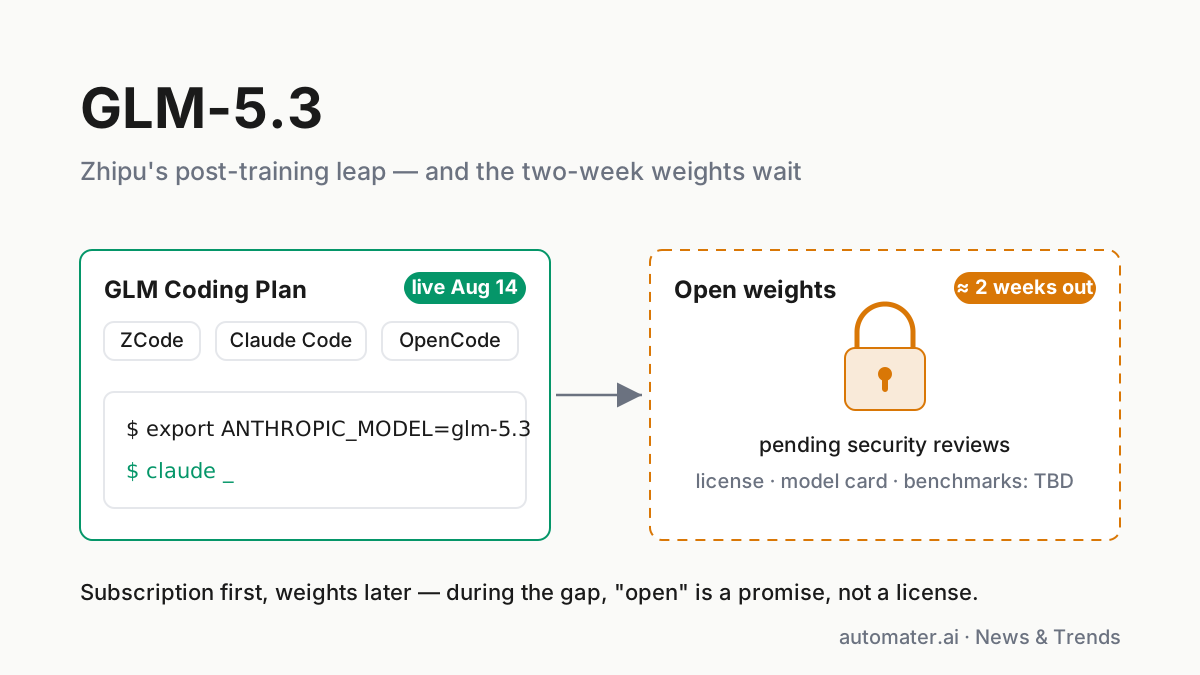
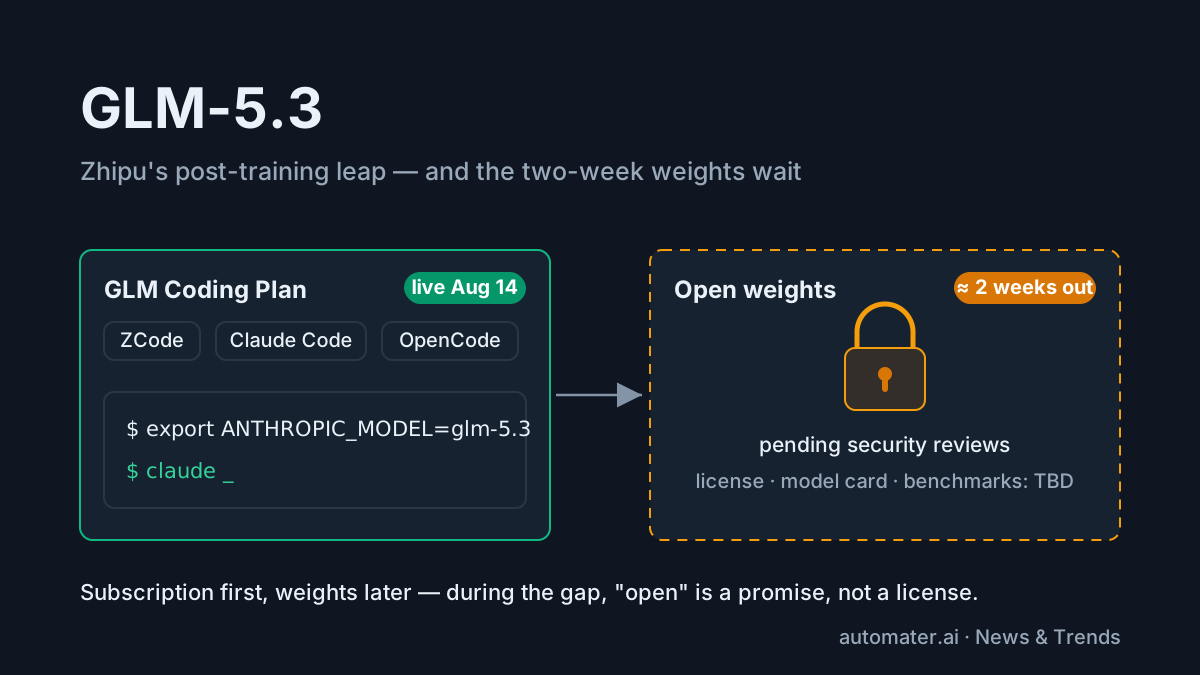
On August 14, 2026, Zhipu shipped GLM-5.3 — and you cannot download it. The Beijing lab behind the GLM line, a self-described open-weights shop, released its newest coding model through its subscription service first: live day one inside the Z.ai GLM Coding Plan via ZCode, Claude Code, and OpenCode integrations, with the weights themselves promised “about two weeks” later, pending internal security reviews. No license text, no model card, no independent benchmarks — just a working endpoint and a stack of vendor claims.
That release shape is the actual story. GLM-5.3’s predecessor arrived weights-first under MIT on day one; GLM-5.3 arrives as a subscription product with an open-weights promise attached. If you want to understand where the open-model economy is heading, this launch is a cleaner specimen than any benchmark chart.
This piece covers what shipped and what did not, why the plan-first pattern exists, an honest audit of the Zhipu GLM claims (including the 2,436-vulnerability number), how to drive GLM-5.3 today from harnesses you already run, the checklist for the day the weights land, and the Ox Alpha wrinkle that makes the whole week stranger.
What shipped on August 14 — and what didn’t
GLM-5.3 is Zhipu’s successor to GLM-5.2, released August 14, 2026 through the Z.ai GLM Coding Plan first — reachable via ZCode, Claude Code, and OpenCode integrations — with open weights promised roughly two weeks later pending security reviews. It keeps GLM-5.2’s base architecture; Zhipu attributes all gains to post-training. No independent benchmarks exist yet.
What you could actually touch on launch day:
- The model, behind the plan. GLM-5.3 became the engine available through the Z.ai GLM Coding Plan — the flat-rate subscription whose whole pitch is powering harnesses you already use.
- Three harness lanes. ZCode, Zhipu’s own CLI shipped in July 2026; a documented Claude Code integration in the familiar Anthropic-compatible style; and OpenCode support. Zhipu is not asking anyone to change tools — it is selling an engine swap.
And what you could not:
- Weights. Promised roughly two weeks out — which from August 14 means about August 28 — held back, per Zhipu, for security reviews. As of publication they had not landed.
- A license. Undisclosed at announcement. GLM-5.2 was MIT; nobody has confirmed GLM-5.3 will match it.
- A model card, standalone API pricing, or any eval anyone else can rerun. All absent at announcement.
The architectural note in the announcement matters more than it looks: GLM-5.3 is the same base model as GLM-5.2 — the 744B-parameter mixture-of-experts with 40B active (per the mid-2026 open-model roundup) that anchors the open-weight scorecard — with every claimed gain coming from post-training. That makes GLM-5.3 a test of the year’s most interesting thesis: that post-training, not pretraining scale, is where coding-agent capability now comes from. It also means the claims are, in principle, cheap to verify the moment weights exist — same architecture, same serving stack, diff the behavior.
Plan-first, weights-later: read the release shape
Two months separate two very different Zhipu launches. June 16: GLM-5.2 ships weights-first, MIT-licensed, downloadable the day you read about it. August 14: GLM-5.3 ships subscription-first, weights in a promised two weeks. Same lab, opposite shapes. What changed is not ideology; it is that the GLM Coding Plan started working as a business.
The pattern decodes cleanly:
Subscription revenue meets open-weights marketing. The Coding Plan is the revenue; the weights are the reputation. A plan-first launch captures the news cycle’s entire attention spike as paid signups — every developer who wants to try GLM-5.3 this week must come through the subscription gate. The weights still arrive, still earn the “open-weights lab” halo and the community goodwill visible in Hugging Face’s GLM-5 family write-ups, but only after the launch window has been fully monetized. Kimi K3 ran the same play in July — API first, weights staged afterward — which makes this a pattern now, not an incident.
The exclusivity window is the product. For roughly two weeks, the only way to run the claimed “strongest open-weights coding system” is Zhipu’s own metered lane. No Western re-hosts undercutting the plan, no quantized community builds running on someone’s workstation, no independent eval shops publishing inconvenient numbers on day two. Every early impression forms inside infrastructure the vendor controls.
“Security reviews” is doing quiet work. The stated reason for the delay is plausible on its face — labs do red-team releases, and a model marketed on finding vulnerabilities invites extra care before its weights go public. But the review period is also, functionally, the exclusivity window, and outside observers cannot distinguish diligence from marketing calendar. Both can be true at once. Withhold judgment, and note the incentive.
What “open” means during the gap: nothing. A promised license is not a license. Until a repository exists with real weights and real terms, GLM-5.3 is a closed, subscription-only model with a press release attached, and it should be evaluated exactly the way you evaluate any proprietary lane — on price, behavior, and terms of service. The open-weights label becomes true on the day you can git clone it, and not before.
None of this makes Zhipu villainous — it makes Zhipu a company. Flat-rate coding plans have been the Chinese labs’ sharpest wedge all year, and using a model launch to sell subscriptions is what a business does with a wedge that works. Just file the lesson: “open-weights lab” now describes a marketing posture with a delivery lag, and the lag is where your skepticism should live.
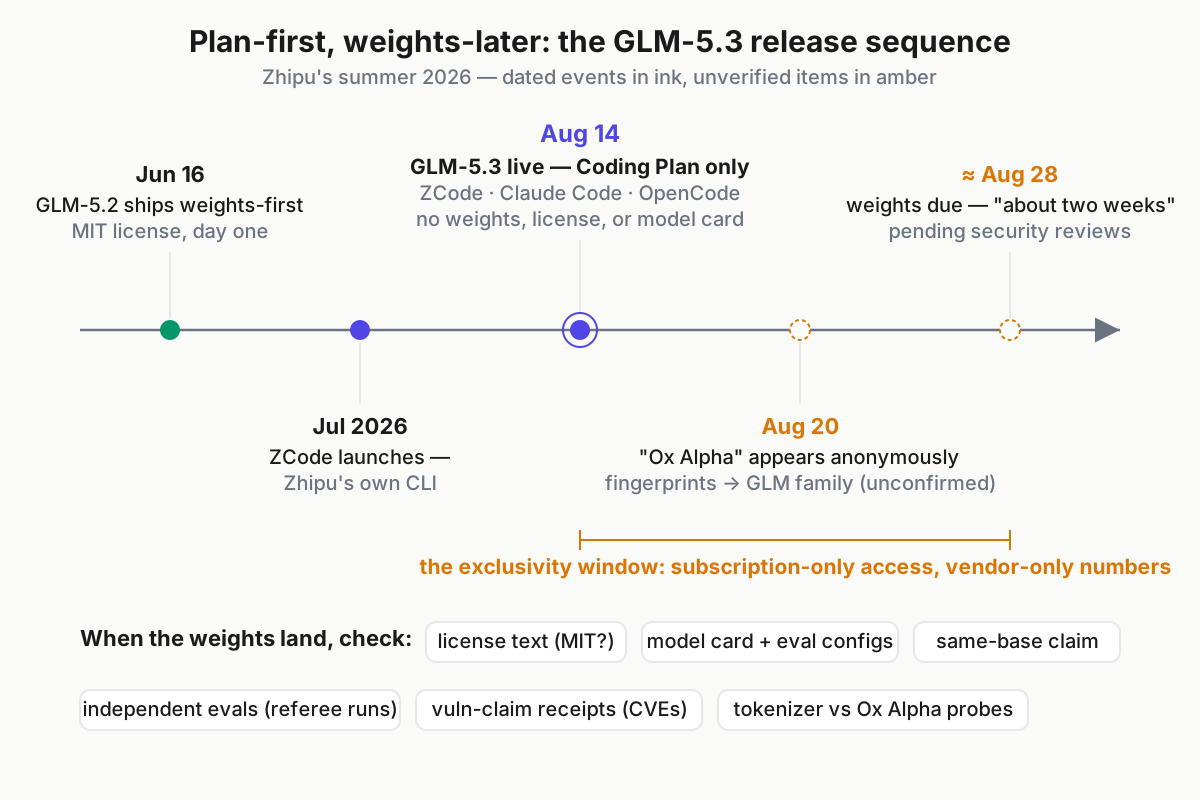
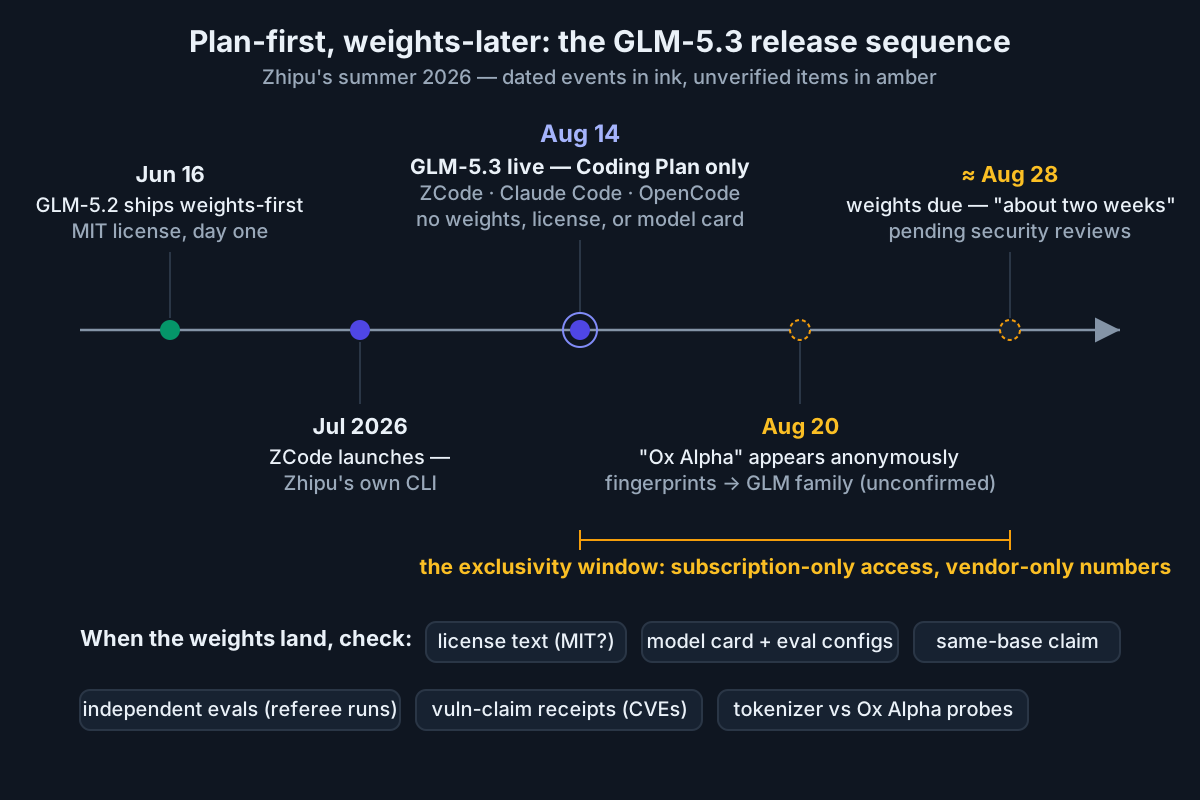 Two months from weights-first to plan-first. Amber marks the unconfirmed: the Ox Alpha attribution and the weights due date.
The GLM-5.3 claims audit: what Zhipu says vs. what anyone can check
Every fact in the launch story currently traces to one source: Zhipu. That is normal for launch week and fine to report — as long as the labels stay on. Here is the ledger, as of August 27:
| Claim | Source | Independently checkable today? |
|---|---|---|
| “50% improvement over GLM-5.2, from post-training alone” | Zhipu | No — no referee runs, and the metric is unspecified |
| “Strongest open-weights coding system” | Zhipu | No — weights not released; “system” undefined |
| Found 2,436 vulnerabilities across 269 OSS projects | Zhipu | Not yet — no public advisory trail |
| Same base architecture as GLM-5.2 | Zhipu | When weights land — config files will settle it |
| Live via ZCode, Claude Code, OpenCode | Zhipu + users | Yes — subscribe and run it |
The “50 percent improvement” claim deserves the most suspicion, not because it is implausible but because it is unfalsifiable as stated. Fifty percent of what? A win-rate against GLM-5.2? An error-rate reduction? A composite internal eval? Each reading implies a wildly different model, and the announcement does not say. A delta without a metric is a mood, and vendors know that “50% better” survives repetition in headlines long after the missing denominator would have embarrassed it.
The “strongest open-weights coding system” superlative has two escape hatches built in. “System” can mean model-plus-harness rather than model, which makes any comparison unfixable; and the claim is being made while the weights are closed, which means the one category it claims to lead is a category it is not yet in.
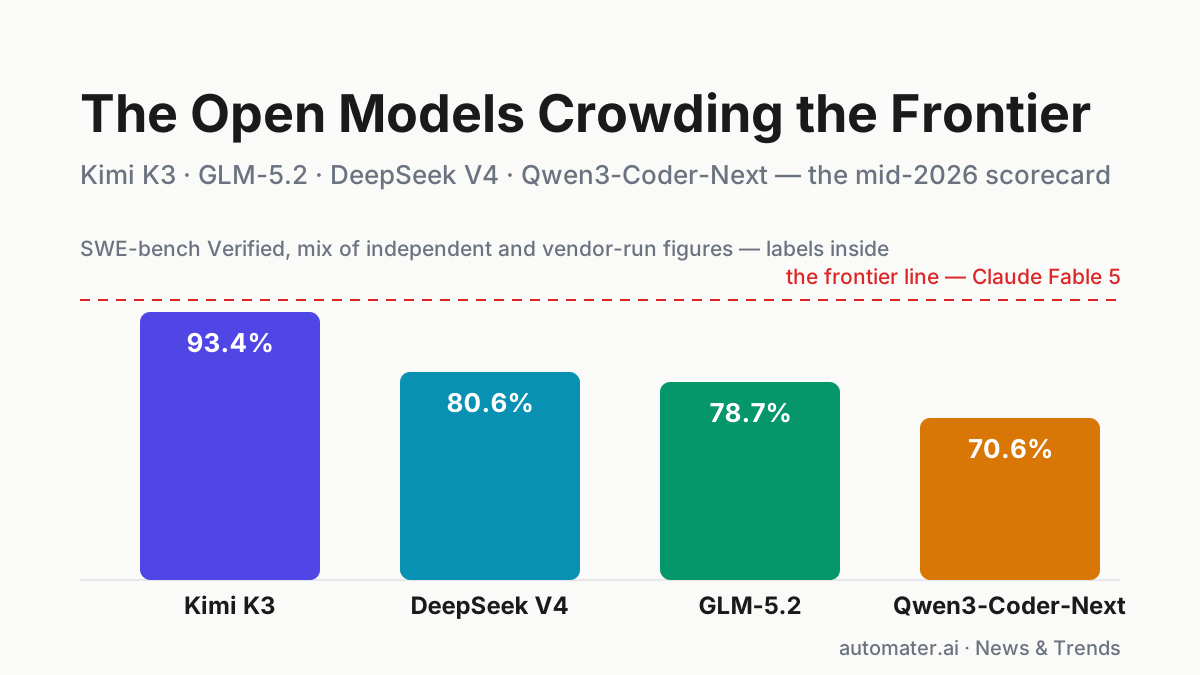
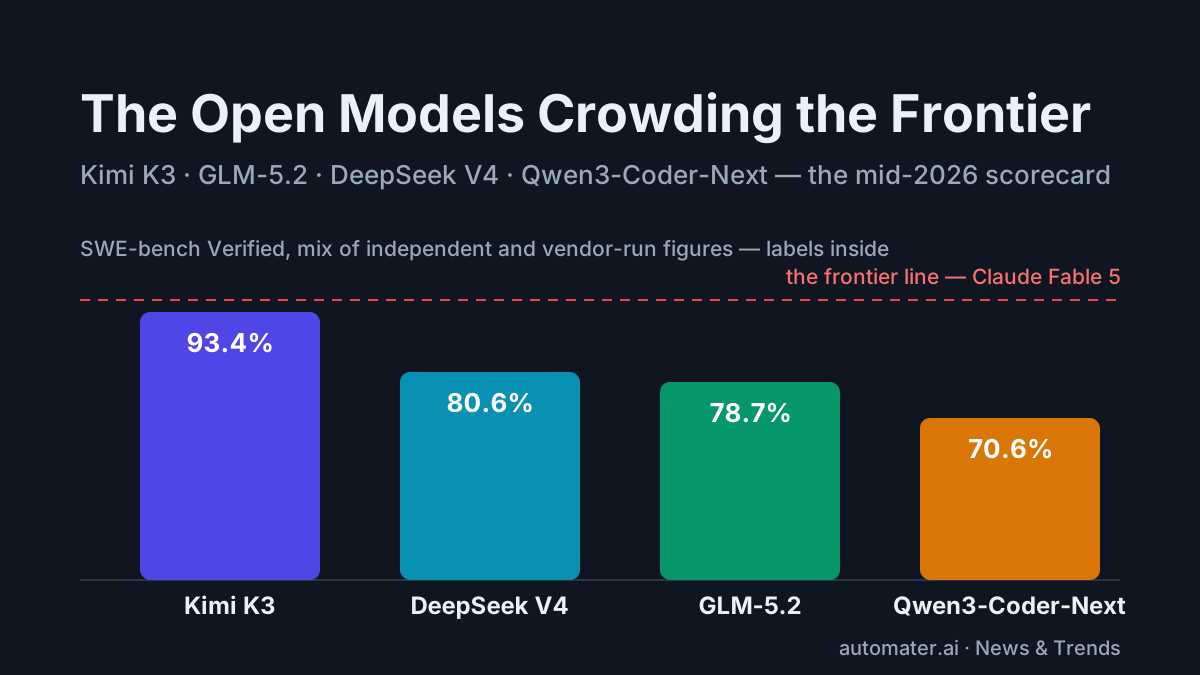
Here is what an earned version of these claims looks like, because Zhipu itself provides the template. GLM-5.2’s credibility rests on a referee: Epoch AI’s independent run put it at ~78.7 percent on SWE-bench Verified, against the vendor’s own ~62.1 percent on the harder SWE-bench Pro. Those numbers mean something precisely because someone outside the building produced one of them. GLM-5.3 has had no chance to earn that yet — the weights gap forecloses it — so every ranking you see this month is marketing arithmetic. Vendor numbers are hypotheses; referee runs are results, and until Epoch- or Vals-class runs exist, GLM-5.3’s leaderboard position is officially “unknown, promising.”
The discipline, compressed: date-stamp the claims, label the source on every number you repeat, and keep a short list of what would change your mind — for us, one independent SWE-bench-class run and one long-horizon agentic suite. Anything less is transcription, not evaluation.
2,436 vulnerabilities across 269 projects: the claim that needs receipts
The launch’s most striking number is a security claim: GLM-5.3, per Zhipu, found 2,436 vulnerabilities across 269 open-source projects. If the model genuinely operates as a capable vulnerability researcher at that scale, it matters well beyond leaderboards — for defenders, for OSS maintainers, and for anyone thinking about dual-use capability in coding models.
Which is exactly why the number needs a paper trail it does not yet have. AI-found-vulnerability claims in the wild have ranged from real, maintainer-confirmed discoveries to automated slop that buried volunteer maintainers in plausible-sounding false reports — the curl project’s public exasperation with AI-generated junk reports became the canonical cautionary tale. A four-digit vulnerability count sits in the range where methodology is everything: 2,436 findings across 269 projects averages nine per project, and without severity data that is compatible with anything from “landmark security result” to “a linter with confidence.”
Verification here has a known shape. Before treating the claim as real, look for:
- CVE or GHSA identifiers — assigned advisories traceable to specific findings, not aggregate counts
- Maintainer confirmations — named projects acknowledging the reports as valid, ideally with patches
- A disclosure timeline — evidence projects were notified responsibly before the press release counted their bugs
- A severity distribution — how many critical/high versus informational, and the false-positive rate
- A published methodology — target selection, tooling, human triage in the loop
As of late August, none of that is public. The honest posture: an interesting claim from a capable lab, currently resting entirely on the lab’s word. If even a tenth of it survives confirmation at meaningful severity, it will deserve its own article. Until then it is the launch deck’s boldest slide.
How to try GLM-5.3 today
The weights wait does not stop you from evaluating the model — it just routes you through the subscription. The Z.ai GLM Coding Plan is the lane: tiers named Lite, Pro, and Max, with Lite marketed around $3 a month at promotional pricing. Three integration paths, in increasing order of familiarity:
ZCode, Zhipu’s own CLI from July 2026, gets first-party treatment and the earliest feature support. OpenCode takes the plan through its normal provider configuration. And Claude Code — the path most readers will use — takes it as the canonical env-var engine swap:
# Claude Code → Z.ai GLM Coding Plan, GLM-5.3 lane
export ANTHROPIC_BASE_URL="https://api.z.ai/api/anthropic"
export ANTHROPIC_AUTH_TOKEN="<your-z.ai-key>"
export ANTHROPIC_MODEL="glm-5.3"
claude
Then evaluate like it is your money, because it is. Do not re-run the vendor’s demo; run your last two weeks of real work. Pick fifteen or twenty representative tasks — the bulk refactor, the flaky-test hunt, the API migration — and run them through the GLM-5.3 lane while your usual lane handles production. Score patch quality, tool-call discipline over long sequences, and how often you intervened. A cheap lane that handles 70 percent of your grunt work is worth keeping even if it never touches the hard 30 — that split, not a leaderboard delta, is what the daily-driver tool rankings actually turn on.
Two practical cautions from the plan lane’s known mechanics. Quota is metered in prompts per rolling window, so a long agent session that starts near a window’s edge can stall mid-refactor — schedule bulk runs accordingly. And the marketed usage multiples against US plans are vendor claims; your workload’s shape decides your real cost per useful patch.
Product note: A new cheap lane is a metering problem before it is a trust problem. Automater Lite meters tokens locally across every provider you run and archives every session into one searchable library, so two weeks of GLM-5.3 trial produces actual numbers — what the lane burned, what it shipped, where it stalled — instead of a vibe. The lane earns trust on your data, not the vendor’s. Free on automater.ai.
When the weights land: the checklist
Around August 28, if the two-week estimate holds, GLM-5.3 stops being a subscription exclusive and becomes checkable. Run this list before repeating anyone’s conclusions, including ours:
- Read the license file, not the announcement. GLM-5.2 was MIT. Confirm GLM-5.3 matches — or note exactly what the new terms restrict (commercial use, distillation, redistribution) before it touches your stack.
- Grade the model card. Parameters and active parameters, context length, training-data cutoff, eval methodology with configs. A thin card two weeks after a loud launch is itself information.
- Verify “same base as GLM-5.2” from the configs. Architecture files settle the post-training thesis instantly — and make the claimed gains reproducible research rather than folklore.
- Wait for referee numbers before re-ranking. Epoch- or Vals-class independent runs, on Verified and on a harder suite, are the moment “50% better” becomes a testable sentence. Vendor launch charts do not count, per the standing benchmark-reading rules.
- Check the vulnerability claim’s paper trail. Advisories, maintainer confirmations, methodology — the section above, applied.
- Compare the tokenizer against the Ox Alpha probes. The community’s fingerprints are on record; the weights end the whodunit one way or the other.
- Price the self-host reality. A 744B/40B MoE is datacenter-class even quantized; watch whether a smaller sibling ships alongside, and what first-party API pricing looks like against GLM-5.2’s roughly quarter-of-frontier posture.
The checklist’s shape is the article’s argument in miniature: everything interesting about GLM-5.3 is currently a promise, and promises have due dates. This one’s is about two weeks old the day it ships.
The Ox Alpha wrinkle
Six days after GLM-5.3 went live behind the Coding Plan, a free, anonymous model called Ox Alpha appeared on OpenRouter, OpenCode, Cline, and Nous Research’s portal — million-token context, multimodal input, no maker named. Community forensics on its tokenizer behavior and video-token accounting pointed at the Zhipu GLM family, and the speculation converged on an unreleased “GLM-5.3 Flash” — a smaller multimodal sibling being stress-tested in public while the flagship’s weights sat in security review. Zhipu has not commented, and nothing is confirmed.
If the speculation holds, the two launches are one strategy viewed from both sides: a paid, named lane monetizing the flagship, and a free, anonymous lane harvesting real-world usage for the family — subscription revenue and training data, collected in parallel, during the exact window when the weights were “in review.” That is not a scandal; it is unusually legible product strategy. But it would also mean the quiet part of plan-first releases is quieter than anyone said out loud. The full Ox Alpha story — the benchmark collapse, the fingerprint evidence, and what it is sane to send an anonymous model — is its own article, and the two are best read together.
Step back and the week makes one point twice. Whether GLM-5.3 is a leap or a solid increment is currently unknowable by design — the release shape defers every check that would tell you. The harness ecosystem made trying it trivially easy; the weights wait made verifying it temporarily impossible. Hold both: run the cheap lane on your real work this week, and keep the claims in escrow until the repository, the license, and the referees exist. As of August 2026, that is what evaluating an “open” model means.
FAQ: GLM-5.3
What is GLM-5.3?
GLM-5.3 is Zhipu’s coding-focused model released August 14, 2026 — first through the Z.ai GLM Coding Plan via ZCode, Claude Code, and OpenCode integrations, with open weights promised roughly two weeks later pending security reviews. It shares GLM-5.2’s base architecture; Zhipu credits all gains to post-training.
Is GLM-5.3 open source?
Not yet. At launch there were no downloadable weights, no license text, and no model card — Zhipu said weights would follow in roughly two weeks after security reviews. Until a repository with a real license exists, treat GLM-5.3 as a closed subscription model with an open-weights promise attached.
How can I use GLM-5.3 right now?
Subscribe to the Z.ai GLM Coding Plan and drive it from a harness you already run: Zhipu’s own ZCode CLI, Claude Code via an Anthropic-compatible endpoint swap, or OpenCode’s provider config. The Lite tier has been marketed around $3 a month at promotional pricing — verify current tiers before buying.
Is GLM-5.3 better than GLM-5.2?
Unknown, honestly. Zhipu claims a 50 percent improvement from post-training alone and calls it its strongest coding system, but no independent benchmarks existed as of late August 2026, and the claim’s metric is unspecified. GLM-5.2’s 78.7 percent SWE-bench Verified came from an independent run — hold GLM-5.3 to that standard.
Is Ox Alpha the same model as GLM-5.3?
Unconfirmed. Community fingerprinting of Ox Alpha — tokenizer behavior, video-token metering — points to Zhipu’s GLM family, and the timing fits a “GLM-5.3 Flash” sibling appearing six days after GLM-5.3’s plan-first launch. Zhipu has not commented. If the weights land with a matching tokenizer, the case closes; until then it is a strong lead.
Sources
- MLQ: Zhipu releases GLM-5.3 through its coding service, with weights still two weeks away
- Hugging Face community blog: the GLM-5 family
- Z.ai — Zhipu’s international platform and home of the GLM Coding Plan
- Wikipedia: Z.ai (Zhipu AI) — company background
- Epoch AI — independent evaluations, including GLM-5.2’s SWE-bench Verified run
- Mid-2026 open-source coding model roundup — GLM-5.2 baseline figures
- Decrypt: Mysterious AI model Ox Alpha