Google Ships Gemini 4 Neon: A $3/$15 Mid-Tier Frontier Model for Agentic Coding, Already in Copilot
Gemini 4 Neon slots between Carbon and Hydrogen at $3/$15 per million tokens with a 1M context, live day one in the Gemini API and GitHub Copilot.
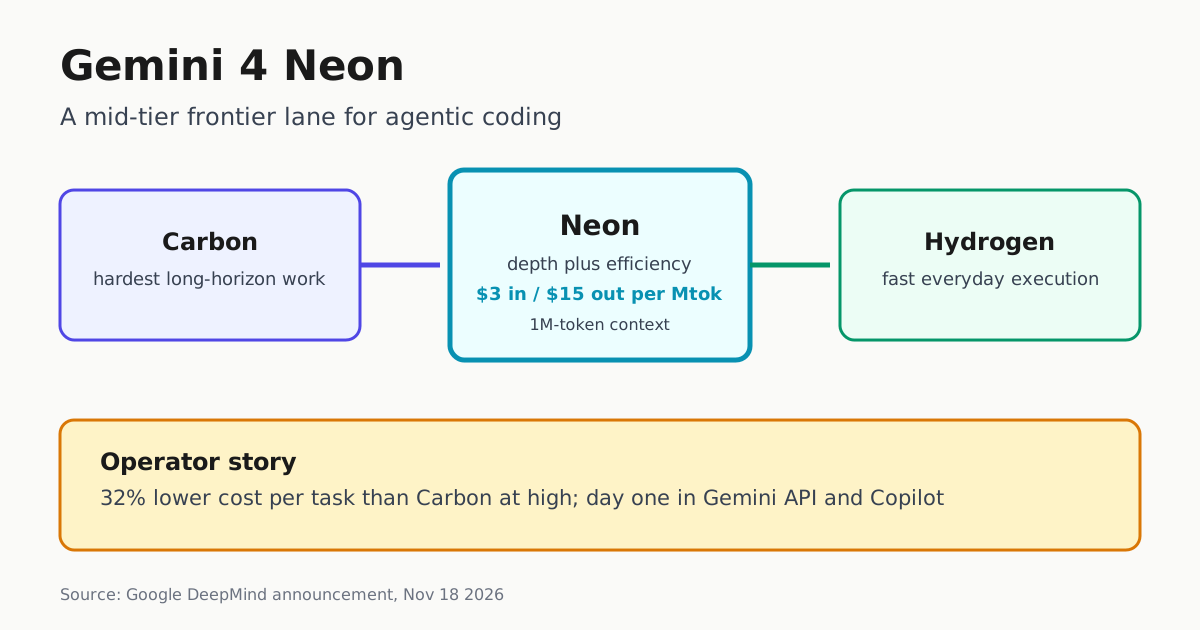
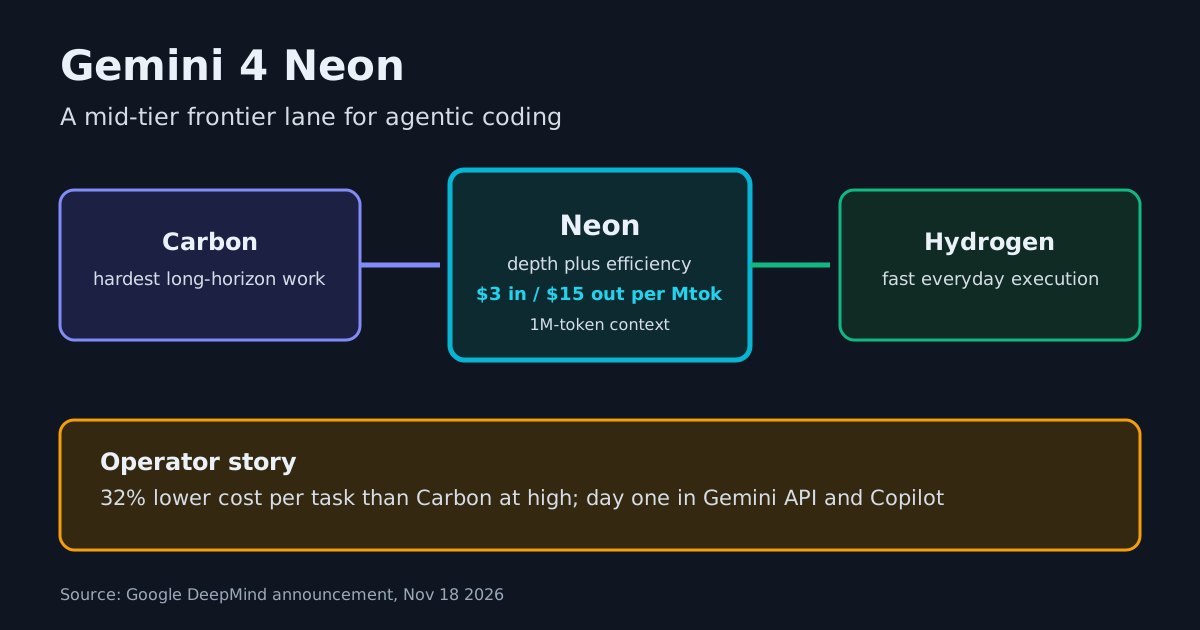
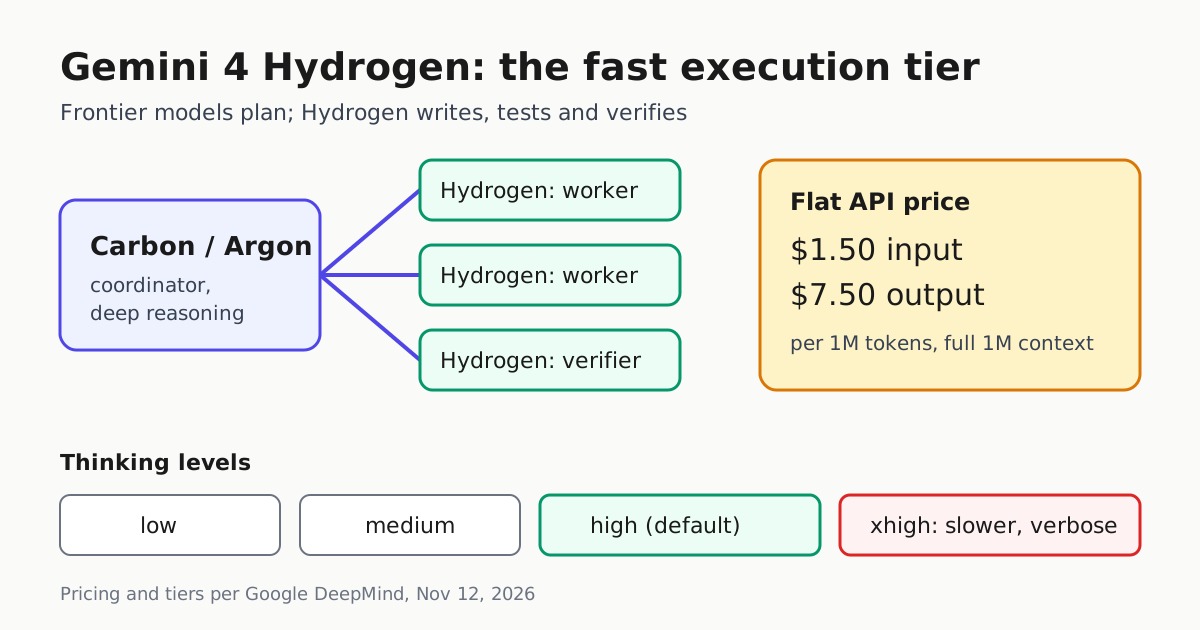
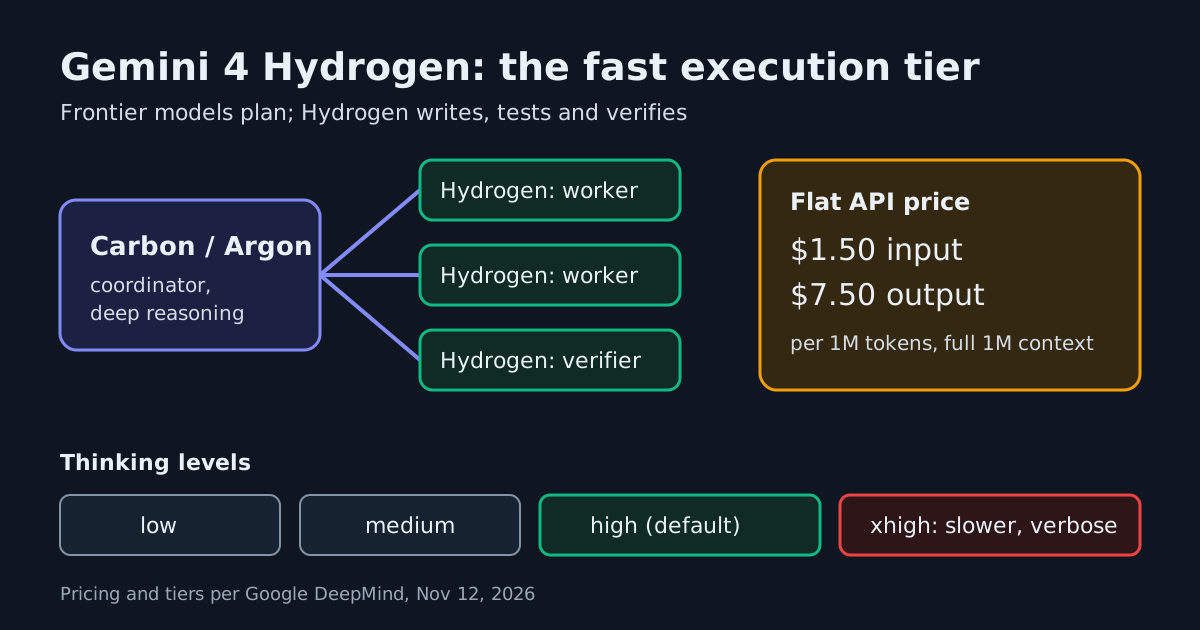
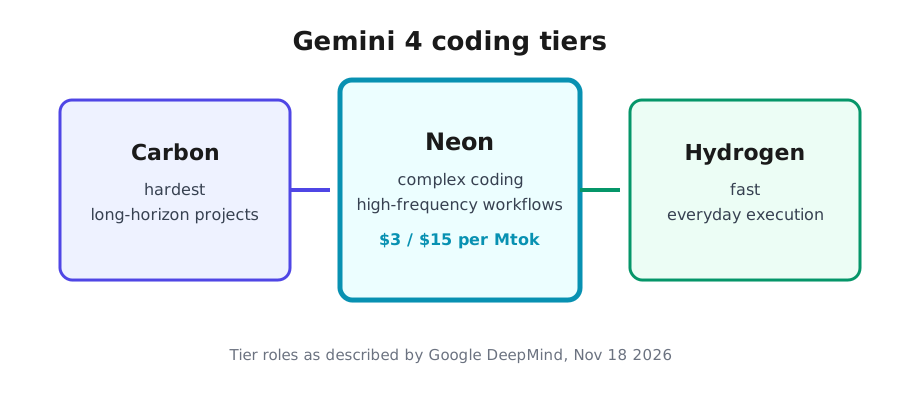
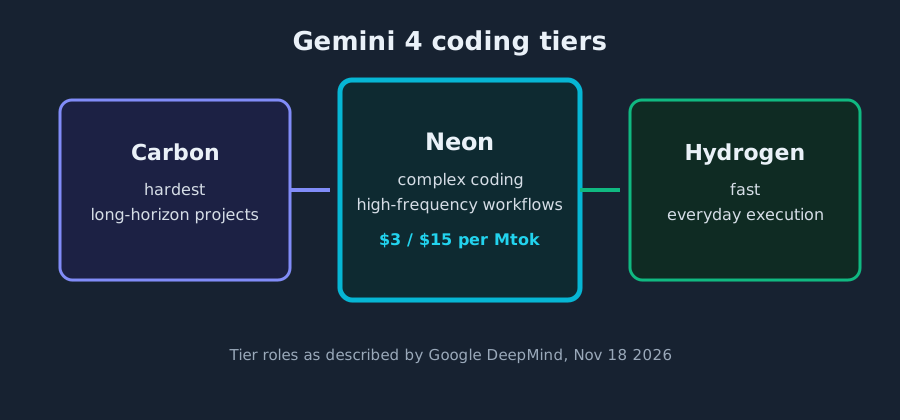
Google DeepMind shipped Gemini 4 Neon today, and the interesting part for anyone operating coding agents is not another benchmark table — it is where the model sits. Neon is a new mid-tier lane between Carbon (Google’s hardest, long-horizon work, which we covered at its Carbon launch) and Hydrogen (fast everyday execution, see our Hydrogen launch coverage). It is priced at $3 per million input tokens and $15 per million output tokens with a 1 million-token context window, and available the same day in the Gemini API and GitHub Copilot (DeepMind announcement, GitHub changelog).
What shipped, where
Per Google’s announcement (also mirrored on the Google blog, Nov 18, 2026), Neon is rolling out now in:
- The Gemini API paid tier, Google AI Studio and Android Studio
- Gemini for business (API and model dropdown) and Google Antigravity for paid AI Pro/Ultra subscribers
- The Gemini app for Pro and Ultra subscribers
- GitHub Copilot, where GitHub says it is generally available to Pro+, Max, Business and Enterprise users across VS Code, Visual Studio, Copilot CLI, the Copilot coding agent, JetBrains IDEs, Xcode, Eclipse, GitHub Mobile and github.com, billed at provider list pricing under usage-based billing
Copilot administrators should note the default: new models are automatically enabled unless an administrator has turned off the global default or explicitly disables the model. If your team is not already routing Copilot model access through policy, Neon just appeared in your model picker.
The operator case: cost per completed task
Google’s own framing is the useful one: at Neon’s default high thinking level it pairs a high Artificial Analysis Intelligence Index score with a 32% lower cost per task than Carbon, and sits on the Pareto frontier on both the Vals Index and Agent Arena with roughly 50% to 80% lower cost per task than top competing frontier models. At xhigh — its highest scoring setting — Google says it still costs 36%+ less per task than competing models at their highest setting. Cached input runs $0.15 per million tokens, a 95% discount, which matters for agent loops that re-read a large repo prefix on every turn.
On coding-agent work specifically, Google reports Neon #1 on the Artificial Analysis Coding Agent Index (58.6), 65.2% on Terminal-Bench 4.1, and an SWE-sweep result that jumps from 12.8% on the mini-SWE harness to 39.0% inside Google Antigravity — a reminder that the harness moves the score as much as the model.
GitHub’s changelog adds the operational detail that matters more than leaderboard rank: Google reports that compared with Carbon, Neon starts responding faster, makes fewer unrequested changes on coding tasks, and is less likely to make unsupported claims about code, tool or test results. Those are exactly the failure modes that generate review load and rollbacks on unattended lanes.
Routing implications
For fleet operators, Neon is best read as a routing candidate, not a default swap:
| Workload | Candidate | Why |
|---|---|---|
| High-volume agentic coding, tool-heavy loops | Neon (high) | 32% cheaper per task than Carbon, frontier-class scores |
| Hardest multi-step reasoning | Neon (xhigh) | Highest intelligence score, still 36%+ cheaper than rivals’ top setting |
| Long-horizon, highest-stakes projects | Carbon | Still Google’s tier for the hardest work |
| Fast everyday execution | Hydrogen | Cheaper fast lane for routine turns |
Google also positions Neon as an Orchestrator that directs parallel Hydrogen subagents inside Antigravity, cutting redundant file reads and handling context compaction reliably in long sessions. If you run coordinator/subagent topologies, that is the pattern Neon was tuned for — and our fast-worker lane contract guidance applies: swap the model, keep the lane, and measure cost per completed task rather than per-token price before you commit.
Caveats
All quality and cost-per-task figures above are Google-reported or Google-cited; the Copilot behavioral claims are GitHub relaying Google’s reporting. Independent verification will take days. Rollout in Copilot is gradual, and Neon for cyber reaches only Fairwind Program defenders in the coming days. Benchmark shoppers should also note that scores like the 39.0% SWE-sweep result are harness-specific, not portable to your setup.
Still, day-one availability in two major harnesses, a 1M-token window, sub-Carbon pricing and a steerability story make Neon an obvious candidate to benchmark on your own task mix this week.