Google Ships Gemini 4 Hydrogen: Flat $1.50/$7.50 Pricing, a Gemini 3.8 Flash Replacement and a Global Search Rollout
Gemini 4 Hydrogen is rolling out today in the Gemini API, AI Studio, the Gemini app, Search and Antigravity. It costs $1.50/$7.50 per million tokens across its full 1M context. Here is who gets it and what the speed claims leave out.
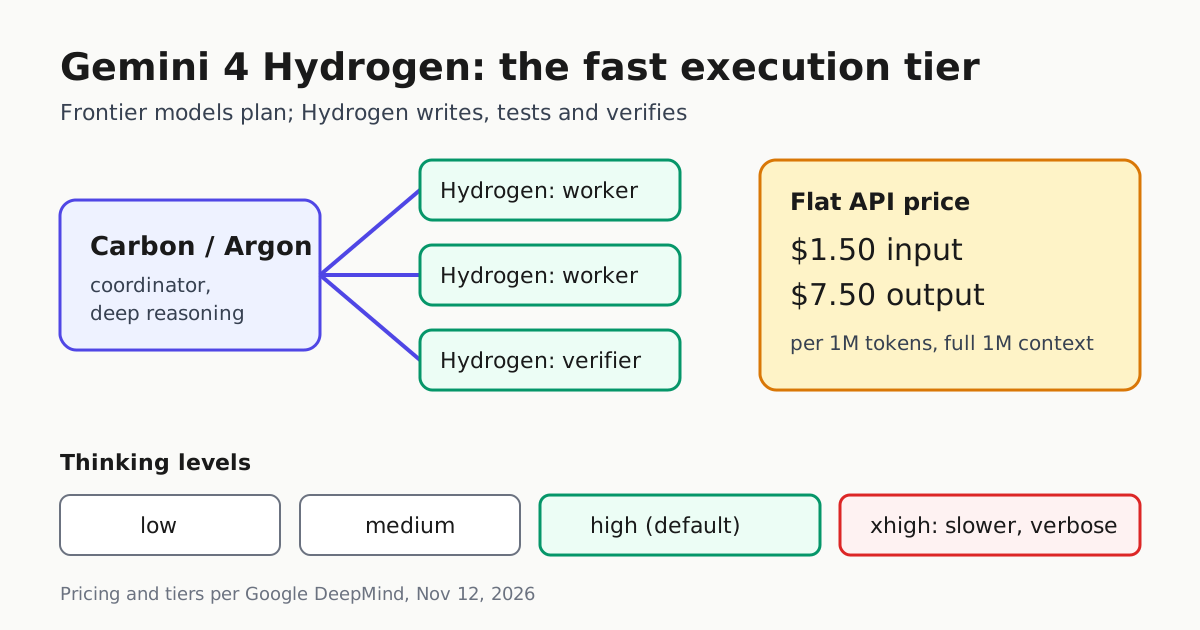
Google released Gemini 4 Hydrogen on Nov. 12, 2026. It is the fast execution tier of the Gemini 4 family. Unlike most model launches, it started rolling out the same day to developers, enterprises and consumers. In the Google DeepMind announcement, Koray Kavukcuoglu describes Hydrogen as “built for rapid execution across diverse agentic workflows.” Long-horizon reasoning stays with the frontier models, Gemini 4 Carbon and Gemini 4 Argon.
For operators, three things matter. Hydrogen has one flat price across its full context window. It replaces Gemini 3.8 Flash as Google’s everyday coding and agent model. And it now runs inside Google Search for every user, worldwide.
What shipped, and where you can use it
Google says Hydrogen is “rolling out globally” starting today. The same post on The Keyword splits access by surface:
| Surface | Who gets Hydrogen today |
|---|---|
| Gemini API, Google AI Studio, Android Studio | Developers on all AI Studio and Gemini API tiers |
| Google Antigravity | Paid Google AI Pro and Ultra subscribers, plus Gemini for business |
| Gemini for business | Via the API or the model drop-down |
| Gemini app | Model drop-down; free users get it only through auto model selection when it fits the prompt |
| Gemini in Google Sheets | Starting with AI Pro and Ultra; eligible business subscriptions |
| Google Search | All users globally |
The Gemini app footnote matters. Free users cannot pin Hydrogen. They get it only when Google’s router decides it suits the prompt. Google’s announcement says “all tiers” of AI Studio and the Gemini API. It does not publish free-tier rate limits, and the pricing documentation we tried to check was not readable. So this report does not confirm a free API tier or its quotas.
Pricing: one rate across the full 1M window
Google prices Hydrogen at $1.50 per million input tokens and $7.50 per million output tokens. It describes that price as “flat across its entire 1 million-token context window.” That removes the long-context price step that complicates budgeting for agents that load whole repositories. The model accepts up to 1 million input tokens and can produce up to 1 million output tokens.
According to Silicon Report, Artificial Analysis describes these rates as moderate. It puts the industry medians at $2.00 input and $10.00 output. Artificial Analysis also calculated a weighted cost of $3.16 per task on its Intelligence Index.
The speed and quality claims, all vendor-reported
Google positions Hydrogen as a direct upgrade for teams moving off Gemini 3.8 Flash. It claims:
- Hydrogen finishes tasks 2.5x faster at its default high thinking level.
- It scores 57% vs. 18.2% on Terminal-Bench 4.1.
- It produces fabricated claims more than 5x less often.
- Partners saw it run 2x to 2.8x faster with 12% to 23% fewer tokens on graph, SQL and data-heavy work.
- On the Artificial Analysis Intelligence Index it scores 51 at the default high level, above Argon’s 50. At the new xhigh level it scores 54.
These figures come from Google and early partners, not from independent replication. Silicon Report notes a caveat. Google’s own comparison shows Hydrogen trailing Claude Sonnet 5.5 and GPT-6.1 Terra on science and math, on computer use and on Terminal-Bench 4.1. Google calls those gaps small.
Google’s safety claims are also internal measurements. It says Hydrogen reduces overreach in agentic tasks by up to 81%. It says Hydrogen is up to 2x less likely to bypass permission boundaries on blocked tasks. And it reports 2.3x more resilience on the Gray Swan indirect prompt injection benchmark.
The xhigh catch
Hydrogen has four thinking levels: low, medium, high (the default) and a new xhigh. The 54 score requires xhigh, and that level has costs. According to Silicon Report, Artificial Analysis measured these results on xhigh:
- 41.11 seconds average time to first answer token, against a peer median of 13.45 seconds.
- 304 million output tokens across the index run, against a median of 72.8 million.
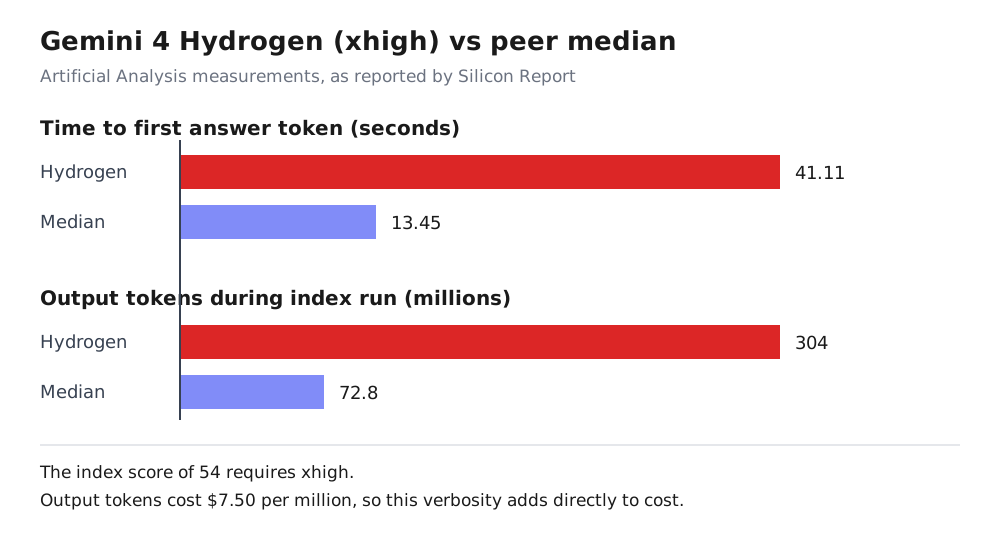
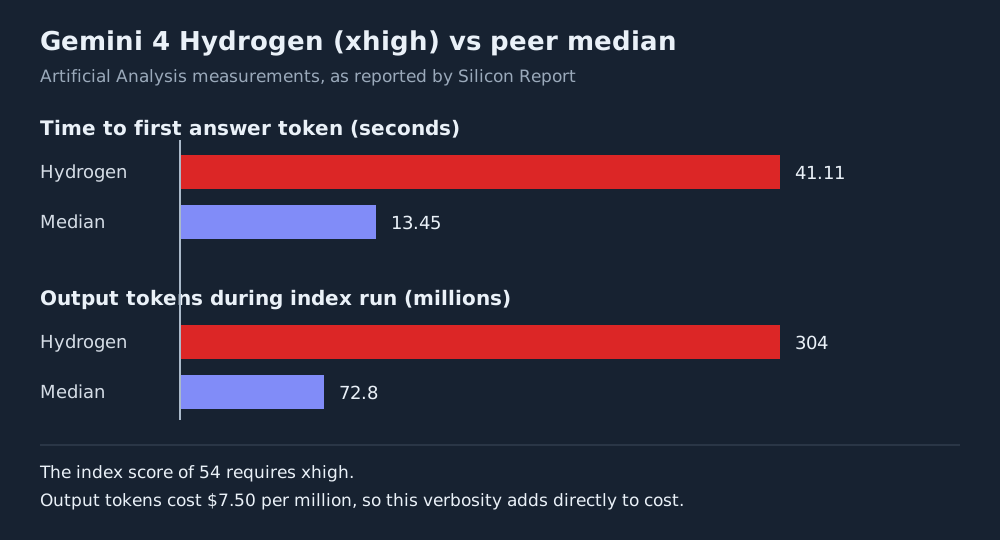
Output tokens cost $7.50 per million, so verbose reasoning drives the bill more than the input price does. Leave Hydrogen at high by default. Use xhigh only where you have measured a gain. Our guide to pricing effort per completed task explains how to make that call.
Orchestrator: Hydrogen as the worker tier
Google also announced Orchestrator for Google Antigravity. It switches between models such as Carbon and Hydrogen within one session. On Terminal-Bench 4.0, Google says Orchestrator came close to Carbon’s success rate while using 24% less quota and finishing 19% faster. Google also describes a setup for parallel agents. Carbon acts as the coordinator, and Hydrogen powers worker and verifier agents in isolated workspaces. The post does not say which plans get Orchestrator. Check Antigravity directly before you build around it. For background, see our field notes on Antigravity.
Search: the largest audience
Robby Stein, Google’s VP of Product for Search, calls Hydrogen “the biggest model upgrade to Search yet.” The post says it brings:
- better handling of multi-part queries and queries with typos;
- an upgraded query fan-out that runs simultaneous sub-queries and returns a wider range of links;
- more visual answers;
- better responses in all supported AI Mode languages.
The Verge reports Stein’s statement that Hydrogen is “now the new default model in AI Mode” and is used for the hardest questions in AI Overviews. If you publish content, a wider fan-out could change which pages get cited. Google has not published data on how much link distribution shifts.
What to do
- Test before you switch from 3.8 Flash. Re-run your own agent tasks at the high level. Compare cost per completed task, not just token price. This guide covers the method.
- Keep xhigh behind a gate. The latency and token figures make it a poor default for interactive work.
- Check plan access. Antigravity access requires a paid AI Pro or Ultra subscription. Free Gemini app users cannot select Hydrogen directly.
- Treat Google’s benchmarks as claims. Independent results so far come mainly from Artificial Analysis, as reported secondhand.