Cisco, Goldman and JPMorgan Move From Open AI Access to Token Budgets and Caps
Cisco gives every manager a token budget, JPMorgan caps Claude Code at $2,000 a month and Goldman rations frontier models — token governance goes standard.
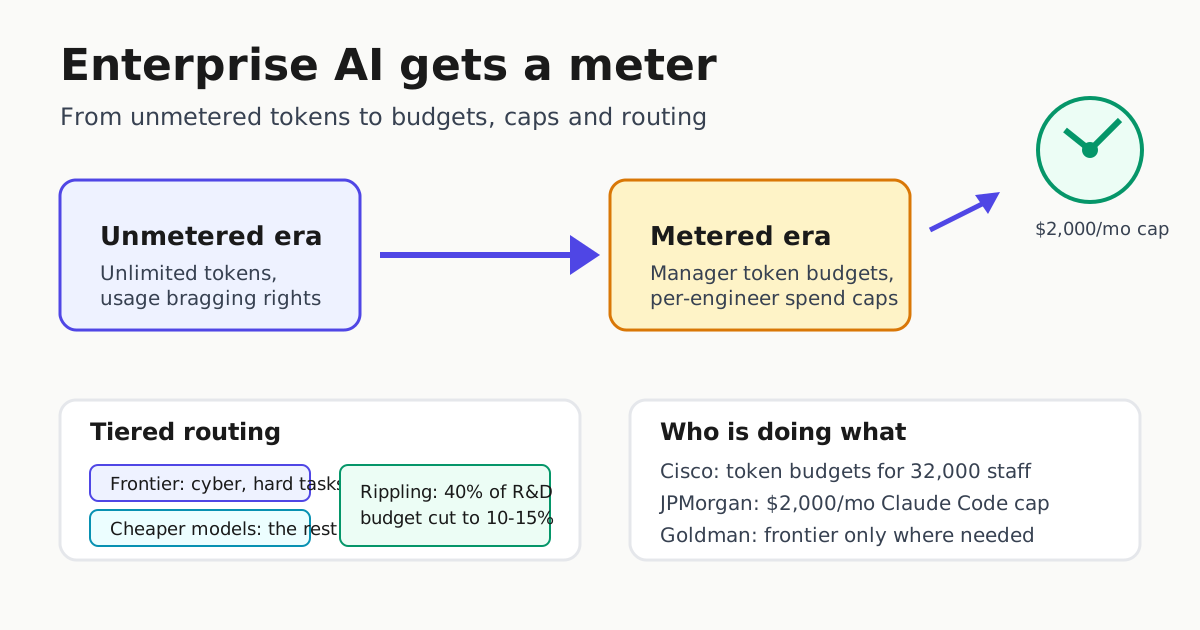
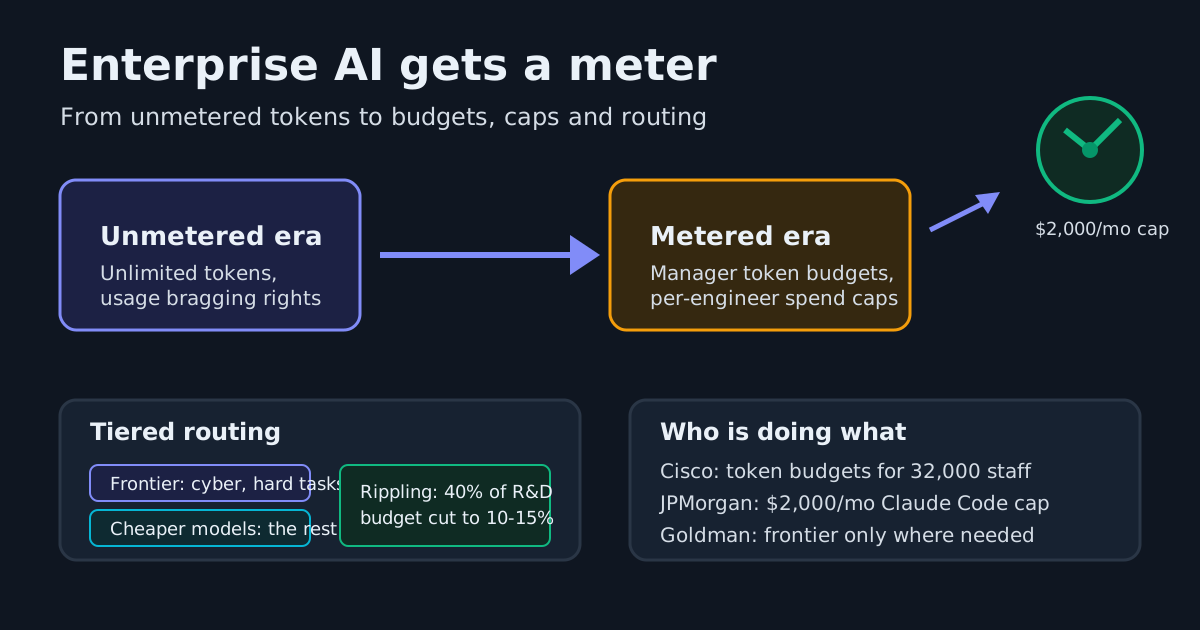
The unmetered phase of enterprise AI adoption is ending. A Business Insider report published November 11 documents that Goldman Sachs, Cisco, and JPMorgan — three of the largest employers in finance and technology — are replacing broad, encouragement-era AI access with budgets, caps, and tiered model routing. For operators running coding-agent fleets, the story is a signal that token cost governance is moving from nice-to-have to standard enterprise practice.
What the report actually documents
At Goldman Sachs, CEO David Solomon said the bank is rapidly expanding the range of AI tools for its 45,000 employees but that it does not make sense for all of them to reach the most advanced models every day. “We need frontier models for certain things, particularly cyber,” he told Bloomberg TV — but “there are a lot of things where we don’t need the frontier” for productivity work.
Cisco’s chief product officer, Jeetu Patel, described a deliberate two-phase rollout: coding teams first got months of unlimited tokens to become fluent, an approach he compared to learning to ride a bicycle. Now, he said, managers across his 32,000-person organization will receive token budgets.
JPMorgan, Business Insider notes, imposed a $2,000 monthly cap on some engineers’ use of Anthropic’s Claude Code in September. A bank spokesperson framed the cap as tying costs to productivity, quality, risk reduction, and business impact — not as retrenchment. It is the same line-item logic we saw when Accenture capped centrally funded Claude at $29 per month and pushed overage to project budgets.
Rippling, a workforce-management software startup, offers the most concrete before-and-after numbers. After projecting that token spending could reach 40% of its R&D headcount budget, it set monthly caps in August; the limits plus more efficient model routing brought the projection down to between 10% and 15% — while token use stayed near its previous peak. “The point isn’t to cut AI cost,” CPO Matt MacInnis said in a statement. “We’re actually fine with cost growth, provided it’s productive.”
The economics driving the caps
Two data points frame why employers are acting now. Menlo Ventures found enterprise AI deployment spending reached $177 billion by September, up from $33 billion in all of 2025 — a spending surge we examined in Enterprise AI Spend Hit $177B and Coding Agents Are a $34B Market — while only 13% of roughly 2,000 tech executives polled by Gartner said their organizations had gained significant value from AI. That gap between spend and demonstrated value is exactly what a budget line forces into the open.
The spending curve is also bending at the macro level. Ramp’s October AI Index, summarized by research lead Ara Kharazian, shows business AI spend growth slowed to about 2% month over month, with OpenAI and Anthropic growth at low single digits and engineering teams driving 72% of all AI spend. And the composition of that spend is shifting toward always-on workloads: SemiAnalysis founder Dylan Patel wrote that persistent agents now account for 45% of his firm’s AI spend. Persistent agents burn tokens whether or not a human is watching — which is precisely the usage pattern that per-manager budgets and per-agent spend ceilings are designed to bound.
The pendulum swung fast
What makes this notable is how quickly the posture flipped. Months ago, employers were bragging about consumption: Visa said it doubled monthly token use from 1 trillion in February to nearly 2 trillion in March, and Nvidia CEO Jensen Huang said he would be “deeply alarmed” if a $500,000 engineer used less than $250,000 worth of tokens. Business Insider’s reporting shows the same market now converging on rationing, routing, and measurement — driven partly by cost and partly by risk, including a 2025 KPMG survey finding 44% of US workers used AI without authorization and 46% had uploaded sensitive information to public AI platforms.
What this means for agent-fleet operators
For teams running Claude Code, Codex, or similar agents, the direction of travel is clear:
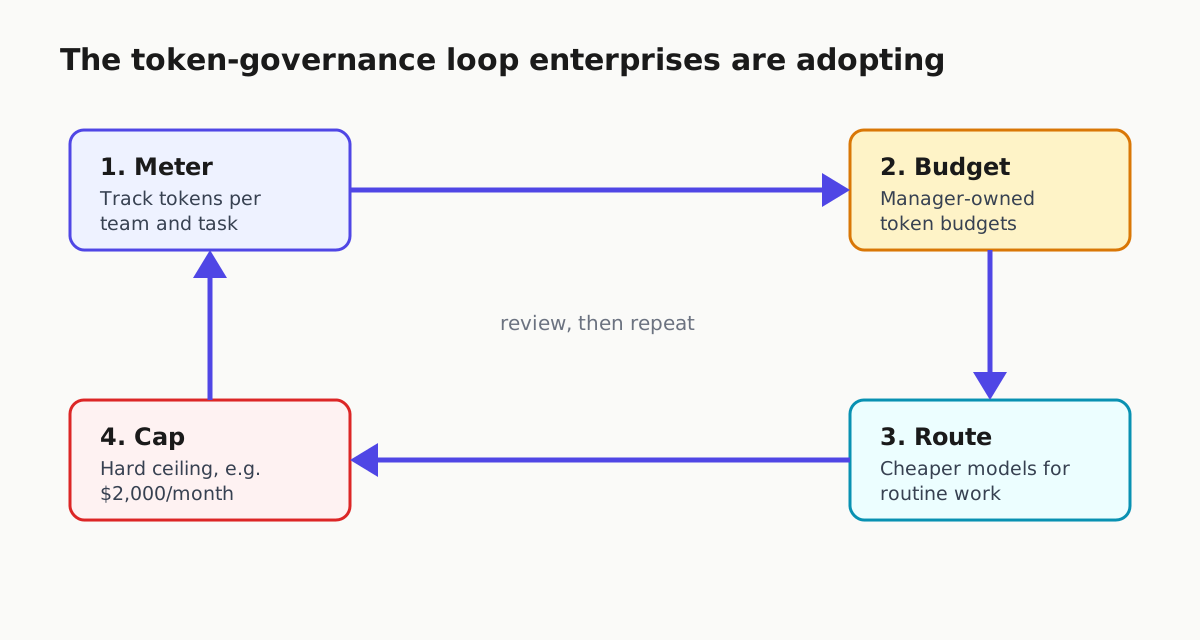
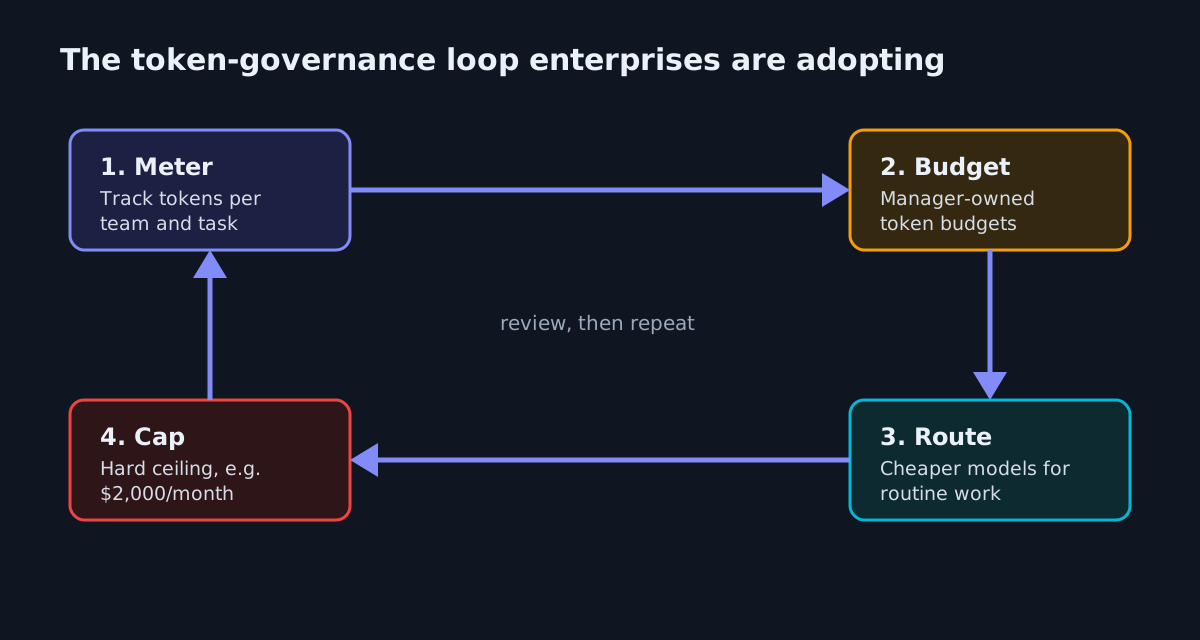
- Metering becomes a requirement, not an optimization. Cisco putting budgets in managers’ hands mirrors how fleet operators already think about anomaly thresholds, paging and auto-pause — except soon the budget meeting will ask why those thresholds exist at all.
- Routing beats restriction. Rippling hit its target mainly by moving work to cheaper models, not by cutting usage — token volume stayed near peak. Expect demand for routing layers and gateways that can send routine tasks downmarket and reserve frontier models for jobs like security work, where Solomon says they’re irreplaceable.
- Caps arrive as line-item policy. JPMorgan’s $2,000 Claude Code ceiling suggests fixed ceilings per role or project will become a normal procurement control. If you want a preview of what heavy users actually pay once every plan carries a meter, our Token Plans Decoded breakdown maps the tiers and their effective costs.
None of the companies in the report is pulling back on AI adoption. They are converting it from an open subsidy into a managed spend category — the same transition cloud computing went through a decade ago. The operators who already track cost per completed task, rather than raw token burn, will find that transition uneventful. Everyone else is about to get a budget meeting.
Sources
- Cisco, Goldman, and JPMorgan Are Reconsidering AI Access at Work - Business Insider
- Ara Kharazian on X: "NEW Ramp AI Index: In October, AI spend rose 2%. OpenAI and Anthropic growth fell to low single-digits. Engineering teams drove 72% of spend, followed by customer service and leadership. Given this relatively modest growth in spend, and new competitive dynamics that may stick…
- Dylan Patel on X: "Persistent Agents are the next unlock of AI usage Our spend on AI is now 45% persistent agents Unfortunately for Anthropic, Claude Tags sucks OpenAI's Slack agent is even worse We primarily use Perplexity Computer, which uses a lot of different models Perplexity's Harness mogs" /