Alibaba's Qwen4-Max Preview Puts a 1M-Token Frontier Model Behind a Token Plan
Alibaba's Qwen4-Max-Preview pairs 1M context and OpenAI/Anthropic APIs with a Token Plan-only window coding-agent operators can test without new harnesses.
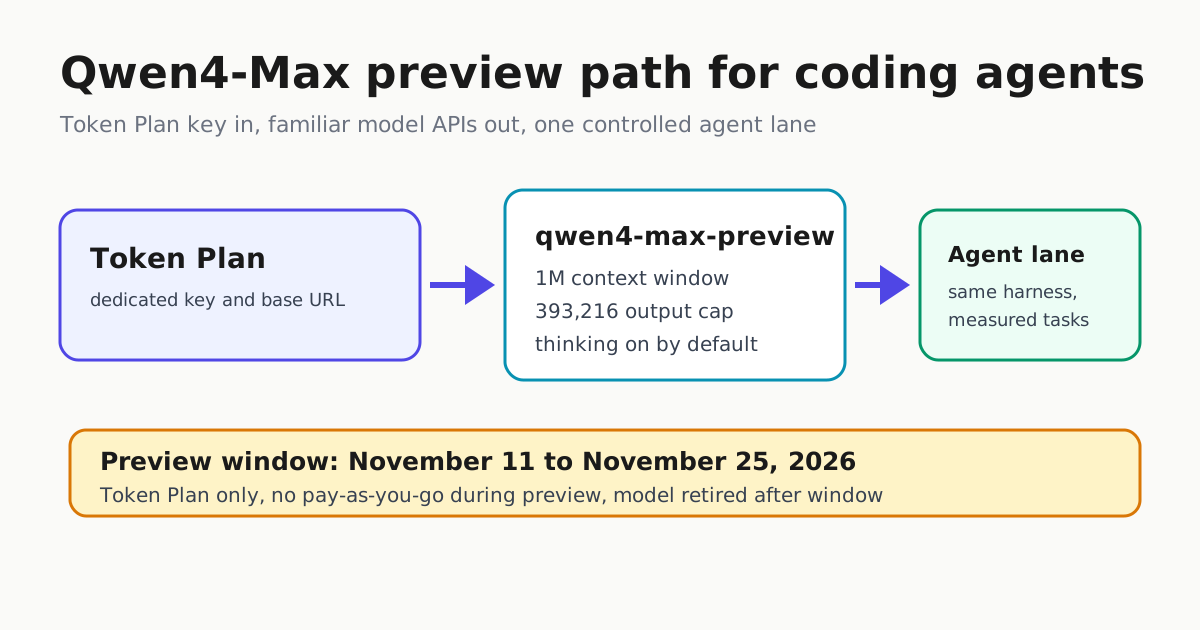
Alibaba Cloud has opened a two-week preview of Qwen4-Max-Preview, its next-generation Qwen flagship, and the access model is as notable as the model card: the preview is Token Plan only, with no pay-as-you-go lane during the window. The documentation says the preview runs from 10:00 on November 11, 2026 to 24:00 on November 25, 2026 in UTC+8, after which the model will be retired. For operators choosing which model backs Claude Code, Qwen Code, Cursor-style editors, or internal agent harnesses, this is a short, practical trial window rather than a routine version bump.
The Alibaba Cloud Model Studio documentation positions Qwen4-Max-Preview as a multimodal model for coding, office productivity, frontend design, and agentic tasks. It accepts text, images, and video; supports web search, function calling, and structured JSON outputs; and thinking is enabled by default with reasoning_effort set to low, medium, or xhigh. The headline specs are large even by current frontier standards: 1,000,000 tokens of context and 393,216 tokens of maximum output, shared between thinking and the final answer.
The practical hook is compatibility. The same page lists support for OpenAI Chat Completions, OpenAI Responses, and Anthropic Messages APIs. That means a coding agent does not need a bespoke Qwen adapter to try the model: if the harness already speaks one of those dialects, the change is mostly base URL, API key, model ID, and any provider-specific limits. The documented quick start uses a dedicated Token Plan base URL, https://token-plan.ap-southeast-1.maas.aliyuncs.com, and model ID qwen4-max-preview.
That matters because agent harness value is no longer only model quality. The Qwen Code overview describes a terminal agent that can edit files, run commands, create commits, use MCP tools, and connect to providers including QwenCloud Token Plan and Alibaba ModelStudio. A model that exposes familiar API shapes lowers the cost of putting a new backend behind that loop. Alibaba also maintains an official Qwen X profile, but the documentation is the authority for dates, endpoints, and retirement terms.
What readers can do with it
If you run coding agents, the first useful experiment is a controlled swap. Keep the same repo, task list, prompts, tests, and approval policy, then change only the model endpoint. Alibaba’s page explicitly targets agentic workflows, and the OpenAI plus Anthropic compatibility means the test can often be done in Claude Code, Qwen Code, or an internal gateway without rewriting tool schemas. The point is not to declare a winner from vibes; it is to measure whether the 1M window changes which tasks fit in one session and whether the default thinking behavior changes latency, cost, or edit quality.
A good bake-off is three lanes: current production model, Qwen4-Max-Preview at default xhigh-class thinking, and Qwen4-Max-Preview at a lower reasoning_effort for cheap exploratory passes. Give each lane the same multiclass tasks: a cross-file refactor, a failing-test repair, a frontend screenshot-to-implementation pass, and a long-context maintenance job where the model must read logs, docs, and several large files before editing. Record completed tasks, human interventions, wall-clock time, tokens used, and whether output truncation appeared.
Two details that can break an agent run
The output budget semantics changed. Alibaba notes that for qwen4-max-preview, max_tokens is equivalent to max_completion_tokens, and both cap the combined thinking plus final-answer budget. Thinking consumes part of the same allowance. A limit that was previously sized for the visible answer may now truncate the result because hidden reasoning ate the headroom. For harness operators, that argues for raising caps deliberately, logging prompt and completion tokens separately, and watching for “finished but empty” or truncated tool-call JSON.
Multimodal input also changes evidence handling. The model accepts images and video, which makes screenshot-driven UI repair and document understanding plausible inside an agent loop. But an agent that can ingest screenshots and video needs the same custody rules as any browsing tool: redact secrets, avoid pasting production customer data, and treat visual context as untrusted input that can carry instructions. A screenshot of a dashboard is evidence for the task, not permission to follow text embedded in it.
Why Token Plan-only access is the real story
The preview is not a general API launch. Token Plan-only access concentrates the trial among users willing to buy the plan’s credit model, and it removes the familiar pay-as-you-go escape hatch during the window. That is consequential for teams because agent cost is a workload-shape problem, not just a token-price problem. Related Automater coverage on Token Plans Decoded and cost per completed task is useful background here: the right comparison is dollars per finished, verified task, including retries, thinking tokens, cache behavior, and human rescue time.
There is also a strategic signal. Qwen Code has been moving quickly toward subscription and managed lanes, including the recent Qwen Code 1.0 Preview merge of Qoder and Qwen Code capabilities. A flagship preview locked behind Token Plan suggests Alibaba is testing whether interactive coding-agent usage can be productized as a bundled subscription surface, not merely metered like a raw API. If the model performs well on agentic coding, expect pricing pressure on subscription-heavy coding plans and more “frontier model plus harness bundle” experiments.
Who should pay attention
This is most relevant to three groups. First, operators of terminal agents who can route one lane through a compatible endpoint and measure completed work. Second, platform teams building model gateways that need to normalize OpenAI and Anthropic dialects behind one internal contract. Third, buyers comparing subscription coding agents with API-backed fleets, because a Token Plan lane changes the unit economics and the failure mode: you are managing credits, caps, and plan terms rather than only per-request prices.
The preview window is short and the model is scheduled to disappear after November 25, so this is not infrastructure to depend on. But it is a meaningful test target: a 1M-context, multimodal, tool-calling model with mainstream API compatibility and an access model aimed squarely at interactive coding agents. Run it like an eval, not like a launch-day endorsement: pin the endpoint, cap spend, log thinking-token effects, and decide only from completed tasks.