Databricks Rebuilds Genie as an Autonomous Coworker and Takes Genie Ontology to GA
Databricks' Nov. 11 posts turn Genie from a conversational analyst into an agent that holds standing jobs, and make Genie Ontology generally available. What is GA, what is Beta, and how to read the 91% vendor benchmark.
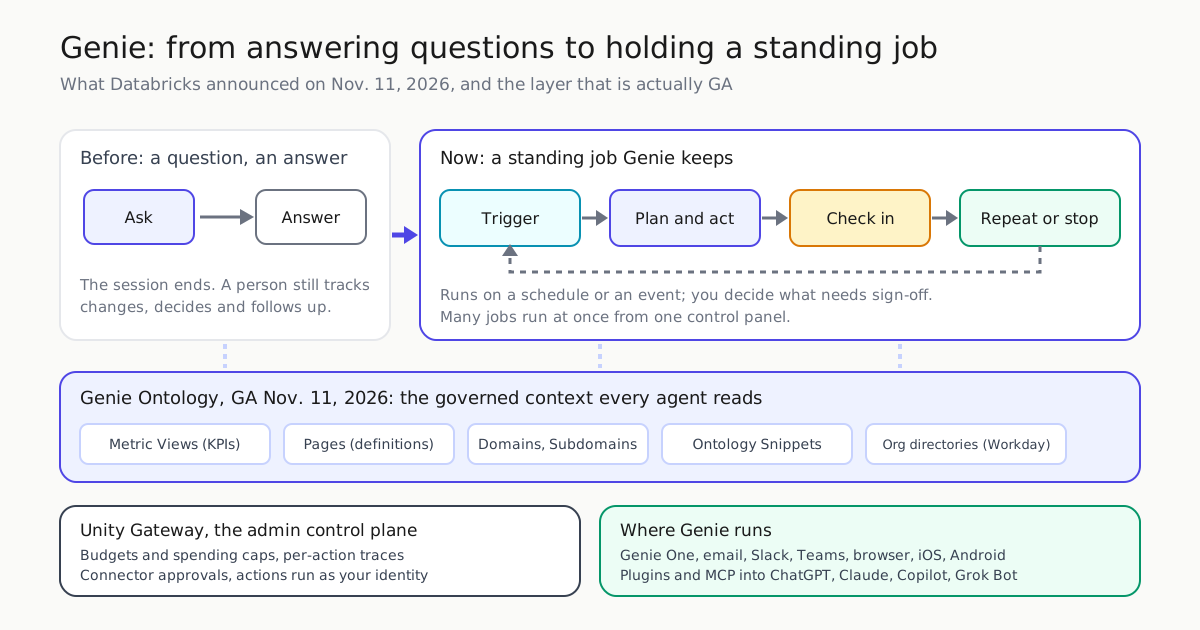
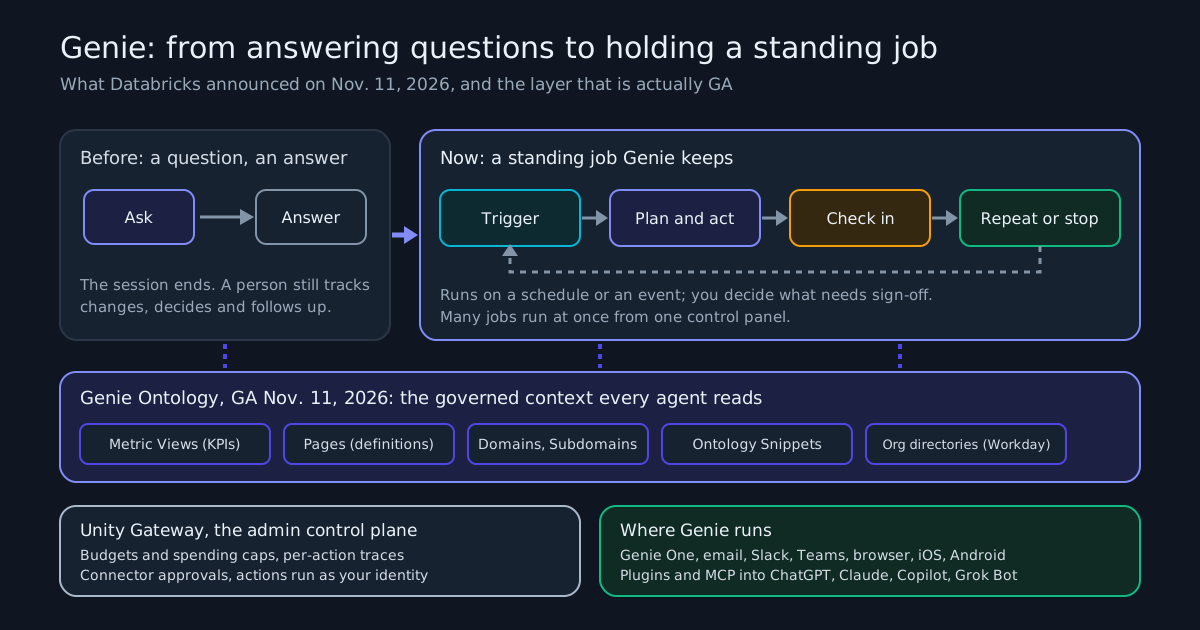
Databricks published two announcements on November 11, 2026 that are really one argument: the rebuilt Genie now holds long-running work instead of answering a question, and Genie Ontology, the governed business-context layer underneath it, reached general availability the same day.
For enterprise data and analytics teams, the interesting part is not the autonomy claim. It is the pairing. An agent that keeps working is only as trustworthy as the definitions it works from, and Databricks is now shipping those definitions as GA infrastructure rather than a roadmap slide.
What actually changed
Genie’s earlier shape, introduced this year as Genie One, was a conversational analyst. The new shape is a coworker with standing responsibility: it tracks progress, follows up on missing inputs and acts as new information arrives, inside guardrails the customer sets.
Three mechanics matter more than the framing:
- Jobs, not sessions. Genie can run many jobs at once, on a schedule or on triggers such as a metric dipping or more than ten customers requesting the same feature. You supervise, steer and stop them from one control panel.
- Actions, not just answers. MCP connectors let Genie read from and act in Slack, Zoom, Microsoft 365, Jira, GitHub and calendars, with custom MCP reaching ServiceNow and PagerDuty. Published skills live in Unity Catalog and run with the permissions of whoever invokes them.
- A spend surface. Unity Gateway is where admins control connector access and approval requirements, trace every action, and set workspace and per-user budgets, spending caps and alerts.
That third item is the operational consequence. Once the unit of work is a standing job that can fan out tool calls around the clock, cost stops tracking how many questions your analysts ask. Price it as cost per completed task before you enable it broadly, and treat the gateway as a control plane rather than a settings page.
Announcement versus availability
The autonomy post is written in the present tense about capabilities. The commercial reality sits on the Genie Agents product page: Genie Agents is available to existing Databricks Lakehouse Pro and Serverless customers with data in Unity Catalog, at standard $DBU rates, and is the evolution of Genie Spaces with no migration and no new SKU. The broader AI/BI page repeats that there are no per-seat or per-license fees.
The GA post is more disciplined about status, and the gaps are worth reading closely:
| Component | Stated status |
|---|---|
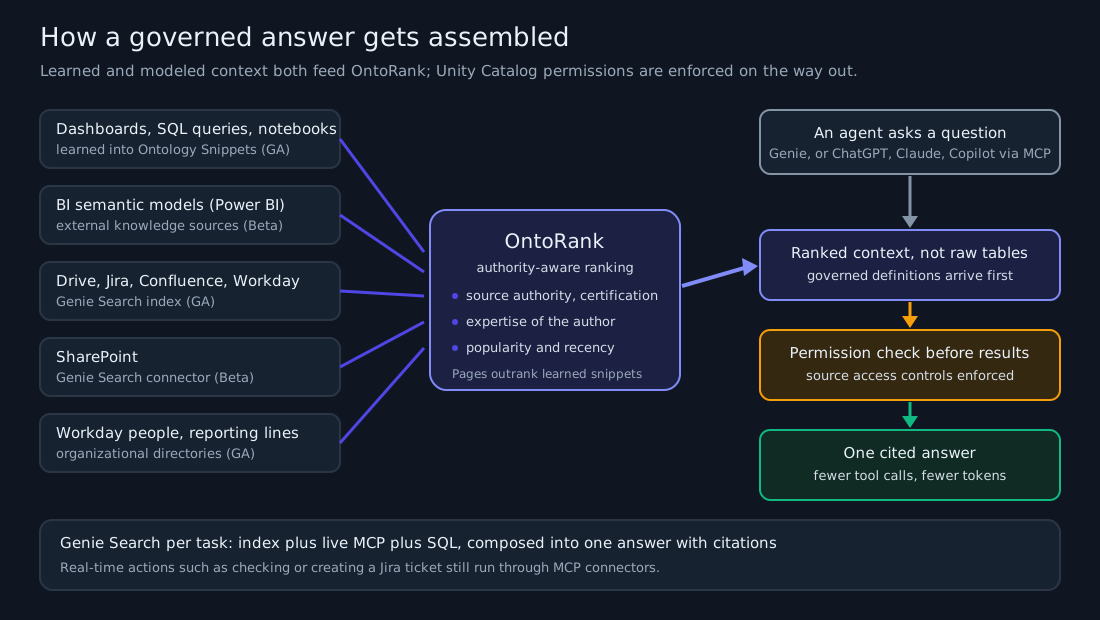
| Genie Ontology | Generally available |
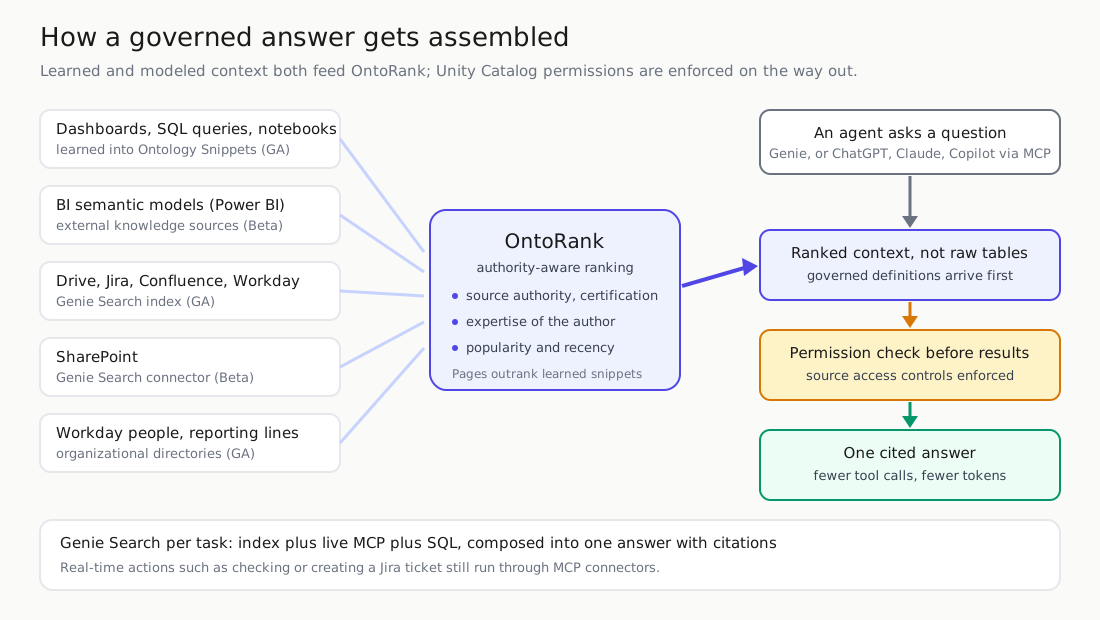
| Genie Search: Drive, Jira, Confluence, Workday | Generally available |
| SharePoint connector | Beta |
| Ontology Snippets | Generally available |
| Unity Catalog Domains, Subdomains, Pages | Generally available |
| Organizational directories (Workday first) | Generally available |
| External knowledge sources (Power BI today) | Beta |
| Ontology Manager | “Coming soon in Beta” |
Ontology Manager deserves the pause. It is described as the first visual interface for assessing ontology health, finding gaps and promoting learned knowledge into authoritative Pages, and it is not available yet. Until it ships, curation runs through Domains, Pages and the bulk-import prompt in Genie Code.
The benchmark, and the caveat Databricks wrote itself
Databricks and Turing built a benchmark on a simulated workspace for a fictional UK energy supplier, ran the same questions five times per task against a rubric fixed before the runs, and compared Genie with two unnamed frontier agents:
| Agent | Pass rate | Avg wall time per run | Avg tokens per run |
|---|---|---|---|
| Genie with Genie Ontology | 91% | 100 s | 432K |
| Agent A | 45% | 435 s | 889K |
| Agent B | 58% | 307 s | 1.05M |
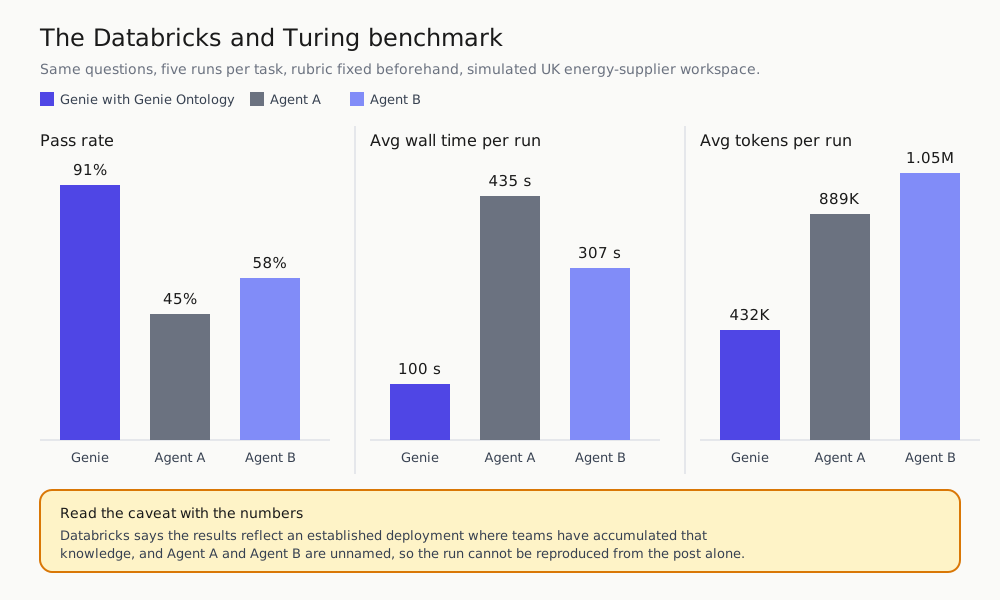
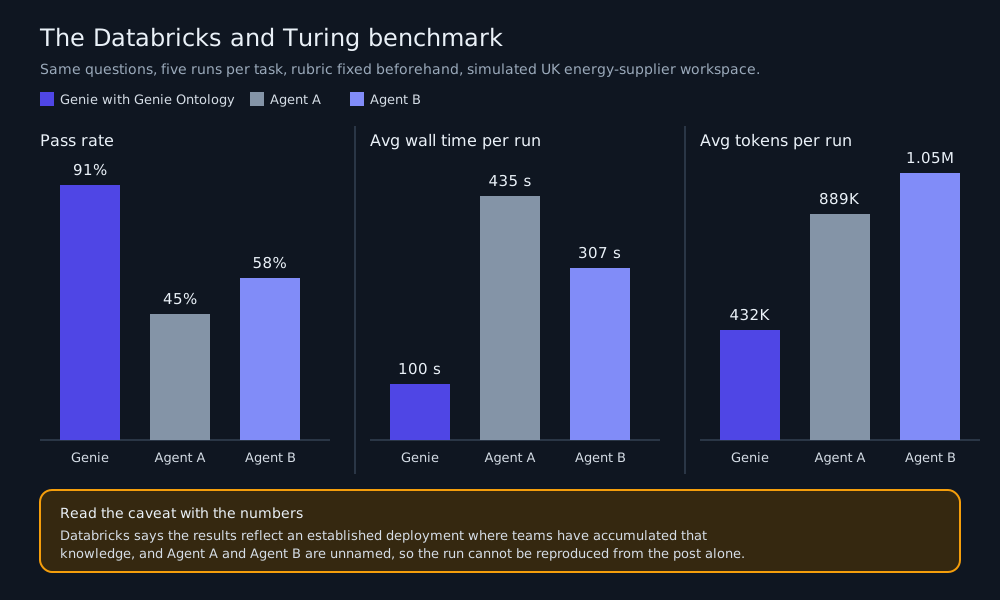
The token and time gaps are the part operators should notice: fewer than half the tokens and three to four times faster, because context that was already learned did not have to be rediscovered per run. Databricks’ own explanation is that all three agents write SQL well, so the difference comes from context.
The caveat is also theirs, not mine. The post states the results “reflect an established deployment where teams have accumulated that knowledge,” and the comparison is against Agent A and Agent B rather than named, versioned products. A new workspace with an empty ontology is not the measured condition. Databricks offers to run the same evaluation in your workspace, which is the only version of this number worth acting on.
What to do first
- Inventory the terms that must be exact. GA means Metric Views, Domains and Pages are production surfaces. Model recognized revenue, ARR or “active customer” once, with a named owner, rather than restating them in every agent prompt.
- Check the permission path before indexing. Genie Search ingests each source’s access controls through Unity Catalog and enforces them before returning results. Verify that with one restricted document, not by trusting the description.
- Set budgets before the first standing job. Per-user caps and alerts exist in Unity Gateway; an always-on job that fires on a trigger will find them either way.
- Audit shared skills. A skill runs with the invoking user’s permissions, so publishing one widely is a permission decision, not just a convenience.
Why it matters beyond Databricks
This continues a pattern in the enterprise agent platform race: the differentiator is moving out of the model and into the context and governance layer the vendor already owns. Databricks has spent the year making that layer load-bearing, from AI Runtime going GA to Lakebase branching for agentic workflows. Genie plugins now push the same governed context into ChatGPT, Claude, Copilot and Grok Bot, which means the ontology becomes a supplier to rival assistants rather than a reason to stay inside one UI.
Competing text-to-SQL and BI agent products now face a raised bar: an answer that cannot cite a governed definition is going to look thin next to one that can. The open question is whether customers will treat an agentic ontology as shared infrastructure owned by IT, as Databricks argues, or as yet another per-agent configuration surface that drifts. The GA release makes the first option buildable today; Ontology Manager is what will decide whether it stays maintained.