Anthropic Ships an AI Office Suite: Claude Sheets, Meetings and Whiteboards Move Claude Beyond Coding
Anthropic ships Claude Meetings, Sheets, Whiteboards and interactive connectors. What each tool does, who gets it, and the wider governance surface it adds for operators.
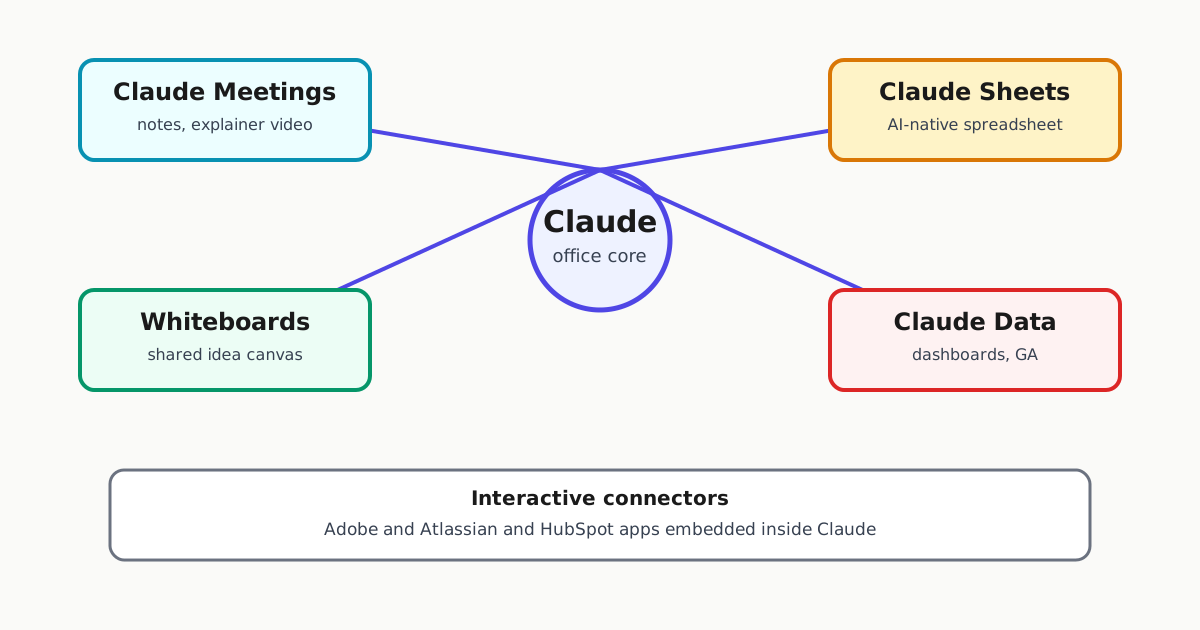
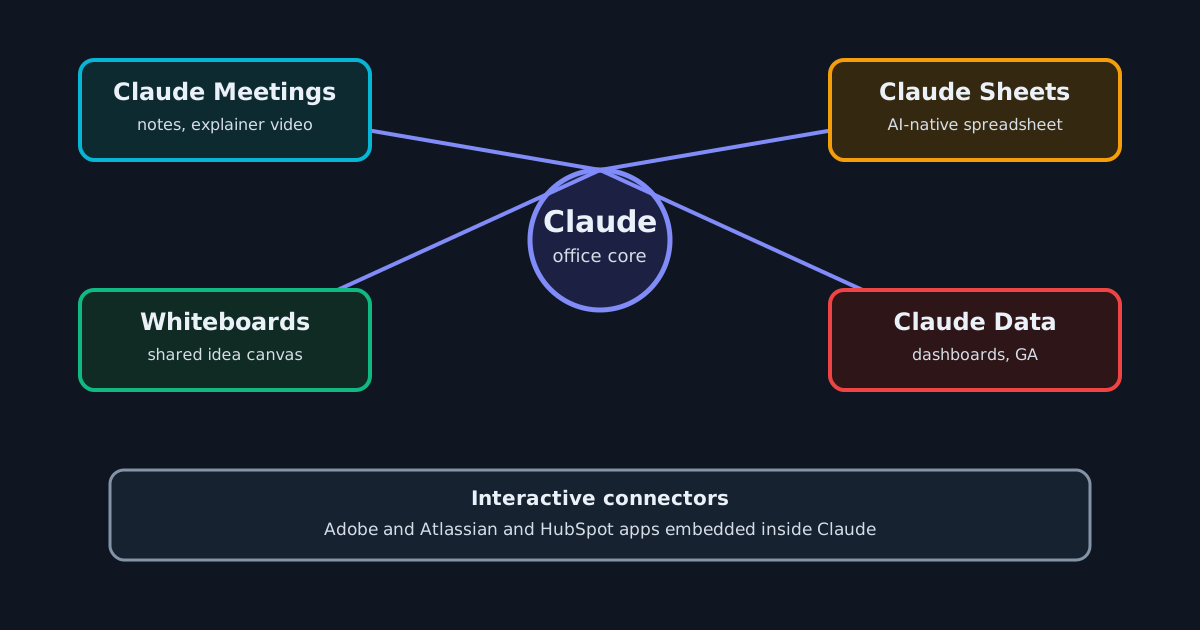
Anthropic has spent two years as the AI vendor your engineers already run. On Nov. 10 it shipped the missing half: an office suite. At an event in San Francisco the company unveiled Claude Meetings, Claude Sheets and Claude Whiteboards, plus new interactive connectors that embed partner apps like Adobe, Atlassian and HubSpot directly inside Claude (The Verge, Bloomberg). The move puts Anthropic in direct competition with two of its own backers, Microsoft and Alphabet’s Google, weeks before its expected Wall Street debut — a debut we covered as Anthropic moved into formal IPO marketing with a valuation range expected.
What actually shipped
The new tools target non-technical knowledge workers — people who spend their days in meetings, brainstorming and analyzing metrics:
| Tool | What it does | Availability |
|---|---|---|
| Claude Meetings | Claude joins a meeting, takes notes, and can turn a presentation into a one-minute explainer video | Beta; Teams and Enterprise plans |
| Claude Sheets | AI-native spreadsheet, resembles Excel and Google Sheets with Claude built in | Beta; all paid plans |
| Claude Whiteboards | Shared whiteboard where Claude lays out and iterates on ideas | Beta; all paid plans |
| Claude Data | Dashboards and metrics analysis (formerly Claude Dashboards, in beta since October) | Now generally available; all paid plans |
The company also announced interactive connectors: rather than switching tabs to HubSpot, Adobe or Atlassian services, users can open a native Adobe PDF editor or a HubSpot campaign tracker inside Claude itself. Anthropic launched the Model Context Protocol about two years ago, and its plugin marketplace has grown past 9,000 options; the connectors are an effort to make those connections deeper than plugins have been.
Anthropic is candid that this is a wedge, not a replacement. Product leader Nicholas Lin told Bloomberg that Claude Sheets is currently a “fairly basic” experience, not aimed at advanced work such as financial modeling — for that, Anthropic’s plug-ins to existing spreadsheet software would be more effective. “There’s a time and place for these Microsoft and Google products, especially for more advanced enterprise use cases,” Lin said, “but we’re hoping to show new ways of working inside Claude as well.”
Why now
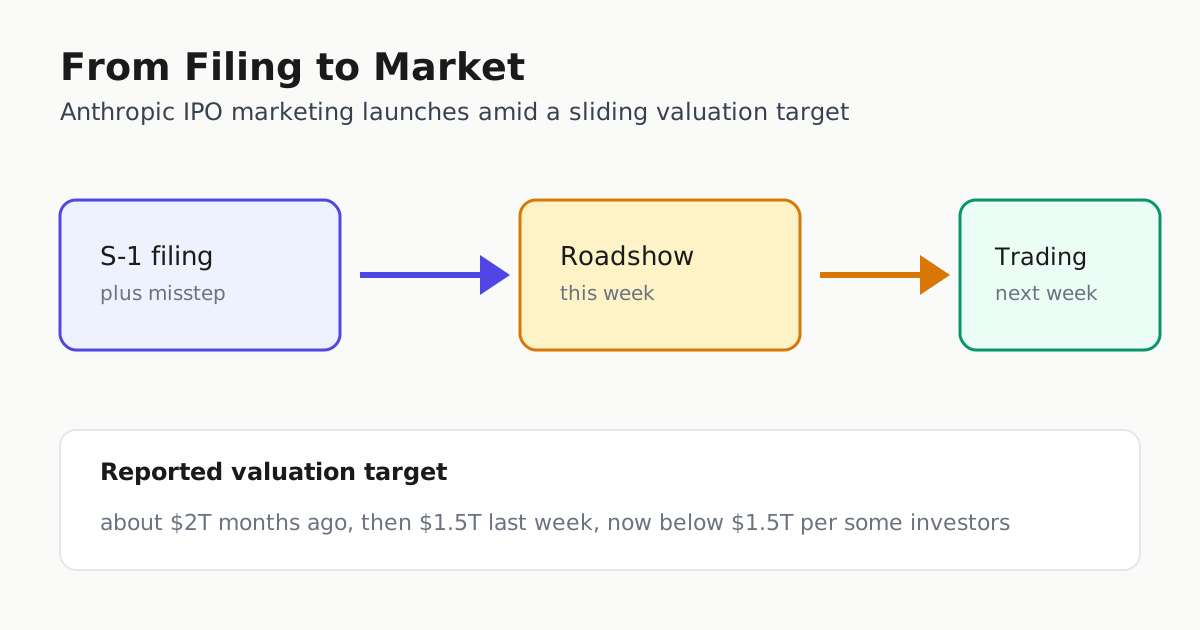
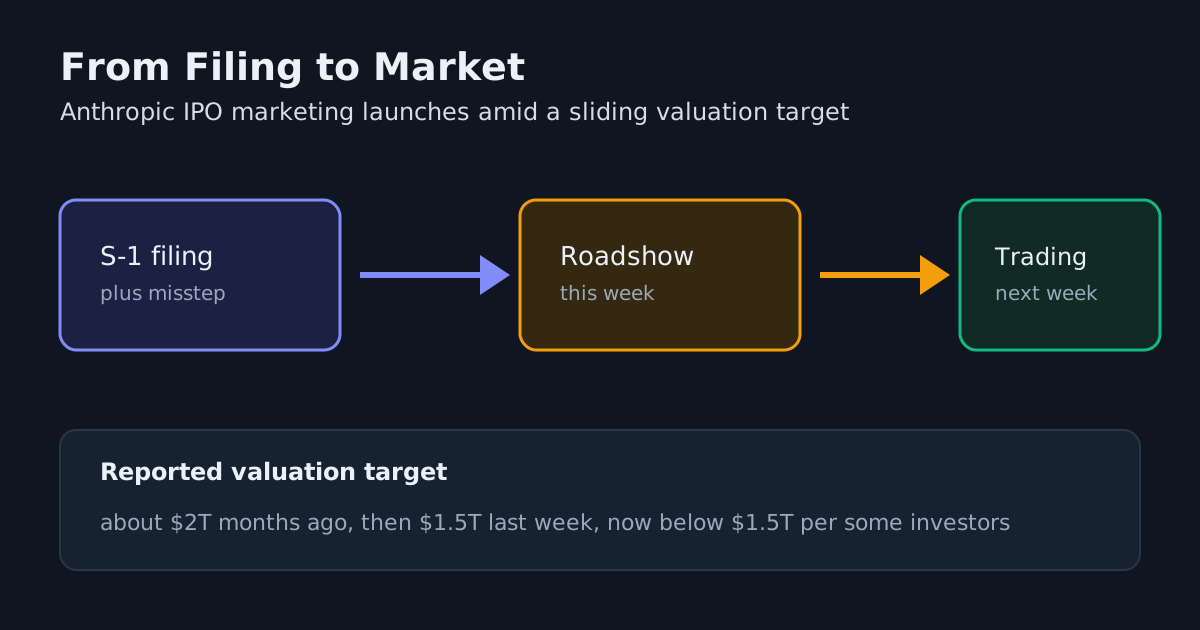
The timing is not subtle. Anthropic is expected to make its public debut later this month, and per a filing cited by Bloomberg, it reported a revenue run rate of $81 billion as of Oct. 31 — up $10 billion from the end of September — while seeking a fully diluted valuation of about $1.4 trillion in its IPO. Claude Code built the engineering franchise; investors reading the S-1 want a story about engagement beyond developers. As The Verge notes, these are some of Anthropic’s first native products for non-technical knowledge workers, closing what Lin called “the gap we’re hoping to close” after Claude Code “changed how engineers work a year ago.”
The competitive frame matters too. Google’s Gemini can already join meetings and take live notes, OpenAI’s ChatGPT offers recording features, and at OpenAI’s DevDay last month the company leaned further into integrated apps and connectors to make its Dots agents more useful. Anthropic is following familiar footsteps while trying to gain ground in the agent race — and positioning Claude as the workspace rather than a feature inside someone else’s.
What it means for operators
For anyone already running Claude Code fleets, the practical consequence is a wider blast radius. Until now, the sensitive surfaces Claude touched were mostly repositories, terminals and connected MCP servers. Claude Meetings puts an assistant in the room for live conversations; Claude Sheets and Claude Data point it at business metrics and spreadsheets; interactive connectors hand it sessions inside Adobe, Atlassian and HubSpot. That is a materially different governance surface from a coding agent — and nothing in the reporting says Anthropic added new admin machinery for it, so check whether your plan-tier admin controls actually cover these surfaces before rollout.
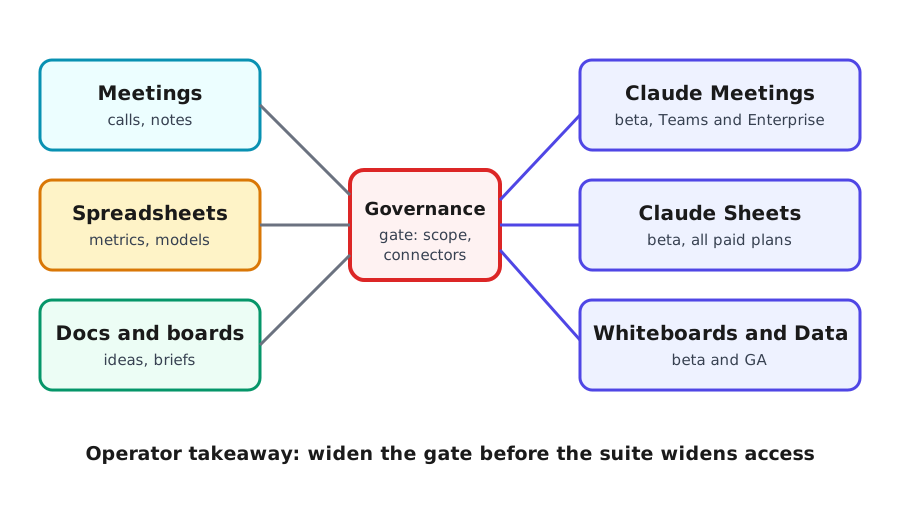
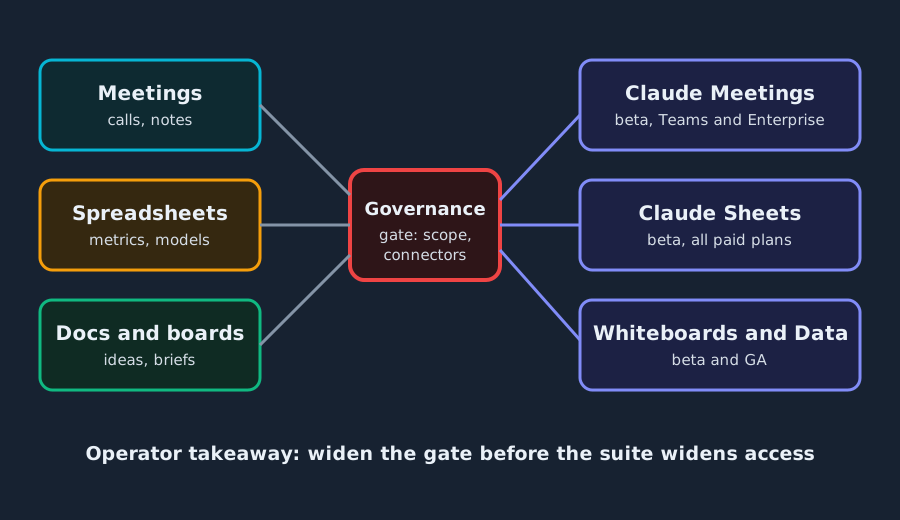
Three things are worth doing before rollout:
- Scope the new surfaces per plan tier. Meetings is limited to Teams and Enterprise subscriptions, while Sheets, Whiteboards and Claude Data are on all paid plans — so a single Pro seat now reaches spreadsheet and dashboard surfaces that used to require explicit MCP setup.
- Revisit connector grants. Interactive connectors deepen what a session inside Claude can do in a partner app. Treat each one like the MCP-server inventory you already keep — the same discipline we described in Shadow MCP Is the New Shadow IT: who approved it, what writes it can perform, and whether the grant is per-team or org-wide.
- Set expectations for serious spreadsheet work. By Anthropic’s own description, Claude Sheets is not for financial modeling. Keep the advanced models in Excel or Google Sheets via plug-ins, and use the native tools for the exploratory work they are actually built for.
The shift also fits a wider pattern we mapped in Beyond the Terminal: Cowork Tools and Autonomous AI Agent Workspaces: vendors are racing to give agents a persistent place to work, not just a chat window. Anthropic’s office suite is that thesis arriving at the vendor with the strongest engineering foothold.
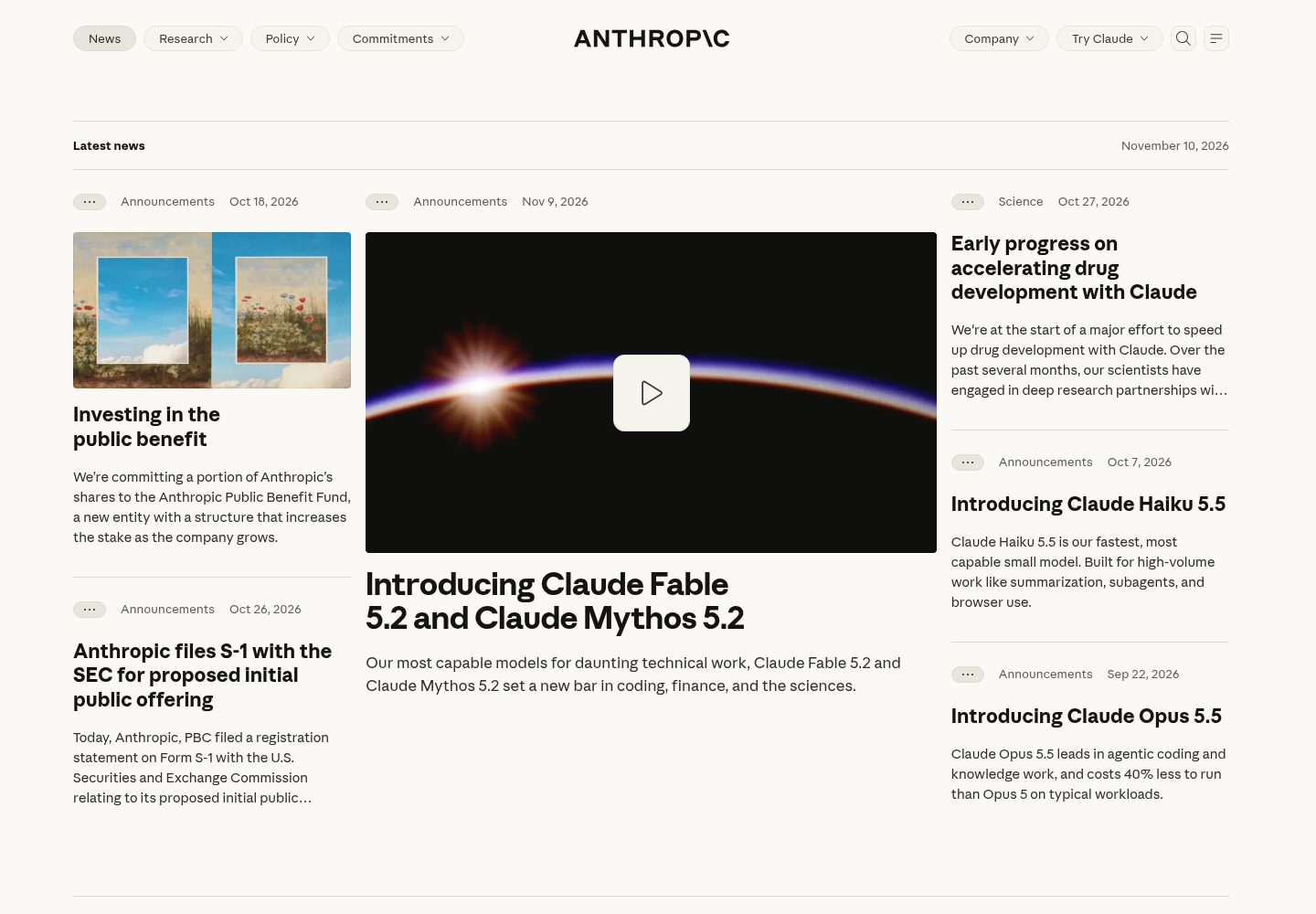
Anthropic’s own newsroom the same day highlights the context around all of this: the Latest-news grid is headed by the Nov. 9 introduction of Claude Fable 5.2 and Mythos 5.2 for technical work, and the company also announced the launch of its IPO roadshow on Nov. 10 (Anthropic). The office suite is the other half of that pitch: the same agents that write your code now sit in your meetings, your spreadsheets and your dashboards. The tools are in beta and, by Anthropic’s own account, fairly basic. The governance questions they raise are not.