Meta's Muse Models Land on Google Cloud's Agent Platform: Ember, Spark 1.3 and Wonder as Managed APIs
Meta's Muse Wonder, Ember and Spark 1.3 are listed as managed OpenAI-compatible APIs on Google Cloud's agent platform. What they cost, what is unverified, and how to route them.
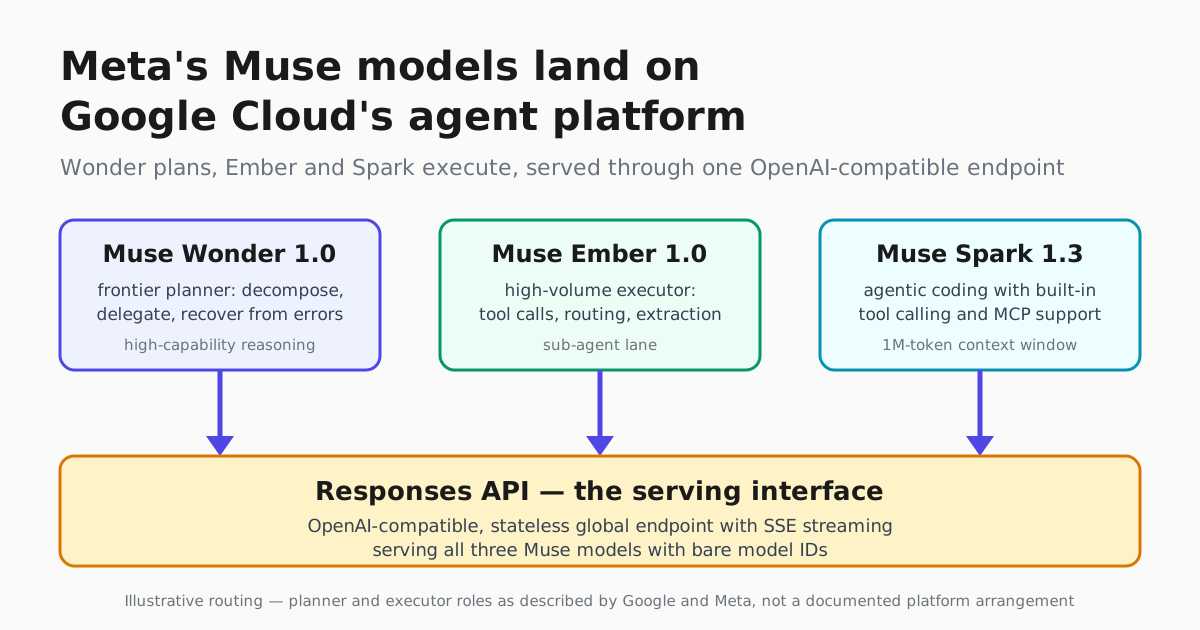
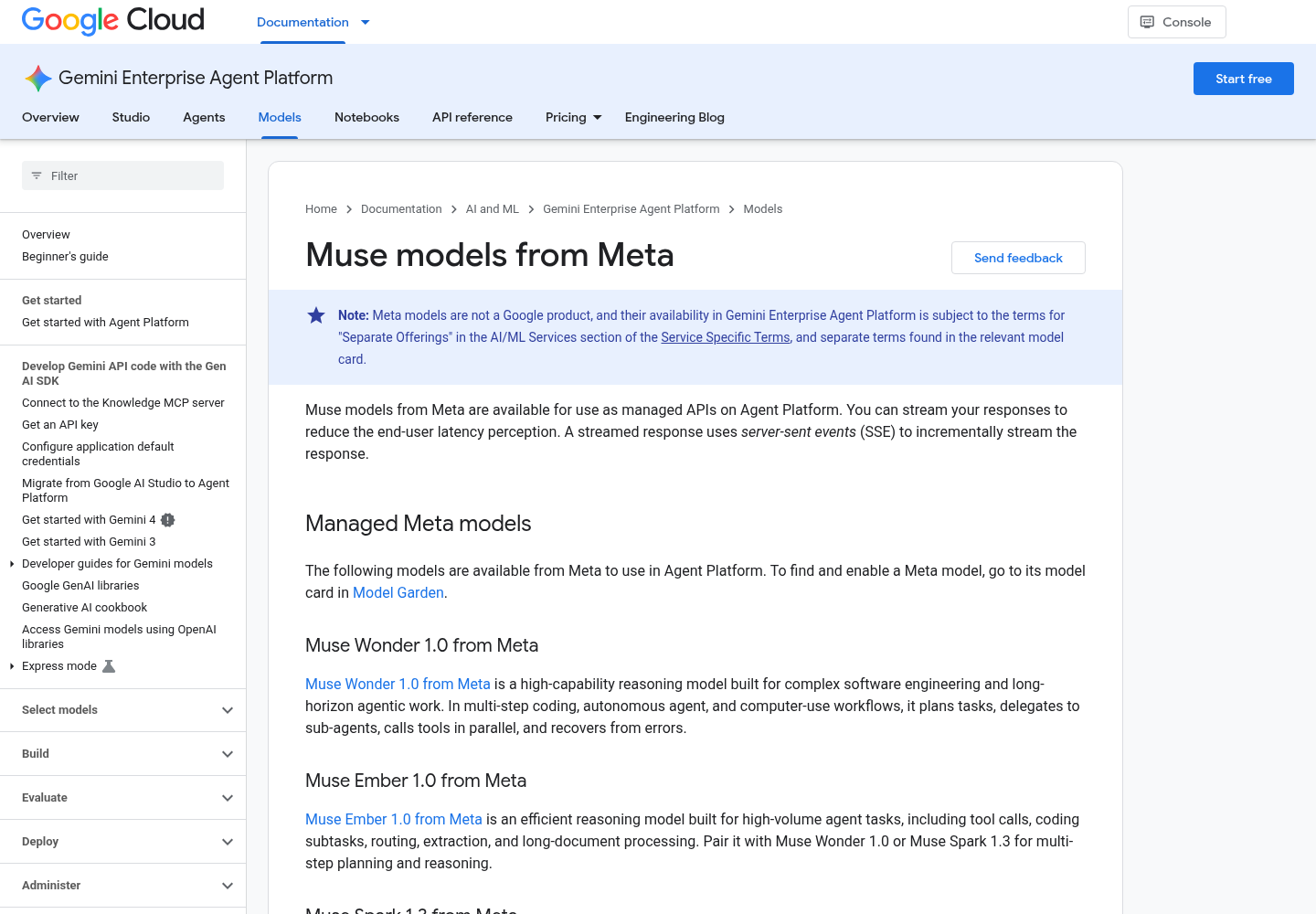
Meta’s Muse lineup is now listed inside Google Cloud. The Gemini Enterprise Agent Platform documentation presents Muse Wonder 1.0, Muse Ember 1.0 and Muse Spark 1.3 as managed APIs; the page was last updated November 9, 2026. The same page carries the key caveat: Meta models are not a Google product, and their availability is subject to the “Separate Offerings” terms in the AI/ML Services section of the Service Specific Terms plus separate terms in each model card.
What each model is for
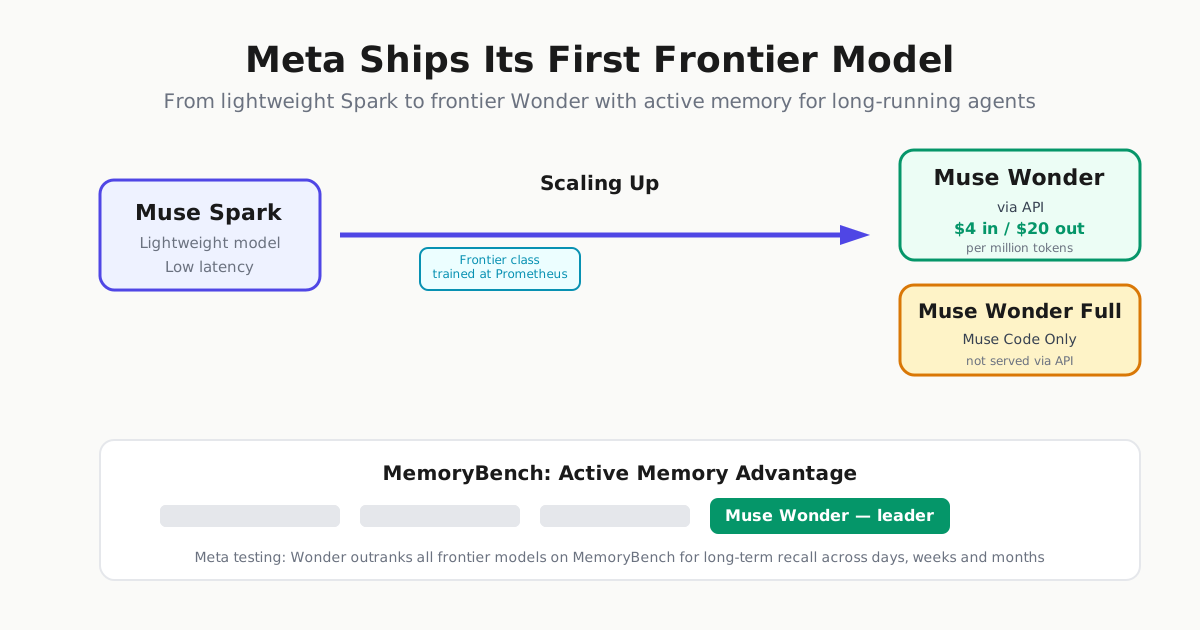
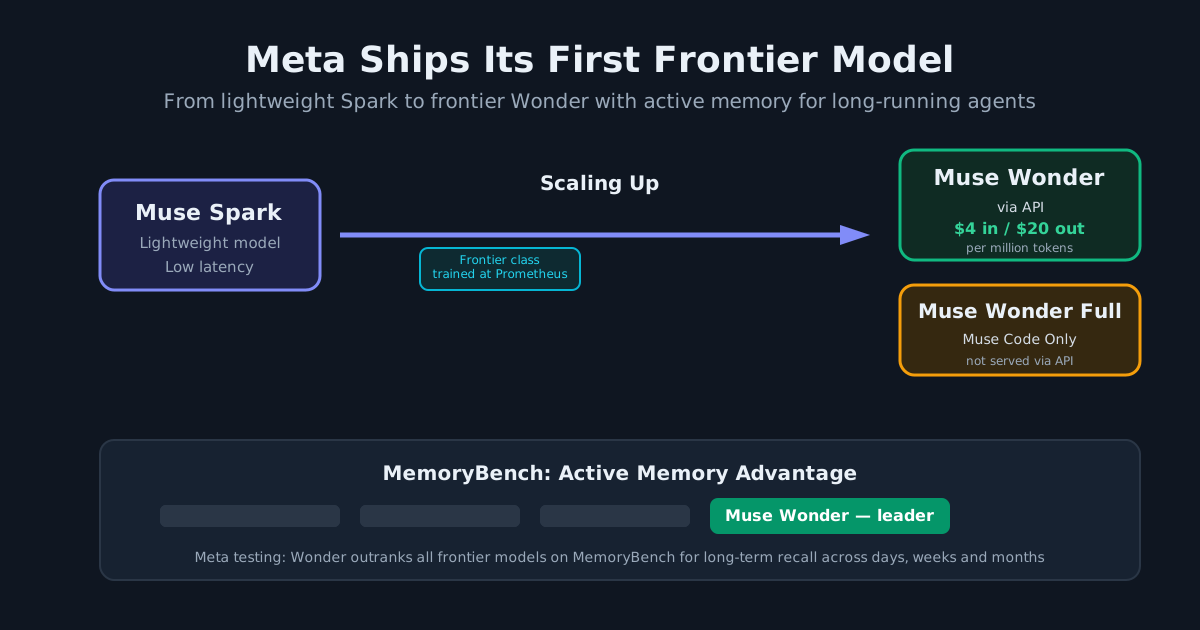
Google describes a tiered agent stack rather than three interchangeable chatbots. Wonder 1.0 is the high-capability reasoning model for complex software engineering and long-horizon agentic work: planning, delegation, parallel tool calls and error recovery. Ember 1.0 is the efficiency model for high-volume agent tasks such as tool calls, coding subtasks, routing, extraction and long-document processing; Google’s guidance is to pair it with Wonder or Spark for multi-step planning. Spark 1.3 is aimed at agentic workflows and competitive coding, with built-in tool calling, Model Context Protocol support and a 1M-token context window.
That frontier-planner plus cheap-executor framing matches how Meta positioned Ember at launch. SiliconANGLE reports that applications commonly split requests into smaller tasks for lower-cost agents, and that Ember is optimized for that sub-agent role. Ember is also the first Meta model trained using Muse Wonder, though Meta did not detail which workflow step was automated.
Calling the models
Google documents one serving pattern for the three Muse models: the stateless, OpenAI-compatible Responses API on a project-specific global endpoint. You POST to https://aiplatform.googleapis.com/v1/projects/PROJECT_ID/locations/global/publishers/meta/v1/responses with the bare model ID (muse-wonder-1.0, muse-ember-1.0 or muse-spark-1.3). SSE streaming is supported; store: true is not.
OpenAI SDK familiarity helps, but this is not a two-field migration. Google’s curl example uses a Google Cloud bearer token from gcloud auth application-default print-access-token, so you need Application Default Credentials or an equivalent auth flow and a Google Cloud project. OpenAI compatibility is also not feature parity: confirm your agent loop does not depend on stored responses before switching lanes. The fetched documentation verifies this endpoint for the three Meta models only; it does not establish the request-shape details of the platform’s other partner models.
The economics that matter for agent fleets
Per SiliconANGLE, Meta’s own Model API pricing for Ember is $0.10 per million input tokens and $0.50 per million output tokens, with cached input at $0.004 per million. Ember has a 1M-token context, multimodal inputs and up to 512k output tokens. Those are Meta list prices; the fetched Google documentation does not state what Google Cloud bills for the managed Muse models, or whether cache support and full feature parity carry over. Confirm both against your Google Cloud contract before forecasting spend.
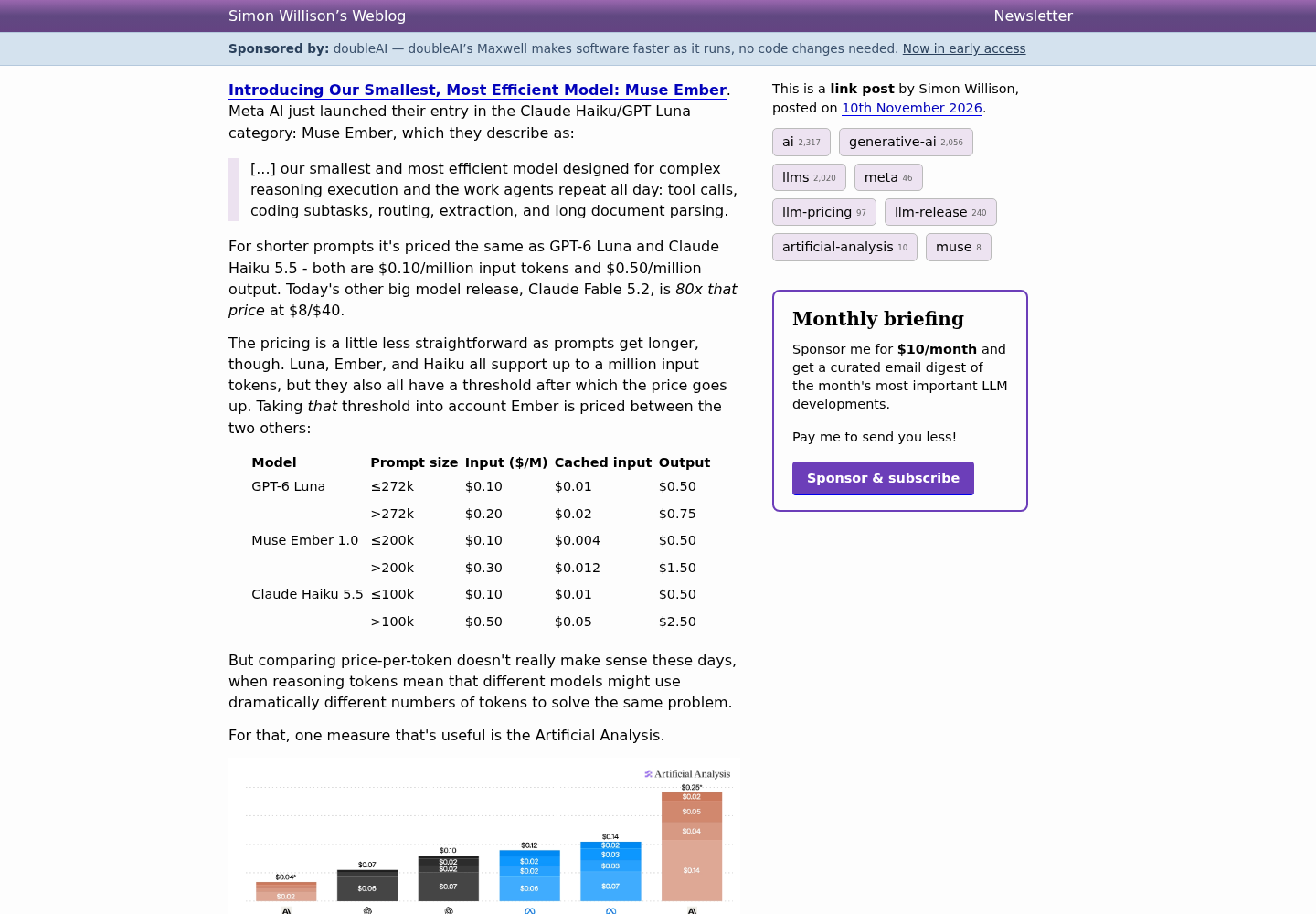
Simon Willison’s breakdown shows the cheap-reasoning race:
| Model | Prompt size | Input ($/M) | Cached input | Output |
|---|---|---|---|---|
| GPT-6 Luna | ≤272k | $0.10 | $0.01 | $0.50 |
| Muse Ember 1.0 | ≤200k | $0.10 | $0.004 | $0.50 |
| Claude Haiku 5.5 | ≤100k | $0.10 | $0.01 | $0.50 |
| GPT-6 Luna | >272k | $0.20 | $0.02 | $0.75 |
| Muse Ember 1.0 | >200k | $0.30 | $0.012 | $1.50 |
| Claude Haiku 5.5 | >100k | $0.50 | $0.05 | $2.50 |
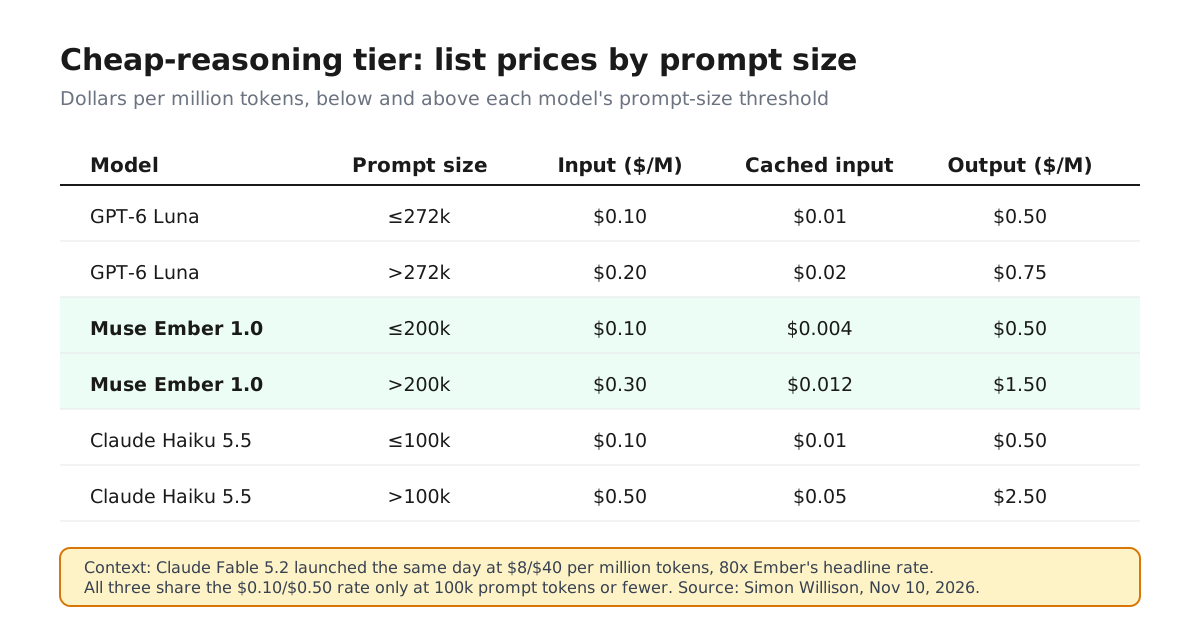
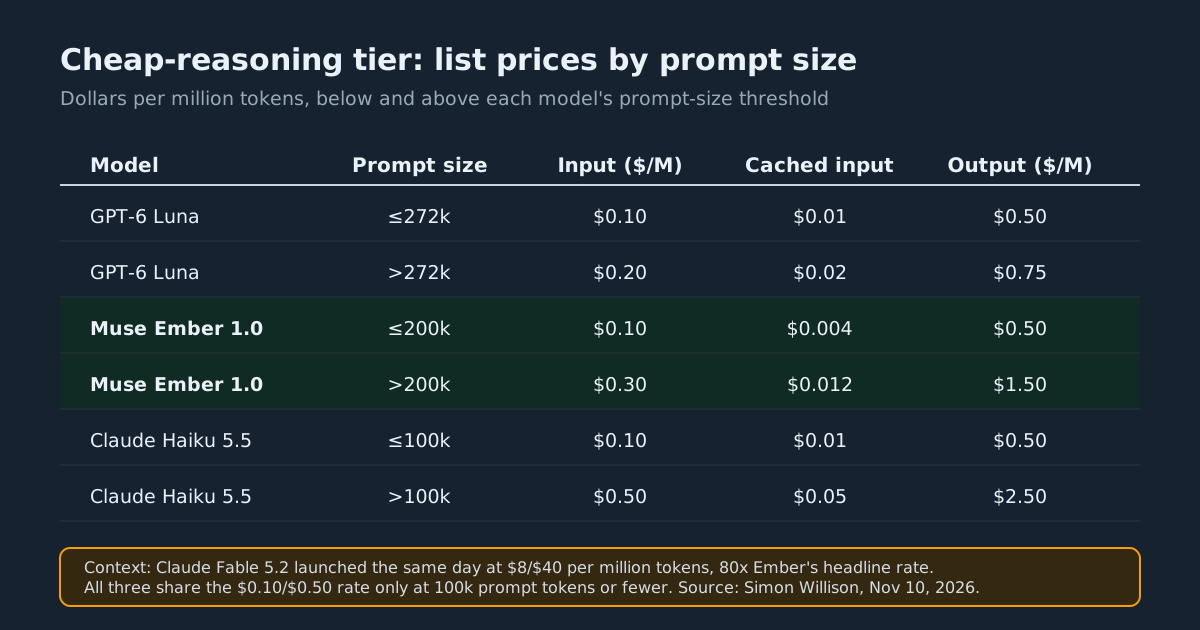
Read the thresholds precisely. All three share the $0.10/$0.50 headline rate only at ≤100k prompt tokens, because Haiku 5.5 rises to $0.50/$2.50 at >100k. For prompts above 100k through 200k inclusive, Ember and Luna hold the headline rate while Haiku does not. For prompts above 200k through 272k inclusive, Ember steps up to $0.30/$1.50 while Luna still charges $0.10/$0.50, so Ember costs more than Luna but far less than Haiku. At >272k, Luna rises to $0.20/$0.75 — still cheaper than Ember — so Luna remains the less expensive of the two at every prompt size past 200k. Willison also notes Claude Fable 5.2 launched the same day at $8/$40 per million tokens, eighty times Ember’s headline rate. Ember’s six reasoning levels make cost-per-task tuning a dial, not a model swap.
Does the cheap lane hold up?
Meta’s numbers, cited by SiliconANGLE, claim Ember matched Claude Haiku 5.5 on the Artificial Analysis Index at about a third of the price, beat GPT-6 Luna, and led by 17% on AutomationBench-AA, a 657-task suite spanning Gmail, Salesforce and other cloud apps. Willison’s own exercise was narrower: he rendered a pelican riding a bicycle as an SVG at each of Ember’s six reasoning levels. The “high” level failed to return a complete SVG, reasoning level did not cleanly map to visual quality, but the “max” output was comparable to one he generated with Muse Wonder at roughly 40x Ember’s price. One illustration task is not an agent- or coding-quality benchmark. Treat vendor and anecdotal signals as screening evidence, then run your own workload against each cheap candidate: the Muse trio through the documented Google endpoint, and Luna and Haiku through their own APIs.
What to do with this
- Add Ember as a sub-agent lane. If your coordinator fans out tool calls, extraction or routing tasks and prompts stay under 200k tokens, Ember’s list pricing makes it a credible candidate executor on paper; reserve Wonder or your current frontier model for planning and error recovery. Confirm Google Cloud billing and cache behavior for the managed endpoint before committing spend.
- Benchmark against Luna and Haiku 5.5 on your tasks. Same headline price, different thresholds and cache rates; your prompt-length distribution decides the winner, and cost per completed task beats price per token as the metric.
- Test the integration path first. The endpoint is stateless, so confirm your harness does not depend on
store: true, wire up Google Cloud bearer authentication for your project, and verify SSE streaming under your latency budget. - Read the Separate Offerings terms. Meta’s models on this platform carry model-card terms on top of Google’s service terms, a procurement detail that matters for regulated workloads.
Meta has been building toward this tiered agent stack for months, from the Muse Wonder frontier launch to the open-weights Muse Spark release. As of the November 9 documentation update, all three models are listed as managed APIs inside Google’s enterprise platform. The pricing that makes that interesting is Meta’s own list rate for the high-volume middle of agent workloads, not yet verified Google Cloud billing.