Muse Code: Meta's Terminal Coding Agent, Reviewed
Muse Code reviewed: Meta's beta terminal coding agent, the Muse Spark 1.2 engine, its 59.3% DeepSWE standing, open questions, and how to trial it safely.

Go deeper. Build your own.
Mark Zuckerberg announced Muse Code in August 2026 with a pitch that fits in one line: install it, run it in your project directory, describe the change you want, and the agent edits your code. If that loop sounds familiar, it should — Muse Code is Meta’s entry into the terminal coding agent category Claude Code defined, and it follows the template deliberately.
What it carries that no other newcomer this year has carried: a frontier lab’s own engine — Muse Spark 1.2, a coding-specialized model — and the distribution weight of the company that gave the field Llama and PyTorch. What it lacks, for now, is nearly everything an evaluator needs to make an adoption call: published pricing, deployment terms, data-handling detail, and any independently reproduced benchmark run.
That mix — serious engine, real strategic weight, large blank spots — is exactly the kind of launch that gets either overhyped or waved off. We’ll do neither. This review covers what Muse Code is and the pattern it follows, what the 59.3% DeepSWE figure does and doesn’t tell you, a known-versus-unknown ledger for the beta, why Meta shipping a harness matters beyond the tool itself, an early verdict by persona, and the protocol for trialing it without disturbing the fleet you already run.
What Muse Code is — and the pattern it follows
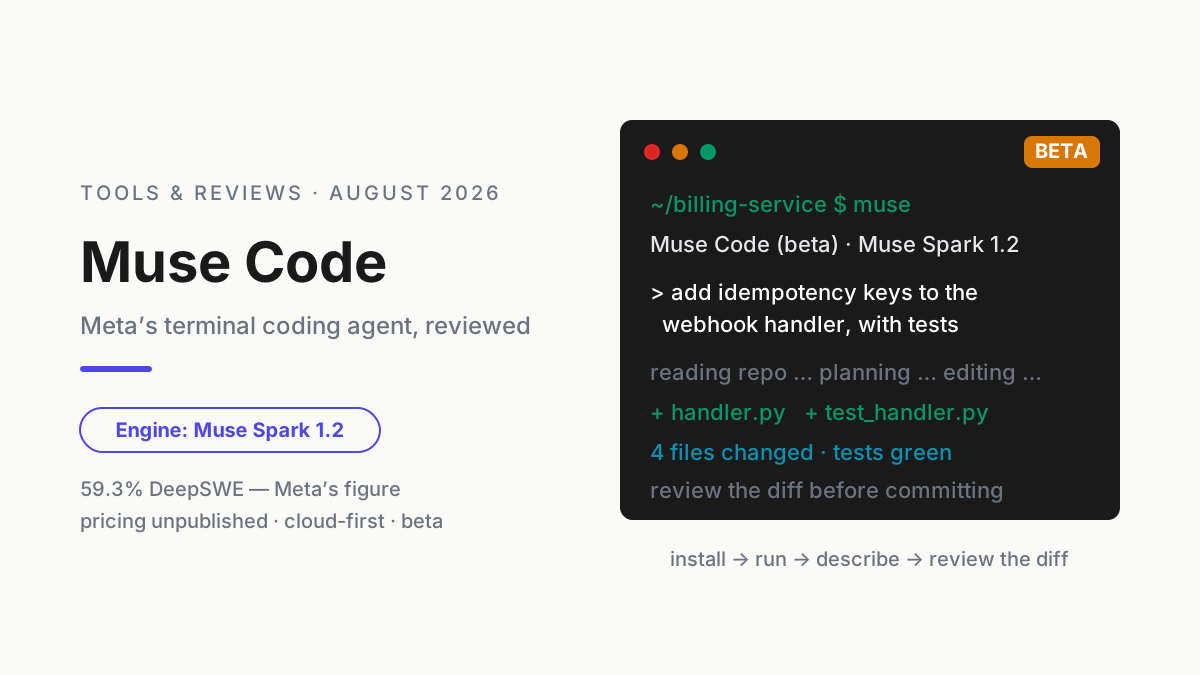
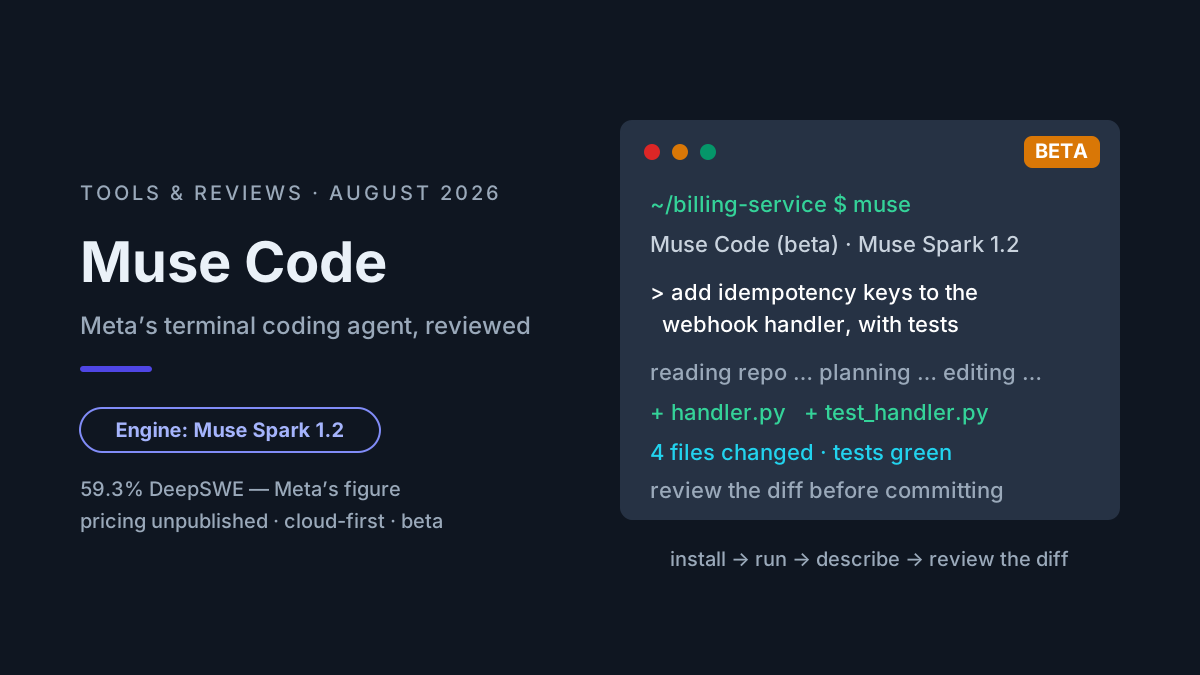
Muse Code is Meta’s terminal-based AI coding agent, released in beta in August 2026. You install it, run it inside a project directory, and describe changes in plain language; the agent reads the repository, plans, edits files, and iterates. It is powered by Muse Spark 1.2, a coding-specialized model from Meta Superintelligence Labs.
That workflow is the terminal-native agent pattern, and in 2026 it is close to a standard. The field map of AI coding harnesses traces how Claude Code’s shape — an agent living in your shell, assembling its own context, editing files and running commands under permission gates — became the template nearly every serious entrant follows. Muse Code adopts it without apology: no IDE fork, no web dashboard between you and the diff. The terminal is the product.
In practice the loop looks like this — treat the binary name and prompt text as illustrative; the official docs are the source of truth for the current install path.
$ cd ~/code/billing-service
$ muse
Muse Code (beta) · engine: Muse Spark 1.2
> Add idempotency keys to the payment webhook handler, with tests.
  reading repo … planning … editing 4 files … running pytest …
  4 files changed · tests green · review the diff before committing
Meta’s published surface is two official pages so far: the Muse Code product page and the developer docs. The launch drew a quick wave of thin news rewrites, but the official pages are what counts for an evaluator — and as of late August, most of what a careful one wants — pricing, data terms, deployment options — is not on them yet. The ledger below collects the gaps.
The engine: Muse Spark 1.2, a coding specialist
The most consequential fact about Muse Code is not the harness. It’s that the harness exists to carry Meta’s own model.
Muse Spark 1.2 belongs to the Muse Spark family — the proprietary line Meta launched on April 8, 2026, its first new model since Meta Superintelligence Labs formed in summer 2025. The general-purpose flagship does natively multimodal reasoning, visual chain-of-thought, and a “Contemplating” mode that orchestrates parallel sub-agents; 1.2 is the member tuned for a narrower, harder job — editing real codebases from inside an agent loop. The strategic story behind that family, including what the pivot means for Llama, is its own analysis; here the relevant fact is that Meta now has a coding-specialized engine and built a first-party harness around it.
“Coding-specialized, not general-purpose” is worth taking at face value, because the specialist lane is where much of 2026’s real progress happened — the open-weight field’s strongest agent engines are mostly coding-first builds, not scaled-down generalists. And pairing a specialist engine with a first-party harness is the vertical-integration play the incumbents proved out: Anthropic tunes Claude Code to its models’ calling conventions, OpenAI does the same with Codex, and the models are post-trained against their harnesses’ tools in return. When that co-design works, the integrated pair beats the sum of swappable parts. Muse Code is Meta running the same play, four months after the engine family existed at all.
Muse Code’s DeepSWE standing, read honestly
The launch number: 59.3% on DeepSWE, per Meta’s materials — behind GPT-5.6 (Sol) and Claude Fable 5, ahead of Qwen 3.8 Max at 56.6%.
Context first. DeepSWE is the harder agentic suite that took over headline duty this year as SWE-bench Verified saturated — open models now post scores into the low 90s there, numbers that stopped discriminating at the top. The full DeepSWE run is 113 tasks, and frontier scores cluster in the 50s and 60s, which is what a benchmark with headroom looks like. The suite also got a public stress test the week before Muse Code’s announcement, when the stealth model Ox Alpha’s viral 80% claim — computed on a 10-task sample — collapsed to roughly 63% on the full 113-task run, a level that coverage described as GPT-5.6 parity. That episode, covered in our Ox Alpha report, left the field a useful reference point: on this suite in August 2026, parity with OpenAI’s flagship meant roughly 63%.
Read against that reference, Meta’s 59.3% deserves both respect and caveats:
- Provenance. The figure comes from launch materials. House rule: a lab scoring its own model, on its own harness, is a claim — worth reporting, not yet evidence. No independent re-run of Muse Spark 1.2 on the full suite has been published as of this writing.
- The gaps are small and the error bars unpublished. On a 113-task suite, one task is worth about 0.9 points. The distance from 59.3% to the ~63% parity reference is four or five tasks — inside the swing you get from harness choice and retry budget alone.
- Part of the comparison set is unverifiable. Meta’s comparison names an order — behind Sol and Fable 5 — without publishing those models’ figures, and the Qwen 3.8 Max entry rests on launch coverage we haven’t confirmed independently.
- Credit where due. A coding specialist from a program that rebuilt its stack barely a year ago, landing within a few tasks of the flagship parity line and ahead of a current Qwen flagship as reported — that is a serious engineering result. Mid-pack at the frontier is not a dismissal; in 2024 it would have been a coronation.
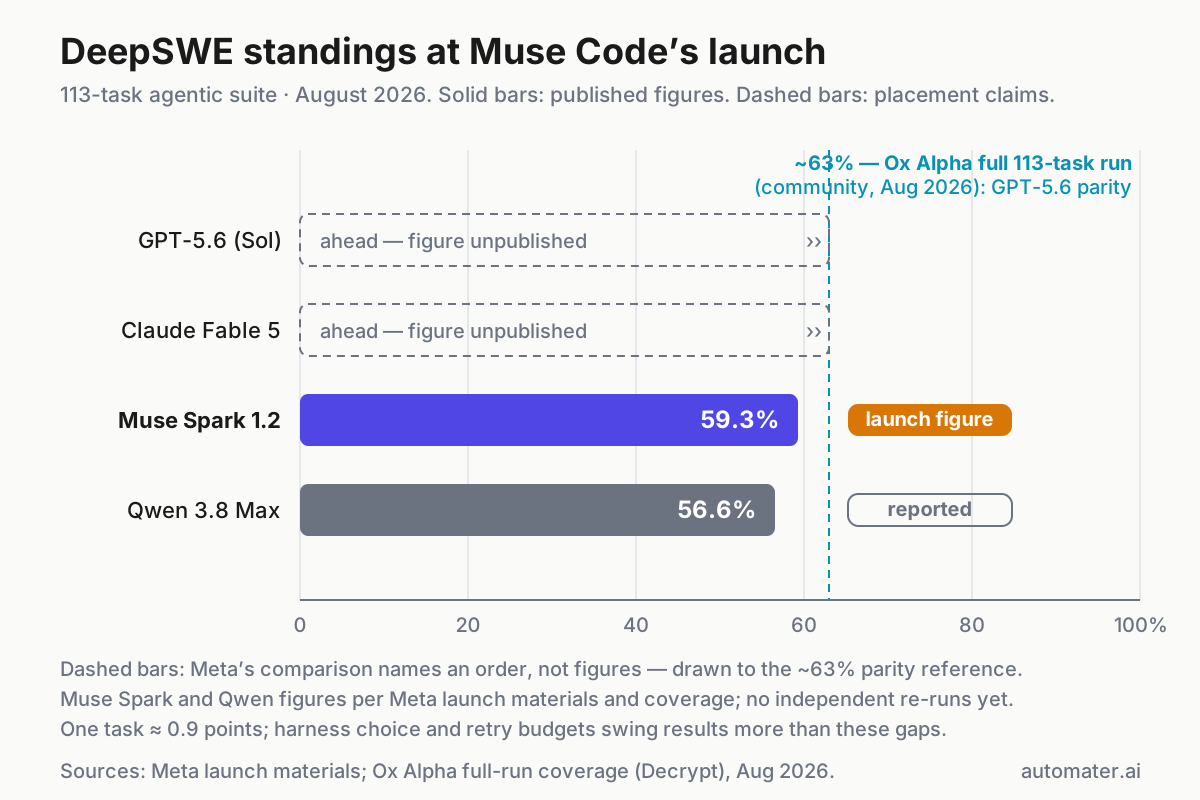
 The standings as published, tiers labeled. Dashed bars are placement claims without figures, drawn to the parity reference — not measurements.
The honest bottom line: 59.3% earns Muse Code a trial slot, not a migration. Benchmarks select what to sandbox; your own evals decide what to adopt — and on this suite the whole cluster from 56 to 63 is close enough that harness quality, latency, and price will decide real-world rankings. Two of those three are currently unknowable, which brings us to the ledger.
What we know — and don’t — about the Muse Code beta
Reviewing a beta honestly means refusing to pad the unknown side with guesses. Here is the ledger as of late August 2026 — re-check the official pages before you rely on any row.
| Question | Where it stands at beta |
|---|---|
| Engine | Muse Spark 1.2, coding-specialized — published |
| Workflow | Terminal-native: install, run in project dir, describe changes, agent edits — published |
| Benchmark | 59.3% DeepSWE per launch materials — not independently reproduced |
| Pricing | Unpublished. No per-token rate, no subscription, no beta-to-GA terms |
| Deployment | Cloud/hosted prioritized; local deployment unconfirmed |
| Data handling | Retention and training-on-your-code terms not detailed on the pages we can cite |
| Model choice | Nothing published on bring-your-own-model or third-party engines |
| Session portability | On-disk transcript format and export path undocumented |
| Protocol plumbing | MCP and endpoint-compatibility posture unstated |
Rather than invent specifics, here is the what-to-watch checklist — the five signals that would move Muse Code from curiosity to contender:
- The pricing model, when it lands. Per-token developer pricing would signal a real API business; bundling into Meta’s existing subscription surfaces would signal a different strategy entirely. The token-plan math only starts once a number exists.
- Local, or not. Cloud-first is stated; local is unconfirmed. For local-first and air-gapped shops this single row is binary — no other feature matters until it flips.
- Independent DeepSWE runs. The first third-party full-suite run of Muse Spark 1.2 will be worth more than every launch chart combined.
- Transcript portability. Where sessions live on disk and in what format decides whether your history survives the tool — the lesson this year’s die-off taught at scale.
- Protocol posture. MCP support and OpenAI-compatible or Anthropic-Messages endpoints are the decoupling-era table stakes; a harness without them is a walled garden with a terminal aesthetic.
Why Meta shipping a harness matters
Strip the launch noise and three structural facts remain.
The harness is the model’s delivery vehicle. Claude Code exists so Anthropic’s models meet developers on Anthropic’s terms; Codex does the same for OpenAI. After the proprietary pivot, Meta lost its old developer channel — Llama downloads — and Muse Code is the replacement: the surface through which Muse Spark reaches working engineers. Read the tool as strategy and its thin launch state makes sense; the harness shipped when the engine needed it, not when the docs were finished.
Distribution muscle is the variable nobody else has. A startup harness fights for every install. Meta enters with the residual gravity of the Llama ecosystem, the PyTorch lineage, and a developer-relations machine a decade deep. Trial volume will not be Muse Code’s problem. The die-off year taught the field which question follows: retention is earned by the loop, the permission model, and the unit economics — none of which distribution can fake, and two of which are still unpublished here.
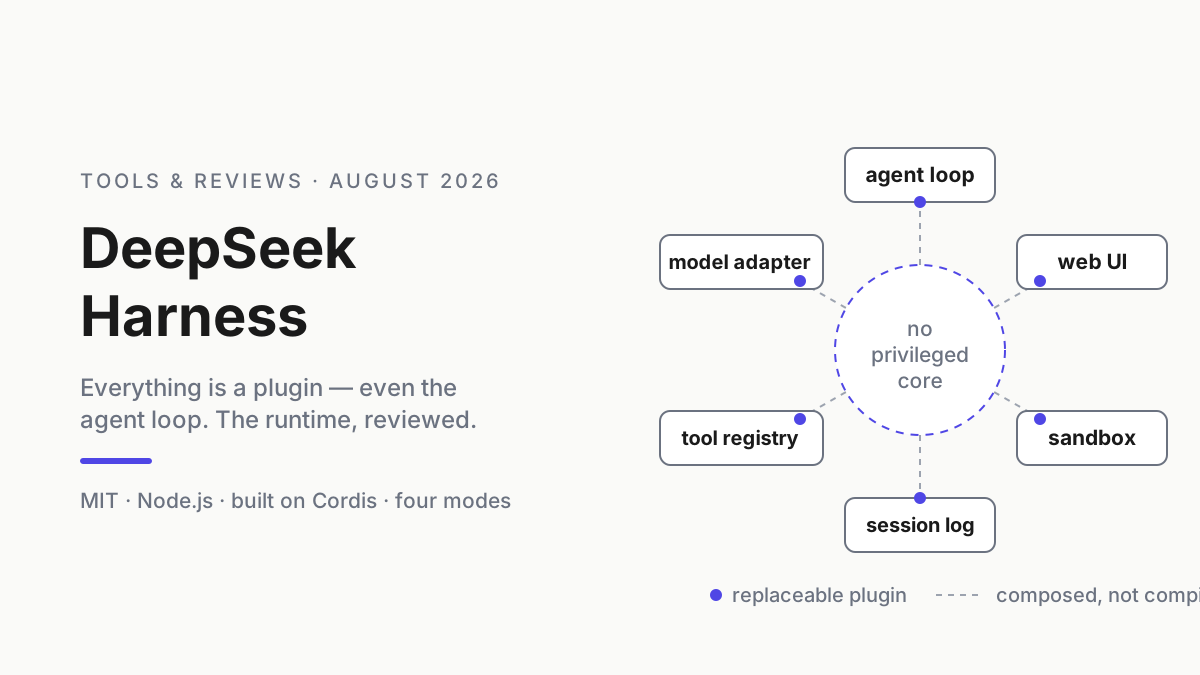
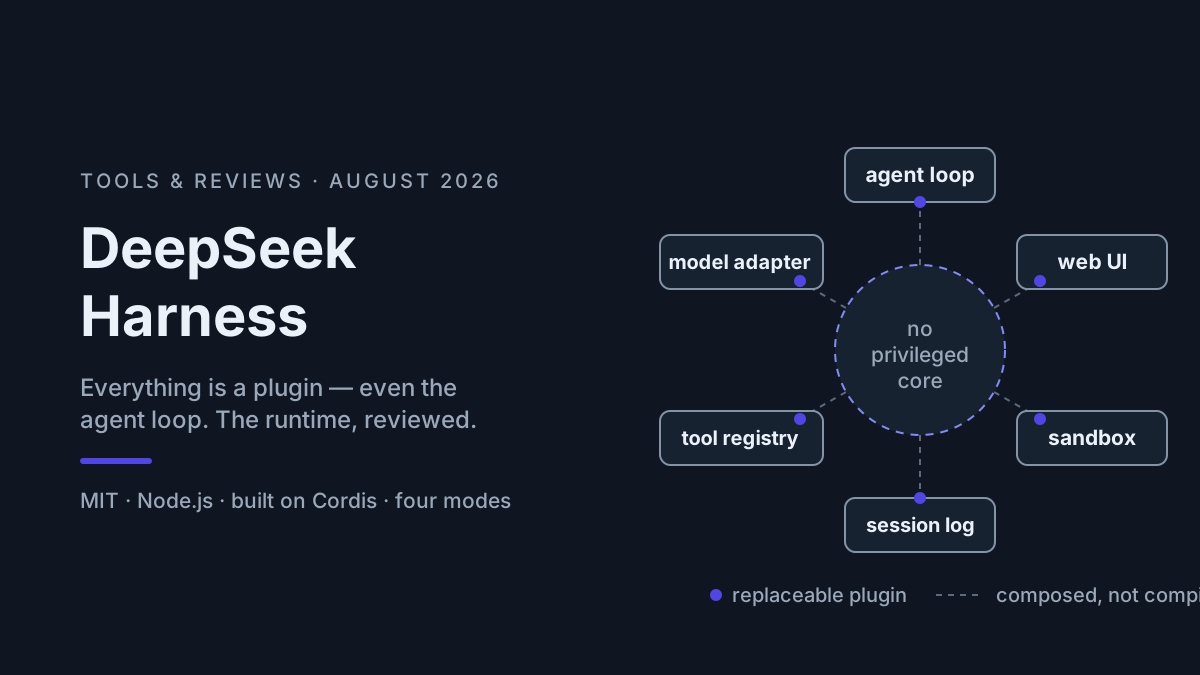
Every frontier lab now ships a harness. Anthropic and OpenAI led; Google replaced Gemini CLI with Antigravity CLI; DeepSeek shipped its Harness; Zhipu shipped ZCode; now Meta. The pattern is the point: labs concluded that model quality gets realized — or wasted — at the harness layer, which is why harness engineering hardened into a named discipline this year. Meta’s arrival closes the roll call. There is no major lab left betting that models sell themselves.
One caution belongs next to all three: judged by the survivor criteria the die-off distilled — explainable revenue, protocol-native plumbing, portable data, code that outlives the vendor — Muse Code’s scorecard is nearly blank, and Meta’s own history of sunsetting products when strategy turns is part of the record. The pivot that created Muse Spark is itself proof that this company can change course fast. Blank isn’t failing; it’s unscored. Treat it accordingly.
Early verdict: who should trial Muse Code, who should wait
Trial the beta now if:
- You maintain a tool bench professionally. Platform teams and tool scouts should have opinions on this one before their orgs ask; the field’s daily-driver roster gets re-litigated every quarter, and Meta just joined the docket.
- Your org is already deep in Meta’s ecosystem. Llama fine-tunes in production, PyTorch infrastructure, existing Meta developer relationships — you’ll want to know early whether the proprietary lane fits your stack.
- You evaluate engines, not just harnesses. Muse Code is currently the only way to put Muse Spark 1.2 through real agent work. If your job includes model selection, that alone justifies a sandbox.
- You have an eval set ready. A beta with unpublished error bars rewards people who bring their own measurements.
Wait for GA if:
- Claude Code or Codex is your settled daily driver. Nothing in a 59.3% standing behind both incumbent engines argues for switching a working setup. The rational posture is watchful, not migratory.
- You can’t adopt what you can’t price. Unpublished pricing means unbudgetable workloads and beta terms that can change under you.
- Your compliance posture needs terms in writing. Cloud-prioritized execution with undetailed retention terms is a non-starter for regulated codebases — revisit when the data pages exist.
- You need local. Unconfirmed is a no, for now.
How to trial the beta safely alongside your fleet
The two-week bake-off protocol from the new-wave review applies to Muse Code unchanged — sandbox, shadow week, live week, pre-written decision gate. The Muse-specific amendments:
- Pick trial repos as if the code is leaving the building — because it is. Cloud-prioritized execution means your project rides Meta’s runtime. Use clones without production credentials, secrets, or unreleased IP until the data terms are published and reviewed.
- Evals before vibes. Replay tasks you already solved with your daily driver and score the four numbers that matter: completion rate, interventions per task, tokens burned, wall-clock to merged. A week of that beats any launch chart — it’s the same discipline that separates benchmark reading from benchmark believing.
- Find the transcript path on day zero. Where do sessions land on disk, in what format, and can you get them out without Meta’s help? If the answer is “nowhere you can reach,” log your own terminal output — beta history has a way of becoming the only record of what a tool actually did.
- Cap and meter spend. Beta pricing that doesn’t exist yet can become GA pricing that surprises you. Scoped credentials, a hard cap, and your own local count of what the trial consumed.
- Decide at the gate you wrote in advance. Day fourteen, keep-or-drop criteria set before day one, sessions exported either way.
Product note: Trialing a brand-new harness is exactly where session sprawl starts — a fresh CLI writing history nowhere your other tools look. Automater Lite ingests transcripts from any CLI that writes them, alongside its 10+ built-in providers, so a Muse Code bake-off lands in the same searchable local archive as your Claude Code and Codex sessions, with local token metering to show what the beta actually burned. Free, on automater.ai.
Run it that way and the fleet you already operate absorbs the trial without drama. The base rate says most new harnesses never earn a permanent slot; Meta’s resources change the odds that Muse Code survives, not the odds that it fits your work. Two sandboxed weeks and an archived transcript trail is how you find out which side of that line it lands on — and if the beta folds into something else next year, you’ll still own the evidence.
FAQ: Meta’s Muse Code
What is Muse Code?
Muse Code is Meta’s terminal-based AI coding agent, announced by Mark Zuckerberg in beta in August 2026. You install it, run it in a project directory, and describe changes in plain language; the agent reads the repo, edits files, and iterates. It’s powered by Muse Spark 1.2, Meta’s coding-specialized model.
What model powers Muse Code?
Muse Spark 1.2, a coding-specialized member of Meta’s proprietary Muse Spark family — not the general-purpose flagship. Meta’s launch materials report 59.3% on the DeepSWE suite: behind GPT-5.6 (Sol) and Claude Fable 5, ahead of Qwen 3.8 Max’s reported 56.6%, with no independent re-run published yet.
How much does Muse Code cost?
Unpublished. As of late August 2026 the beta ships with no per-token rate, no subscription tier, and no stated beta-to-GA terms. Meta has prioritized cloud/hosted execution, and local deployment is unconfirmed. Budget-sensitive teams should meter any trial locally and treat current beta terms as changeable.
Is Muse Code better than Claude Code?
Not on published evidence. Meta’s own comparison places Muse Spark 1.2 behind Claude Fable 5 and GPT-5.6 on DeepSWE, and Muse Code’s harness is months old against incumbents refined over years. It’s a credible trial candidate — especially for Meta-ecosystem teams — not a replacement argument yet.
Can I run Muse Code locally?
Unconfirmed. Meta has prioritized cloud/hosted execution for the beta, and no local or on-prem deployment option has been published. Local-first and air-gapped teams should watch the official docs for a change; until then, assume your code runs on Meta’s infrastructure during any trial.