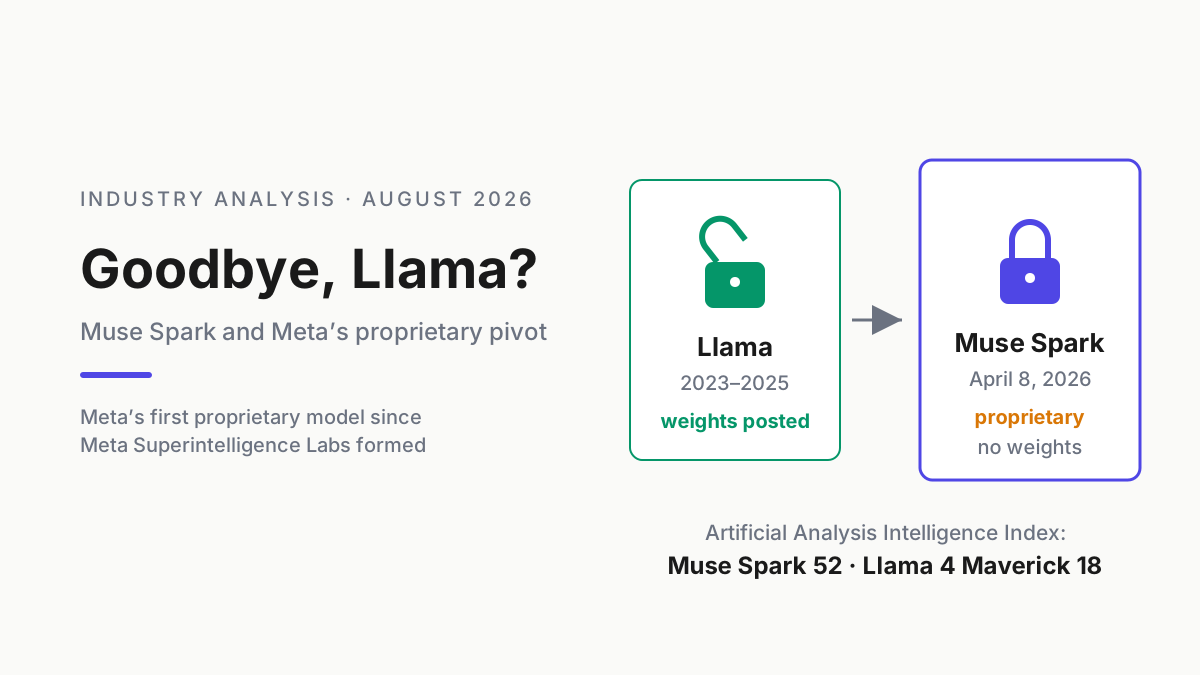
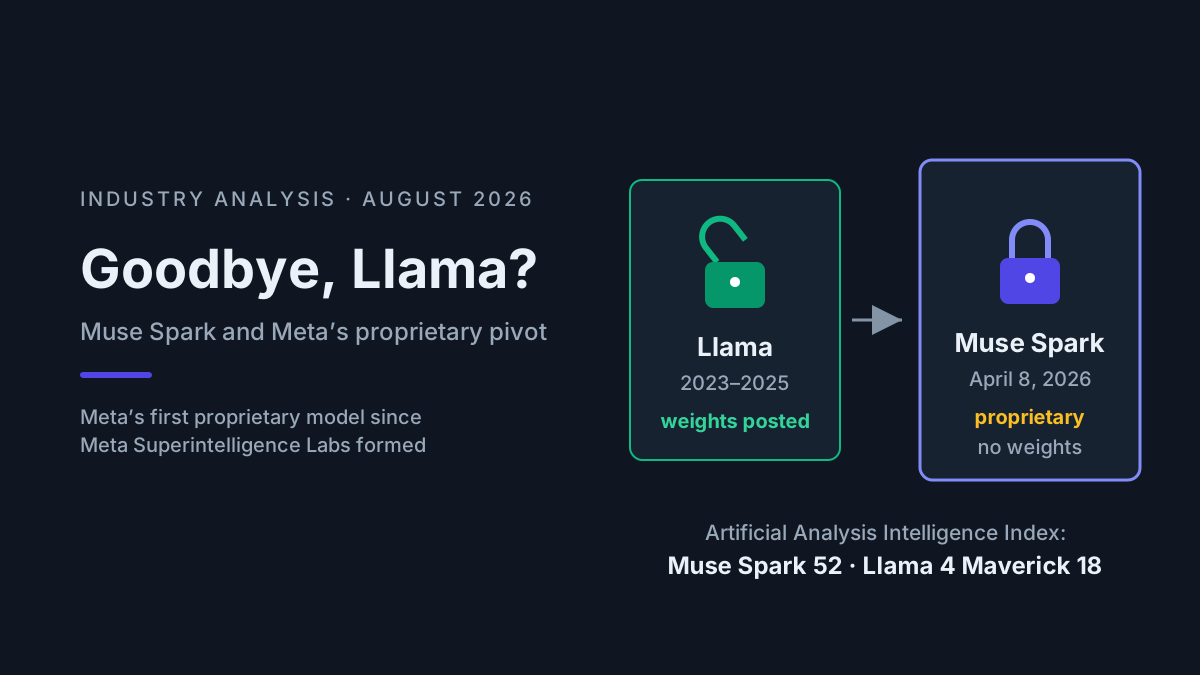
Goodbye, Llama? Muse Spark and Meta's Proprietary Pivot
Muse Spark is Meta's first proprietary model since Llama. What it is, what happens to Llama open source, and how teams standardized on it should hedge.

Go deeper. Build your own.
On April 8, 2026, Meta released a frontier model and did not post the weights. From any other lab, that sentence is unremarkable. From Meta — the company whose Llama releases made “open weights” a mainstream strategy in 2023 and carried it for three years — it marked a reversal loud enough that VentureBeat’s launch story led with two words and a question mark: “Goodbye, Llama?”
The model is Muse Spark, the first proprietary release since Meta Superintelligence Labs formed in summer 2025, and by the numbers it is the most capable thing Meta has ever shipped — nearly triple its own Llama 4 Maverick on Artificial Analysis’ Intelligence Index. Four months later the family grew a coding specialist, Muse Spark 1.2, and a terminal agent to carry it. The pivot is not a rumor; it is shipping product.
This analysis covers what happened and when, what Muse Spark actually is, how to parse the two sentences Meta offered about openness — the rebuilt-stack quote and the carefully-scoped Llama commitment — what the pivot means for the open-weight ecosystem and for agentic software builders, a practical hedging playbook if you standardized on Llama, and our predictions with the falsifiers that would prove us wrong.
The moment: April 8, 2026
Timing tells most of this story, so here it is in five dates.
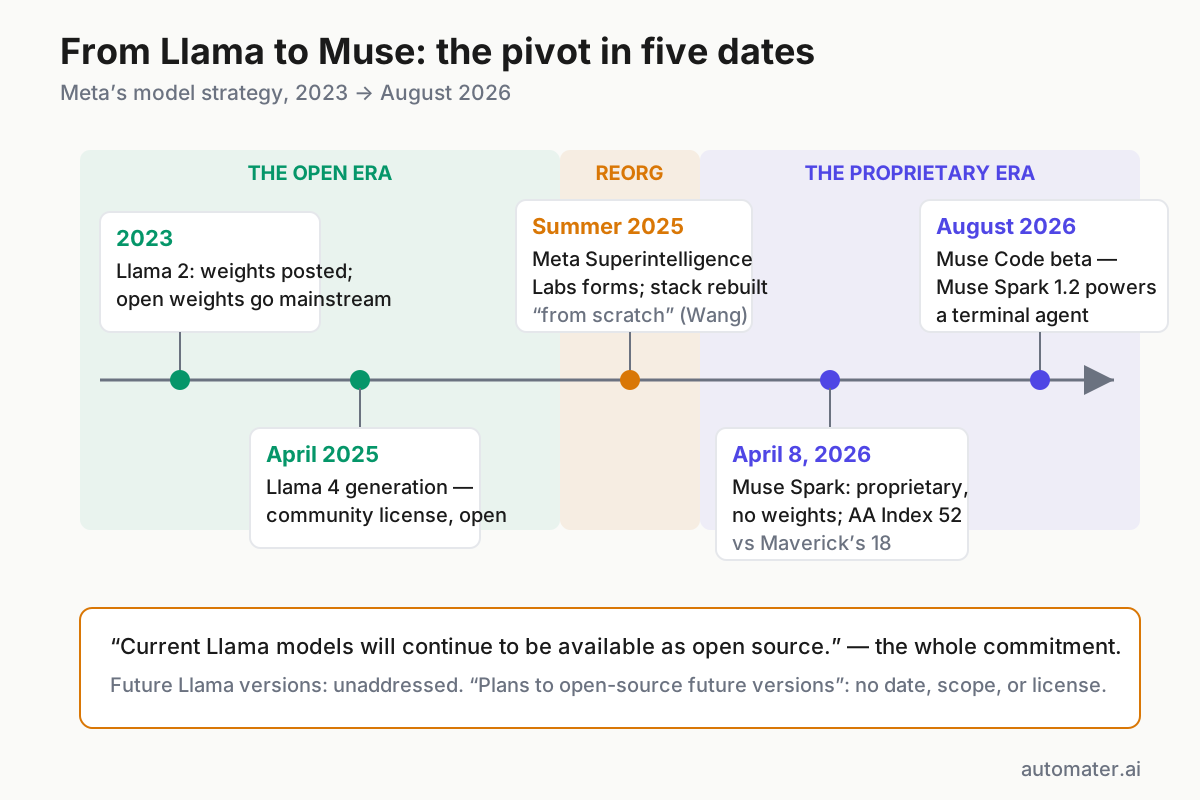
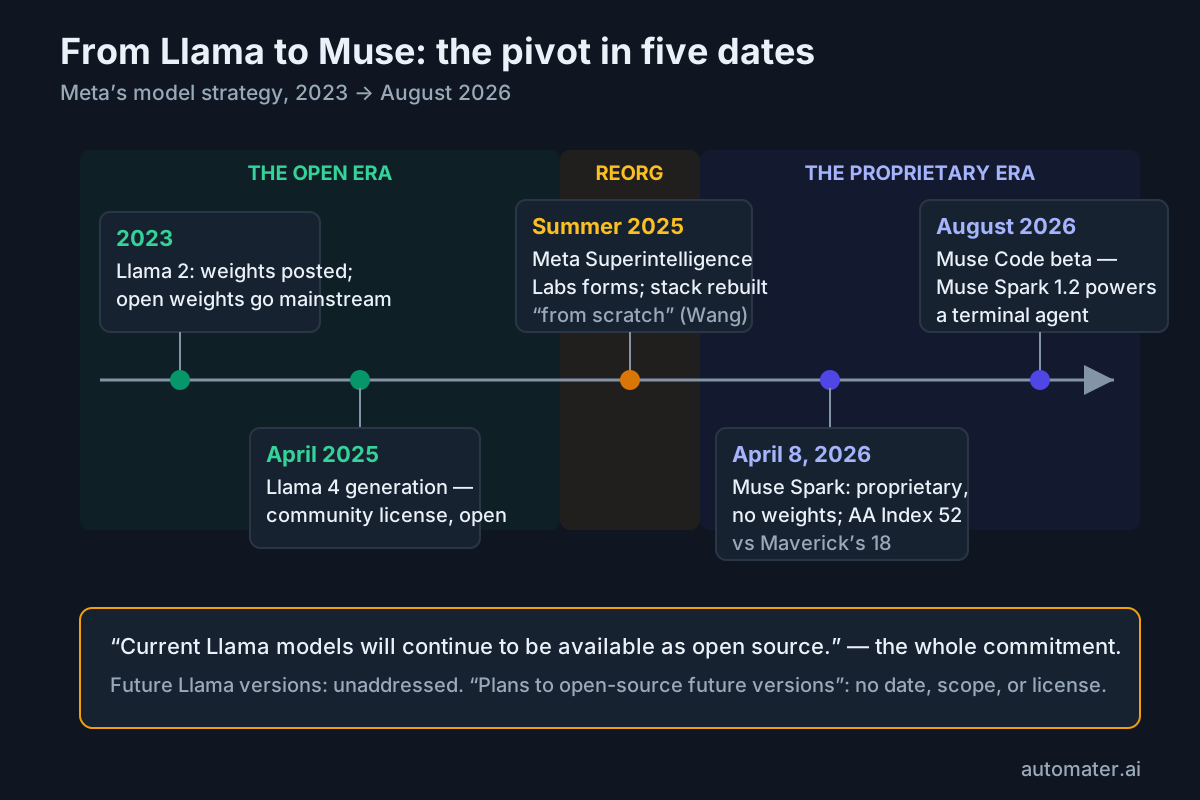 From posted weights to a private API preview in three years. The stack rebuild started with the reorg — Wang’s “nine months ago” lands on it almost exactly.
Llama 2’s 2023 release made frontier-adjacent weights something a company would ship on purpose, not something that leaked. Through Llama 3 and the Llama 4 generation in April 2025, “Meta releases it, everyone downloads it” was the closest thing the open-model world had to a constant — even if the community license, with its scale thresholds and branding terms, was never OSI-open in the strict sense .
Then, in summer 2025, Meta reorganized its AI effort into Meta Superintelligence Labs under Alexandr Wang, and the constant quietly stopped holding. No frontier Llama followed. What followed instead, on April 8, 2026, was Muse Spark: available through the Meta AI app and site, API access in private preview, pricing unannounced — and no weights. Not delayed weights, not staged weights pending a security review. None announced at all.
August 2026 completed the arc. Muse Spark 1.2, a coding-specialized family member, became the engine of Muse Code, Meta’s terminal coding agent — a beta announced by Mark Zuckerberg personally. A lab does not build a first-party harness around a model line it considers an experiment. The proprietary lane is now Meta’s main road.
What Muse Spark actually is
Muse Spark is Meta’s proprietary frontier model family, launched April 8, 2026 — the first Meta model shipped without open weights since Meta Superintelligence Labs formed in summer 2025. It is natively multimodal, reasons with visual chain-of-thought, and can orchestrate parallel sub-agents in a mode Meta calls “Contemplating,” with thought compression to manage long reasoning runs.
Unpack the feature list, because it is more agent-shaped than chat-shaped:
- Natively multimodal reasoning. Multimodality trained in from the start rather than bolted on — and reasoning that runs across modalities, not just captioning that feeds a text chain.
- Visual chain-of-thought. The model reasons in images — sketching intermediate visual state rather than translating everything through prose. The CharXiv Reasoning score of 86.4, a chart-understanding benchmark, is the number Meta points at to back this.
- “Contemplating” mode. For hard problems, the model spins up parallel sub-agents internally and orchestrates them — planner-worker decomposition as a model runtime feature rather than a harness trick. More on why that matters below.
- Thought compression. Long reasoning traces get compressed as they grow, native context management for exactly the long-horizon runs that blow out agent budgets today.
The launch numbers, with the usual house caveats about vendor-era benchmarks: an Artificial Analysis Intelligence Index score of 52, against Llama 4 Maverick’s 18 — nearly triple, and the single clearest measure of what the closed pivot bought . On HealthBench Hard, the difficult split of the medical suite, 42.8; on CharXiv Reasoning, 86.4. At launch, Artificial Analysis placed it behind only Gemini 3.1 Pro, GPT-5.4, and Claude Opus 4.6.
Date-stamp that last claim, because the frontier moved twice since: Muse Spark’s April placement predates both Anthropic’s Claude Fable 5 (June 9) and the GPT-5.6 era — the reference class it launched into no longer exists. Where everything stands now is the mid-2026 frontier scorecard’s job; the point here is narrower: on independent measurement, Muse Spark put Meta back in the frontier conversation its Llama line had fallen out of.
Access remains the asterisk. As of the launch coverage: Meta AI app and site for consumers, a private API preview for developers, no published pricing . For a builder, a model you cannot meter, price, or contract for is a demo, however good the index score — which is why the Muse Code beta, thin as its own terms are, matters as the first developer-shaped surface on this engine.
“Nine months ago we rebuilt our AI stack from scratch”
Meta offered exactly two sentences that frame the strategy, and both reward close reading.
The first is Alexandr Wang’s: “Nine months ago we rebuilt our AI stack from scratch,” paired with stated “plans to open-source future versions.” Do the arithmetic on the first half: nine months before April 8, 2026 is roughly July 2025 — the rebuild began with the reorg, almost to the month. Muse Spark is not a Llama 5 that grew safeguards late in training; it is the first output of a program that started over, on purpose, the moment MSL existed. That reading also explains the benchmark delta. You don’t nearly triple your own index score by iterating; you do it by replacing the thing you were iterating on.
The second half of the sentence — “plans to open-source future versions” — is the load-bearing clause for anyone hoping the pivot is temporary, so parse it like a contract:
- “Plans” is not a commitment. Plans get revised; roadmaps are not licenses.
- “Future versions” is unscoped. It does not say which model line, which size class, or on what delay. A trailing-edge release eighteen months behind the flagship would satisfy it. So would a small distilled variant.
- No date, no license, no mechanism. Compare Zhipu, which shipped GLM-5.2 under MIT on day one and put even its withheld GLM-5.3 weights on a stated two-week clock, and the difference between a practice and a plan is obvious.
None of that makes the statement empty — labs have walked similar paths back before, and OpenAI’s gpt-oss line proves a closed lab can ship real open weights when it decides to. But as of August 2026, zero Muse Spark weights have been posted, and no release has been scheduled. The evidence you can act on is the shipping behavior: closed model, closed follow-up, first-party harness.
The Llama question, handled straight
Here is the entirety of what Meta committed to on Llama: “current Llama models will continue to be available as open source.” Three observations, each fair to both sides.
First: nothing you run today breaks. Weights you have downloaded are yours; the community license you deployed under does not retroactively expire; the Hugging Face repositories, the fine-tune ecosystem, the runtime support in every major serving stack — all of it keeps working. Teams reading this with Llama in production have a roadmap problem, not an outage.
Second: read what the sentence does not say. “Current” scopes the promise to Llama 4.x and earlier. “Continue to be available” promises hosting, not development — availability is not a roadmap. And the sentence’s silence on future Llama versions is not an oversight in a launch this carefully worded. Meta declined to say “Llama 5 is coming,” and that omission is the news.
Third: the “open source” in that sentence was always loose. As our open-weight field guide lays out, Llama’s community license — scale thresholds, branding terms — never met the strict open-source definition. The pivot doesn’t take away something pristine; it stops extending something that was already a compromise. If anything, teams that cared about clean licenses had already drifted toward MIT and Apache alternatives before Meta made the drift official.
So the evenhanded verdict on “goodbye, Llama”: as a product line, no — the models remain available and useful, and Meta says so plainly. As a strategy — the idea that Meta’s best work ships with downloadable weights — the honest answer is that it already ended, in July 2025, and April 8 was when the ending became visible. Plan on Llama 4.x being the last frontier-chasing open Llama until Meta proves otherwise; treat any “future versions” release as upside, not baseline.
For a team standardized on Llama, three signals are worth a quarterly calendar entry, because each converts this from speculation into data:
- Maintenance cadence on Llama 4.x. Patch releases, security fixes, and doc updates are what “available” looks like when it’s alive; a repository that stops moving is the same promise, decaying.
- The official model repositories. New checkpoints, new size variants, or new licenses appearing under Meta’s Hugging Face organization would each revise the story — in either direction.
- What Meta’s developer surfaces promote. Watch whether Meta’s developer properties keep steering builders toward Llama, or quietly reroute every path toward Muse-family APIs. Navigation tells you the roadmap before any announcement does.
The ecosystem consequence: the torch passes
Zoom out from Meta and the striking thing is how little the open-weight ecosystem needs it anymore — and how completely the leadership changed hands while everyone watched the frontier labs instead.
The mid-2026 open-weight scorecard tells the story without editorializing: Kimi K3 posting a 93.4% independent SWE-bench Verified run and topping a frontend arena ahead of Claude Fable 5; GLM-5.2 under actual MIT; DeepSeek V4 setting the $0.14-per-million price floor; Qwen3-Coder-Next running frontier-adjacent coding on one machine. Every one of them from a Chinese lab, most under licenses cleaner than Llama’s ever was, per the roundup consensus. The strongest fully-Western open entry is OpenAI’s Apache-2.0 gpt-oss pair — a sentence that would have read as satire in 2024.
Notice the shape of the irony: open weights won as a strategy in the same year their inventor abandoned them. The approach Llama legitimized — ship weights, harvest ecosystem, monetize elsewhere — is now standard practice for half a dozen labs whose releases outscore Llama 4 on every axis. Meta didn’t leave a vacuum; it left a market that had already replaced it.
The practical consequences for builders are concrete:
- License quality improved. The center of open-weight gravity moved from Llama’s community license to MIT (GLM-5.2, DeepSeek V4) and Apache-2.0 (Qwen3-Coder-Next, gpt-oss). Legal reviews get easier, not harder.
- Geography entered the risk calculus. Teams whose procurement or compliance posture restricts Chinese-origin models now face a genuinely thin Western bench: gpt-oss, Mistral’s smaller lines, and little else at the top. That constraint, not capability, is the real cost of Meta’s exit.
- The “American open weights” hedge is gone. For three years, Llama was the answer enterprises gave when asked how they’d avoid both closed-vendor lock-in and Chinese-origin dependencies. That answer no longer has a frontier-current version. Teams that need it should say so to their vendors, loudly — market demand is the one thing that historically moves these decisions.
The agentic angle: Contemplating mode, and Muse Code
For this site’s readers, the most interesting part of Muse Spark is not the openness fight — it’s what the model absorbs from the harness layer.
Contemplating mode is subagent orchestration implemented inside the model: parallel workers spawned, coordinated, and merged as a runtime behavior rather than a scaffold pattern. Thought compression is context management — the compaction work every serious harness bolts on — running natively. The division of labor that defined 2025, where models think and harnesses orchestrate, is dissolving from the model side, and Muse Spark is the clearest statement yet that frontier labs consider orchestration a model capability, not an integration detail.
If that holds, harnesses don’t die — they specialize. Permissions, sandboxing, portability, local execution, transcript ownership: the parts of the loop that are about your machine and your trust, not about reasoning, remain stubbornly harness-shaped. Orchestration migrating into models mostly squeezes the middle of the market — the frameworks whose whole pitch was wiring sub-agents together.
And the family’s first specialization went exactly where you’d predict: code. Muse Spark 1.2, the coding-specialized variant, now powers Muse Code, Meta’s terminal agent — 59.3% on DeepSWE per launch materials, behind GPT-5.6 and Claude Fable 5, with pricing and local deployment still open questions. Our full Muse Code review grades the beta; the strategic read is simpler: the pivot’s second act is a vertical stack — proprietary engine, first-party harness, Meta-controlled distribution. That is the Anthropic and OpenAI playbook, adopted by the company that spent three years running the opposite one.
If you bet on Llama: the hedging playbook
None of this requires panic. It requires the same portfolio discipline any single-vendor dependency deserves, executed this quarter instead of eventually.
- Inventory the dependency. List every place Llama-family weights run: versions, sizes, quantizations, deployment targets, and which are load-bearing versus experimental. Most teams discover the list is longer than they thought — evals, guardrail classifiers, and internal tools count.
- Snapshot weights and licenses now. Continued availability is Meta’s stated intent, and mirrors are cheap insurance anyway. Archive the exact artifacts and license texts you depend on internally; treat Hugging Face as a convenience, not a guarantee.
- Map what’s base-locked. Fine-tunes and LoRA adapters do not transfer across base models — every adapter you trained on a Llama base is a migration cost waiting to be scheduled. Prompts and eval baselines tuned to Llama’s behavior are softer lock-in, but real.
- Shortlist successors per role, not wholesale. The open-weight scorecard is the menu: Qwen3-Coder-Next for local coding lanes, GLM-5.2 where MIT licensing and verified value matter, gpt-oss where policy requires a Western origin. A per-role migration beats a dramatic wholesale swap.
- Eval before you switch anything. Build the bench from your own real tasks and run candidates against it — evals for AI agents is the method. Index scores chose your shortlist; only your workload should choose your successor.
- Make multi-model the default posture. Route through OpenAI-compatible endpoints, keep per-provider configs portable, and assume any lab — any lab — can pivot within two quarters, because one just did. Running several agents and engines side by side is what makes a pivot a config change instead of a crisis.
Product note: Fleets outlive strategy shifts; single-vendor setups don’t. Automater Lite keeps a local, cross-provider archive of every session — Claude Code, Codex, Qwen Code, Z.ai GLM, and any CLI that writes transcripts — with local token metering per provider, so when a lab changes course your history, your eval corpus, and your cost baseline stay yours and move with you. Free, on automater.ai.
Predictions, with falsifiers
Analysis you can’t be wrong about is marketing. Here is where we think this goes, and exactly what would prove us wrong.
| Prediction | Reasoning | Falsifier — we’re wrong if… |
|---|---|---|
| “Open-source future versions” means trailing releases, if anything | Plans without dates or licenses historically resolve to token gestures; the capability gap is Meta’s moat now | Meta posts weights for any Muse Spark-class model by April 2027 |
| No frontier-chasing open Llama 5 | The rebuilt stack is the frontier effort; running two flagship programs contradicts the reorg’s logic | A new Llama major ships with posted weights and frontier-adjacent independent benchmarks by mid-2027 |
| Muse monetization will be an ecosystem play, not a token business | Consumer surfaces first, private API preview, personal Zuckerberg announcement for a developer tool — the pattern points at platform bundling | Muse Spark GA ships with plain published per-token API pricing and no bundle requirement |
| Open-weight leadership stays with Chinese labs plus gpt-oss through 2027 | The cadence gap is structural: those labs ship open weights as strategy, not charity | Any Western lab takes the #1 open-model slot on Artificial Analysis with posted weights before 2028 |
We’d rather publish these and be checkable than hedge into mush. Re-score them quarterly; we will.
FAQ: Muse Spark and the Llama pivot
What is Muse Spark?
Muse Spark is Meta’s proprietary frontier AI model family, launched April 8, 2026 — the first Meta model without open weights since Meta Superintelligence Labs formed in summer 2025. It’s natively multimodal with visual chain-of-thought, a sub-agent-orchestrating “Contemplating” mode, and scored 52 on Artificial Analysis’ Intelligence Index at launch.
Is Meta discontinuing Llama?
No discontinuation has been announced. Meta states that “current Llama models will continue to be available as open source” — existing weights, licenses, and hosting persist. What Meta has not addressed is future Llama development, and no frontier Llama has shipped since the summer 2025 reorg. Plan for availability, not new versions.
Is Muse Spark open source?
No. Muse Spark is proprietary — available through the Meta AI app and site with API access in private preview, and no weights posted. Alexandr Wang has cited “plans to open-source future versions,” but as of August 2026 that plan has no date, scope, license, or scheduled release attached.
What is Meta Superintelligence Labs?
Meta Superintelligence Labs (MSL) is the AI organization Meta formed in summer 2025 under Alexandr Wang, consolidating its frontier model work. Per Wang, the group rebuilt Meta’s AI stack “from scratch” — a timeline that matches the reorg — and Muse Spark, launched April 2026, is its first released model.
What model powers Muse Code?
Muse Code, Meta’s terminal coding agent (beta, August 2026), runs on Muse Spark 1.2 — a coding-specialized member of the Muse Spark family rather than the general-purpose flagship. Launch materials report 59.3% on the DeepSWE suite, behind GPT-5.6 and Claude Fable 5, with pricing still unpublished.
Sources
- “Goodbye, Llama?” — Meta launches proprietary Muse Spark (VentureBeat)
- Meta for Developers (developer.meta.com)
- Muse Code — Meta AI products (developer.meta.com)
- Artificial Analysis — Intelligence Index (artificialanalysis.ai)
- Hugging Face — Llama model repositories (huggingface.co)
- Best open-source coding models 2026 (morphllm.com)
- Introducing Claude Fable 5 and Claude Mythos 5 (anthropic.com)
- GPT-5.6 (openai.com)