LG AI Research Makes the K-EXAONE 2.5 API Free: A Zero-Cost Agentic Lane With Vendor-Reported Scores
LG AI Research says anyone with an API key can call K-EXAONE 2.5 free on the EXAONE API Platform. The four agentic scores are internal and unaudited, and the post omits limits and terms. Here is what is verified, what is not, and how to canary the lane.
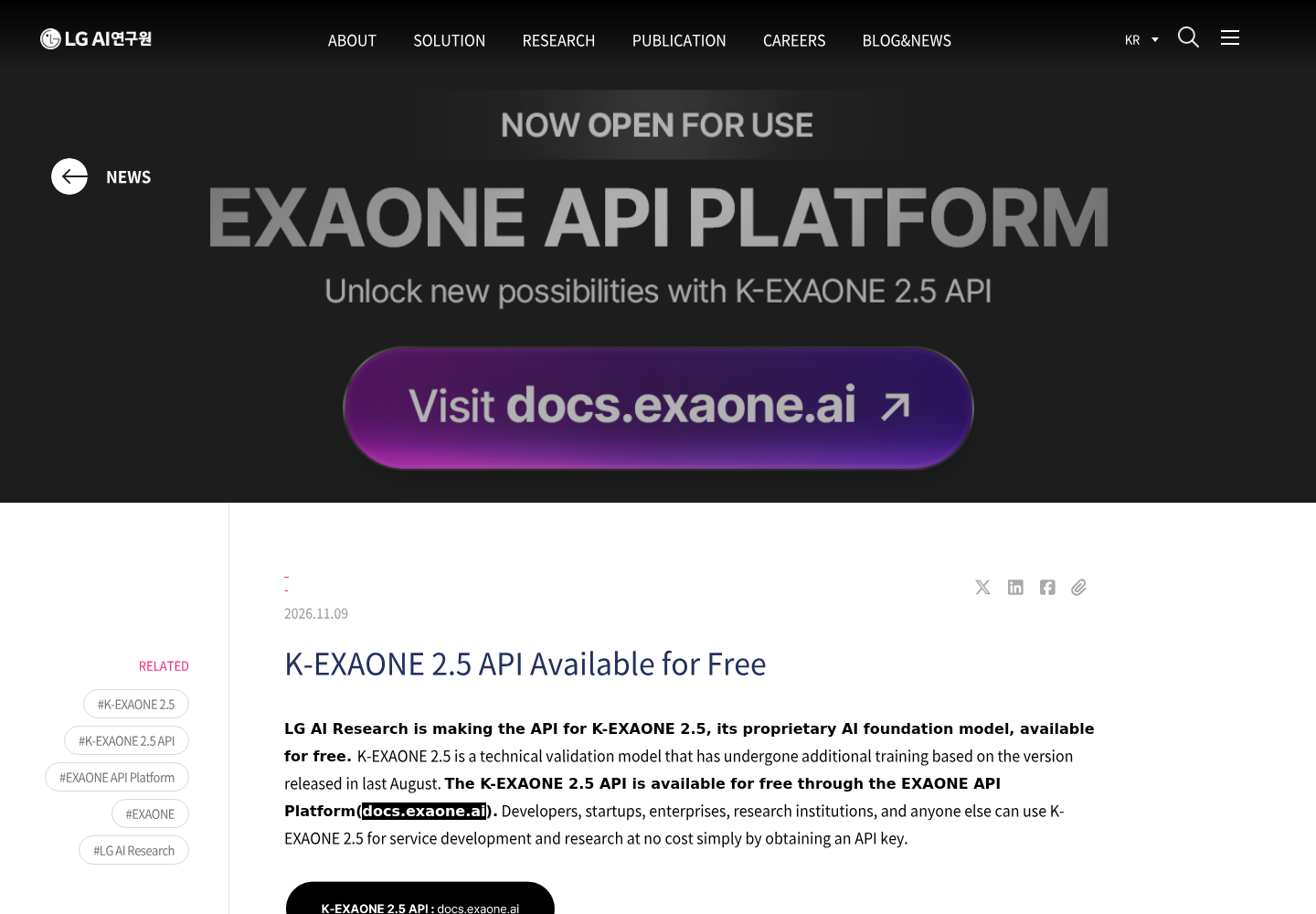
LG AI Research says the API for K-EXAONE 2.5, its proprietary foundation model, is now available free to anyone who obtains an API key. The newsroom post, dated 2026.11.09, calls K-EXAONE 2.5 “a technical validation model that has undergone additional training based on the version released in last August,” served through the EXAONE API Platform at docs.exaone.ai. Developers, startups, enterprises, research institutions “and anyone else” can use it for service development and research at no cost.
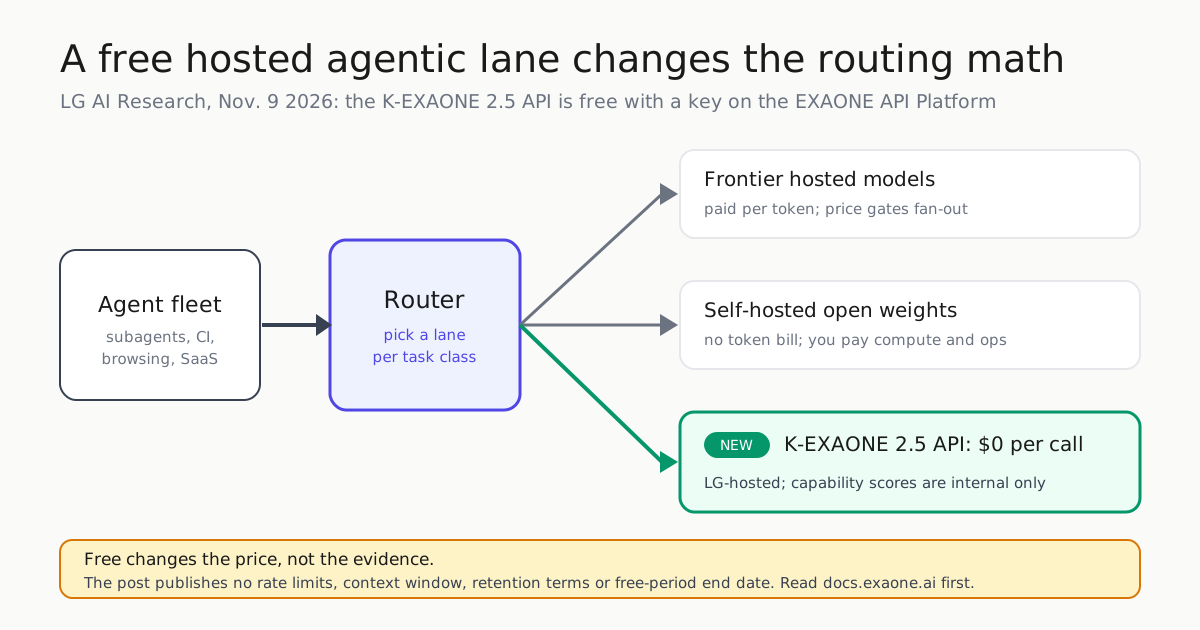
That is an availability claim, not a roadmap item: LG presents the free endpoint as something you can call today with a key. For anyone running an agent fleet it is a genuinely new lane, a hosted agentic-tuned model whose token price is zero, from a national-scale corporate research lab. The catch is that every capability number behind it is LG’s own, and nearly every operational term is missing.
Four vendor-reported agentic scores
LG reports internal evaluations “conducted using publicly available datasets,” saying K-EXAONE 2.5 delivered performance comparable to global frontier-class open-weight models and was competitive with leading Chinese frontier models including DeepSeek-V4.1-Flash and GLM-5.3. The four numbers given in the post text:
| Benchmark | Score | What LG says it measures |
|---|---|---|
| BrowseComp | 78.0 | Navigating the web and finding relevant information |
| Claw-Eval | 77.3 | An agent’s problem-solving in workplace environments |
| AutomationBench-Openset | 74.6 | Automating tasks using SaaS tools |
| SWE-Bench Pro | 59.2 | Real-world software development and modification tasks |
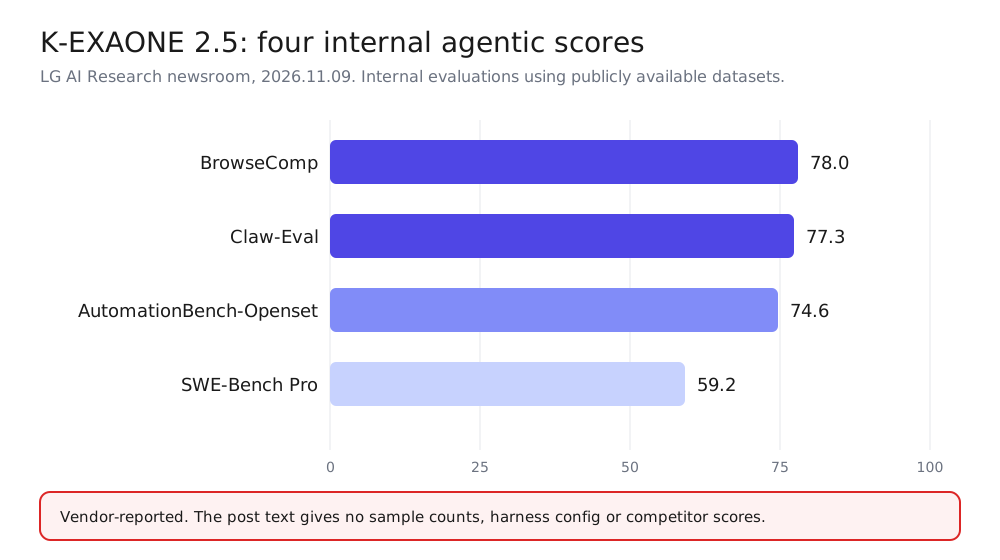
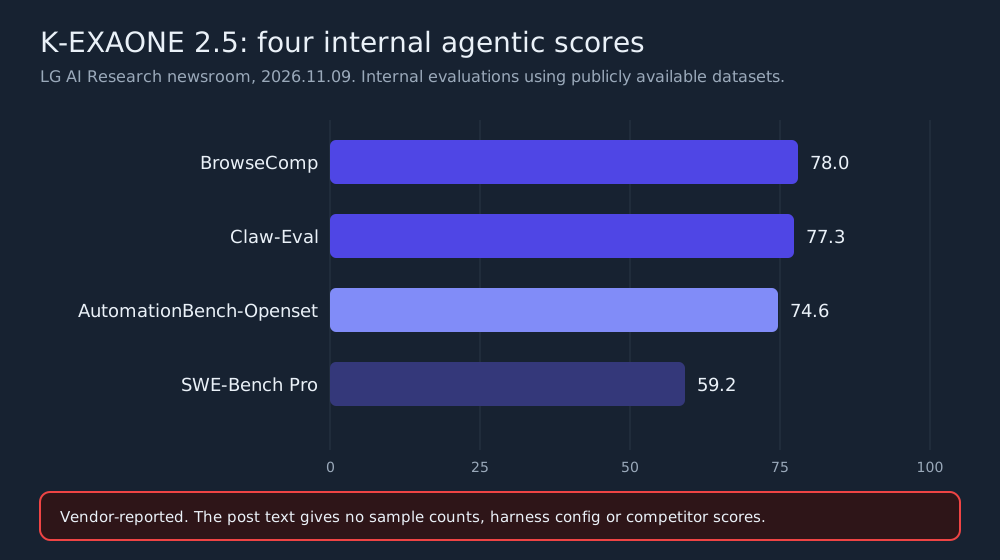
Three limits on those numbers. First, they are unaudited vendor self-evaluations: the post publishes no sample counts, decoding settings, tool harnesses or agentic scaffolds. Second, the named competitors have no scores in the post text. DeepSeek-V4.1-Flash and GLM-5.3 are comparison targets, and the comparison itself sits in an accompanying graphic captioned “Image 1. K-EXAONE 2.5 Performance Evaluation Results,” which a reader has to open on LG’s page to check. Third, scores do not transfer across harnesses, the recurring problem in reading agent benchmarks in 2026. For independent reference points on the two named competitors, see our coverage of DeepSeek V4.1 Flash in Cursor and GLM-5.3’s release.
Why “free” is the operator story
Token price is what caps fan-out. Subagent swarms, browsing loops, bulk classification and first-pass code review generate large volumes of low-stakes calls where the marginal quality gain of a frontier model rarely beats its marginal cost, which is the arithmetic behind cost per completed task. A $0 hosted lane changes that arithmetic immediately for exactly those calls, and BrowseComp and AutomationBench are the two benchmarks that map most directly onto them.
Free is not costless. Adopting the lane means an integration, an eval set, a failover path and a policy decision about sending your prompts to a third-party platform. Those are the same hidden costs that make “free” open weights expensive in practice, and they land on your team rather than on LG.
Two phrases deserve extra weight. “Technical validation model” is not how a lab describes a production flagship; it reads as a checkpoint LG is using to collect evaluation signal, which is a plausible reason access is free. And “at no cost” appears with no end date. Neither is a warning. Both are reasons to treat this as a lane you canary rather than a lane you depend on.
What the post does not say
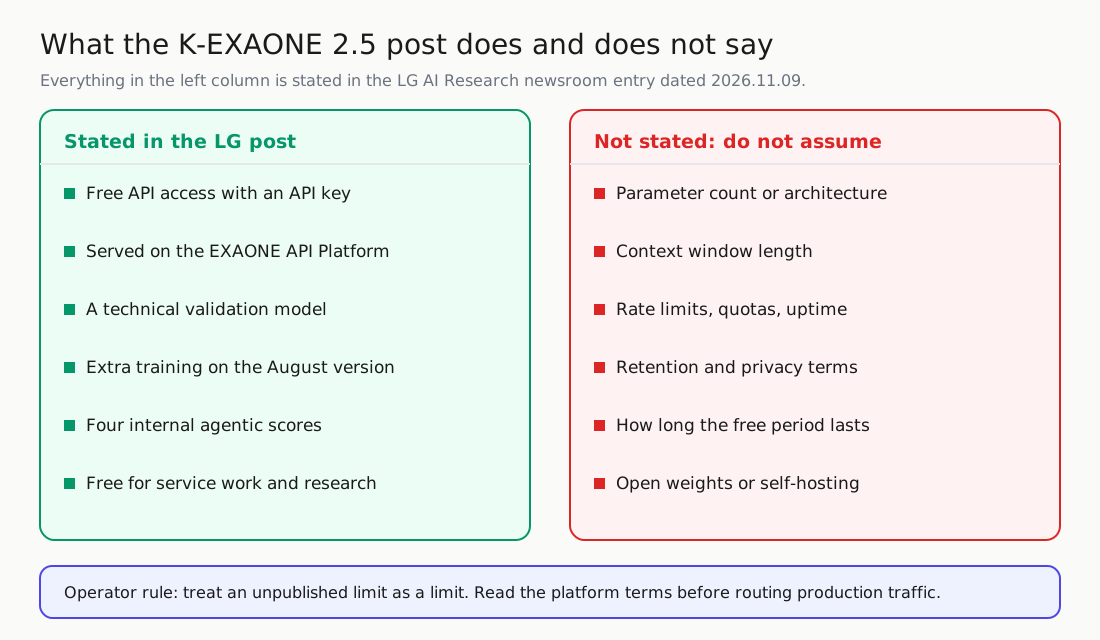
The post carries no parameter count or architecture, no context window, no rate limit or quota, no data-retention or privacy term, no statement of how long access stays free, and no mention of open weights or self-hosting. It also does not describe the request format, so do not assume OpenAI compatibility; read docs.exaone.ai before writing the adapter. Each of those unknowns is a routing decision you cannot make from the announcement alone.
A minimum pre-flight before any production traffic:
1. Read the EXAONE API Platform terms: retention, permitted use, region, quota.
2. Confirm the request schema and error model with one throwaway call.
3. Replay 20 of your own real tasks against K-EXAONE 2.5 and your incumbent.
4. Score cost per completed task and failure modes, not impressions.
5. Put the lane behind your gateway with a hard timeout cap and a fallback.
6. Re-run the 20 tasks monthly: a validation model may change without notice.
Korea’s AI week, kept separate
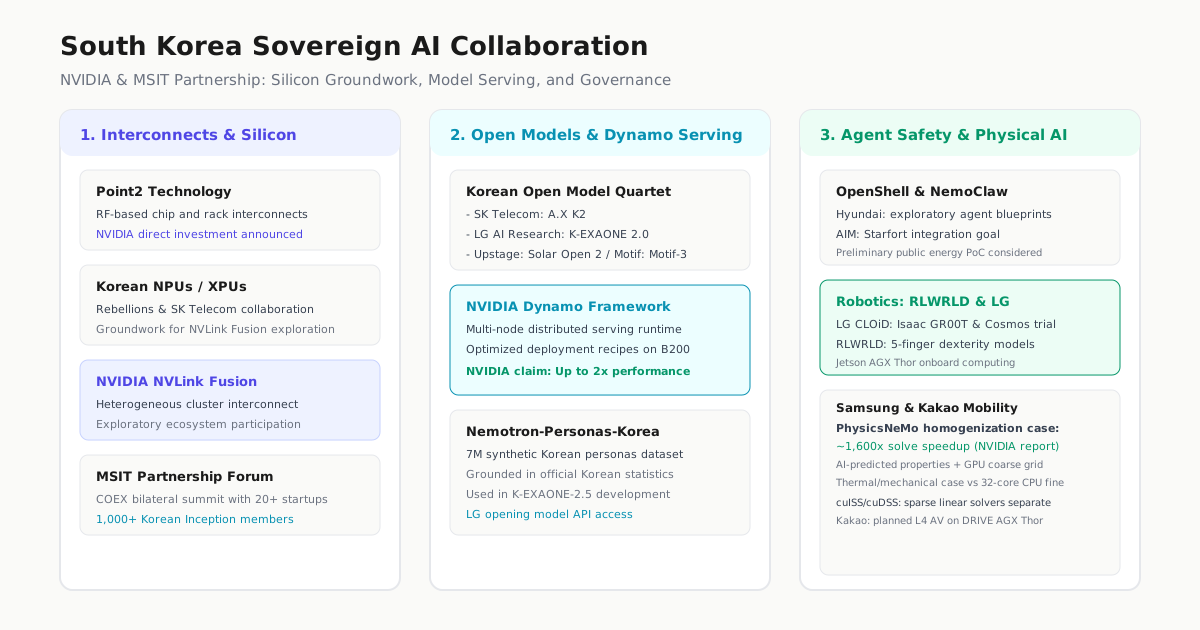
The announcement lands in a busy week for Korean AI. On Nov. 9, NVIDIA described the MSIT-NVIDIA AI Startup Partnership Forum at COEX, where Korea’s vice minister of science and ICT Ryu Je-myung met more than 20 Korean startups across foundation models, physical AI, infrastructure and semiconductors. NVIDIA announced an investment in interconnect company Point2, with additional investments planned in Motif Technologies, RLWRLD and Upstage, alongside more than 1,000 Korea-based members of NVIDIA Inception. A day earlier, NVIDIA detailed physical AI work with Samsung, Kakao Mobility and LG Electronics, including Isaac GR00T-powered robotic manipulation with LG’s CLOiD robot in a real manufacturing environment.
Keep the boundaries straight. Neither NVIDIA post mentions EXAONE or K-EXAONE 2.5, the LG Electronics robotics collaboration is a different LG unit from LG AI Research, and nothing in the evidence ties the free API announcement to that forum. Same week of national AI activity, not the same event. Our coverage of the NVIDIA side is here and here; for the field LG is benchmarking against, see Chinese frontier models for agent work.
Bottom line
A free, hosted, agentic-tuned model from LG AI Research earns a canary lane this week: the price is right, and the four internal scores are in a plausible range for models of this class. It is not yet a lane to depend on. What would change that read is published terms — quota, retention, duration — and independent harness numbers that reproduce LG’s.