Cursor Adds DeepSeek V4.1 Flash, Putting Every Effort Tier on Its Cost Frontier at $0.60-$0.98 per Task
Cursor's model picker now includes DeepSeek V4.1 Flash with no BYOK proxy required. CursorBench 4.0 data shows all four effort tiers beat every other benchmarked model at the same or lower price per task.
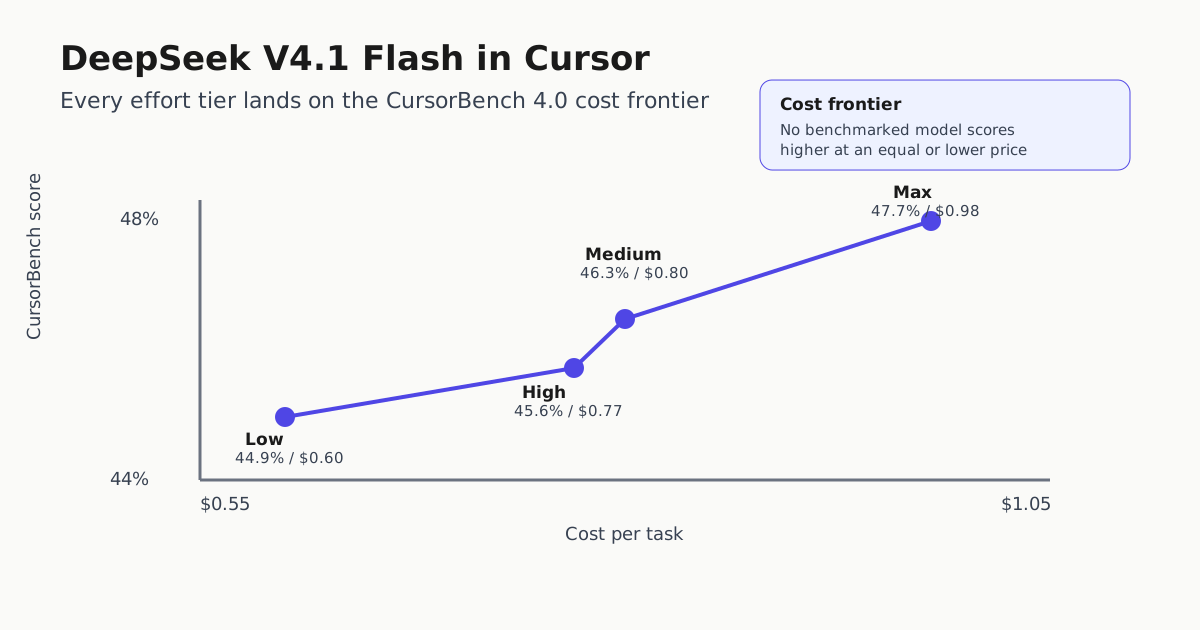
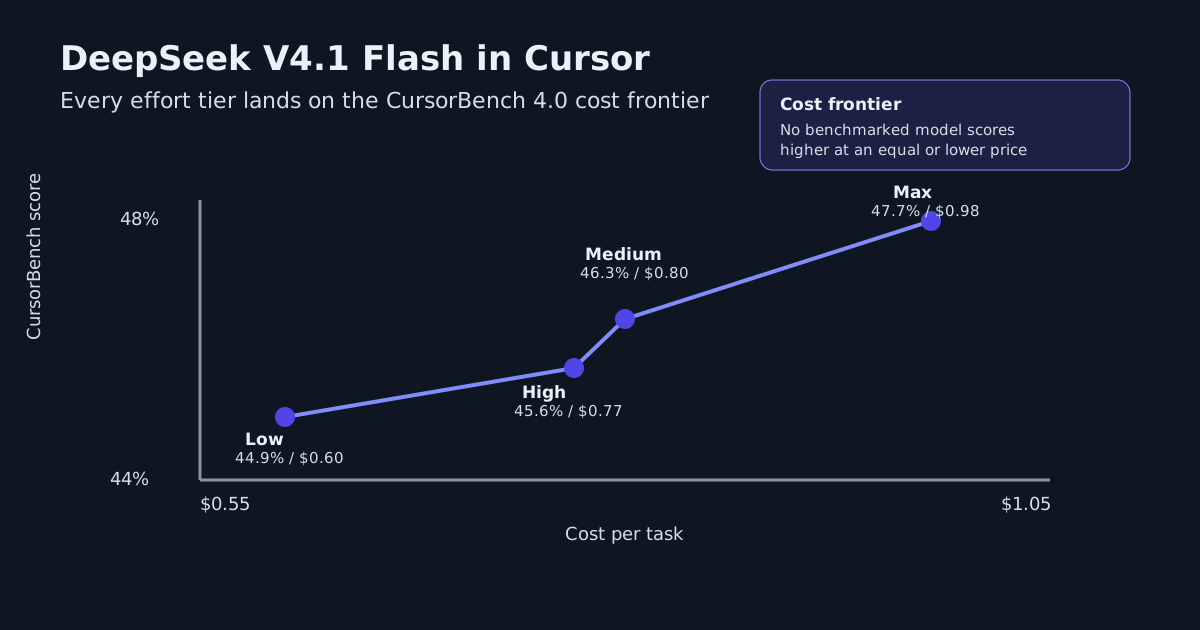
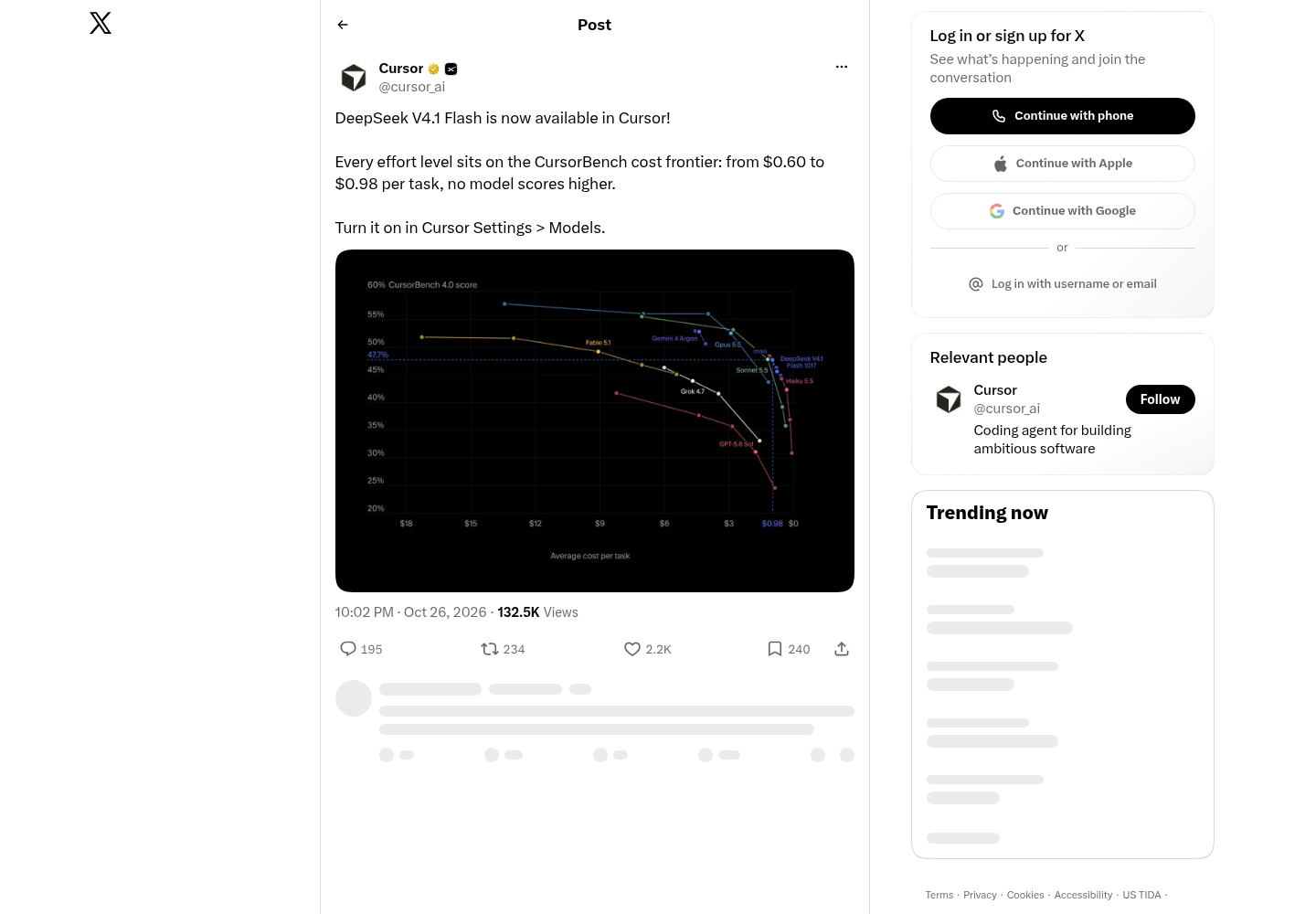
Cursor added DeepSeek V4.1 Flash to its native model picker on October 26, 2026, and paired the release with a specific benchmark claim: every one of the model’s four reasoning-effort settings sits on CursorBench’s cost frontier, meaning no other model Cursor has tested scores higher at an equal or lower price per task (Cursor on X). The model is available under Cursor Settings > Models with no BYOK proxy, custom adapter, or separate API key required.
What CursorBench 4.0 actually reported
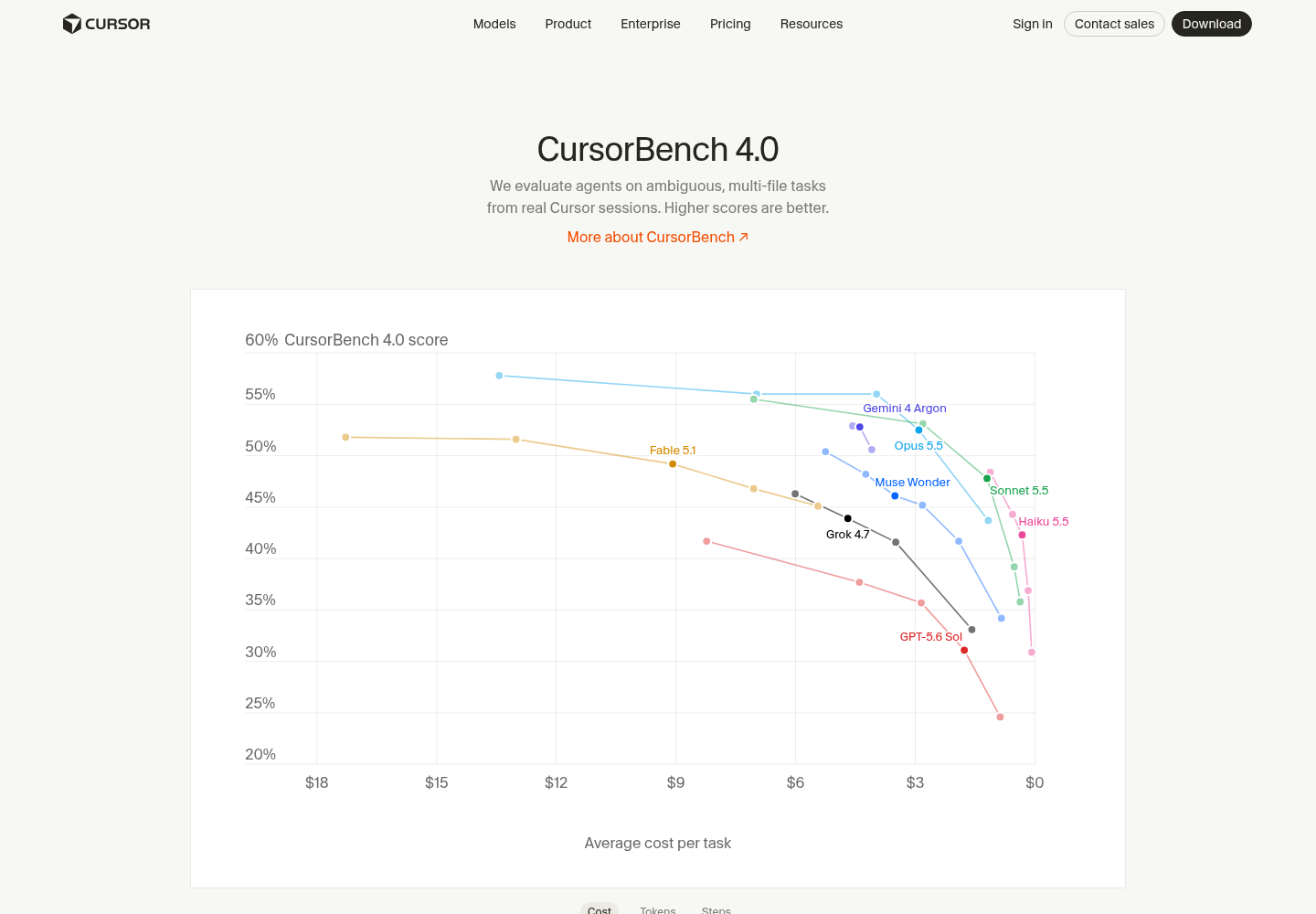
CursorBench evaluates coding agents on ambiguous, multi-file tasks pulled from real Cursor sessions, covering editing, refactoring, investigation, intent interpretation, job management, and adherence to design constraints, scored inside Cursor’s own agent harness (CursorBench). DeepSeek V4.1 Flash’s four effort tiers landed at:
| Effort | CursorBench 4.0 score | Cost per task | Avg. tokens | Avg. steps |
|---|---|---|---|---|
| Low | 44.9% | $0.60 | 290,651 | 161 |
| Medium | 46.3% | $0.80 | 398,255 | 189 |
| High | 45.6% | $0.77 | 385,196 | 186 |
| Max | 47.7% | $0.98 | 537,047 | 187 |
Source: CursorBench 4.0 leaderboard, which lists 81 model-and-effort combinations across Opus 5.5, Sonnet 5.5, GPT-5.6, Gemini 4 Argon, Grok 4.7, GLM 5.3, Muse Wonder, and others (CursorBench).
Checking the frontier claim against the full board
A model is on the cost frontier only if nothing else in the dataset beats its score at the same or lower cost. Scanning CursorBench’s full 81-row table against each DeepSeek tier confirms the claim holds at every price point Cursor cited. At $0.60, the next-cheapest entries — Haiku 5.5 Low (30.9%, $0.08), GLM 5.3 Flash Low (26.9%, $0.15), and Sonnet 5.5 Low (35.8%, $0.37) — all score well below 44.9%. At $0.77-$0.80, Sonnet 5.5 Medium (39.2%, $0.52) and Composer 2.5 (27.7%, $0.68) trail both the High and Medium DeepSeek tiers. At $0.98, the closest rival by score, Haiku 5.5 Max, needs $1.12 to reach 48.4% — just over DeepSeek Max’s 47.7%, but at a higher price, which keeps DeepSeek Max on the frontier rather than inside it. That makes DeepSeek V4.1 Flash Max the highest CursorBench score available anywhere under $1 per task on the current leaderboard.
Why the underlying model is cheap enough to pull this off
DeepSeek’s own model card for V4.1-Flash-1017 attributes the gains to KV-cache compression work that cuts task execution time and output length relative to the prior DeepSeek-V4.1-Flash release, which DeepSeek says moves the model’s performance-cost curve forward across multiple agent harnesses (Hugging Face). DeepSeek reports a 1-million-token context window, and AlphaSignal’s writeup of DeepSeek’s technical report cites roughly 210 output tokens per second under DeepSeek’s test conditions (AlphaSignal); separately, DeepSeek’s DeepSWE v1.1 pass rate (77.0%) edges out both Opus 5 (74.0%) and GPT-5.6 Sol (73.0%) on that repository-level benchmark — though CursorBench’s own numbers, run inside Cursor’s harness rather than DeepSeek’s, are the figures that matter for Cursor users. That trajectory tracks the broader shift Automater has called the DeepSeek effect: open-weight models driving down the per-task cost of running coding agents industry-wide.
What this changes for operators
For teams running high-volume agentic coding loops — repeated repository searches, test-fix cycles, parallel agent runs — the practical change is that Cursor now exposes a sub-$1-per-task option across its entire effort range without a BYOK workaround. AlphaSignal’s breakdown of the rollout frames the four tiers as distinct operational choices rather than a single price point: Low suits bounded edits and changes already covered by strong test suites; High and Medium fit longer, cost-sensitive repository work, with Medium gaining 0.7 points over High for three cents more; Max is the pick for ambiguous investigations and broad refactors where a failed attempt is expensive (AlphaSignal). None of that requires switching away from Cursor’s native billing, which was previously the main friction for trying open-weight models inside the product.
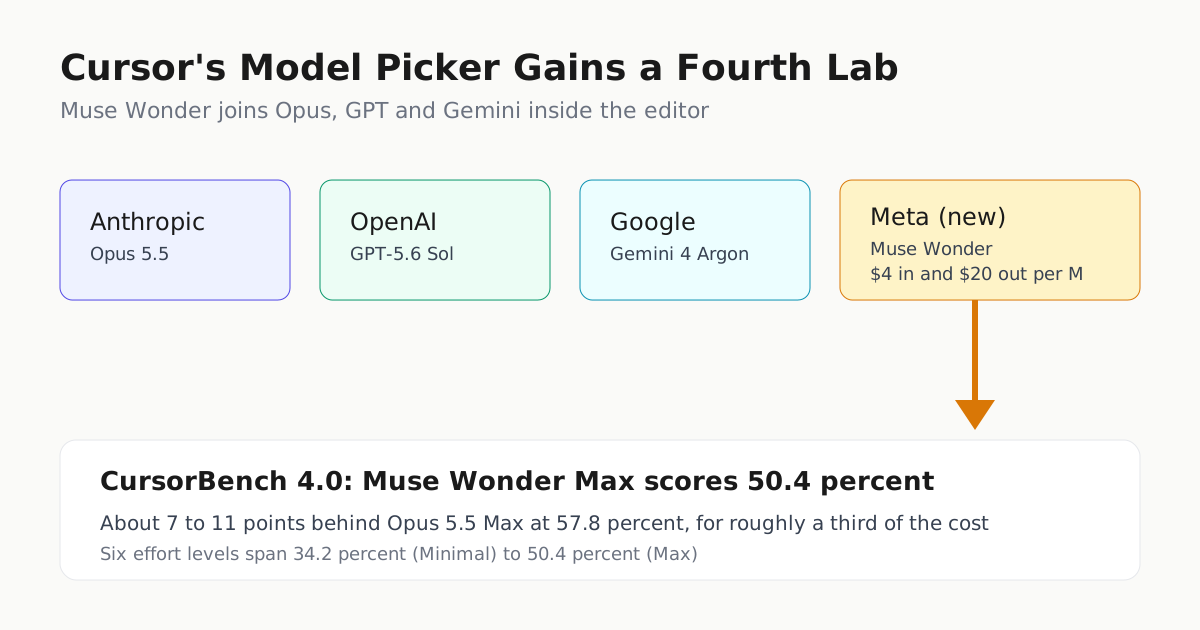
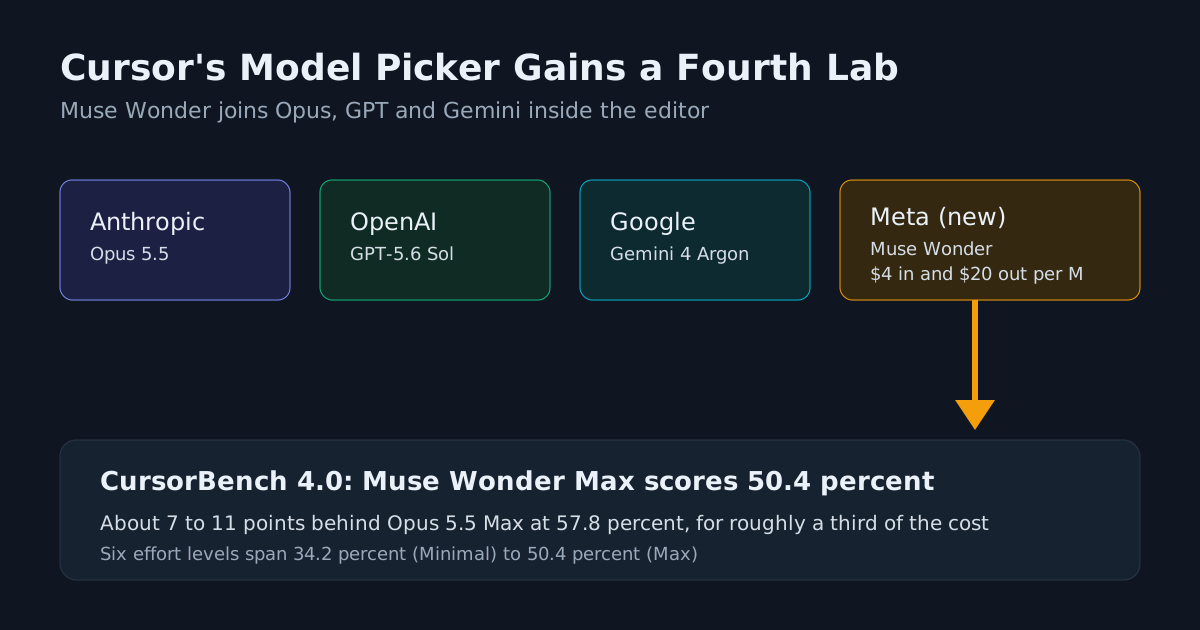
The timing matters too. This lands the same week OpenAI’s GPT-6.1 Terra pushed into lower-cost tiers on Bedrock and GitHub Copilot, part of a broader price squeeze across agentic coding models that Automater has tracked through Cursor’s own prior additions of Gemini 4 Argon and Meta’s Muse Wonder. DeepSeek V4.1 Flash is the cheapest of that recent wave by a wide margin, and it is the only one of the three whose entire effort range, not just one tier, lands on the frontier.
What to verify before defaulting to it
CursorBench’s score ceiling for DeepSeek V4.1 Flash tops out at 47.7%, well below Opus 5.5 Max’s 57.8% — the model wins on cost efficiency, not absolute accuracy, so production use still needs tests, review, and reversible changes regardless of effort tier. Cursor’s benchmark accounting also won’t reconcile cleanly with DeepSeek’s raw API pricing (roughly $0.14 per million input tokens and $0.28 per million output tokens): CursorBench’s per-task costs reflect benchmark token consumption under Cursor’s harness, not a customer’s actual bill, which depends on caching, plan allowances, and usage-based billing. Teams considering a default-model change should run their own representative repository trial — accepted-diff rate, test-pass rate, and retries per completed task will say more about local fit than a leaderboard position. Readers running self-hosted DeepSeek deployments may also want Automater’s Intel guide to V4.1-Flash’s cache-hit economics for the off-platform cost picture.
Sources
- Cursor on X: "DeepSeek V4.1 Flash is now available in Cursor! Every effort level sits on the CursorBench cost frontier: from $0.60 to $0.98 per task, no model scores higher. Turn it on in Cursor Settings > Models." / X
- Cursor · CursorBench
- deepseek-ai/DeepSeek-V4.1-Flash-1017 · Hugging Face
- Cursor Adds DeepSeek V4.1 Flash Hitting 47.7% for Under $1 per Task | AlphaSignal