Nanbeige4.3-33B: An Apache 2.0 Open Model Claims the Agentic-Coding Lead in the ~30B Class
Nanbeige4.3-33B is a 33B dense, Apache 2.0 model with 512K context that claims 17 of 20 wins in a mixed coding, cowork and reasoning benchmark suite against three ~30B open rivals.
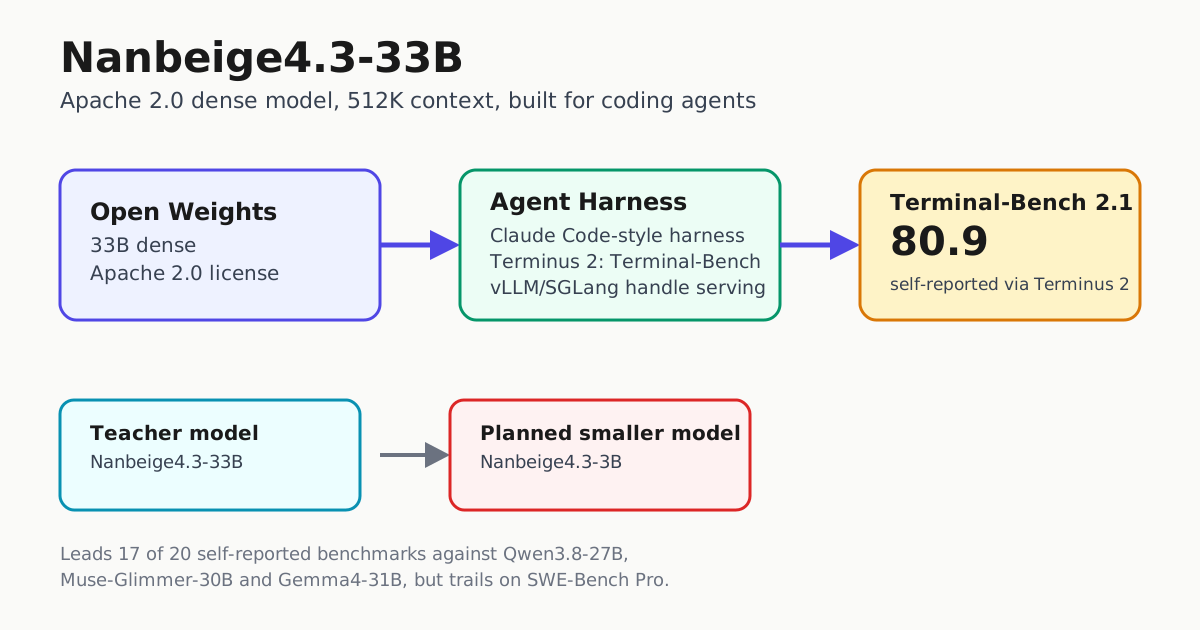
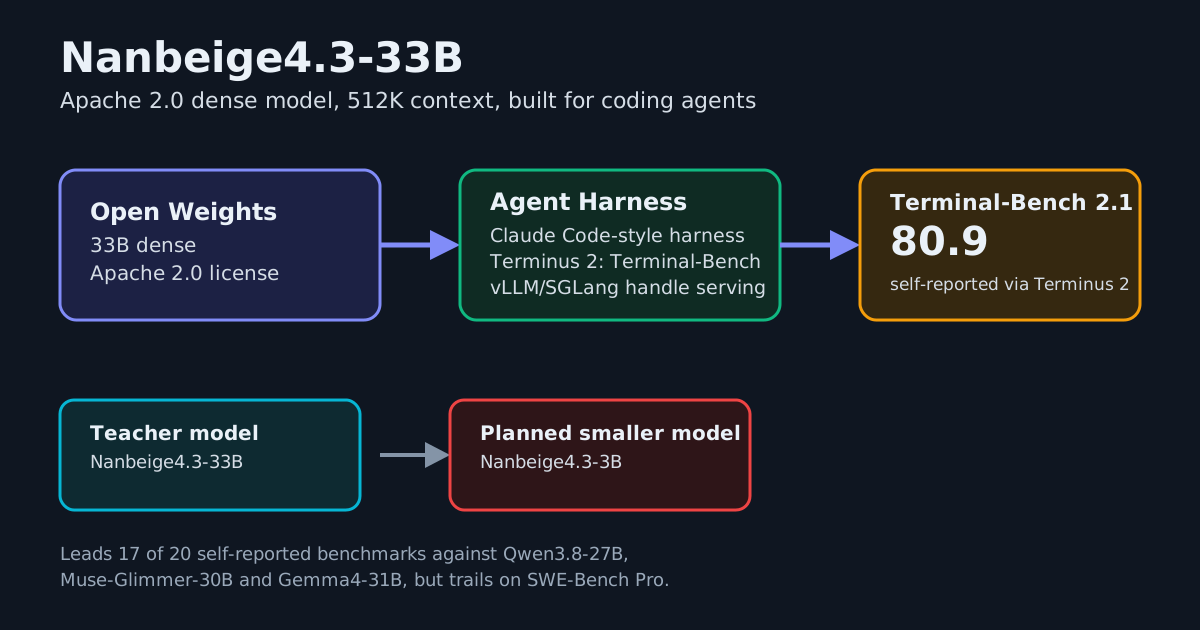
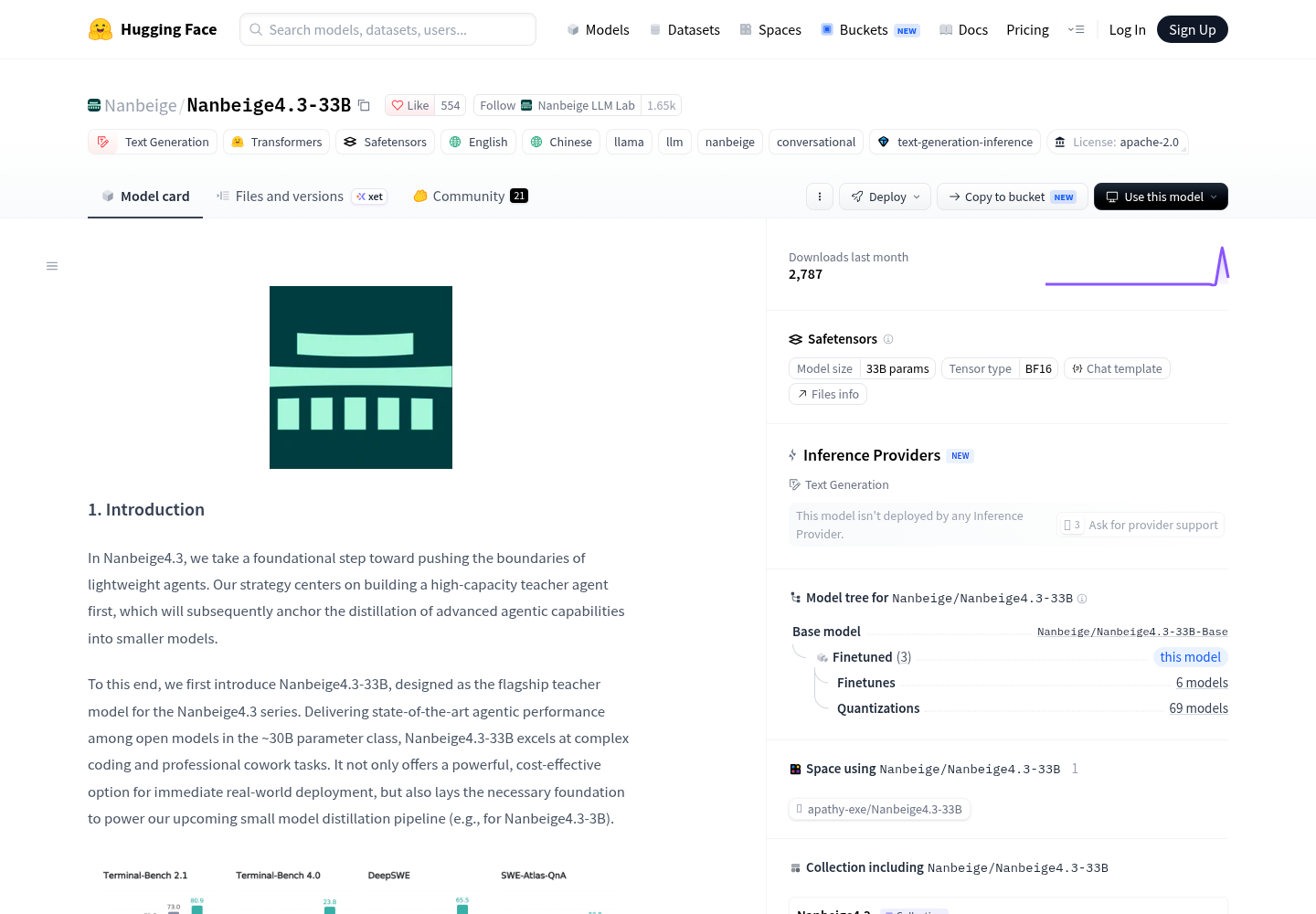
Nanbeige LLM Lab, the research group inside Chinese recruitment platform BOSS Zhipin, published Nanbeige4.3-33B on Hugging Face this week under an Apache 2.0 license. It is a 33B-parameter dense model — no mixture-of-experts routing, so every parameter runs on every token — built specifically for agentic coding and office-style “cowork” tasks, with a 524,288-token (512K) context window and native XML or JSON tool calling built into its chat template.
What it claims, and against whom
Nanbeige ran its own comparison against three other open models that sit near the same 30B-parameter scale: Qwen3.8-27B, Meta’s Muse-Glimmer-30B and Google DeepMind’s Gemma4-31B. All four were run at their highest thinking effort, with shared inference hyperparameters and harnesses for each benchmark. The 20-row table spans agentic coding, agentic cowork and reasoning categories, and Nanbeige4.3-33B leads 17 of those 20 rows.
| Benchmark | Nanbeige4.3-33B | Qwen3.8-27B | Gap |
|---|---|---|---|
| Terminal-Bench 2.1 | 80.9 | 73.0 | +7.9 |
| DeepSWE | 65.5 | 42.5 | +23.0 |
| SWE-Bench Pro | 60.3 | 61.7 | -1.4 |
| Automation Bench | 54.2 | 38.3 | +15.9 |
| JobBench | 44.8 | 34.5 | +10.3 |
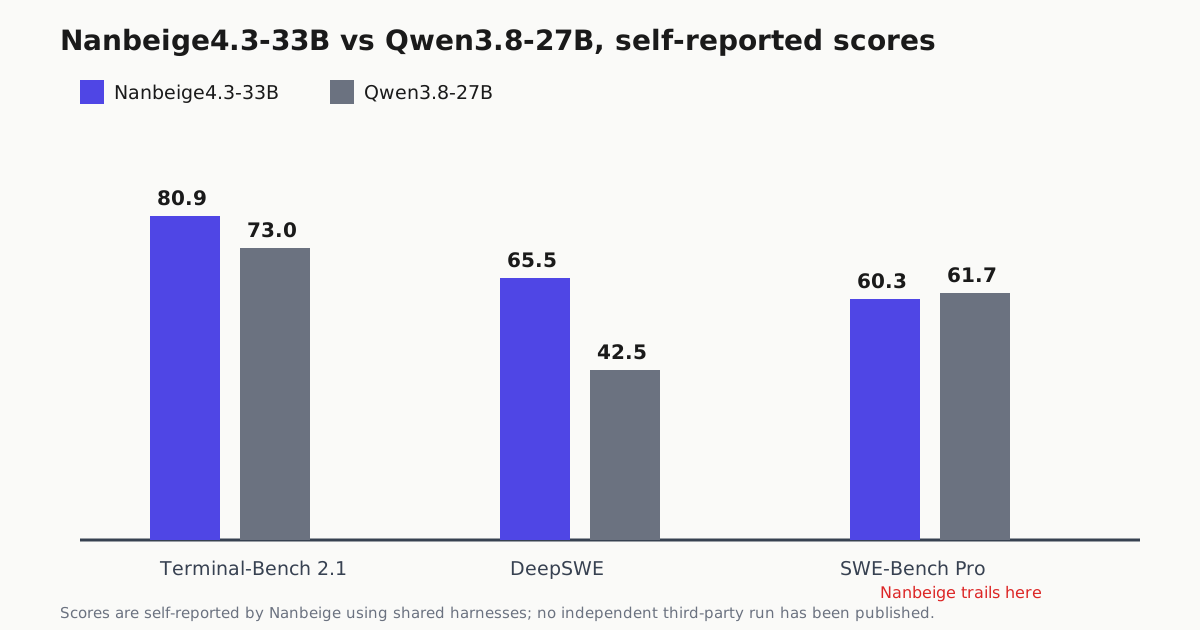
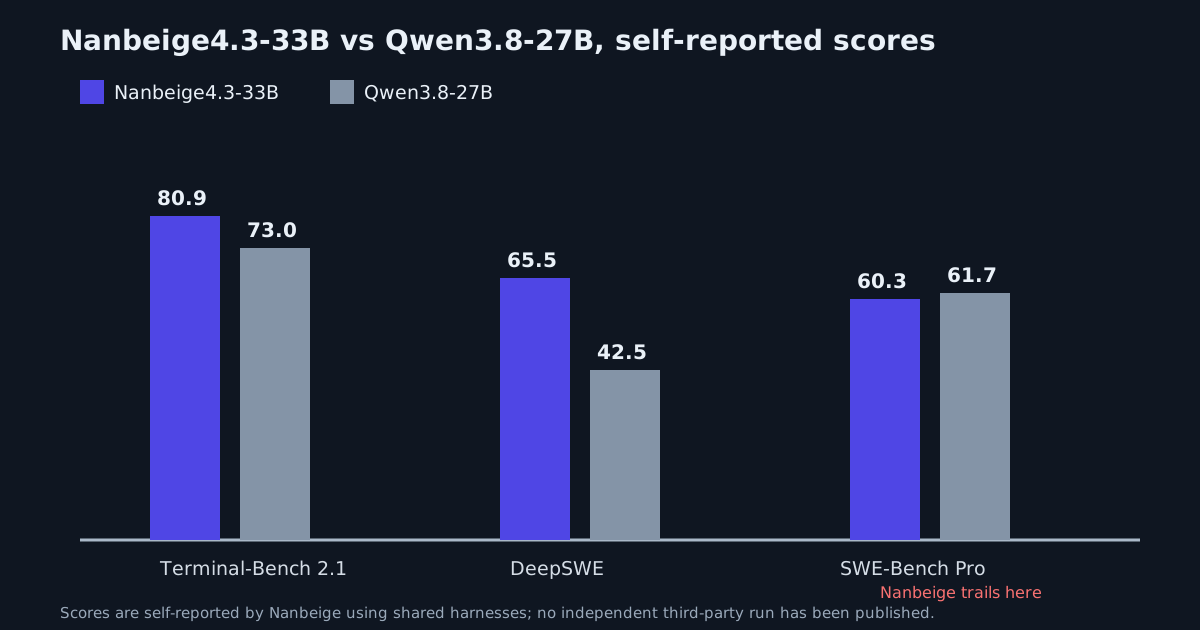
The widest margin is DeepSWE, where Nanbeige4.3-33B scores 65.5 against 42.5 for Qwen3.8-27B. Within the three coding benchmarks plotted above, the one where it loses ground to Qwen3.8-27B is SWE-Bench Pro (60.3 vs 61.7); across Nanbeige’s full 20-row table, Qwen3.8-27B also edges ahead on GDPval (84.8 vs 86.4), and Nanbeige4.3-33B’s weakest absolute score is Terminal-Bench 4.0 at 23.8. These are all self-reported numbers from Nanbeige’s own model card, not an independent evaluation.
The detail that matters for operators: it was tested inside a shared harness, not a lab sandbox
The model card’s footnotes show that Terminal-Bench 2.1 was evaluated using the Terminus 2 harness, while NL2Repo and JobBench — one an agentic-coding benchmark, the other agentic cowork — were evaluated using the Claude Code harness rather than a custom in-house test rig (JobBench added a search tool on top). That is a practical signal: Nanbeige4.3-33B was evaluated inside harnesses operators already run, rather than a bespoke lab rig, and its model card ships ready-made Transformers, SGLang and vLLM serving recipes — vLLM and SGLang are self-hosted inference engines, not agent harnesses, and the model card’s 4-way tensor-parallel launch commands configure the server, not the agent loop running on top of it. That evaluation history does not make Nanbeige4.3-33B a confirmed drop-in replacement for every existing coding-agent scaffold; operators pointing a different harness, such as OpenCode, at the model should expect to run their own integration tests rather than assume out-of-the-box compatibility.
What it costs to actually run
MarkTechPost’s coverage worked through the hardware math from the model’s config.json: 52 layers, hidden size 7,168, grouped-query attention with 56 query heads and 8 key-value heads, and a vocabulary of 166,912 tokens. By that outlet’s arithmetic, the BF16 weights need roughly 66 GB of memory on their own, and a full 524,288-token context adds roughly 112 GB of KV cache on top of that at BF16 precision. In other words, this is a multi-GPU deployment, not a single consumer card — the model card’s own quickstart recipes assume a 4-GPU tensor-parallel server. At publication, no Hugging Face Inference Provider was hosting the model, so running it means standing up your own serving stack.
The caveats a reader should hold onto
Three things keep this from being an unqualified “best open model” claim. First, every number in Nanbeige’s comparison table is self-reported; there is no independent third-party benchmark run published yet. Second, the model explicitly trails Qwen3.8-27B on SWE-Bench Pro and GDPval, so it is not a clean sweep even inside Nanbeige’s own table. Third, and more pointedly, MarkTechPost’s report flagged that some competitor figures in Nanbeige’s comparison table conflict with those labs’ own published model cards — Meta’s card lists Muse-Glimmer-30B at 51.2 on SWE-Bench Pro and Gemma4-31B at 36.9, while Nanbeige’s table shows the reverse, and Google’s own Gemma 4 31B card lists 84.3 on GPQA Diamond against the 91.3 shown in Nanbeige’s table. Different harnesses can explain some of that drift, but it means the cross-model comparisons in the card should be treated as provisional until someone reruns them independently.
Why this is worth tracking anyway
Nanbeige frames 4.3-33B as the “teacher” model in a planned distillation pipeline, citing a smaller Nanbeige4.3-3B as an example of what that pipeline is meant to produce — the card does not commit to a release date or confirm it as the next model Nanbeige ships, only that the 33B model lays the foundation for it. The accompanying Nanbeige4.3-33B-Base model, intended for custom post-training, already beats Gemma4-31B-Base on all eight reported base-model benchmarks, including MMLU-Pro (66.9 vs 59.3) and GPQA (62.0 vs 41.5). It is also the latest entry in a wave of Chinese frontier models targeting agentic coding specifically rather than general chat.
For operators evaluating open-weight options for agentic coding work, the practical takeaway is narrower than the headline claim: this is a 33B Apache 2.0 model, cleared for commercial use, that was evaluated inside a harness-style workflow (Terminus 2 for its Terminal-Bench score, Claude Code for NL2Repo and JobBench) rather than a closed, hosted product — provided you have the multi-GPU memory to serve its 512K context, you confirm compatibility with your own agent harness before relying on it, and you treat its benchmark table as a starting point for your own testing rather than a verdict. Readers comparing it against other recent open releases in this weight class should see Meta’s Muse Glimmer 30B and the broader open-weight models landscape for agents, and anyone weighing self-reported scores generally should read how to interpret agent benchmarks in 2026 before picking a model on a single leaderboard row.