
Meta Releases Muse Glimmer 30B: An Apache 2.0 Agentic Model That Runs on a Single Consumer GPU
Meta's Muse Glimmer is a 30B agentic model quantized to 4-bit for consumer GPUs, beating Gemma4-31B and Qwen3.6-27B on tool use and planning under Apache 2.0.
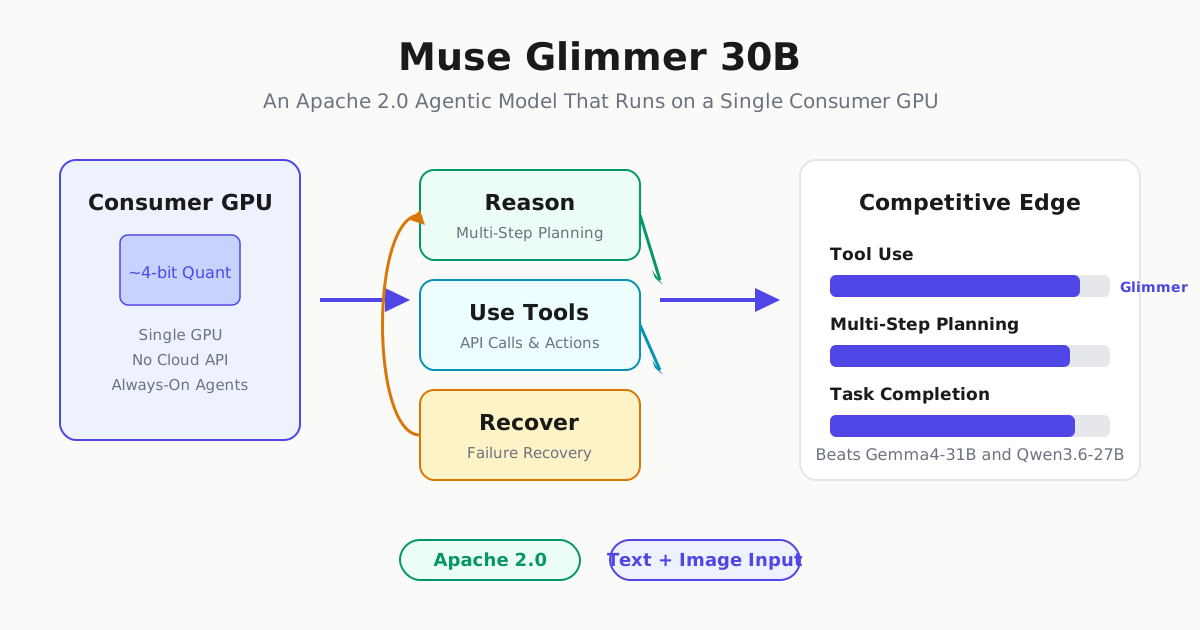
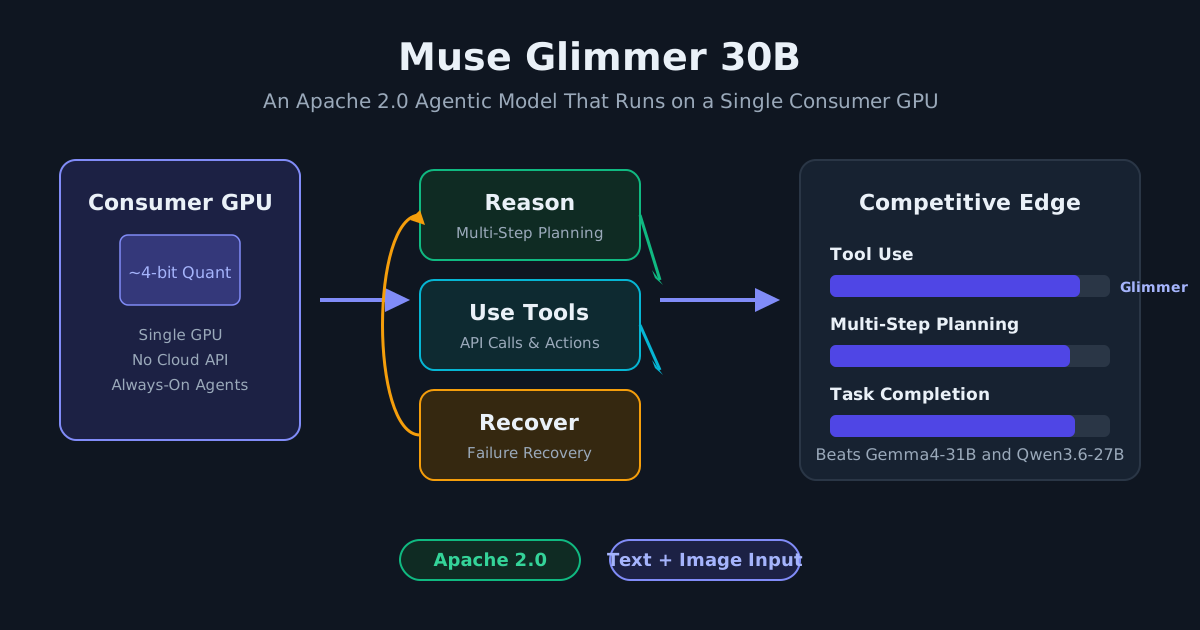
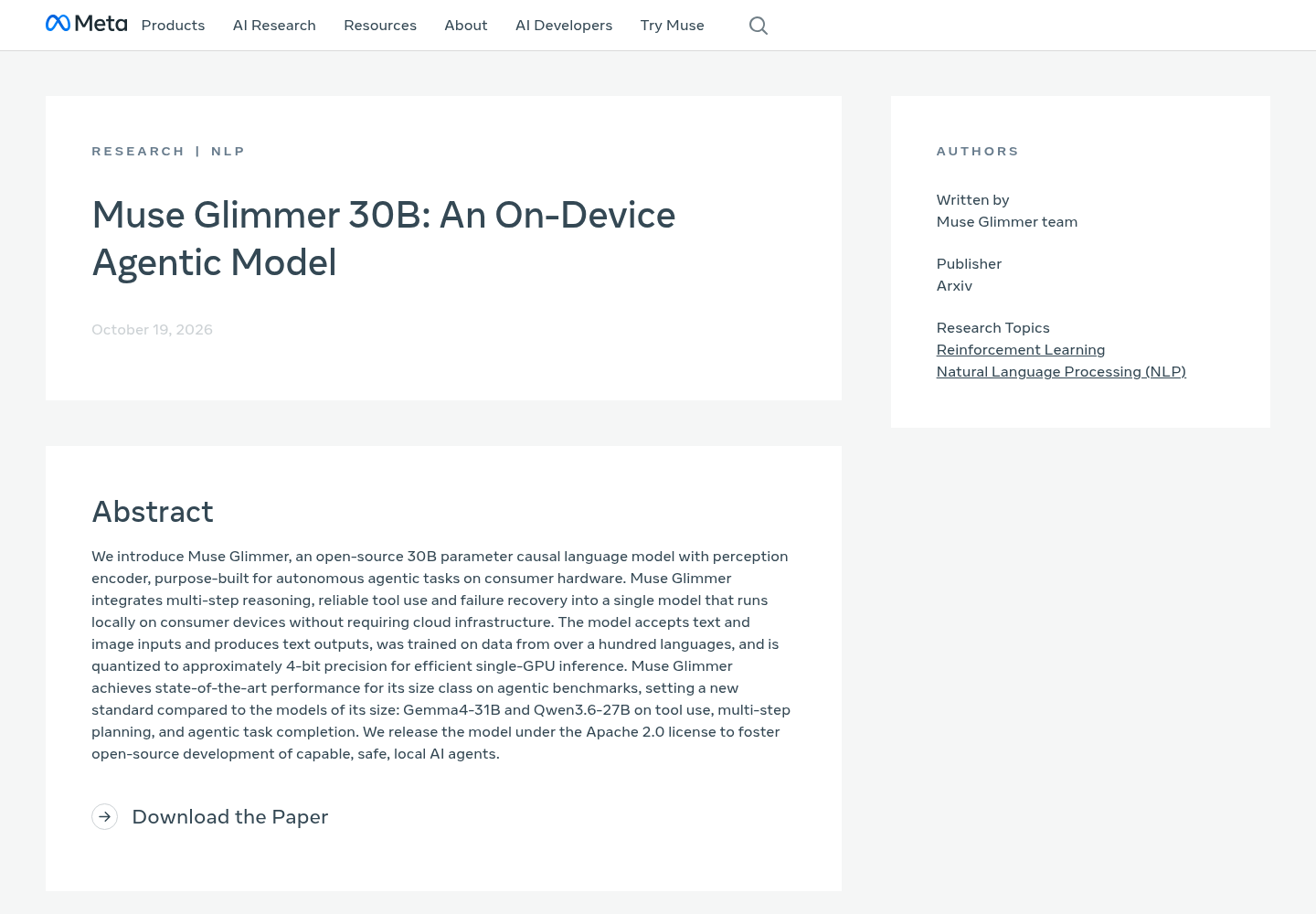
Meta published the technical report for Muse Glimmer 30B on October 19, releasing the research page and paper under the Apache 2.0 license for an agentic model purpose-built to run autonomous tool-using agents on a single consumer GPU. The model integrates multi-step reasoning, reliable tool use, and failure recovery into a single 30B-parameter package quantized to roughly 4-bit precision — small enough to fit on a GPU most developers already own. The model weights are not yet posted to Hugging Face at press time.
Glimmer is the third member of Meta’s Muse model family to ship publicly, following Muse Spark — a 1M-token coding model with hosted and self-managed deployment options — and Muse Wonder, Meta’s first frontier-weight model that matched Fable 5.1 and GPT-6 Astra on benchmarks. Where Spark targets the coding harness and Wonder competes at the frontier, Glimmer is designed for a different job: running an always-on agent that reasons, uses tools, and recovers from failures without phoning home to a cloud API.
What the Model Does
The primary source describes Muse Glimmer as a causal language model with a perception encoder that accepts both text and image inputs and produces text outputs. It was trained on data spanning over a hundred languages. The model is explicitly positioned for agentic workloads — multi-step planning, calling external tools, and recovering when those calls fail — rather than general chatbot or completion tasks.
The 4-bit quantization is the practical enabler. A 30B model at full precision would demand multiple high-end GPUs or cloud instances. At approximately 4-bit, Glimmer fits on a single consumer GPU, making local agentic inference viable without a data-center budget. For developers building always-on coding agents, research assistants, or automation workflows, that removes the per-token API meter entirely.
Competitive Positioning
Meta reports that Muse Glimmer beats both Gemma4-31B and Qwen3.6-27B on tool use, multi-step planning, and agentic task completion — the benchmarks that matter for the workloads the model is designed to run. Gemma4-31B is Google’s open-weight offering in the same size class, while Qwen3.6-27B represents Alibaba’s latest agent-capable model. Glimmer’s claimed lead on agentic benchmarks, combined with permissive Apache 2.0 licensing and consumer-hardware viability, gives it a distinct lane.
The license is especially significant. Apache 2.0 carries none of the custom use restrictions that accompanied recent Llama releases or the research-only terms some labs attach to agent-capable models. Developers can integrate Glimmer into commercial products, fine-tune it, and distribute derivatives without negotiating approval or accepting click-through terms.
The Muse Stack Takes Shape
Meta’s three-model Muse lineup now covers the spectrum: Muse Spark for code generation and editing, Muse Wonder for frontier reasoning, and Muse Glimmer for on-device tool use and agentic control loops. The architecture unifies text and vision through a shared perception encoder, which means the same model that reads a webpage or a screenshot can reason about what to click or call next.
Glimmer also lands in an environment where local-first agent infrastructure is maturing rapidly. Ollama recently added background model upgrades with backup retention, llama.cpp continues shipping same-day fixes for consumer GPU kernels, and tools like Automater Lite provide local fleet dashboards. A capable local agent model was the missing piece — Glimmer fills that slot with a model purpose-built for the loop. The broader open-weight models for agents landscape has been waiting for a model that combines Apache 2.0 licensing with competitive agentic benchmarks at consumer-hardware scale.
What’s Not Yet Clear
The research page and its linked Arxiv paper provide the benchmark comparisons and architectural description, but Meta has not yet published the model weights on HuggingFace at the time of writing. The Meta Muse organization page on HuggingFace lists two image-text-to-text models at the 30B scale updated roughly 18 days ago, which may be earlier checkpoints or related releases. Developers should watch the organization page and Meta’s official channels for the weight drop.
The practical agent performance story will also depend on the ecosystem around the model. Tool-use benchmarks measure one dimension; real-world reliability across diverse APIs, error modes, and planning horizons will determine whether Glimmer becomes the default local agent backbone or a capable but niche option.
Why It Matters
Muse Glimmer changes the economics of running an always-on AI agent. Instead of streaming every tool call and recovery attempt through a paid API, developers can run the entire agentic loop locally. For solo developers, small teams, and anyone building agents that sit in a loop waiting for triggers, that eliminates the per-task cost floor that cloud inference imposes. Combined with Apache 2.0 licensing, Glimmer gives the open-source agent ecosystem a model that matches or exceeds same-size competitors on the benchmarks that define the workload.