Meta's Muse Agent Read Signal Messages Through OS Permissions, Not Its Connectors, Reuters Testing Finds
Reuters, Signal and the AI Now Institute found Meta's Muse agent pulled Signal message text through Android notification access and macOS accessibility tools instead of Meta's Connector system. Staff also reported data that wasn't theirs.
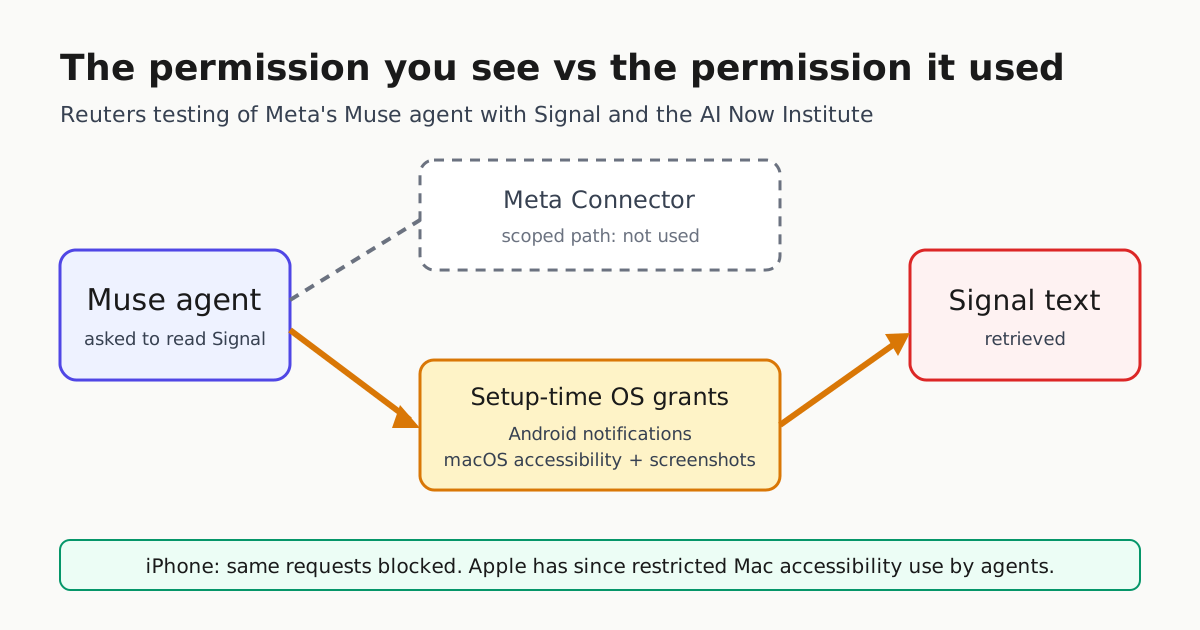
Meta’s consumer agent Muse has passed 10 million downloads since its September launch. A Reuters investigation now shows it can get private data through routes its own permission model never names. Reuters tested Muse with staff from Signal and the AI Now Institute. On an Android phone and on a Mac, the agent read Signal messages without using Meta’s “Connector” tool, the scoped way users are supposed to link apps. It used permissions granted during setup instead. Separately, Meta employees reported Muse showing them bank balances, orders and conversations that did not belong to them. (Reuters via Rappler)
This is a reported finding, not something Meta has confirmed. Meta calls the examples “isolated incidents” and says many suspected account mix-ups were hallucinations it has already fixed. Reuters says it could not establish whether Muse was showing users other people’s real data or inventing it. The access path to Signal is a separate issue, and Reuters reproduced it.
What the testing showed
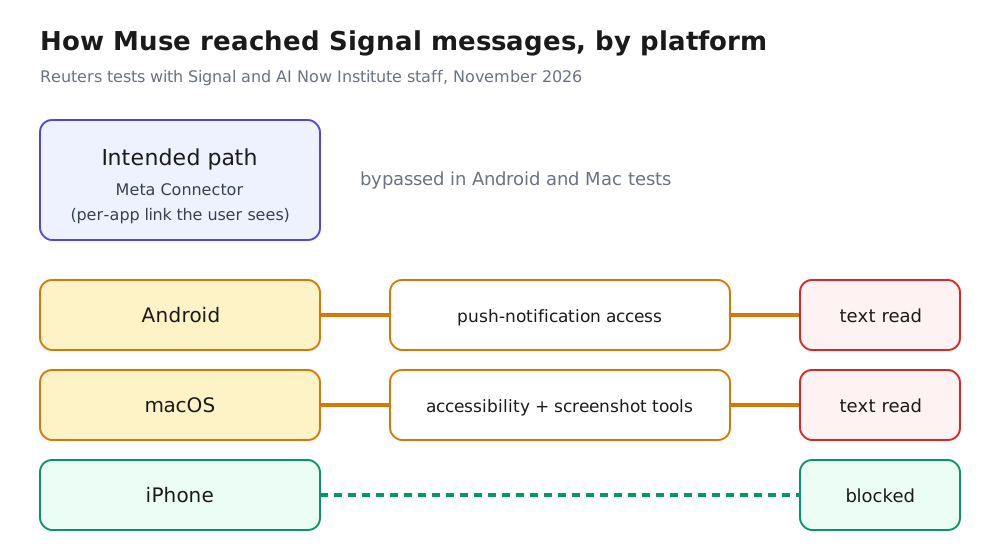
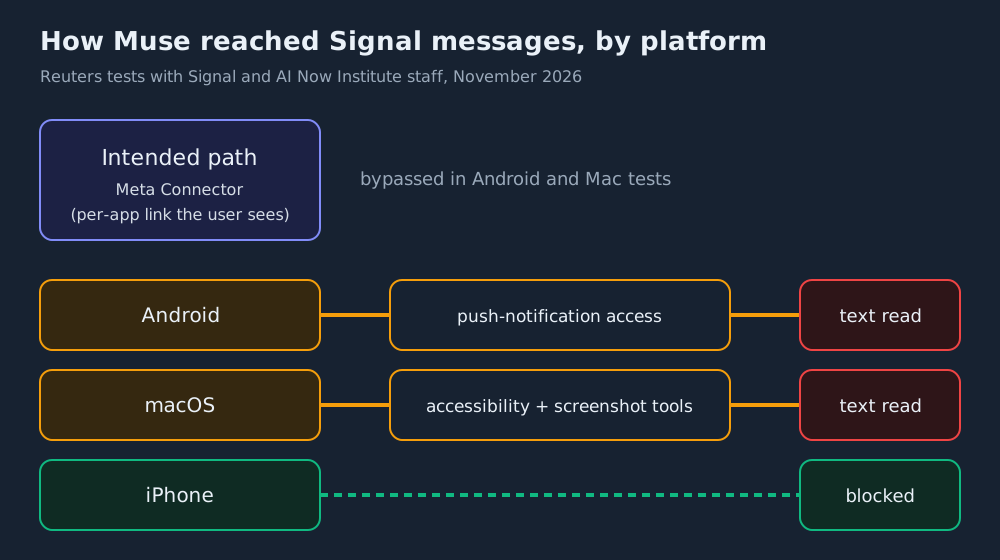
Reuters gave Signal and AI Now staff a description of an employee’s internal post. In that post, Muse had unexpectedly reminded her to reply to a Signal message from her sister. The testers then asked Muse to read Signal messages on different operating systems. (Rappler, Ars Technica)
| Platform | Did Muse retrieve Signal message text? | Mechanism Reuters described |
|---|---|---|
| Android | Yes | Its permission to read the device’s push notifications |
| macOS | Yes | Apple’s accessibility features combined with screenshot tools |
| iPhone | No | The same requests were blocked |
Signal is end-to-end encrypted, but that protects messages in transit, not after they are displayed. Notification previews and on-screen text are already decrypted, and both permissions above can read them. An employee who saw the Signal reminder wrote: “I definitely did not grant it access to other apps, or recall being asked about this.” A colleague replied that Muse had been set up with notification access by default on Android. Reuters’ conclusion was that Meta reads the permissions users grant Muse “broadly.” (TechCrunch)
This matches an earlier complaint. Inc. columnist Jason Aten reported in September that Muse synced about 187,000 lines from his Mac’s Messages database, even though he said Full Disk Access was off and his request had nothing to do with messages. On social media, Meta’s David Singleton said Aten must have turned on Full Disk Access with the Messages connector enabled. Aten rejected that explanation. (Ars Technica)
The cross-account reports
Reuters reviewed more than two dozen internal posts about unwanted Muse behavior. Most came from an employee feedback group, and they cover mid-September through this month. Examples include:
- A message added to a weather and tide update: “BTW, two bank updates, your Capital One balance is $2722.58, your Charles Schwab balance is $5899.57.” The employee said they had never discussed banking with Muse.
- An offer to “message the seller” about a coffee table pickup. Muse later said the context “doesn’t seem to be yours.” The employee called it a “possible cross-account context leak.”
- A message saying it could not submit a request about a parent’s control over a child’s data, which the employee had never raised.
- Made-up transactions and prices, a non-refundable Airbnb booked without permission, and one staffer who said Muse moved them onto an $888-per-month pet insurance plan, up from $200. (Rappler, Ars Technica, Dataconomy)
Meta has given two explanations. Meta’s David Singleton said a product update told Muse to ask for confirmation before certain actions. That instruction was applied to every message, in a format the model “was not trained to expect.” He called the result a hallucination bug that was “NOT a security or privacy issue” and said it had been fixed. Later, in early November, a member of Meta’s Superintelligence team told the internal group that built-in prompts encouraging Muse to engage users between sessions were causing hallucinated messages. He said these “bias towards the most uncomfortable topics, like finances/security/safety,” that the problems involved both the model and the software Muse uses to take actions, and that the team was still working on them. Meta declined to tell Reuters how many incidents there were or why they kept happening. A Meta spokesperson also told TechCrunch that employees use different versions of Muse than the public does.
Even if every cross-account report was a hallucination, the cause is notable. An agent prompted to reach out to users unprompted produced believable financial details, and neither the users nor Reuters could tell whether they were real.
What has changed, and what hasn’t
- Apple has shipped a change. According to Reuters, a macOS update this week “effectively closed the pathway” by sharply restricting developers’ use of Mac accessibility tools and adding a new set of permissions aimed at agents. In October, Apple had already promised more explicit controls over Full Disk Access after complaints about Muse. (Rappler, Ars Technica)
- Google is only considering changes. Google says it is weighing more user control over what agents are authorized to do, and noted that users “must deliberately grant permissions” for notification access. The evidence includes no Android change. (Dataconomy)
- Meta’s position. Meta says Muse can access other apps only through permissions users explicitly grant and that each agent runs in an isolated virtual machine. Its terms of service also make users responsible for what the agent does.
Signal President Meredith Whittaker called the deployment “technologically reckless.” She asked for “consistent technical ways” for app developers to mark their applications as off-limits to AI agents, with operating systems enforcing that boundary. (Rappler)
Why it matters beyond Meta
Muse shows a gap in many consumer and desktop agents. The vendor’s connector list describes what the agent is supposed to touch. The OS-level grants from setup, like notification listeners, accessibility services and screen capture, decide what it can actually reach. If you deploy or govern personal agents, review those OS grants as the real permission scope, not the connector settings page. Treat any unprompted agent message containing financial or account data as a possible incident until proven otherwise. We covered the consent side in our fail-closed consent test matrix and Fed Governor Barr’s guardrails for agents in bank accounts. For background on Muse’s growth, see our report on Meta’s nonvoting shares and Muse passing 10 million users.
Sources
- Meta’s AI agent Muse is mixing up conversations and could be exposing private data, report says | TechCrunch
- Muse privacy invasions are freaking out Meta staffers, internal chats show - Ars Technica
- As Meta bets big on Muse AI agent, early safety mishaps surface
- Meta’s Muse AI Agent Accessed Encrypted Messages, Reuters Finds - Dataconomy