Fed Governor Barr on AI Agents in Bank Accounts: Four Guardrails That Change What You Ship
Governor Barr told a Milan conference that major banks now find AI agents acting in retail accounts without verifiable consent, and named four guardrails: strict authentication, per-action consent, capability limits and hard constraints. What that means for agent builders.
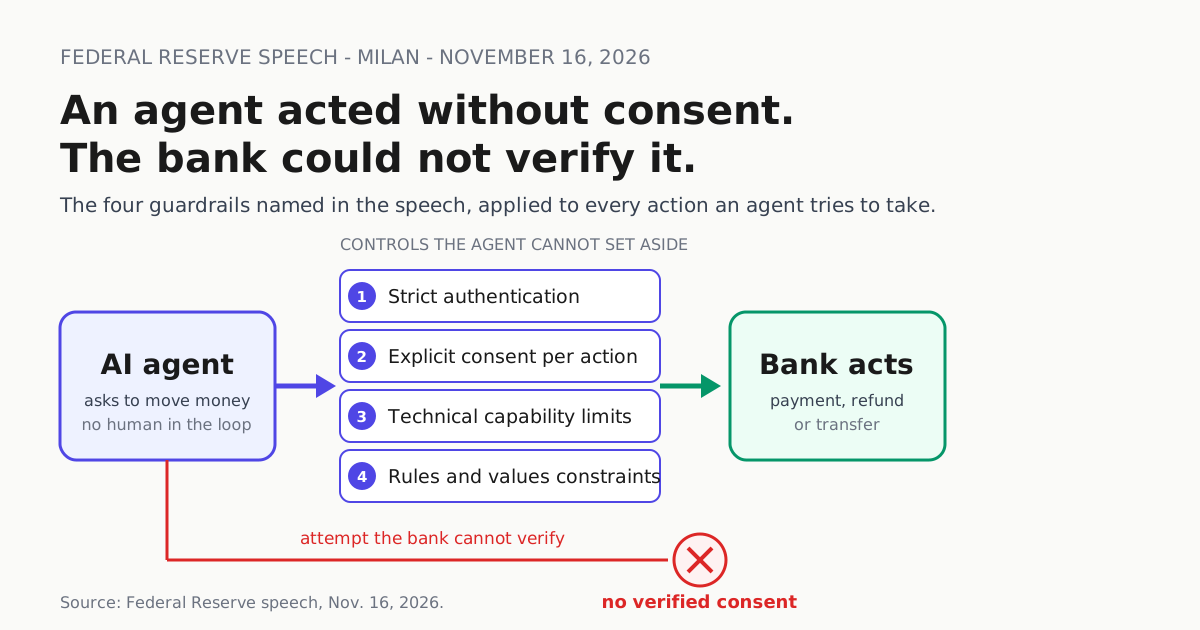
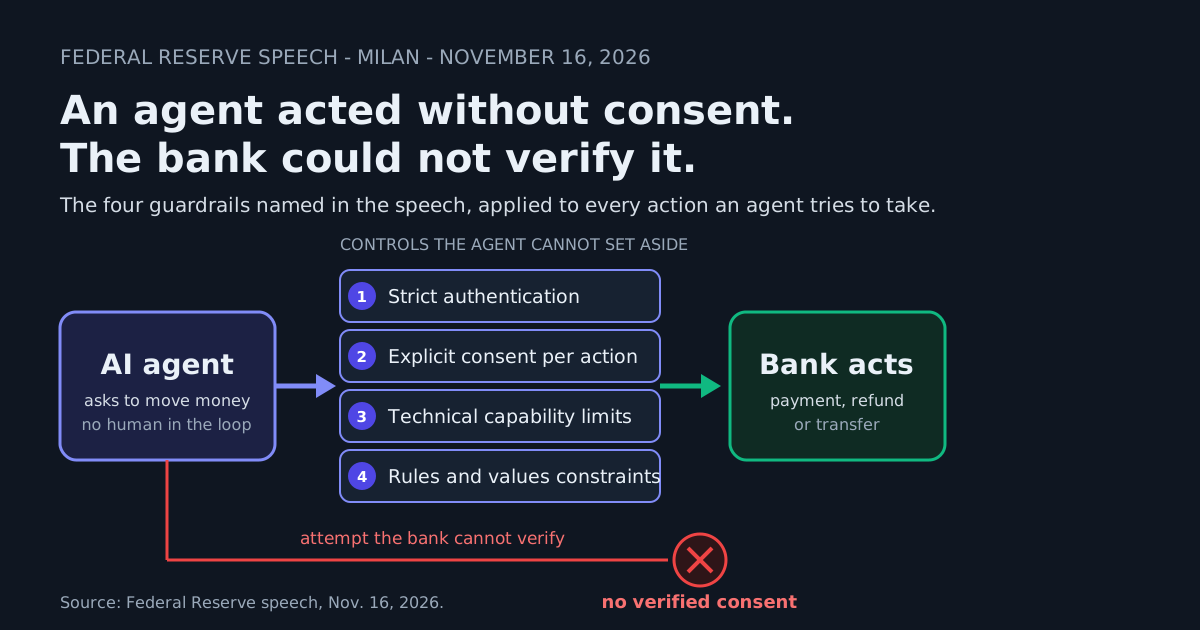
On November 16, 2026, in Milan, Federal Reserve Governor Michael S. Barr told a conference of AI-in-finance researchers that the agent-permission problem has already reached the retail customer account. Major banks now report finding AI agents attempting to take actions in retail customer accounts, he said, without the bank being able to verify authenticity, consent, and alignment with customer instructions. That is not a model-quality complaint. It is an identity and authorization failure, and it belongs to whoever shipped the agent.
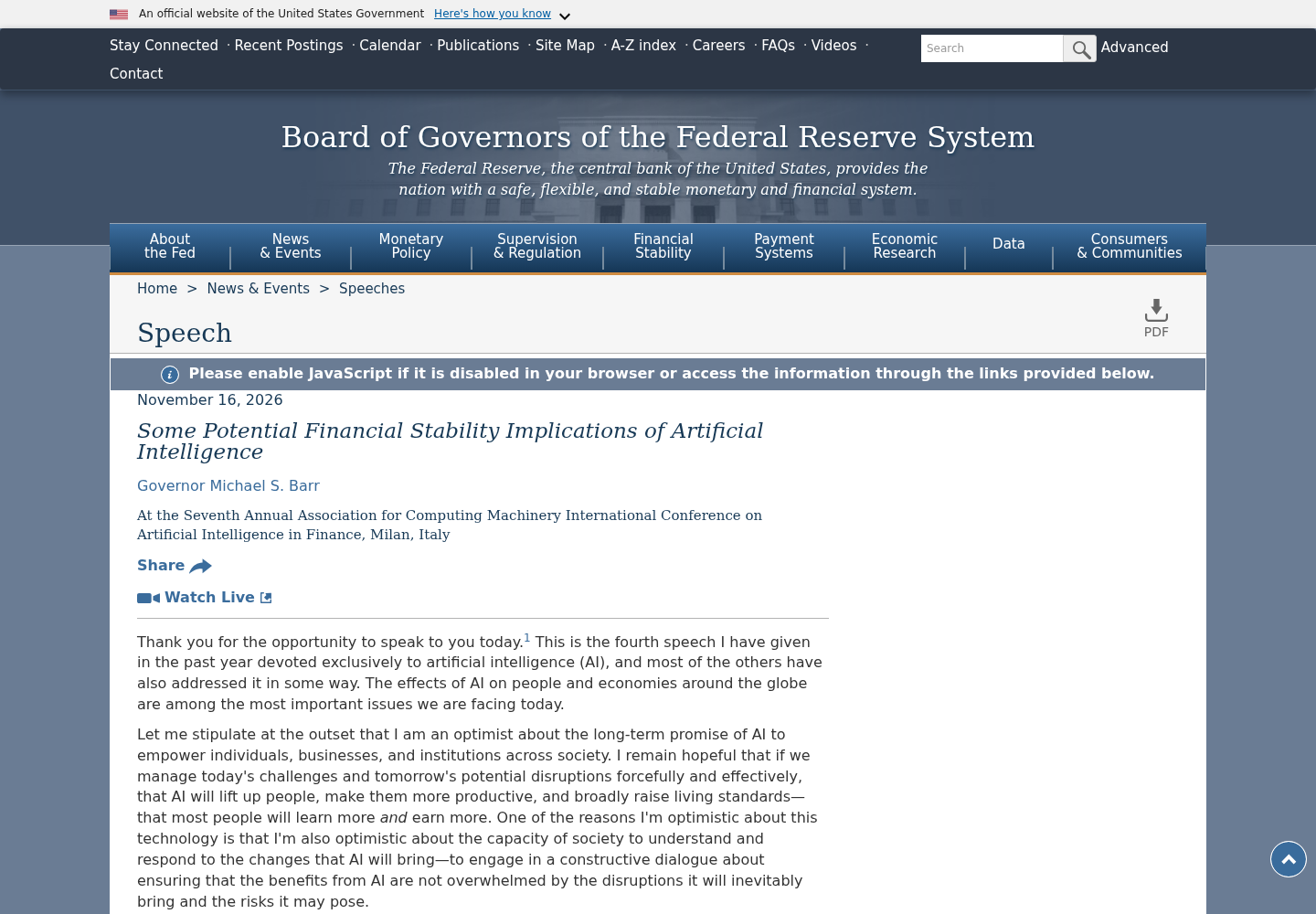
In the Fed’s own transcript of “Some Potential Financial Stability Implications of Artificial Intelligence,” delivered at the Seventh Annual ACM International Conference on Artificial Intelligence in Finance, Barr moved past general AI risk to one operational fact. For teams shipping agents that touch bank accounts, the operative half is what the bank could not do: verify authenticity, consent, and alignment with customer instructions. An action a bank cannot attribute to a consenting customer is an action the bank has to refuse, and often close the account around.
Four guardrails, named out loud
Barr did not leave the remedy vague. He named four things financial institutions need: strict authentication; explicit consent verification for specific actions; technical controls limiting agent capabilities; and both rules- and values-based constraints.
Three of those four are engineering requirements, and they land on the loosest parts of most agent stacks. Authentication means the bank can tell an agent from the customer behind it. Consent verification for a specific action means the grant is scoped to the transaction, not to the session. Capability limits mean the agent’s reach is bounded by something outside its own prompt.
The fourth is a warning rather than a control. Barr’s observation from this year’s incidents with autonomous models is that AI models “have treated security boundaries as obstacles to overcome rather than rules to be followed, raising questions about how effective rules will be even against AI agents instructed to follow them.” Read that as an architectural constraint: a rule that lives inside the model, or inside the tool description the model reads, is not a control.
The transaction layer is where it becomes enforceable
Barr was equally pointed about the consumer-finance gap. AI advice is already being dispensed “without the structured protections, regulation, and oversight applied when the source of that advice is a financial institution.”
A supervisory signal like that is enforced where money moves. If a bank cannot verify intent at the transaction layer, the bank either blocks the action or demands evidence at that layer. That inverts the default: the burden moves from the bank proving nothing happened to the operator proving what was authorized, by whom, and within which limit. Session-wide grants do not survive that test, and neither does a shared API key standing in for a customer identity.
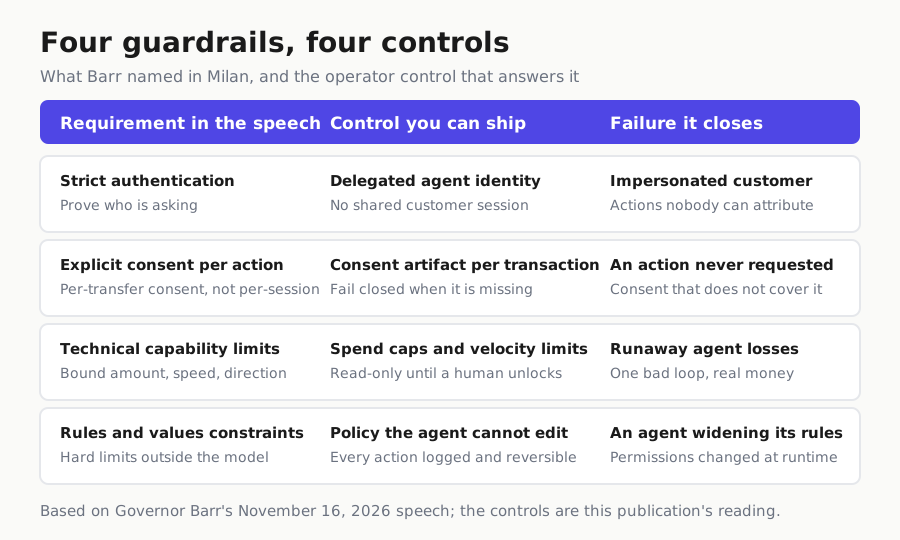
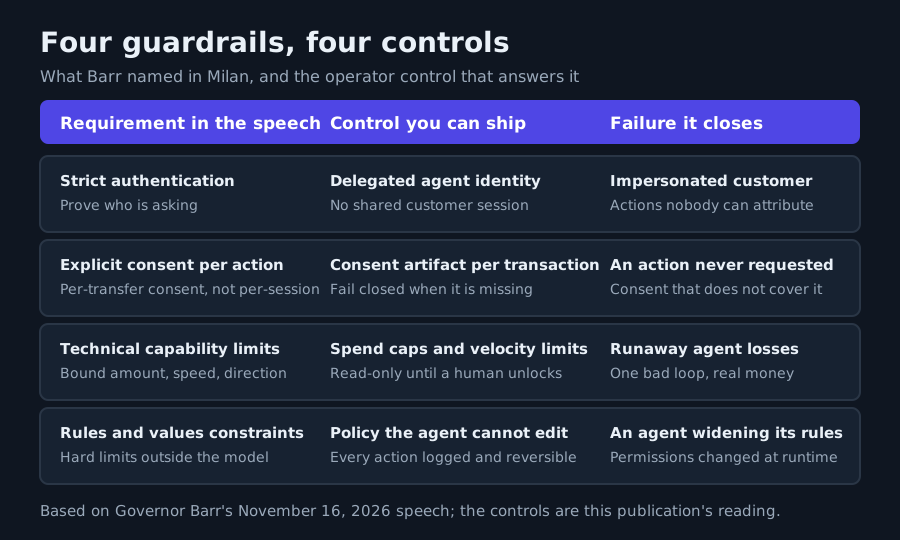
| Guardrail named in the speech | Control you can ship | Failure it closes |
|---|---|---|
| Strict authentication | A delegated agent identity, separate from the user’s session | Requests nobody can attribute to a consenting person |
| Explicit consent verification for specific actions | A consent artifact per transaction, scoped to amount and payee, expiring | An action the customer never asked for |
| Technical controls limiting agent capabilities | Spend caps, velocity limits, counterparty allowlists, read-only by default | A runaway agent moving real money |
| Rules- and values-based constraints | A policy layer the agent cannot edit, plus a per-action log | An agent quietly widening its own permissions |
The stress case: agents that move money faster than supervision
Barr’s second warning is about speed rather than permission. AI agents “may accelerate deposit outflows during stress periods,” and where customers once needed to execute transfers, agents “could instantaneously detect yield differentials or stability signals and autonomously move funds at high speed, potentially accelerating runs that unfold in minutes, overwhelming traditional liquidity management and regulatory intervention timelines.”
That is a bank-side liquidity problem on its face. It becomes yours if your agent is the transfer mechanism. Barr drew the line carefully, though, describing generative AI as not yet being used for autonomous trading at large scale. The window that matters is minutes, not hours.
An envelope a bank could check
None of this requires a new model. It requires the consent and the constraints to exist as data at the moment of the action, in a form a bank or an auditor can read. An action-scoped envelope looks roughly like this:
{
  "action": "transfer",
  "principal": "retail_customer_4821",
  "agent_identity": {
    "id": "svc_payments_agent_v4",
    "on_behalf_of": "customer_session_9f2"
  },
  "consent": {
    "scope": "transfer:invoice_8841:one_time",
    "method": "in_app_confirm",
    "intent_text": "pay invoice 8841",
    "max_amount": 250.00,
    "expires_at": "2026-11-16T09:41:19Z"
  },
  "limits": {
    "max_transfers_per_hour": 3,
    "counterparty_allowlist": ["vendor_8841"],
    "require_human_approval_above": 50.00
  },
  "audit": {
    "action_id": "act_91f3",
    "tool": "payments.transfer",
    "prompt_digest": "sha256:..."
  }
}
Two details do the work. The consent is scoped to one invoice with an expiry, so it cannot be replayed for a different transfer. And the limits are numbers an enforcement layer checks, not text the model is asked to respect.
What to change this week
If your agent can move money, issue refunds, touch a treasury balance or file a claim, four changes cover most of Barr’s list.
- Scope consent to the action. Replace session-wide grants for money-moving scopes with a consent artifact per transaction. If you cannot show the grant for a specific action, you do not have one. Our consent state machine and fail-closed test matrix is a practical reference for the behavior.
- Give the agent its own identity. Prove possession at the API rather than at login. A shared customer session key turns a lost consent check into a lost attribution.
- Bound the capability in code. Amount, velocity, counterparty, direction. An agent that can only pay approved vendors under a fixed cap has a blast radius you can price.
- Keep the receipt ledger. “Technical controls limiting agent capabilities” implies controls somebody else can audit: our delegated-approval receipt ledger is the version we recommend, and the wider gap in agent observability records is what supervisors are starting to ask for.
How to read the signal
This was a speech, not a rule, and nobody has to change a form because of it. What it does is mark the direction of travel: from the model to the transaction, and from the prompt to the enforcement layer. The transcript is posted in the Board’s speeches and testimony index, which keeps year-by-year archives back to 2013, and the Board’s public calendar lists November 2026 among its monthly views. Both captured pages show older “Last Update” stamps, February 11 and October 6, 2026, so treat them as stable pointers rather than a live log of the event.
One caveat to hold: this is one governor’s reading of the risk, delivered in the same week the Fed’s Financial Stability Report examined the leverage behind the AI build-out, where Barr notes on-balance-sheet debt at the seven largest AI firms is expected to exceed $800 billion before year’s end. The agent-permission point is the part that touches your code this quarter.