Hugging Face Routes Inference Providers Through OpenRouter: Automatic Failover, :fastest/:cheapest Suffixes, and the End of Custom Provider Keys
Hugging Face now routes language-model calls through OpenRouter: same HF token, automatic failover, :fastest and :cheapest suffixes, and custom provider keys dropped.
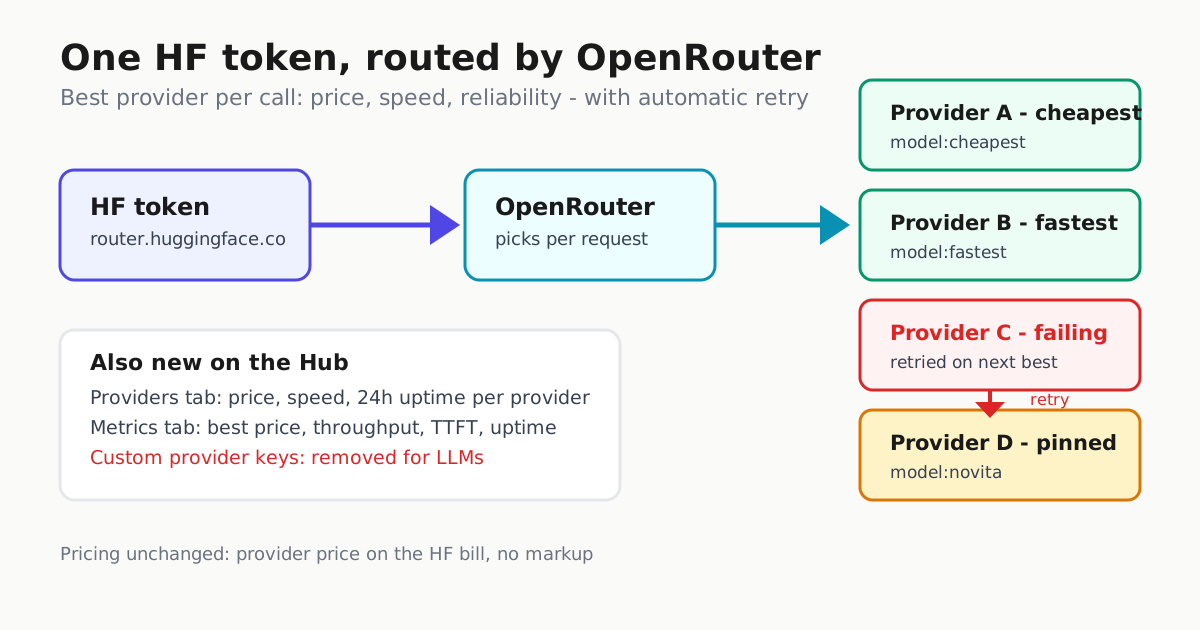
Hugging Face has switched Inference Providers from its own custom router to OpenRouter’s, the company announced today. Every language-model request through the Hub now goes through OpenRouter, which picks the serving provider per call based on live price, speed and reliability — and retries on another provider if the first one fails. Your code and your Hugging Face token stay the same. The one thing that breaks is custom provider keys: language-model calls are now billed to your HF account or organization, so you can no longer plug in your own Novita or Together credentials for those models.
What actually changed
Before, Inference Providers picked one provider per request and returned that provider’s error if it failed. Now OpenRouter’s router handles the whole call. According to Hugging Face’s post, OpenRouter recently rebuilt its routing to optimize for the best mix of price, speed and reliability rather than just the lowest list price, and traffic moves away from providers that slow down or start failing until they recover. In OpenRouter’s own measurements across more than 800 trillion monthly tokens, the rebuilt routing cut capacity errors by 46% and improved time to first token by 16.9% and throughput by 16.3%. OpenRouter’s documentation describes the same model: one unified API that handles fallbacks automatically and picks the most cost-effective option for each request.
Control still exists — you just express it differently. A suffix on the model ID picks a policy or a provider:
zai-org/GLM-5.3            # default: best mix of price, speed and reliability
zai-org/GLM-5.3:fastest    # highest throughput
zai-org/GLM-5.3:cheapest   # lowest price
zai-org/GLM-5.3:novita     # only Novita
Routing is also cache-aware: a conversation stays on whichever provider holds its prompt cache, and sending a stable UUID per conversation in the X-HF-Session-Id header makes that explicit. The Inference Providers docs show the same suffixes work through the native InferenceClient, the OpenAI-compatible endpoint at https://router.huggingface.co/v1, and plain REST calls authenticated with HF_TOKEN.
Why agent builders should care
The router speaks OpenAI’s Chat Completions and Responses APIs and Anthropic’s Messages API for every chat model regardless of the provider behind it. Hugging Face ships setup guides for Claude Code, Codex, OpenCode, Pi and Hermes Agent, so a coding agent can reach essentially every open-weight model on the Hub with one token. That collapses a real operational chore: instead of holding accounts, keys and rate limits at 80+ providers, a fleet gets automatic failover inside a single call. It also folds into the same token that already covers Storage Buckets, Jobs and Inference Endpoints.
The economics are the context for the deal. Open-weight models went from 26.8% of tokens served on OpenRouter in October 2025 to 71.7% at the end of September 2026, with weekly open-weight volume growing more than 60-fold. Hugging Face cites average open-weight pricing of $0.28 per million input tokens and $1.62 per million output tokens, against $1.27 and $6.36 for closed models — roughly four times cheaper. The capability gap hasn’t closed: on the Artificial Analysis Intelligence Index, the best open-weight model (Kimi K3.1 Pro at 46) still trails Claude Fable 5.2 (65), but at about a seventh of the cost per task. For high-volume agent work, that trade is often worth it.
Pricing on the HF side doesn’t change: you pay the provider’s price on your Hugging Face bill with no markup, and PRO users get $2 in monthly credits ($2 per seat for Team and Enterprise). Image, video and audio generation skip OpenRouter entirely and keep working as before — including custom keys for image and video providers.
The breaking change, and what to do about it
If you run agents that call language models through Inference Providers with your own provider API key, that lane is gone. The migration path the announcement gives is straightforward:
- Drop the custom provider key and authenticate with your HF token.
- If you need a specific provider, pin it with the
model:providersuffix instead of credentials. - If a provider is unacceptable (compliance, residency), turn it off in your personal or organization settings — the router never sends requests there, and org settings apply to every request billed to the organization.
- Check the new Providers and Metrics tabs on model pages, which list each routable provider with its price, speed and 24-hour uptime, plus the best values across them. Your usage overview now breaks spend down by the provider the request actually hit.
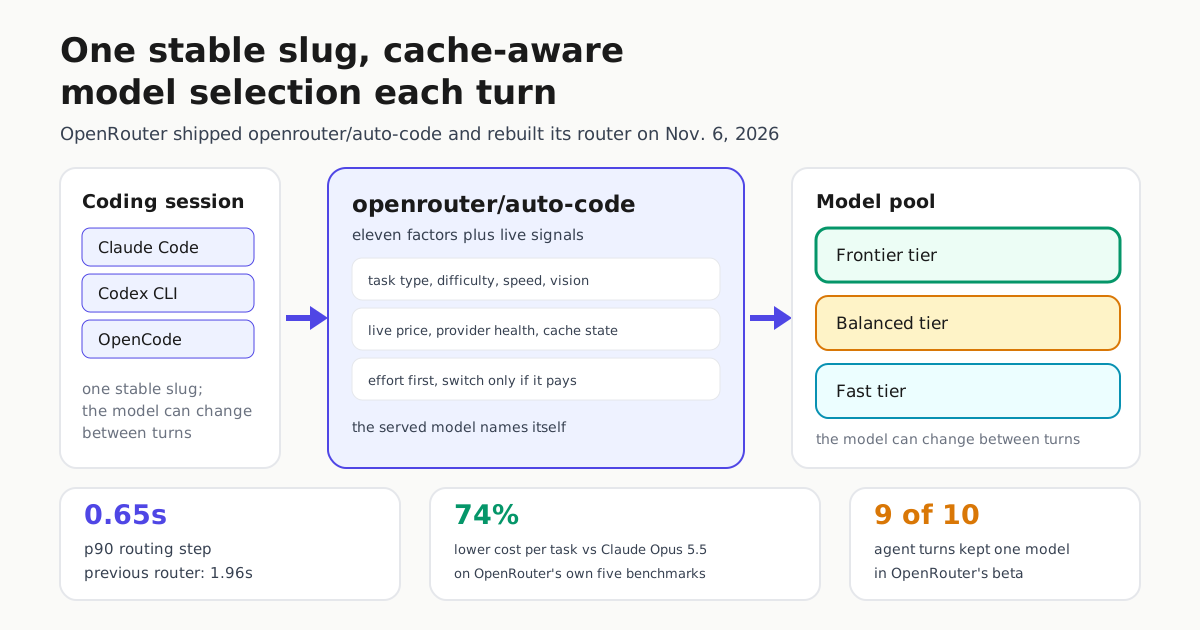
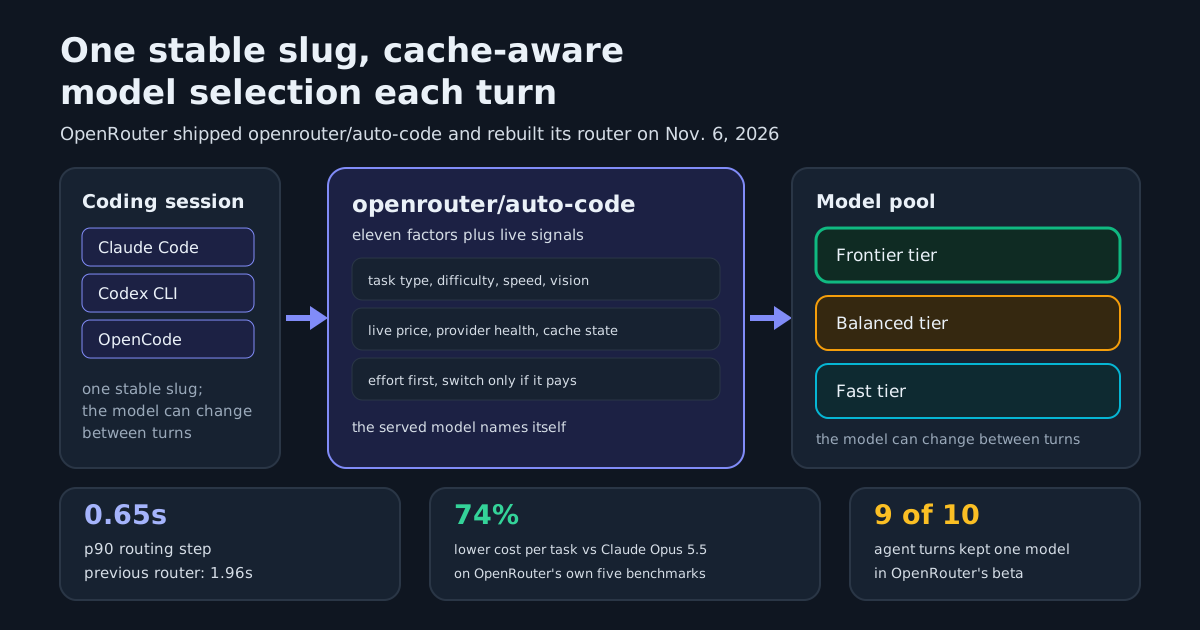
This is the first step of the partnership; Hugging Face says connecting an OpenRouter account directly to Hugging Face and routing more tasks through OpenRouter come next. If you already run fleets over OpenRouter’s auto code router, the pattern is familiar — one entry point, per-call provider selection — and it’s the same bet as Vercel’s virtual models: stabilize the model ID, swap the backend. Operators who lose a pinned-provider lane should rehearse the provider-cutoff continuity drill anyway, because a router you don’t control is still a dependency.
For most teams the practical upshot is simple: one token, automatic failover, provider-level spend visibility, and suffix-based control instead of key management — minus the custom keys you may have been relying on.