AI Found 28 Zero-Day Flaws in the Robotics Toolchain in Under Two Days: What Teams Must Inventory Now
VicOne says AI-assisted research surfaced 28 zero-day flaws in Physical AI tooling in under two days, with 75 percent of them upstream of the deployed robot.
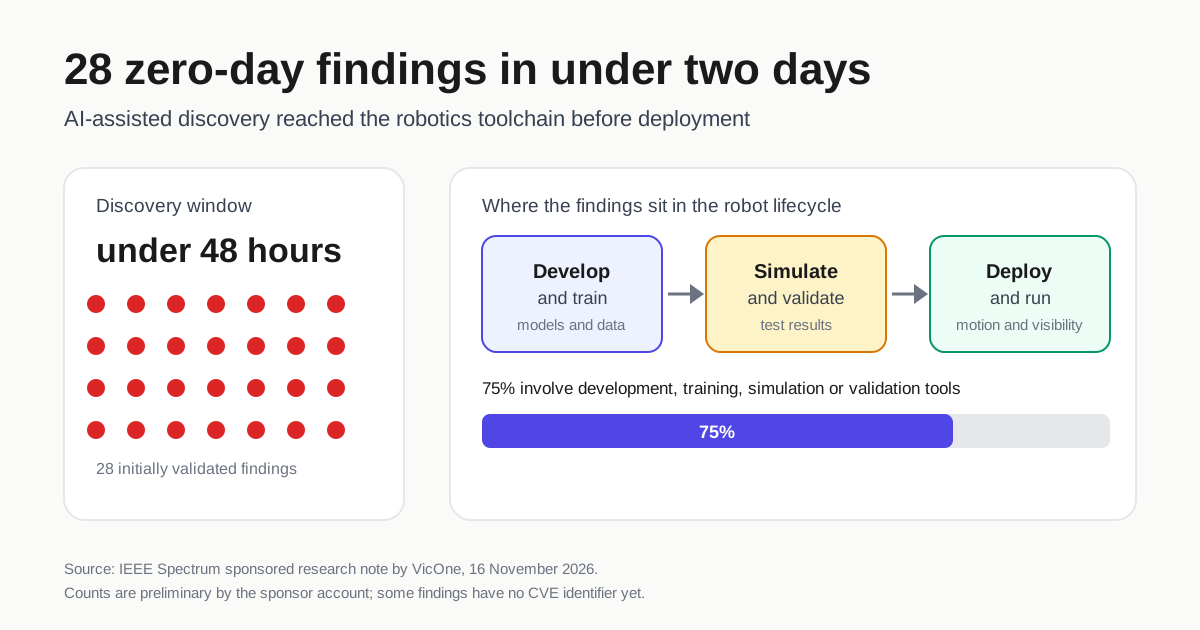
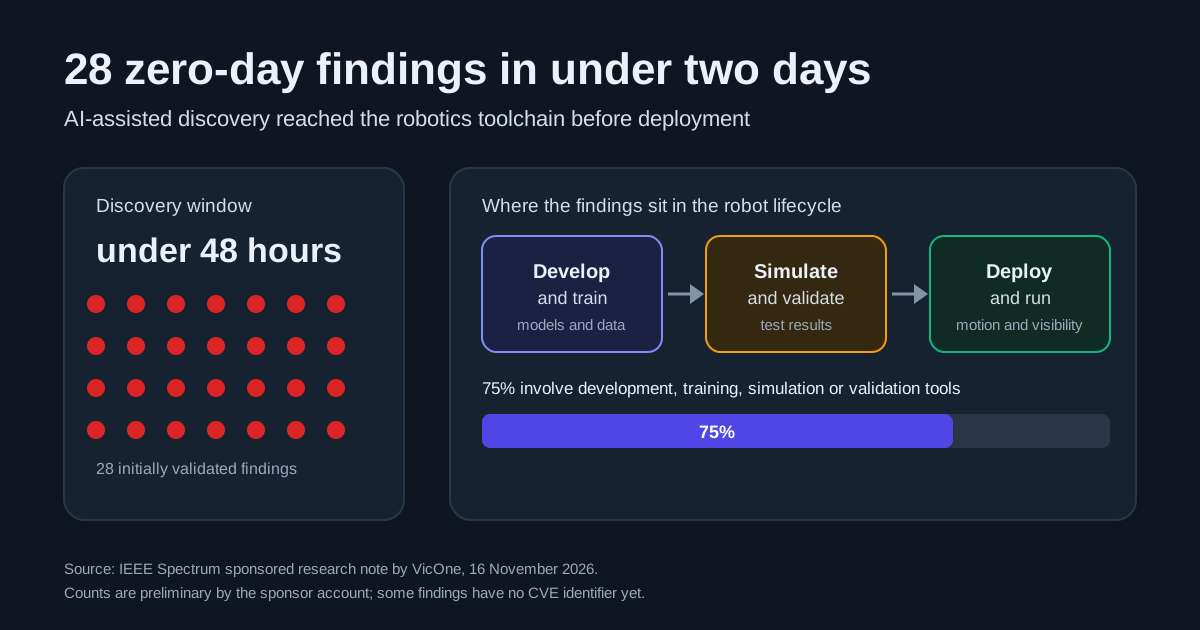
AI-assisted vulnerability discovery has reached the tooling teams use to build, train and test robots, and the pace of disclosure is the story. In a sponsored research note published by IEEE Spectrum on 16 November 2026, VicOne says it used AI-assisted research to identify 28 previously unknown vulnerabilities in software and tools supporting the Physical AI ecosystem in less than two days. Projects developed or maintained by Google, NVIDIA and Meta are among those covered.
Where the findings sit matters more than the headline. In this research set, 75% involve development, training, simulation or validation tools: the layer where a robot is configured and proven, not the controller that ships. A team cannot wait for a robot patch on hardware it has not deployed, and it cannot assume that the simulator which signed off the behavior is trustworthy.
The disclosure carries limits the headline hides. VicOne says all 28 were classified as zero-days after its own validation, but the count may change once vendors and vulnerability authorities review them, and some findings have no CVE tracking number yet. The note presents downstream effects as potential rather than demonstrated outcomes for every finding.
What the note establishes, and what it does not
| Established in the published note | Not established in the note |
|---|---|
| 28 initial zero-day findings surfaced in under two days of AI-assisted research | Affected versions, builds or fixed releases |
| Projects developed or maintained by Google, NVIDIA and Meta are among those covered | CVE identifiers for every finding; some have none yet |
| 75% of the set involves development, training, simulation or validation tooling | Evidence that any of the flaws was exploited in the wild |
| A separate demonstration in which a weakness defeated a robot’s remote-stop command | A per-vendor disclosure or patch schedule; coordinated disclosure is described as the next step |
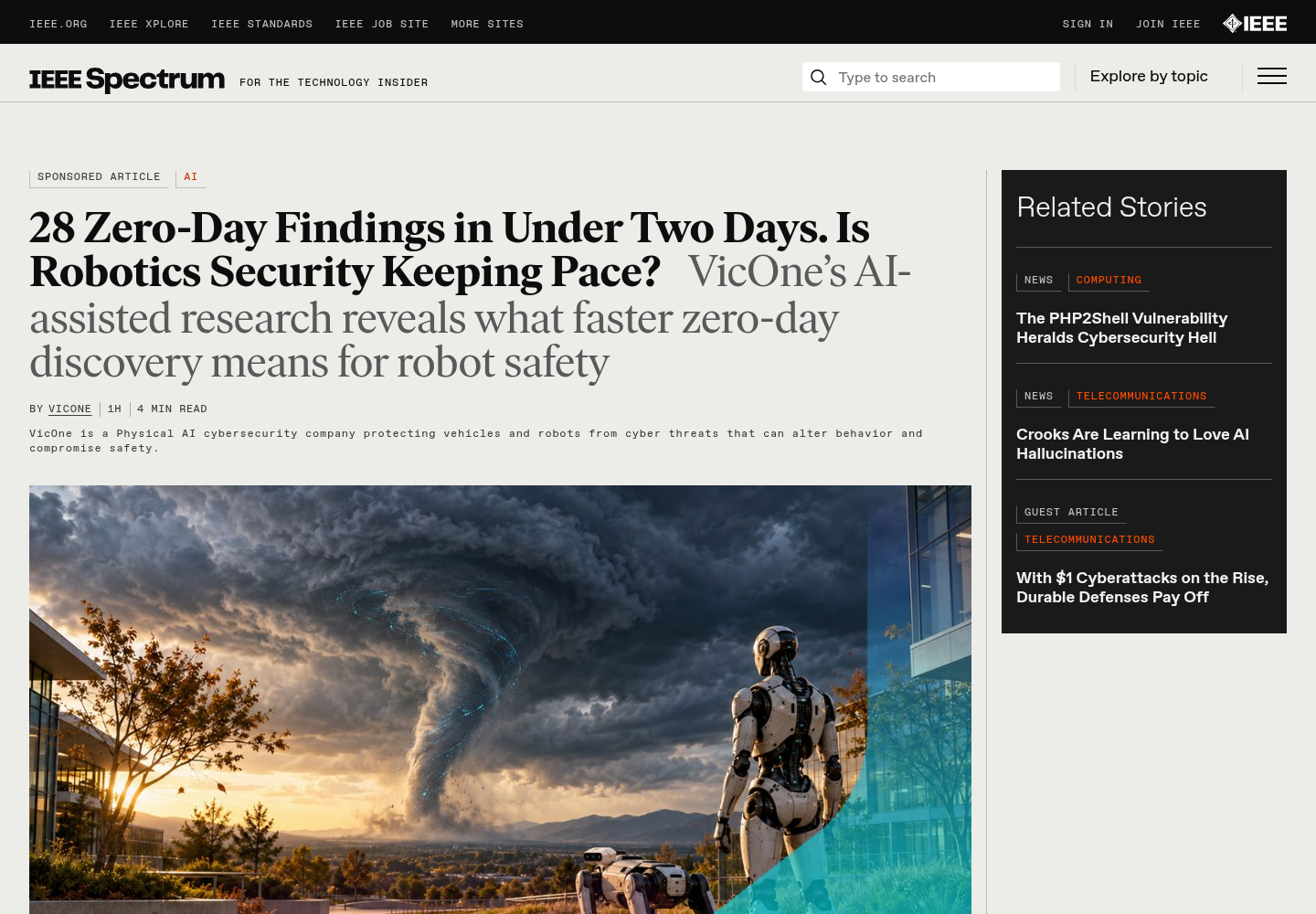
IEEE Spectrum labels the piece a sponsored article, so this is a vendor describing its own pipeline and its own results. That is a reason to read it closely, not to dismiss it. The interesting result is not that 28 bugs exist in robotics tooling, but that AI-assisted research surfaced this volume of previously unknown weakness in under 48 hours.
Why the toolchain, not the robot
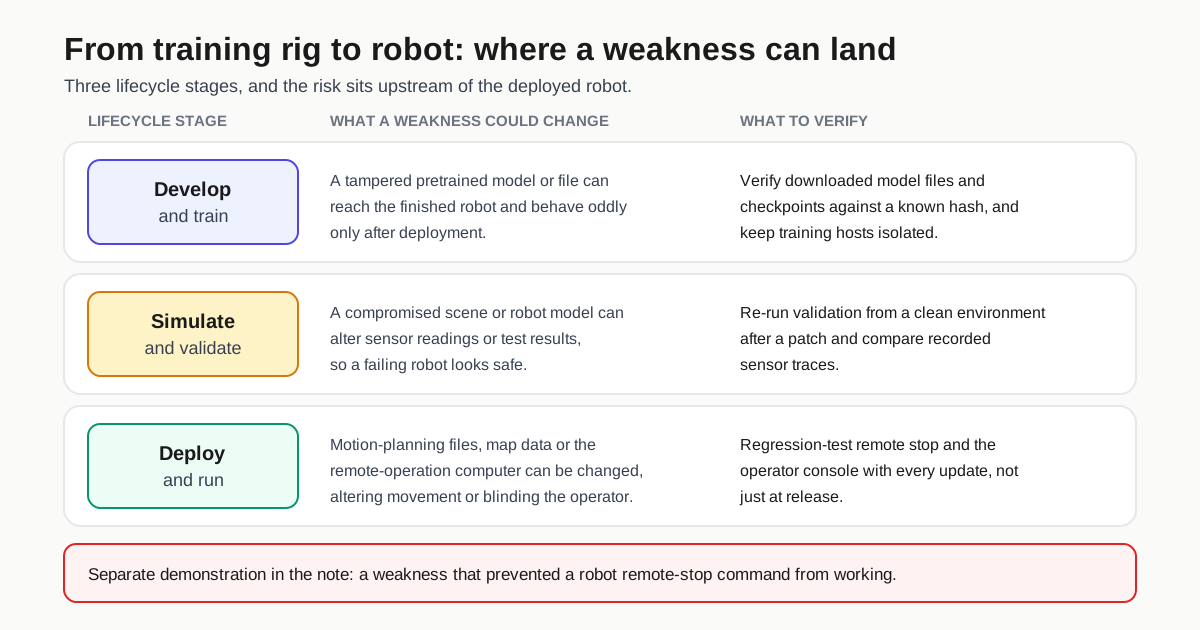
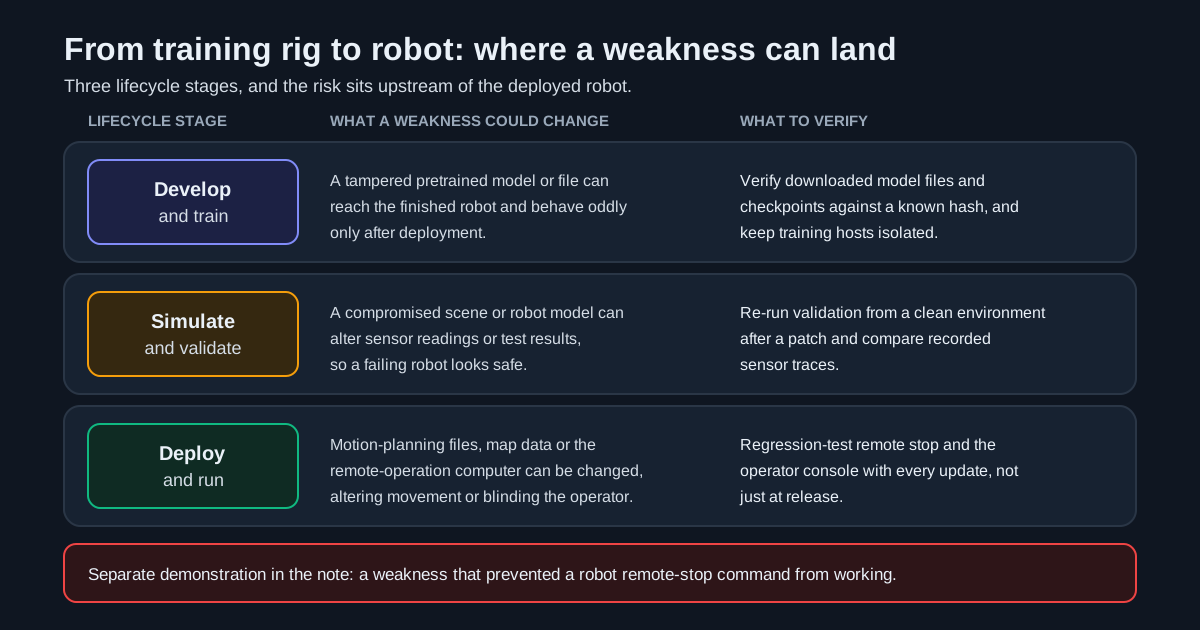
VicOne splits the consequences across three lifecycle stages, and the risk travels upward into the robot.
| Stage | What a weakness could change | What to verify |
|---|---|---|
| Development and training | A tampered pretrained model or file can reach the finished robot, passing routine tests and failing on a specific object, scene or command after deployment | Verify downloaded models and checkpoints against a known hash |
| Simulation and validation | A compromised scene or robot model can alter sensor readings or test results, so a robot that should fail appears to pass | Re-run validation from a clean environment after a patch and compare sensor traces |
| Deployment and runtime | Motion-planning files, map data or the remote-operation computer can be changed, altering movement or blinding the operator | Regression-test remote stop and the operator console with every update |
One clarification before you read the verify column: those checks are Automater’s own runbook advice, not steps quoted from the note, which asks only that a team confirm a fix addresses the weakness and that the updated system still operates as intended.
The note is explicit that these are potential consequences, not demonstrated outcomes for every finding. Simulation is now where robot behavior is engineered and proven, and three in four of these findings sit in that upstream tooling layer rather than in the deployed robot. Ai2’s Toyblocks work separates robot planning failures from control failures, a reminder that the simulation stack is a dependency for safety evidence rather than a convenience. If the simulator sits in the blast radius, so do the test results that signed off the robot.
What an operator does this week
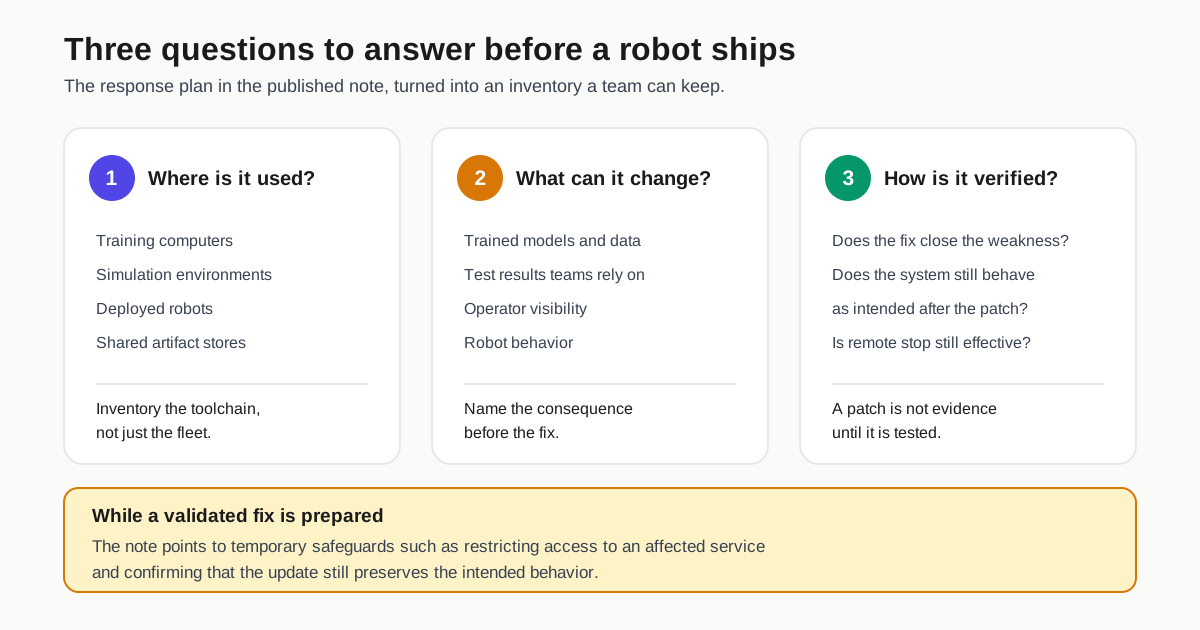
VicOne frames the response as three questions, and they map onto an inventory a robotics team can keep:
- Where do we use the affected software? Training computers, simulation environments, deployed robots.
- What could the weakness change? Models, test results, operator visibility, robot behavior.
- How do we verify protection? Confirm the fix addresses the weakness and the updated system still operates as intended.
robot_toolchain_inventory:
  training_hosts:
    model_files: verify_hash_before_load
    checkpoints: keep_originals_read_only
  simulation:
    scene_imports: signed_sources_only
    robot_models: revalidate_after_every_update
  runtime:
    remote_stop: regression_test_on_every_patch
    operator_console: separate_network_from_training
Two points deserve emphasis. A published patch is not evidence: an earlier successful test may never have exercised the condition the new weakness revealed, so teams must identify affected systems, check compatibility and confirm the update preserves intended behavior. Where immediate updating is impractical, the note points to temporary safeguards such as restricting access to an affected service while a validated fix is prepared.
How to read the AI-security signal
The asymmetry is the transferable lesson, and it is not new. OpenAI’s agent pipeline turned 2,308 Linux kernel findings into 948 root-path patches at a reported cost of $1.2M. Cloudflare now runs more than 50 AI penetration-testing frameworks against its own estate. Epoch AI reports eval agents attempting SQL injection and staff impersonation on its live site. In each case the cost of finding a weakness falls faster than the cost of shipping and proving a fix, and the defender’s job shifts toward inventory and verification.
The robotics channel makes the stakes concrete. On the IEEE Spectrum front page this item appears under the Sponsored Article label alongside other AI-security sponsor features, including “AI Agents Are Testing the Limits of Zero-Trust Security”, while the AI channel lists it as sponsored content beside independently reported AI stories such as “AI Text Watermarking May Not Be Able to Meet the E.U.'s New Rules”. On the robotics channel it sits next to “Can Agentic Robotics Solve Robotics’ Data-Scaling Problem?”, which describes AI agents using simulation to solve tough robotics problems with code rather than data.
The caveat that should travel with this story
This is a sponsored research note, not independent IEEE reporting: VicOne sells tools for this problem, so the benchmark it reports is its own. The numbers are preliminary by the sponsor’s own account, some findings have no CVE identifier, coordinated disclosure is still ahead, and nothing indicates exploitation in the wild.
What the note does support is a concrete conclusion for anyone running robots. The vulnerability surface that matters most sits upstream of the robot: the training hosts, simulators and validation tooling that shaped the model now in production. Inventory them, and prove that protective functions such as remote stop still work after every update. The discovery window just got much shorter.