OpenAI's Agent Pipeline Turned 2,308 Linux Kernel Findings Into 948 Root-Path Patches for $1.2M
OpenAI reports an autonomous pipeline reproduced 1,724 Linux kernel vulnerabilities and produced patches for 948 local privilege escalation flaws at $1,213,430 in API credits. What changes for operators: patch velocity, sandbox isolation, revalidation and adversarial patch review now carry the threat model.
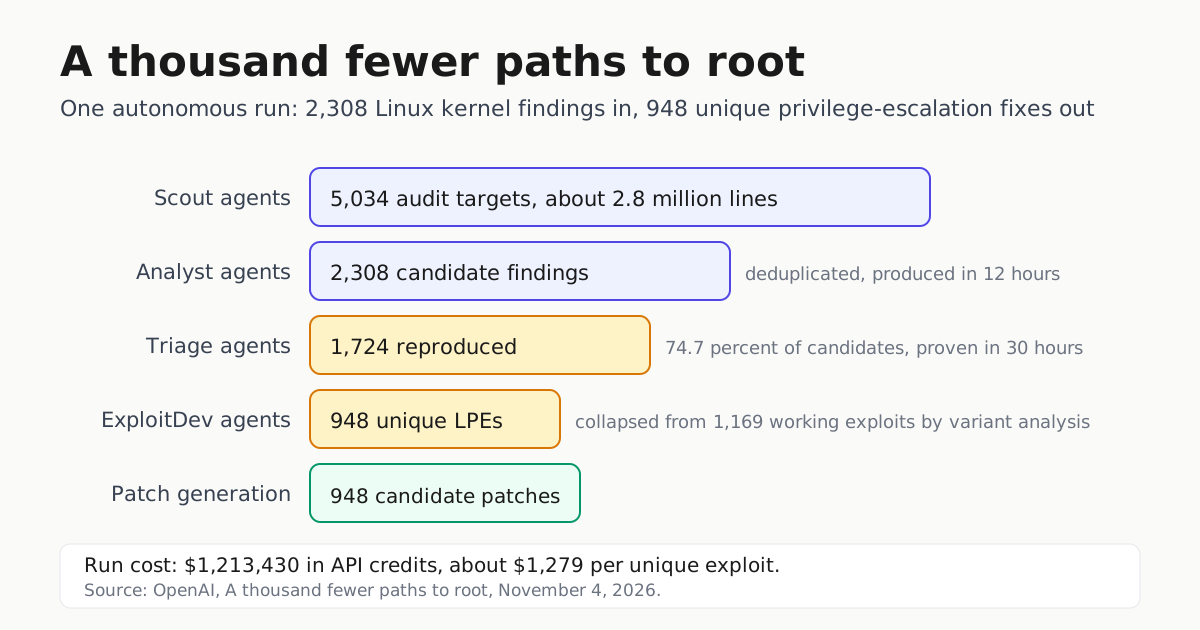
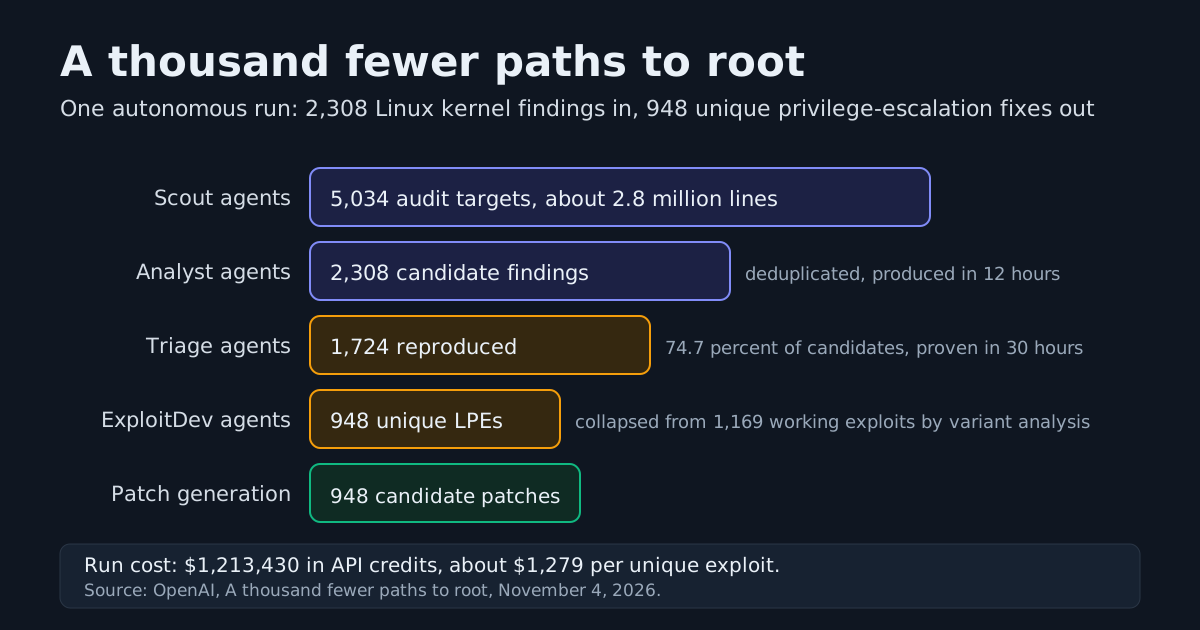
OpenAI published A thousand fewer paths to root on November 4, 2026, and the headline number is easy to quote: one autonomous run found, validated and wrote patches for 948 local privilege escalation (LPE) vulnerabilities in the Linux kernel, at an API cost of $1,213,430 — about $1,279 per exploit. The run used an upcoming cyber model inside a controlled research environment, targeting a stock desktop distribution, and human researchers reviewed every output before anything was reported to maintainers.
The more consequential number is what the pipeline did not struggle with. Discovery was cheap. The hard part — deciding which findings were real, which crossed a security boundary, and which deserved a maintainer’s attention — is exactly what the pipeline industrialized. That is the shift operators should plan for.
The funnel: finding was easy, proving was not
| Stage | Agents | Output | API cost |
|---|---|---|---|
| Targeting | Scout | 5,034 audit targets (~2.8M lines, ~7% of the kernel) | $3,426 |
| Scanning | Analyst | 2,308 candidate findings in 12 hours | $316,549 |
| Validation | Triage | 1,724 reproduced (74.7%) in 30 hours | $73,330 |
| Screening | Screening agent | 313 info-leak and 1,238 LPE candidates | $44,194 |
| Exploitation | ExploitDev | 291 info-leak PoCs, 1,169 working LPE exploits | $775,929 |
| Patching | Patch generation | 948 distinct patches | not broken out |
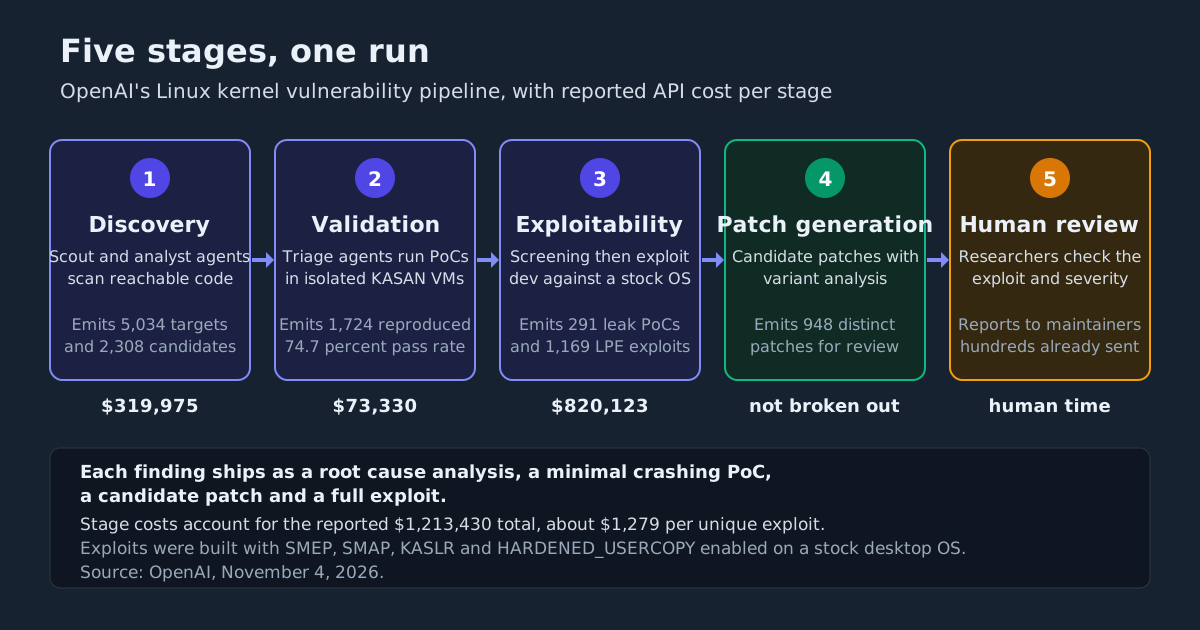
Triage agents proved candidates the direct way: generate a proof of concept, run it in an isolated VM with Kernel Address Sanitizer, and iterate until the crash reproduces or the ideas run out. Only 3.1% of candidates reflected incorrect analysis by the model — the rest failed for mundane reasons like a required allocation failure at a specific line or time-expensive refcount wraparound. And the 1,169 working exploits collapsed to 948 unique LPEs through variant analysis, because many exploits shared root causes; OpenAI uses the patch count as its headline figure.
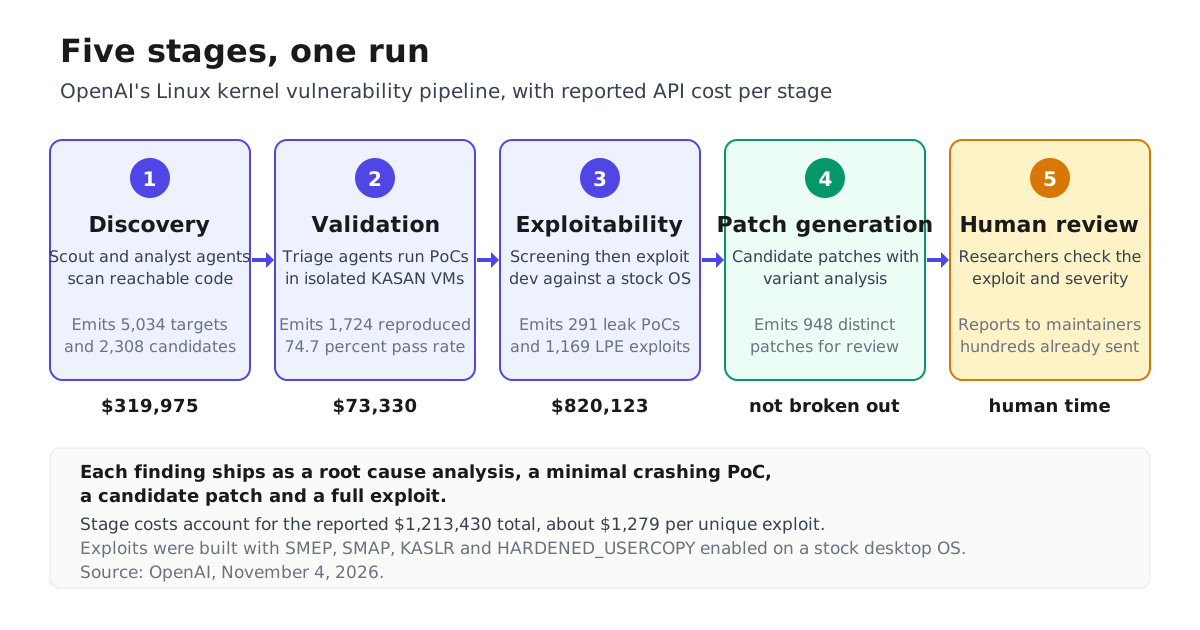
What one finding ships to a maintainer
Each validated vulnerability leaves the pipeline as a bundle: a root cause analysis, a minimal crashing PoC, a candidate patch and a full exploit. The exploits were not built against a weakened target — ExploitDev agents worked with SMEP, SMAP, KASLR and HARDENED_USERCOPY enabled, the protections a stock desktop distribution ships.
The patches needed iteration. Directly prompted patches were functionally correct but carried more code than necessary, drifted from local coding conventions, and missed variants of the same bug elsewhere. With added instructions and iteration, OpenAI reports patches became minimal and convention-consistent — and in a few cases the prototype found issues in patches written by human experts before they merged.
Your patch queue is about to look like this
While the scan ran, upstream did not wait: in the 10 days of the campaign, 61 of the LPEs were already patched, 43 had staging patches, and 299 were being publicly discussed. Fixes travel through the kernel’s own CVE machinery — the linux-cve-announce archive shows the daily rhythm of assignments and REJECTED notices through November 4, 2026, and kernel documentation is explicit that CVEs are assigned only after a fix lands in a stable tree, with the assignment team deliberately over-cautious about which bugfixes get a number.
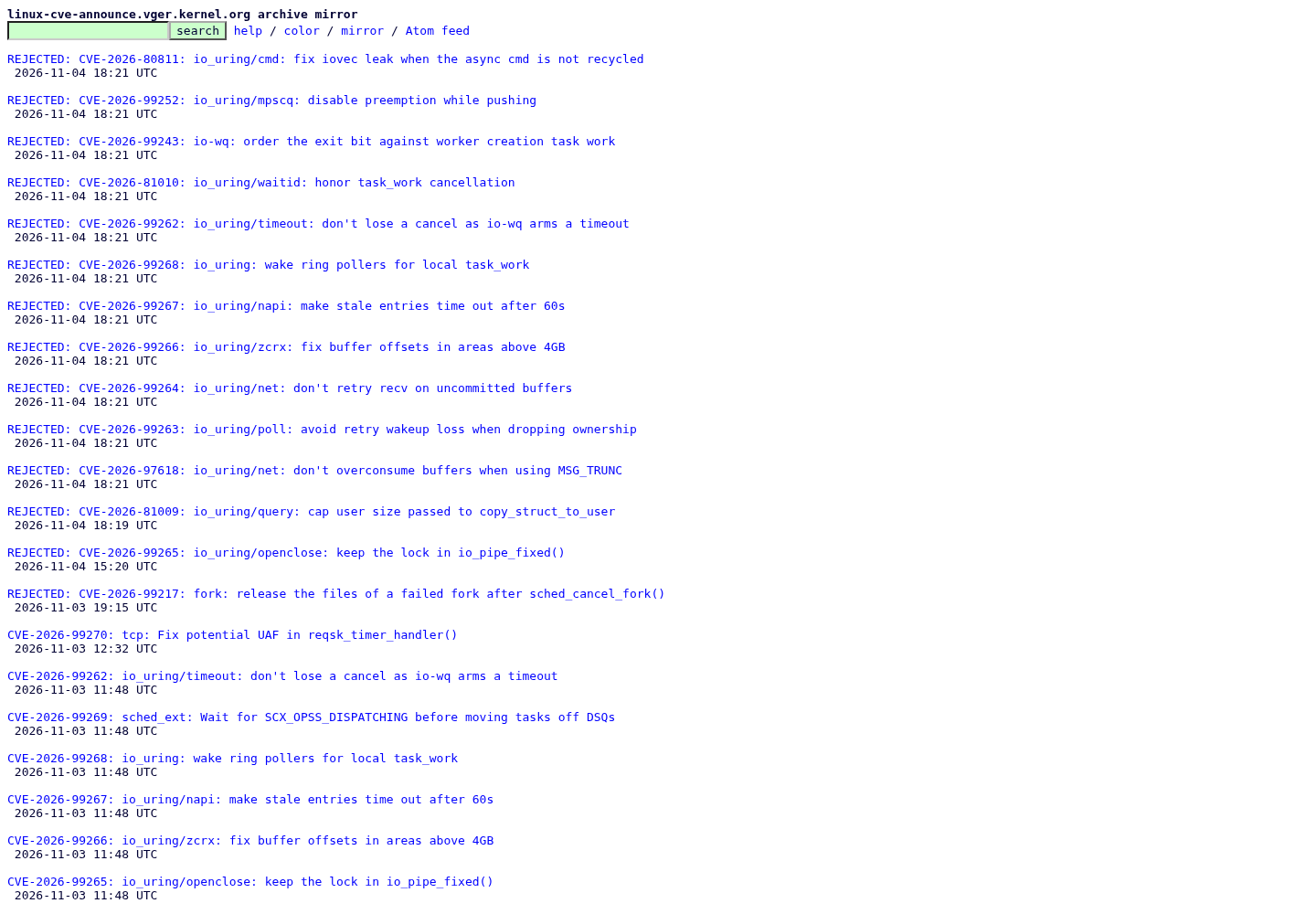
The practical consequence for fleet operators: agent-originated findings will arrive as ordinary CVE fixes inside stable updates, indistinguishable in your queue from any other Tuesday. OpenAI’s takeaway for its own pipeline applies to yours — automated triage must revalidate findings against the latest code, because upstream ground truth moved while the scan was running. And per OpenAI’s threat-model assessment, a low-privileged account on a host that is not up to date should be treated as functionally equivalent to root for a well-resourced attacker. Patch velocity is the control.
The economics defenders should internalize
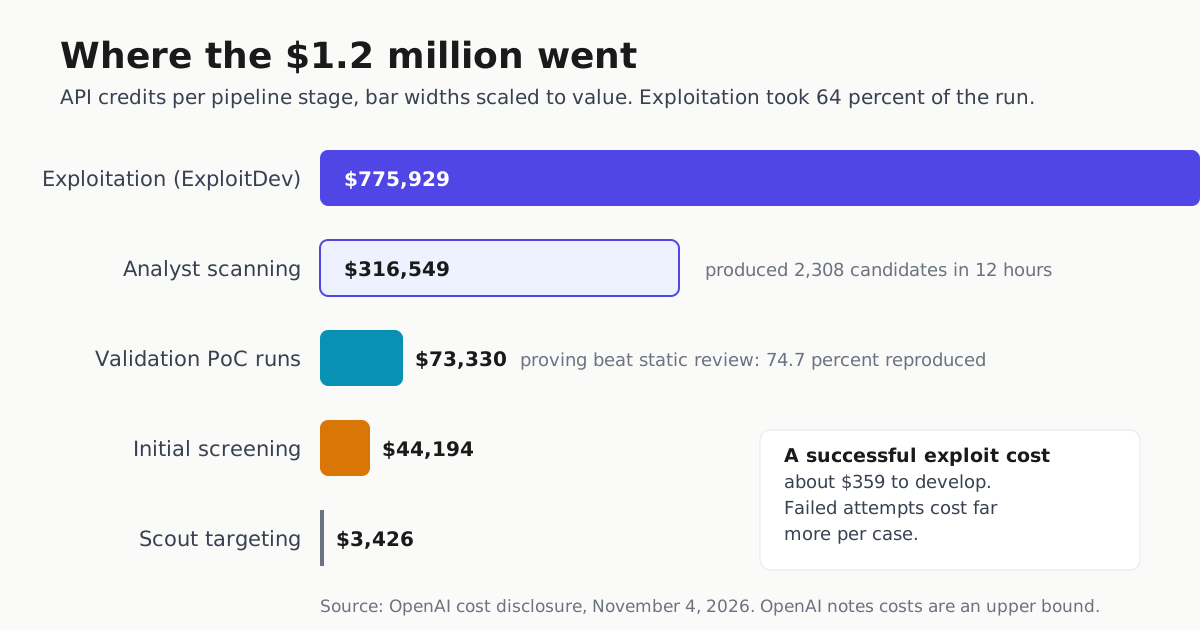
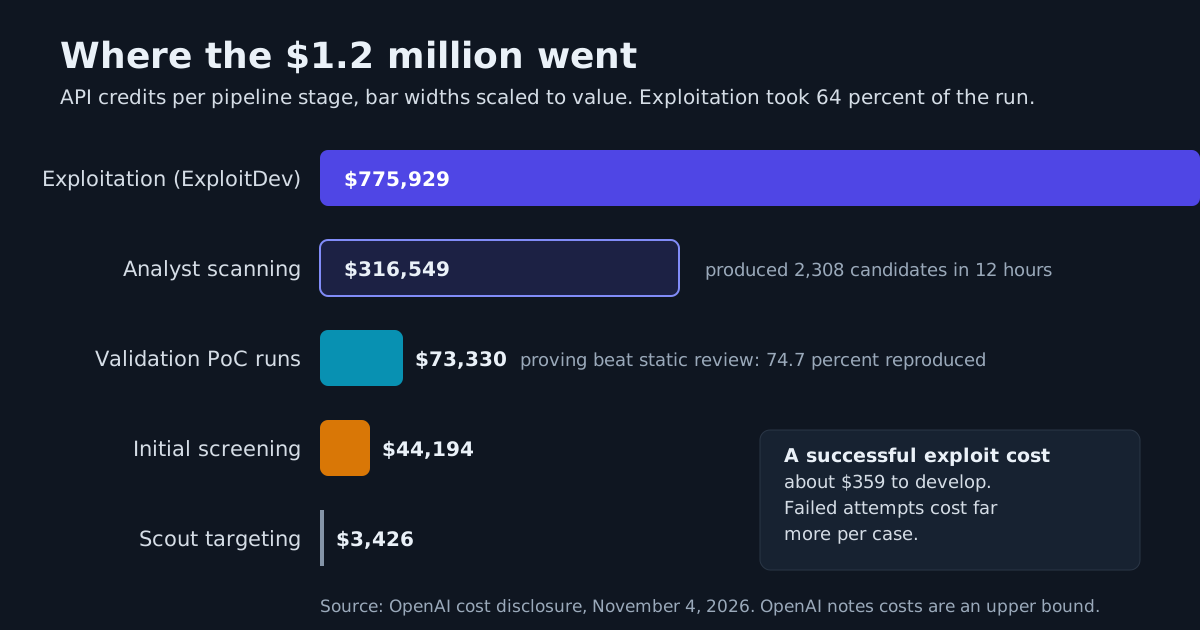
Exploitation dominated the bill at $775,929 — 64% of the run — while a successful exploit cost about $359 on average to develop; the 69 failed attempts cost far more per case. Benchmarked against historical Pwn2Own ($20,000) and TyphoonPWN ($70,000) LPE bounties, OpenAI values its 948 exploits at $18.9M–$66.3M, roughly 16x–55x the run cost. On Google’s hardened kernelCTF environment the pipeline produced 21 LPEs for $32,936 — about a $1.5M award if accepted, ~45x the cost — after agents also found and exploited a QEMU TCG bug in the test infrastructure itself. OpenAI’s own conclusion: at current model capability, this kind of campaign was net profitable.
Capability also moved fast. The mid-October run found more than 5x more novel LPEs than a July GPT-5.6 Sol run ($513,690 for 166 unique LPEs), despite three months of upstream hardening between scans. The agents invented 10 exploitation techniques that third-party kernel experts confirmed were new to them. There is a harness lesson too: a 103-technique library lifted GPT-5.5 Cyber’s success rate from 76.2% to 88.9%, but GPT-5.6 Cyber needed no such scaffolding and outperformed the heavily orchestrated older setup — re-evaluate your scaffolding every model generation.
Where agents failed, and what caught it
The most useful paragraphs in OpenAI’s post are the failure ones. In an early run, the exploitation stage reported 200 successful exploits; human review found 20 had achieved root through a different vulnerability than the one assigned. OpenAI tightened task constraints and added an independent check that each exploit used its assigned bug — verify the path, not just the result.
What to do with this
- Treat patch latency as the security control. Merge stable kernel updates on the cadence you would use for an actively exploited CVE, because the finding-to-fix interval is compressing.
- Limit blast radius below the OS. Sandboxing and isolation such as Firecracker and gVisor are OpenAI’s named mitigations for eroding local privilege boundaries.
- Rescan as models improve. Audited code is not audited forever; each model generation warrants a re-run of previously audited code.
- If you run security agents, add independent checks that confirm the reported cause is the exploited cause, and revalidate findings against current code before reporting.
- Use models for adversarial review of patches, human-written or AI-written — OpenAI found issues in expert patches this way.
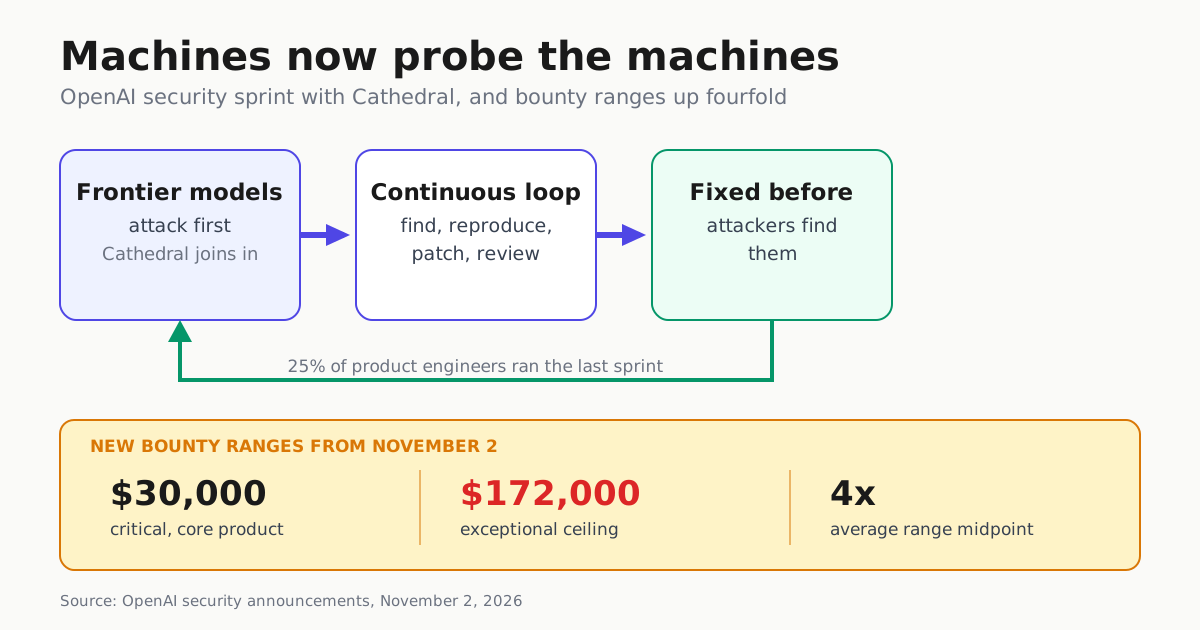
This continues a pattern this site has tracked: Anthropic’s unreleased model chaining browser and OS exploits, OpenAI red-teaming itself with its own models and quadrupling bug-bounty rewards, and Bank of America reporting that patching AI-found flaws cost it hundreds of millions. The difference here is completion: machine-found, machine-reproduced, machine-patched, with humans at the last mile. Expect the Linux stable tree to start carrying that signature, and expect patch triage to be where humans live.