Google Backstops Anthropic's $19B Kentucky Data Center Leases as TeraWulf Signs Fluor Construction Deal
Google signed three credit support agreements backstopping Anthropic's 401 MW, 20-year leases at TeraWulf's Hawesville, Kentucky campus. How the backstop works, what ends it, and what is still unfinished.
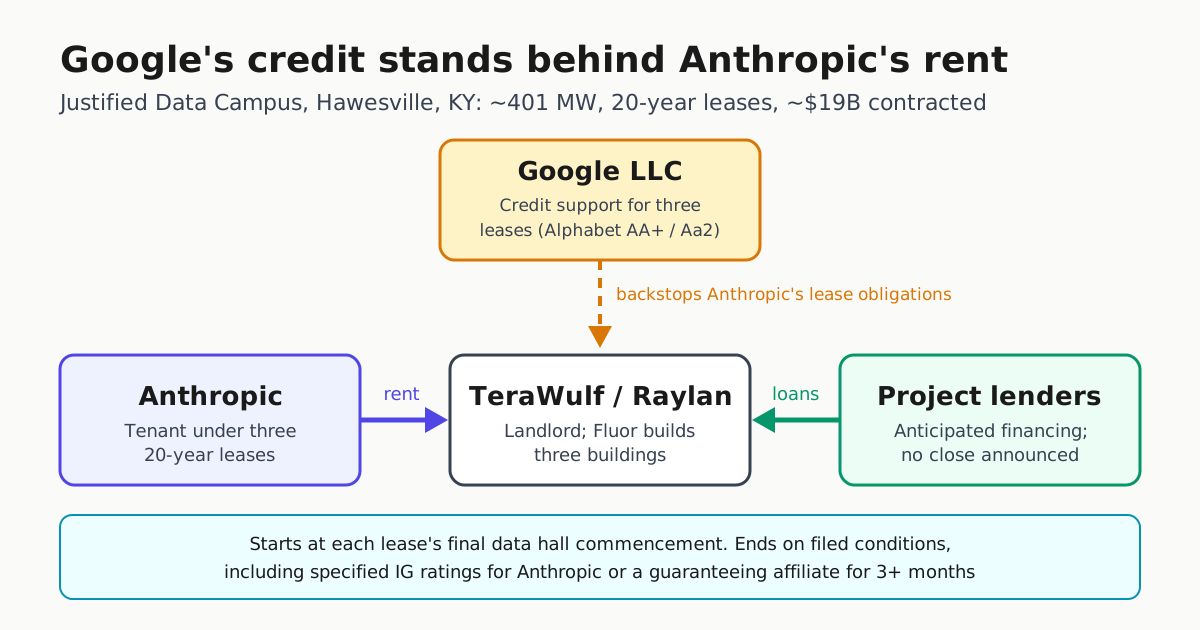
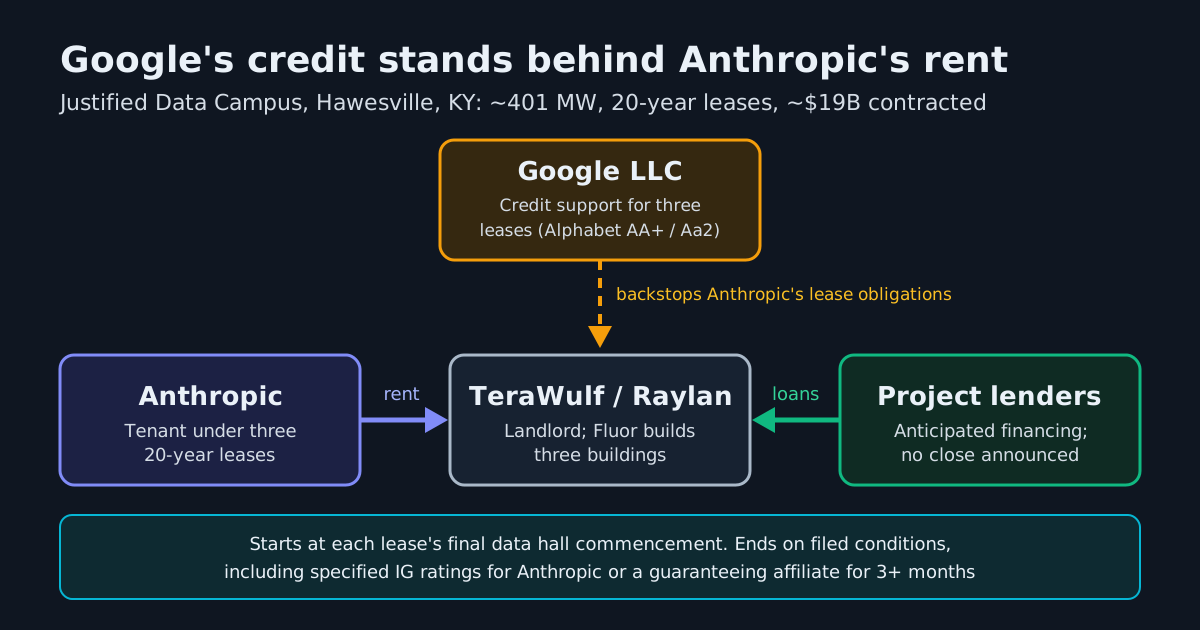
TeraWulf said on Nov. 4, 2026 that Google LLC has signed credit support agreements covering certain obligations of Anthropic, its tenant at the Justified Data Campus in Hawesville, Kentucky. The agreements back anticipated debt financing for about $19 billion of contracted lease commitments, according to TeraWulf’s press release. The same day, the company signed a definitive engineering, procurement and construction (EPC) agreement with Fluor for three data center buildings at the site.
The headline number isn’t new. Anthropic signed the 20-year, roughly 401 MW lease in July. What changed is whose credit stands behind the rent. Alphabet’s senior unsecured debt is rated AA+ by S&P and Aa2 by Moody’s. TeraWulf’s CFO said this “strong investment-grade credit support” improves the project’s ability to pursue competitive long-term debt. The borrower here is TeraWulf’s project, not Anthropic. The release ties Google’s support to TeraWulf’s anticipated debt financing for the campus.
What was signed
TeraWulf’s Form 8-K sets out the legal structure. TeraWulf subsidiary Raylan Data LLC is the landlord under three leases, one each for premises called CB-1, CB-2 and CB-3. On Nov. 4, TeraWulf, Raylan, Justified DataPower LLC, Anthropic and Google signed three Credit Support Agreements, one per lease. Under them, Google agreed to backstop certain of Anthropic’s lease obligations. Raylan and Anthropic also amended the leases that day.
| Term | What the filing says |
|---|---|
| Scope | ~401 MW of critical IT load, 20-year leases, three premises (CB-1, CB-2, CB-3) |
| When rent starts | As each data hall is delivered |
| When the backstop starts | On the commencement date of the final data hall under each lease |
| Trigger | Anthropic payment default or insolvency event, after notice from Raylan |
| Google’s option (i) | Pay all rent currently due and take over the lease as tenant |
| Google’s option (ii) | In certain circumstances, pay a termination fee and become entitled to acquire an equity interest in Raylan |
| Deferral | After a payment default only, Google can delay its choice for a set period while paying unpaid and newly due rent |
| Fee shape | The termination fee amortizes over a defined term |
| Exit | The backstop ends when the agreements’ conditions are met, including Anthropic (or a guaranteeing affiliate) achieving and maintaining certain investment-grade ratings for at least three months |
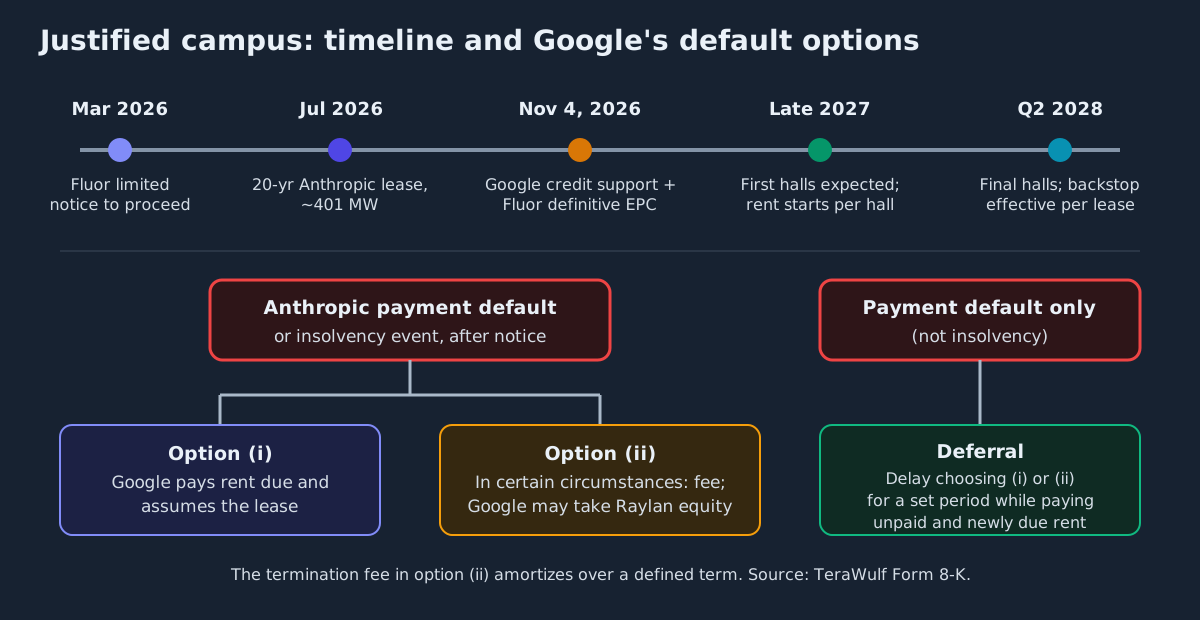
The timing matters for lenders. Each backstop starts only when the final data hall under its lease begins, so Google’s support doesn’t cover the construction years. It covers the operating years until the termination conditions are met. The 8-K names one of those conditions: Anthropic, or an affiliate that has agreed to guarantee its lease obligations, achieving and maintaining certain investment-grade ratings for at least three months. The full set of conditions is in the form agreement filed as Exhibit 10.1. The 8-K summary doesn’t reproduce it.
What happens in a default
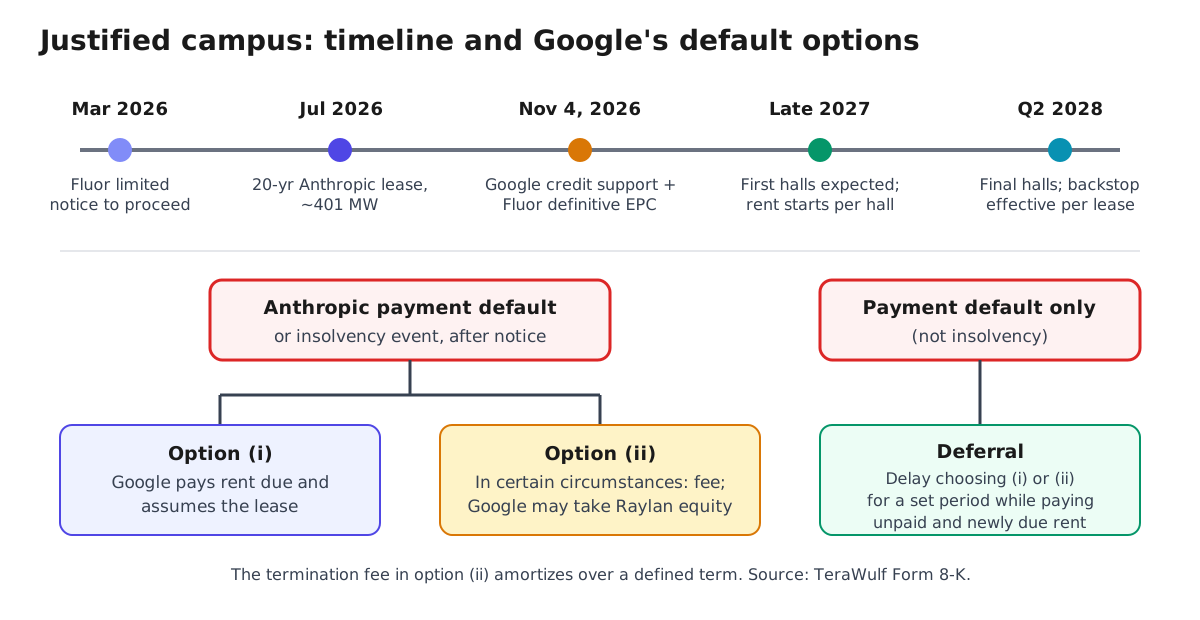
The filing treats the two triggers differently. After a payment default or an insolvency event, and once Raylan gives notice, Google has two options. It can pay the rent due and step in as tenant. Or, in certain circumstances, it can pay a termination fee, which amortizes over a defined term, and become entitled to acquire an equity interest in Raylan. A payment default also gives Google a third option: it can defer that choice for a specified period. During the deferral, Google pays all unpaid rent and any additional rent that comes due.
For lenders, this means a missed payment doesn’t leave the rent unpaid while Google decides what to do. The equity route means that if Google pays the fee instead of taking over the lease, it could end up owning part of the landlord. The 8-K doesn’t say which circumstances make the termination fee available, how large the fee is, or how long the deferral period lasts.
Contracted versus delivered
The deal is not finished:
- No financing close is announced. TeraWulf calls the debt “anticipated,” and neither the release nor the 8-K announces that it has closed. The release presents competitive financing as a goal of Google’s support, not a result.
- The construction price is still open. The Fluor contract is on a guaranteed-maximum-price basis, but TeraWulf says that price “is being established” as engineering and procurement progress. The contract expands Fluor’s role from the limited notice to proceed announced in March 2026 to the full scope: engineering, procurement, construction, testing and commissioning. It also adds delivery milestones, open-book cost reporting and performance protections.
- No capacity is live. Phased ready-for-service completions are expected to start in late 2027 and run through the second quarter of 2028. Reuters, via KFGO, says the initial capacity is expected online in the second half of 2027.
TeraWulf’s release says labor availability is becoming “an increasingly important constraint” on large data center builds. That is part of the company’s reason for handing execution to Fluor instead of building its own construction organization.
Why it matters
Reuters calls the agreement the latest example of large tech companies providing multibillion-dollar backstops to smaller AI infrastructure developers. TeraWulf is one of those developers. It is moving from bitcoin mining to AI hosting, and its release says it doesn’t invest in compute hardware itself. It supplies land, power and buildings, so the cost of its debt is the main lever on its returns. Google’s credit support is meant to lower that cost.
Anthropic is a party to all three agreements, which put Google’s credit behind its rent on 401 MW of dedicated capacity. The exit terms link Google’s role to the tenant’s own credit standing. The backstop is designed to end once specified investment-grade ratings are achieved and held for at least three months, along with any other conditions in the agreements. The deal is a concrete example of how frontier-lab compute is being financed, alongside moves such as Microsoft making Maia its primary inference system and the funding race described in OpenAI’s push to raise about $30B before Anthropic’s IPO.
The market reaction was cautious. Reuters said TeraWulf shares were down about 3% in premarket trading, amid a broader slide in AI data-center stocks as investors weighed the chance of tighter regulation after the midterm elections. Power and community impact are part of the same story; see OpenAI’s Grid Protectors pledge.
What to watch
- Whether TeraWulf announces a project debt close, and at what spread compared with debt that has no backstop.
- The guaranteed maximum price Fluor finally sets for the three buildings.
- Whether the first data halls are ready for service in late 2027, as scheduled.
- Any credit rating for Anthropic or a guaranteeing affiliate. Specified investment-grade ratings held for at least three months are among the conditions that end Google’s role.
- What the full form agreement (Exhibit 10.1) says about when the termination-fee route is available and how long Google can defer.