OpenAI's Grid Protectors Program: Future Compute Campuses Pledge to Cut Power When the Grid Is Strained
OpenAI launched the Grid Protectors Program on Nov. 2, 2026: future compute campuses designed to cut electricity demand when the grid is strained, starting with a Georgia pilot promising up to 1,000 MW of flexible demand response. What's committed, what isn't, and what capacity planners should watch.
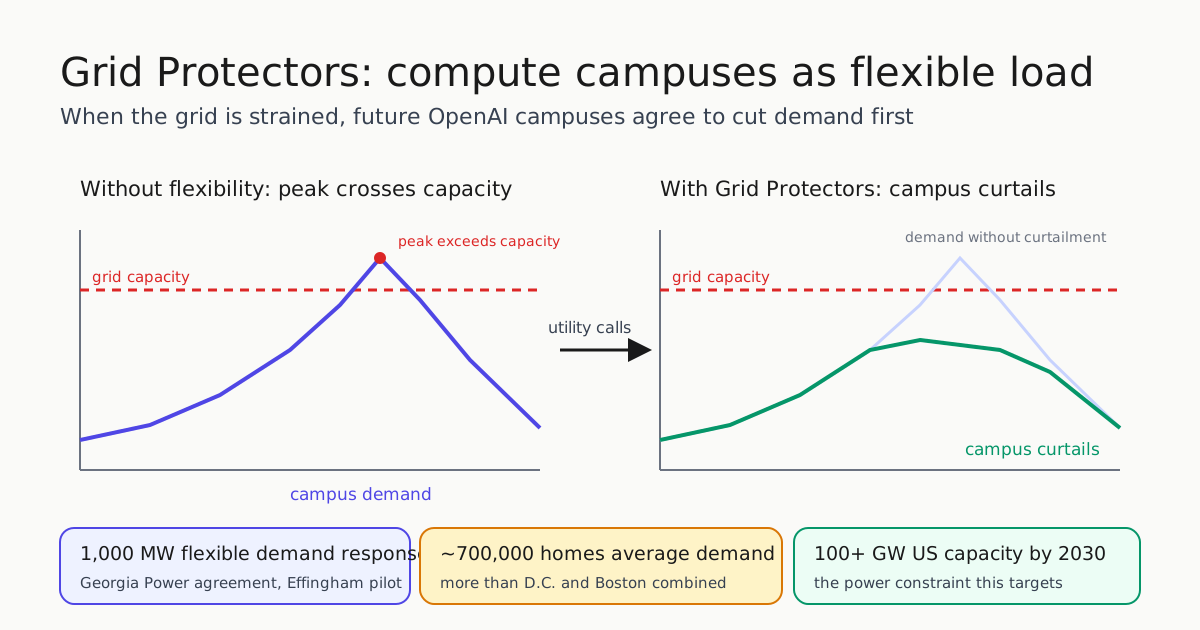
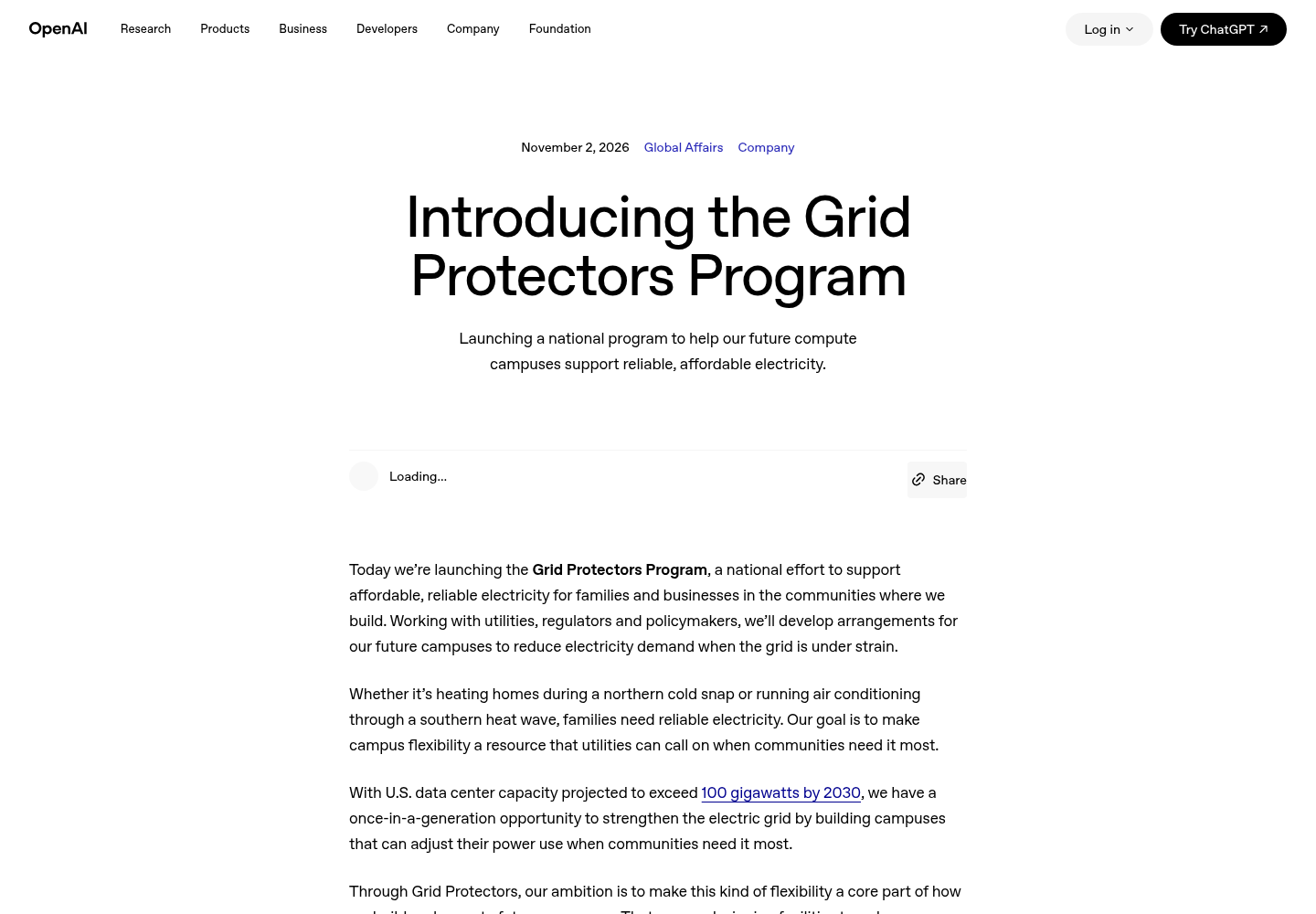
OpenAI published Introducing the Grid Protectors Program on its newsroom page on November 2, 2026 — a “national effort to support affordable, reliable electricity” in the communities where the company builds, under which its future compute campuses would be developed and contracted to reduce electricity demand when the grid is under strain. OpenAI says it will work with utilities, regulators and policymakers on those arrangements, that terms will differ by location, and that it will share additional commitments “as they are finalized.”
Strip the framing and this is a document about the binding constraint on AI capacity: power. Strip the policy language and it is a siting strategy for getting multi-gigawatt campuses approved in communities that have started saying no. Both readings matter for anyone planning around inference capacity.
What the program actually commits to
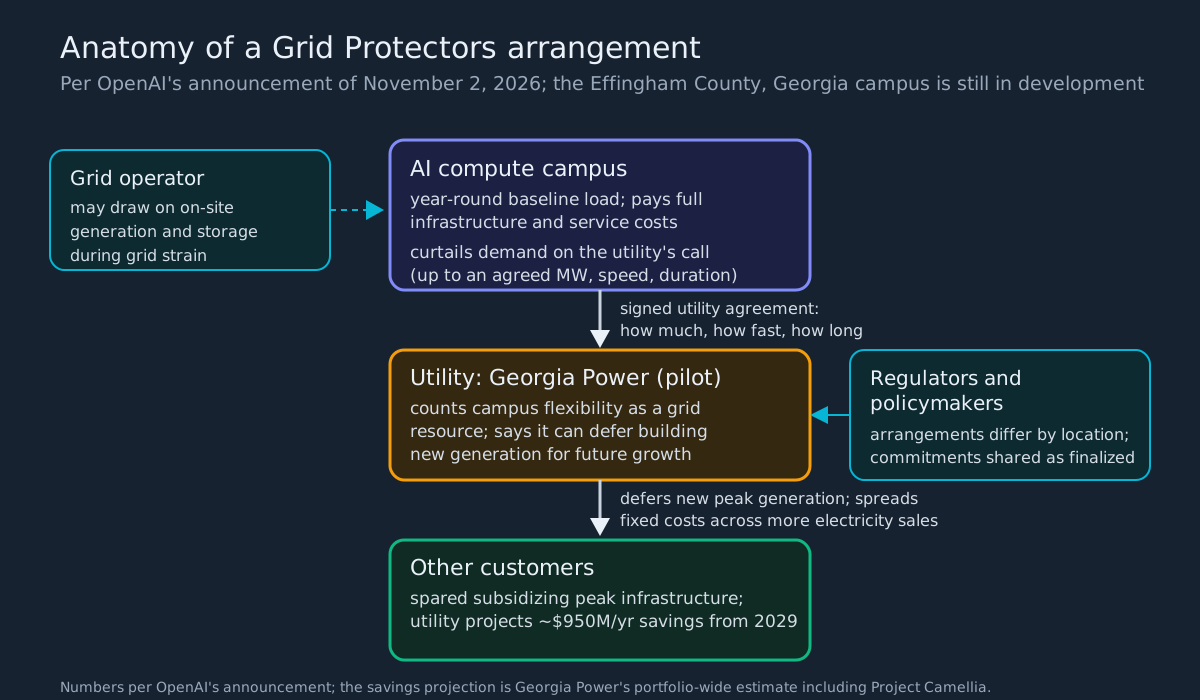
The announcement names three mechanisms:
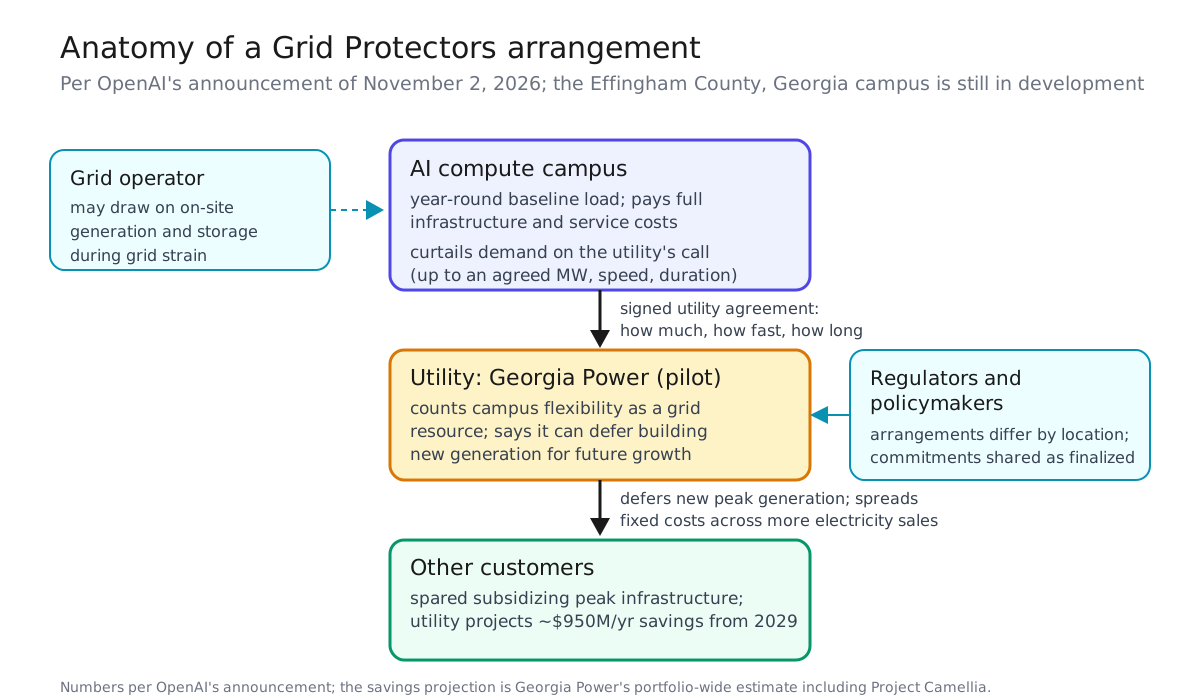
- Design for curtailment. Facilities designed so electricity use can be reduced when needed, with utility agreements spelling out how much demand can be cut, how quickly, and for how long.
- On-site supply. Depending on local needs and available equipment, OpenAI will work with grid operators to supply power from on-site generation or storage, and use batteries and power controls to smooth changes in demand.
- Cost coverage. OpenAI restates that it pays its own electricity and infrastructure costs: “Families and small businesses should not be asked to subsidize a compute campus’s electricity needs.”
What is not in the announcement: named utility partners beyond Georgia, quantified curtailment obligations outside the pilot, or dates when any obligation begins. OpenAI is explicit that arrangements will differ by location and that commitments will be shared as they are finalized. This is a framework plus one concrete agreement, not a fleet-wide policy already in force.
The Georgia model
The concrete part is Effingham County, Georgia, where OpenAI has a planned campus and an agreement with Georgia Power. OpenAI says the campus is still in development and is intended to serve as the Grid Protectors pilot.
| Figure | Value | Whose number |
|---|---|---|
| Flexible demand response in the Georgia Power agreement | Up to 1,000 MW | OpenAI |
| Equivalent average electricity demand | Roughly 700,000 households | OpenAI’s calculation |
| Projected annual customer savings | About $950 million beginning 2029 | Georgia Power, cited by OpenAI |
| Estimated benefit, typical 1,000 kWh residential customer | At least $15/month | Georgia Power, cited by OpenAI |
| U.S. data center capacity projection | Above 100 GW by 2030 | Cited in OpenAI’s post |
Two rows of that table carry more weight than the headline megawatts. First, the campus has committed to pay the full infrastructure and electric-service costs required to serve the project — cost allocation to local ratepayers is exactly where data-center fights have concentrated. Second, the $950 million figure is Georgia Power’s projection for its entire portfolio of large-load agreements and expected growth, including Project Camellia, not a measured effect of this campus. The Verge’s coverage translates the pilot into plain terms: freeing up to 1,000 MW during extreme weather or emergencies, “enough to power air conditioners in around 700,000 homes.”
Why this, why now
The Verge places the launch squarely in the data-center backlash: Utah residents protesting a Box Elder County project expected to consume more than double the state’s peak electricity demand in 2025; laws in Tennessee, Florida, Oklahoma and Oregon aimed at stopping AI companies from passing energy costs to residents; a Houston Advanced Research Center study warning that powering proposed Texas data centers could undo decades of air-quality gains within five years. The same report notes OpenAI has switched to calling its AI data centers “compute campuses” to separate them from their poor public reputation — and Grid Protectors is the substantive version of that rebrand. Techmeme’s November 2 snapshot aggregated the launch with follow-ups including Axios’s terse framing: “OpenAI pledges data center power cuts.”
The economics OpenAI is arguing
The core claim concerns fixed costs. Power lines, substations and other grid builds cost the same whether demand is high or low, so a customer that buys year-round and steps aside at peak spreads those fixed costs across more electricity sales and defers peak-only upgrades. OpenAI’s analogy is a restaurant in a vacation town that needs enough tables and kitchen space for the busy season but pays for that capacity all year — and OpenAI proposes to be “that regular customer.” The company also concedes the pitch’s limit: flexibility “cannot replace investment in new energy supply and transmission.”
What operators should track
Power, not accelerator supply, is increasingly the variable that decides where inference capacity comes online and when — the same constraint behind multi-gigawatt buildout plans like Microsoft’s Maia roadmap. And energy infrastructure is part of the operating bill sitting underneath the token bill, whether or not any invoice itemizes it.
Three concrete things to watch:
- Whether the pilot hardens. Effingham’s curtailment promise is real on paper. It becomes verifiable when the operating campus executes a curtailment event, or when the 1,000 MW commitment surfaces in a Georgia regulatory filing.
- Whether other campuses get named partners. One Georgia agreement is an announcement. A second and third named utility with signed numbers turns Grid Protectors into procurement.
- Whether utilities price flexibility into interconnection. If large-load agreements increasingly reward curtailment, campuses that can flex will site faster than campuses that cannot.
The honest reading: a frontier lab has concluded that grid politics now gates its buildout as tightly as hardware does, and it is bidding to be treated as flexible, cost-covering load — the kind utilities want. Whether campuses that do not yet exist honor that bid is the story to check next year.
Sources
- Introducing the Grid Protectors Program | OpenAI
- OpenAI pitches data center power plants as a way to protect nearby areas | The Verge
- Techmeme: OpenAI launches the Grid Protectors Program, a US effort for its future data center campuses to reduce electricity demand when the grid is under strain (OpenAI)