
Microsoft Makes Azure Maia Its Primary Inference System: Maia 200 in Production, Maia 300 and Multi-Gigawatt Scale Start 2027
Microsoft's Oct. 12 announcement says Maia 200 already serves Copilot workloads and that the Maia family will scale to multi-gigawatt deployments from 2027, when Maia 300 enters production. What is shipped, what is roadmap, and how to read the efficiency claims.
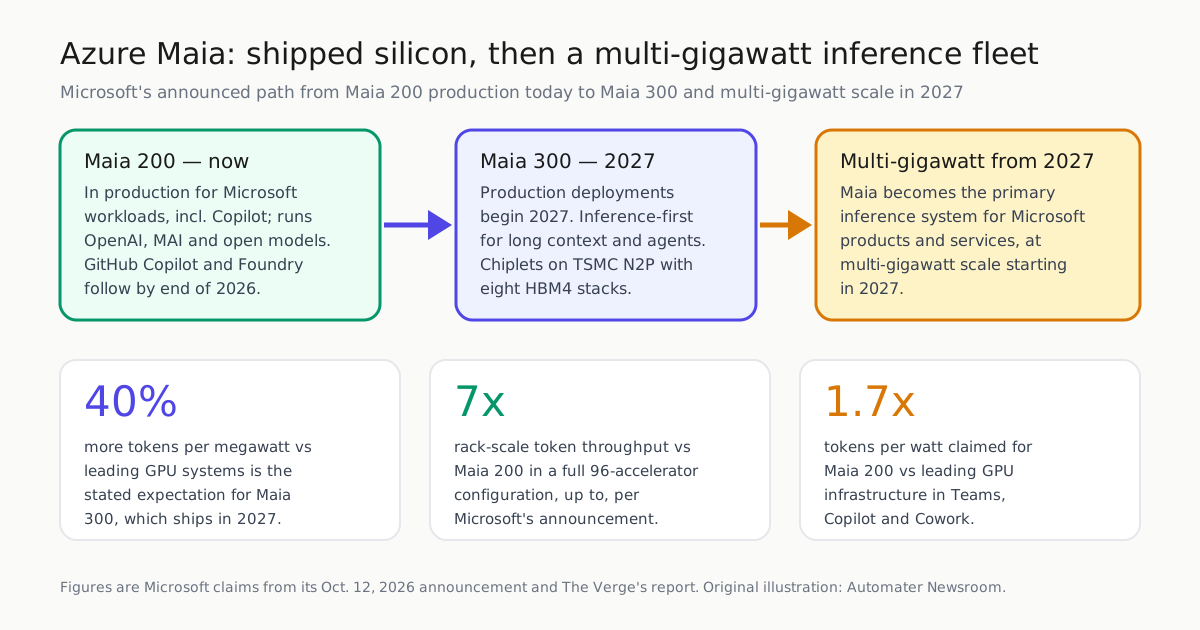
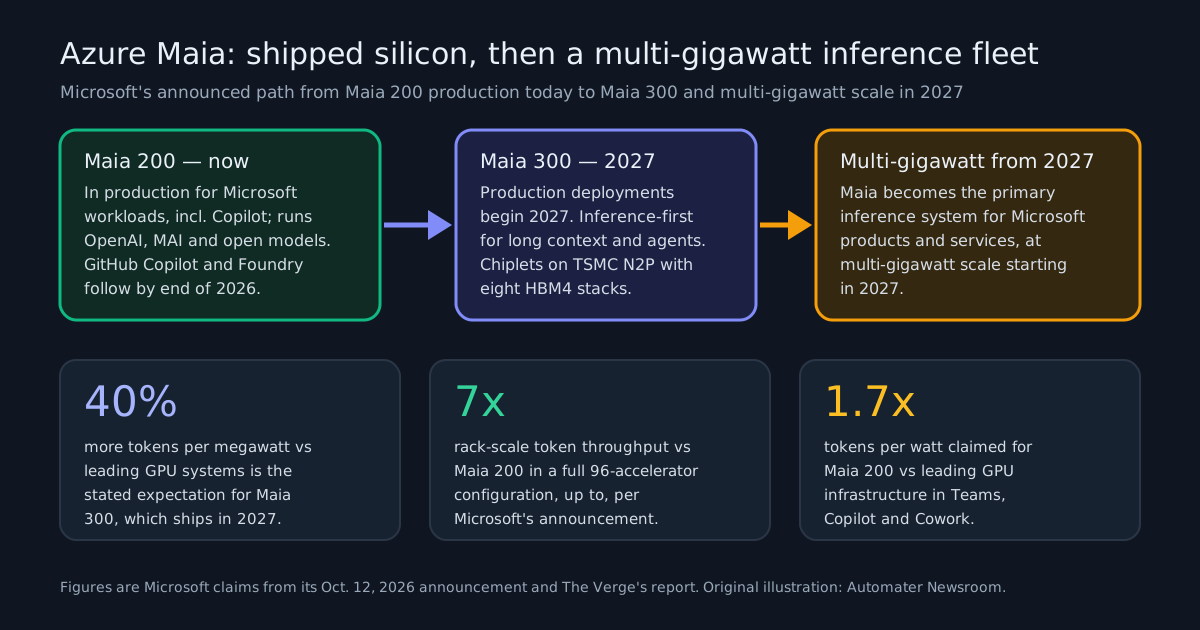
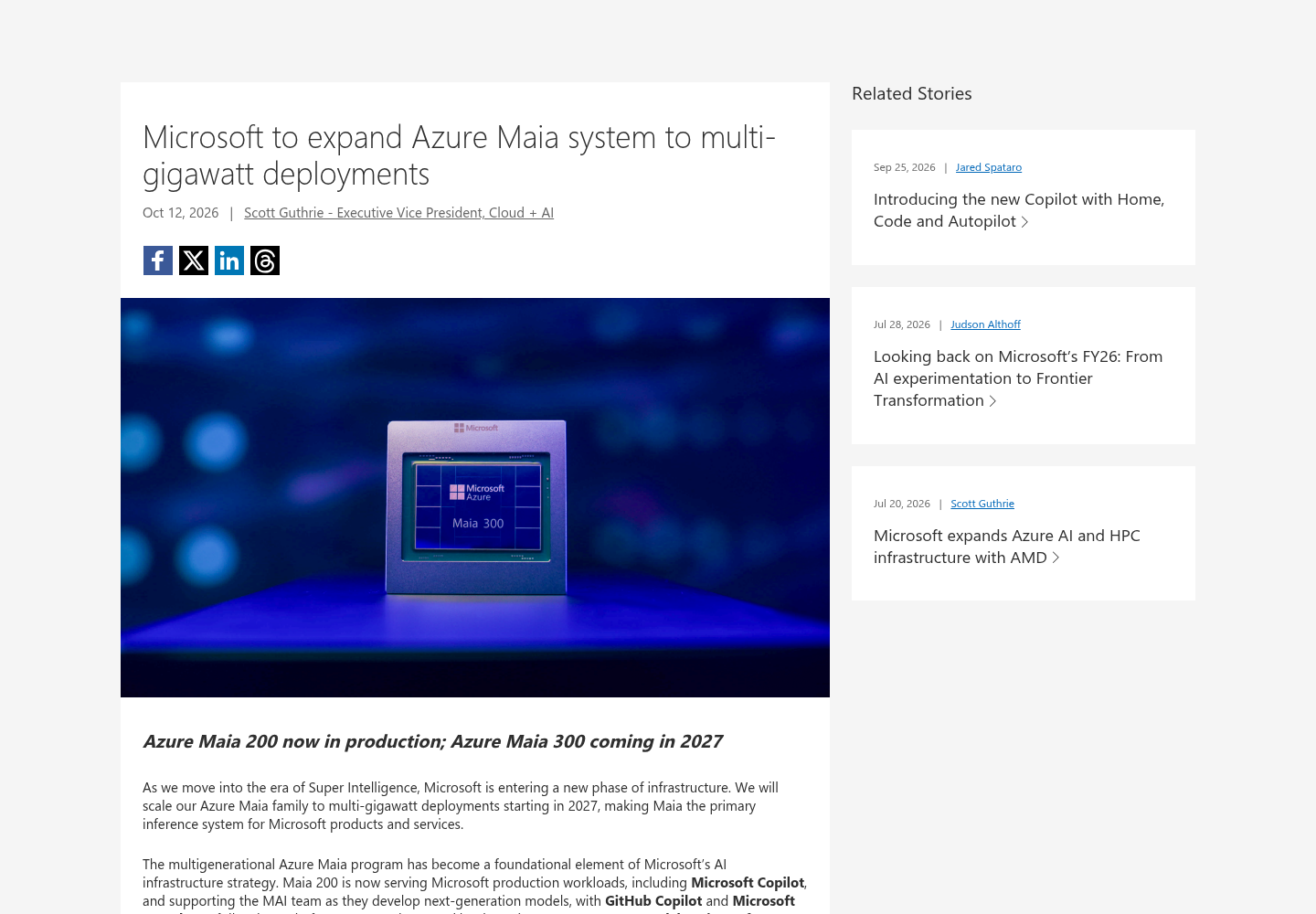
On Oct. 12, 2026, Microsoft announced on the Official Microsoft Blog that it will scale its Azure Maia family to multi-gigawatt deployments starting in 2027, making Maia “the primary inference system for Microsoft products and services.” The post from cloud chief Scott Guthrie pairs one shipped fact — second-generation Maia 200 is now serving Microsoft production workloads, including Microsoft Copilot — with a roadmap: third-generation Maia 300 begins production deployments in 2027. The Verge’s same-day report framed the announcement as making Microsoft less reliant on Nvidia’s GPUs, and the story ran in the outlet’s AI section on Oct. 12.
For readers tracking AI infrastructure economics, the consequential part is not another chip reveal. It is a hyperscaler committing to make its own silicon the default place where its inference tokens are generated — with concrete, checkable efficiency claims and a dated rollout.
Shipped versus promised
Microsoft’s language separates present-tense production use from future plans:
| Item | Status per Microsoft |
|---|---|
| Maia 200 serving Microsoft production workloads, including Microsoft Copilot, and supporting the MAI model team | Shipped now |
| Maia 200 running OpenAI models, Microsoft’s MAI models and leading open-source model families | Shipped now |
| Maia 200 deploying across the United States, Europe and Australia | Underway |
| GitHub Copilot and Microsoft Foundry on Maia 200 | To follow by end of 2026 |
| Maia 300 production deployments | Roadmap: begins 2027 |
| Multi-gigawatt Maia deployments as Microsoft’s primary inference system | Roadmap: starting 2027 |
One discrepancy is worth flagging: The Verge describes GitHub Copilot and Microsoft Foundry as already running production workloads on Maia 200, while Microsoft’s own post says they will follow by end of year. We treat the vendor’s wording as the primary claim. The Verge also notes Maia 200 itself was only announced in January, so the program moved from reveal to production to a successor announcement within a year. “Maia 200 is the best performing AI infrastructure in our fleet, measured in real world metrics for AI services,” Guthrie told The Verge.
What Microsoft claims for Maia 300
Maia 300 is described as an inference-first system designed for long-context reasoning, latency-sensitive conversational experiences and sustained, multi-step agentic tasks. The published figures:
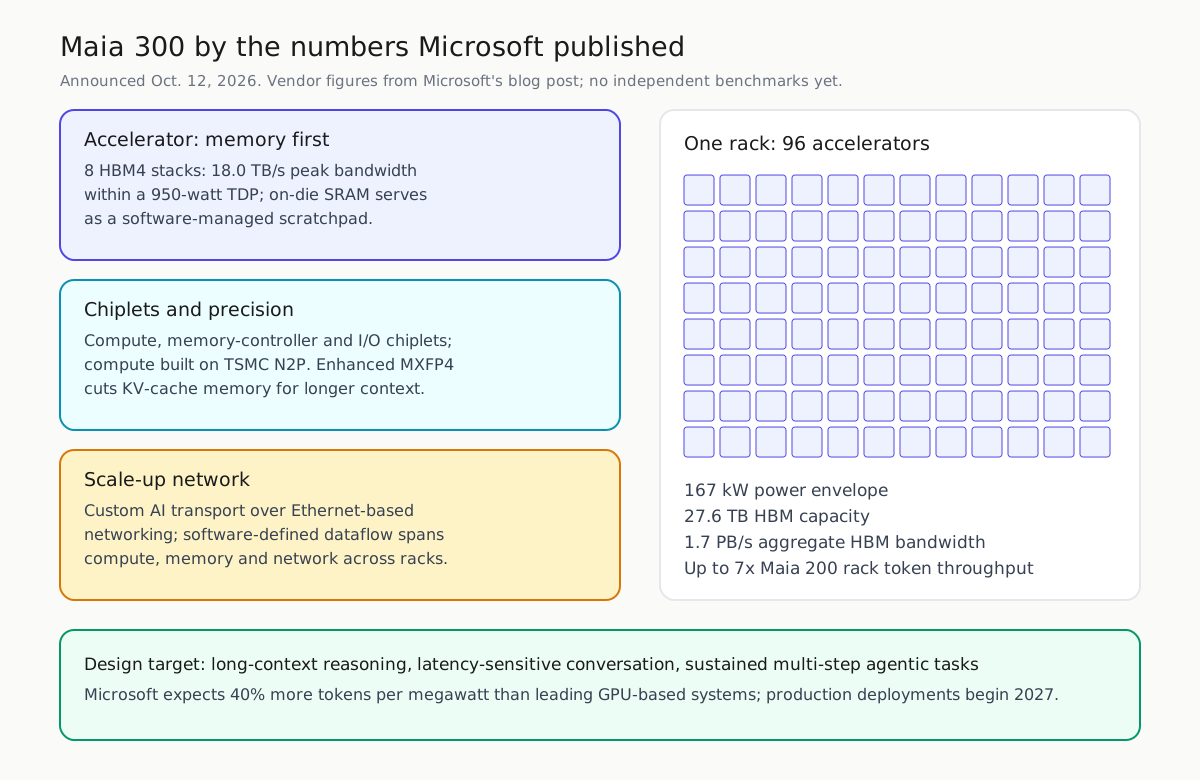
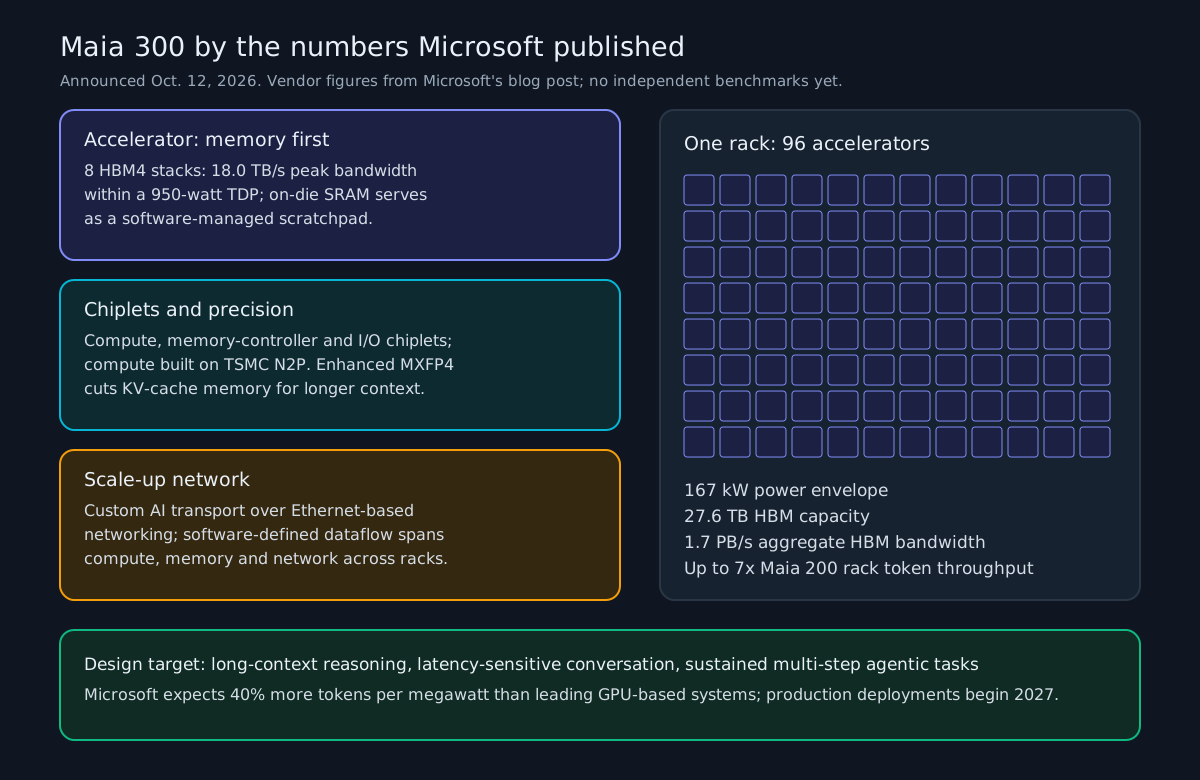
- Chiplets on TSMC N2P. A multi-chiplet design separates compute, memory-controller and I/O functions, with compute chiplets on TSMC’s N2P node. The Verge quotes the Azure hardware team saying this increases the silicon area dedicated to compute and lets each function use the technology best suited to it.
- HBM4 density. Eight HBM4 stacks deliver 18.0 TB/s of peak memory bandwidth per accelerator within a 950-watt TDP, with on-die SRAM used as a software-managed scratchpad to reduce HBM pressure.
- Low precision. Enhanced MXFP4 support reduces memory and bandwidth requirements for computation and KV-cache storage, enabling larger context windows within the same power envelope.
- Rack scale. A 96-accelerator rack draws 167 kilowatts and provides 27.6 TB of HBM capacity and 1.7 PB/s of aggregate HBM bandwidth in a single high-speed scale-up domain.
- Ethernet-based scale-up. A custom AI transport runs over Ethernet-based networking, extending a software-defined dataflow architecture from a single rack to datacenter-scale deployments.
Vendor numbers, not independent benchmarks
The headline efficiency claims deserve caution. Microsoft says it expects Maia 300 to deliver 40% more tokens per megawatt than “leading GPU-based systems,” and up to 7x the rack-scale token throughput of Maia 200 in a full 96-accelerator configuration. For Maia 200, Microsoft claims up to 1.7x more tokens per watt for built-in AI capabilities in Teams, Copilot and Cowork compared with leading GPU infrastructure. No independent benchmark is cited, the comparison GPUs are unnamed, and tokens-per-megawatt framing rewards inference-dense serving. These are directional vendor claims about a system whose production deployments do not begin until 2027.
Why it matters
Vendor concentration. If Maia becomes Microsoft’s primary inference system, less of Microsoft’s first-party inference spend flows to Nvidia and AMD accelerators — the shift The Verge highlights. Microsoft AI CEO Mustafa Suleyman told The Verge the company has to “work across the full stack, all the way down to the silicon,” and that running Microsoft AI models on Maia is a critical focus for catching up with Google DeepMind, OpenAI and Anthropic.
Where agent work will run. Microsoft explicitly targets GitHub coding experiences, Microsoft Foundry model serving, MAI inference and data generation, and Dragon Copilot clinician workflows — sustained agentic and long-context workloads. Teams building on those products should expect Maia-backed capacity to influence throughput and pricing over time, which is a good reason to price the finished job rather than the token when budgeting agent work.
Continuity planning. A fleet that increasingly runs on one vendor’s custom silicon still needs a failover story. Our guide to rehearsing the provider cutoff applies directly: multi-gigawatt commitments do not remove the need for model and capacity fallbacks.
Microsoft says it will share more at Ignite 2026 next month in San Francisco, and points to a technical paper and a dedicated Maia 300 site for architectural detail. Until Maia 300 ships in 2027, the verifiable present is narrower: Maia 200 is in production inside Microsoft, and the rest is a dated promise.