Word, Excel and PowerPoint Go Generally Available Inside Copilot as Microsoft Bets on 'the New OS for Work'
Word, Excel and PowerPoint are now generally available inside Copilot as Microsoft calls it the new OS for work. What users, IT and agent builders should do next.
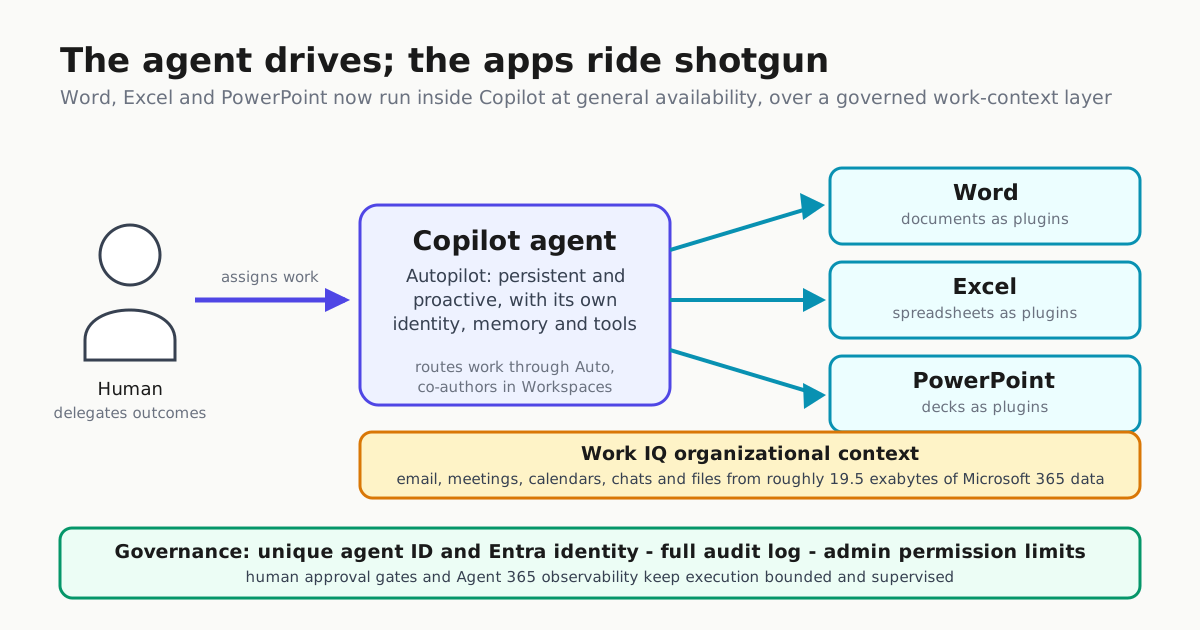
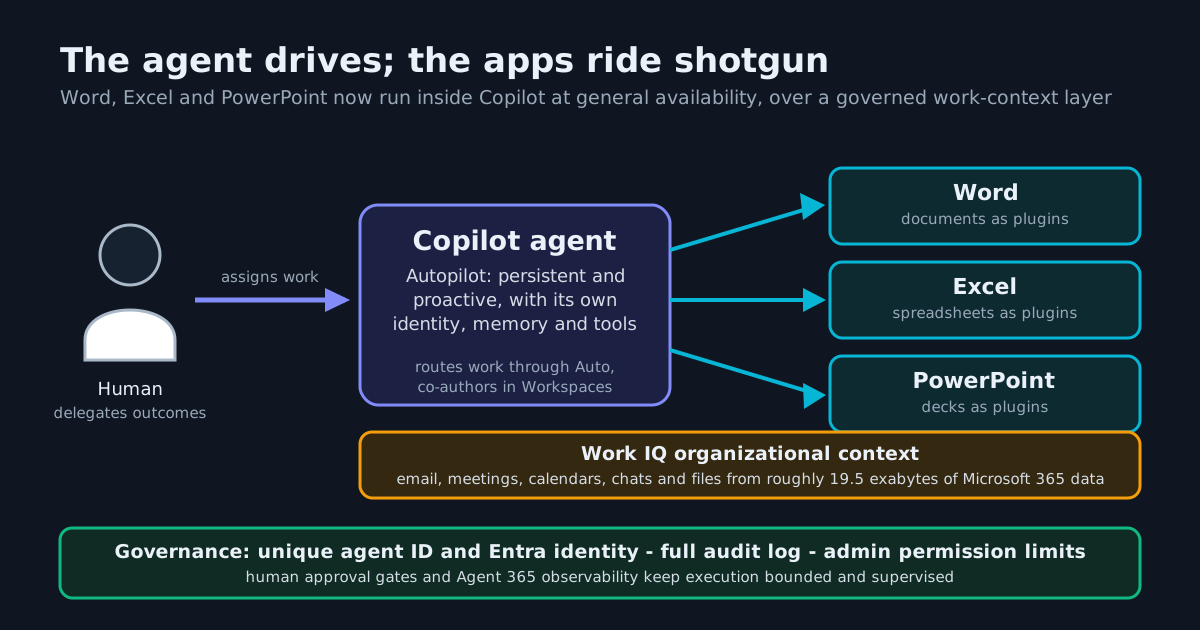
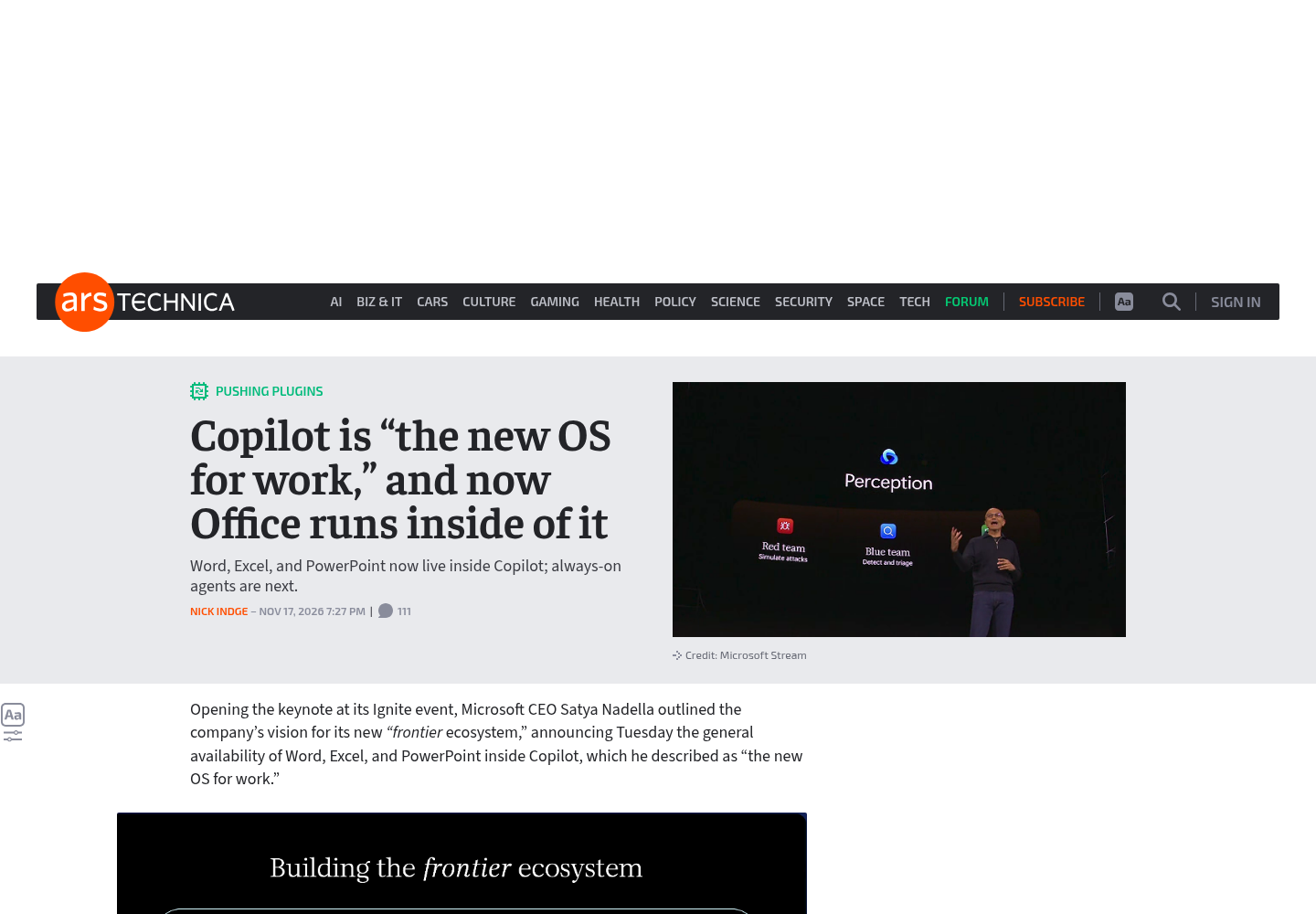
Microsoft’s Ignite 2026 keynote opened with a structural claim rather than a feature demo: Copilot is “the new OS for work,” and the world’s most-deployed productivity apps now live inside it. Word, Excel and PowerPoint are generally available within Copilot, CEO Satya Nadella announced, completing the redesign Microsoft first outlined in September.
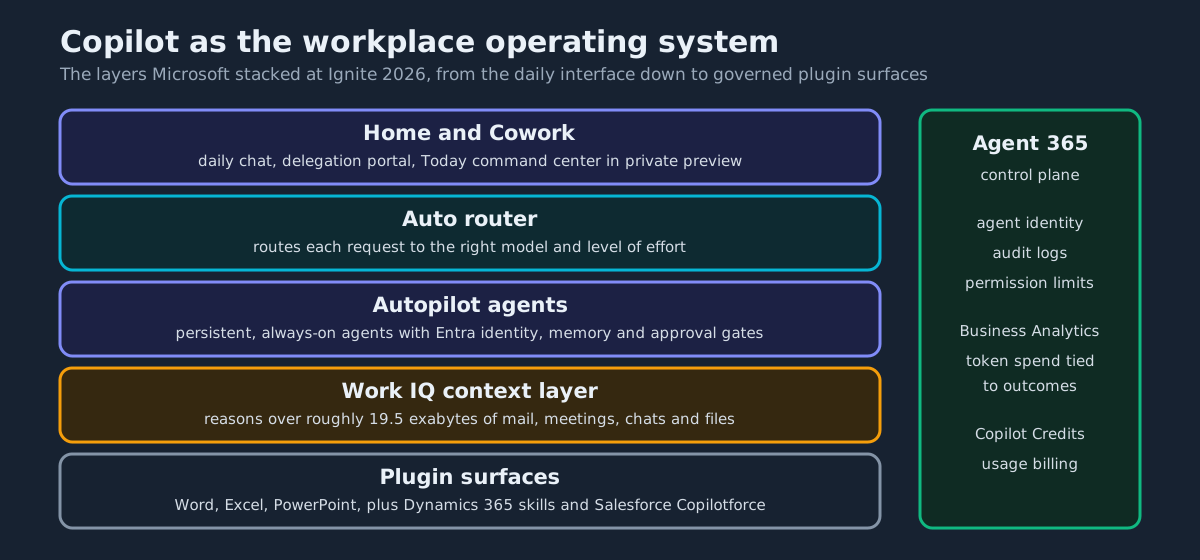
The framing inverts four decades of personal computing. Traditionally the application — Word — was the product, and the assistant rode along inside it. Microsoft’s new model puts the agent in the driver’s seat: applications become plugin components the agent invokes, backed by a knowledge layer drawing context from email, meetings, calendars, chats and files. Users create documents, spreadsheets and presentations directly in Copilot, and the files stay editable in the desktop Office apps. That detail matters for rollout: this is a new front door to the same documents, not a new file format.
What actually shipped
| Capability | Status | What it does |
|---|---|---|
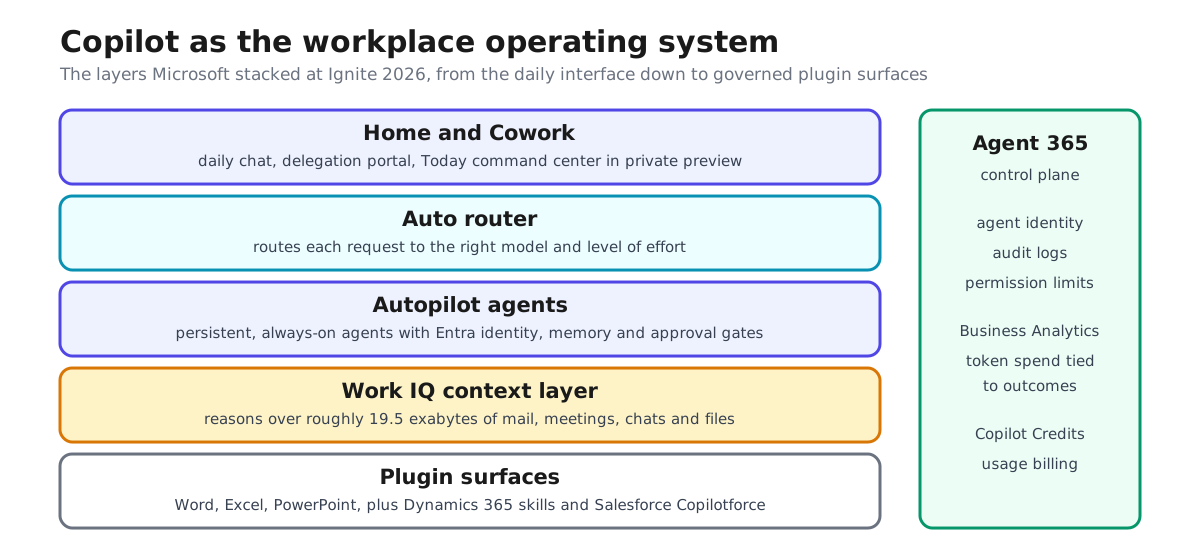
| Word, Excel, PowerPoint inside Copilot | Generally available | Create and co-author Office files inside Copilot; files remain editable in the Office apps |
| Copilot Autopilot | Frontier early access; usage-based Copilot Credits, pricing unannounced | Persistent agent with its own Entra identity, memory and tools; watches Teams and inboxes, runs recurring processes |
| Microsoft IQ and Work IQ | Generally available | Context layer indexing the people, relationships and communications in a company’s work |
| Home, Cowork, Auto, Today | Home and Cowork live; Today in private preview | Auto routes requests to suitable models; Today surfaces the day’s priorities |
| Copilot Workspaces | Frontier early access | Shared canvas where people and agents co-author |
| Copilot Code | Weeks away | Natural-language dashboards, widgets and lightweight apps in Copilot Managed Runtime |
| Agent 365 Business Analytics | Expanded | FinOps-style analytics tying token spend to outcomes |
Microsoft 365 already stores roughly 19.5 exabytes of customer business data — the raw material Work IQ reasons over, retrieving what matters and ignoring the rest, per SiliconANGLE’s coverage.
The agent becomes the privileged user
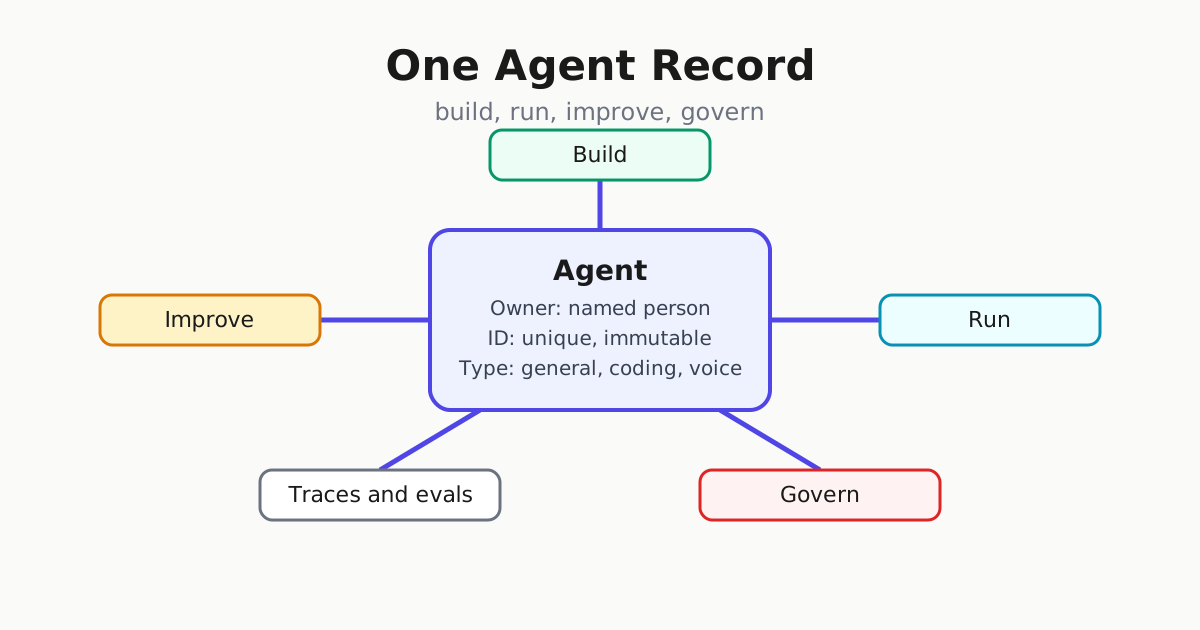
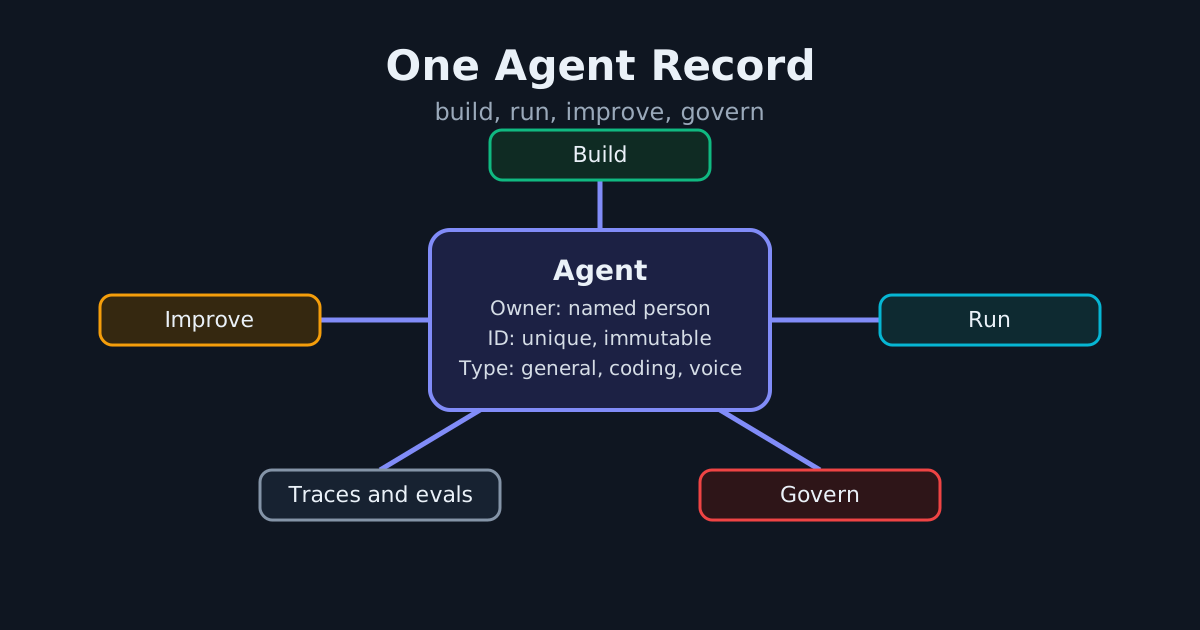
For operators, the consequential part is identity and control. Each Autopilot agent gets a unique ID and its own Entra identity; its sign-ins and actions are logged under its own name, IT can restrict or block it, and it can ask for human approval before specific actions. Microsoft calls the objective “autonomous in execution, but bounded and supervised.”
That is the pattern every agent fleet now needs: treat every agent as a privileged user, with its own credentials, an audit trail and permissions narrower than a human’s. Microsoft’s bet is that enterprises accept autonomous software precisely because that machinery exists — and that the machinery, not model alignment, is what makes delegation safe.
Nadella was blunt about why. “Alignment is elusive. Mechanistic understanding of these models is elusive,” he said — by definition you cannot trust the technology, so separate the supply of intelligence from the authority granted to it. The answer to untrustworthy intelligence is not to make agents trustworthy but to bound what they may do. Microsoft also launched an AI Transparency Initiative with 40-plus companies including Adobe and Mastercard to draft open governance standards.
Microsoft also prices the promise
Agent 365 gained Business Analytics, which Nadella described as “an ERP system of AI usage,” connecting token spend to delivered outcomes. Notably, Microsoft conceded its assisted-work-hours estimates are model-generated, not measured — a real caveat as enterprises hunt for AI ROI. The competitive posture was plain: Microsoft Commercial Business CEO Judson Althoff claimed “anything you can do with Claude or ChatGPT, you can do better with Copilot, for less.” Metered agent billing is spreading industry-wide — see how Cisco, Goldman and JPMorgan moved to token budgets — and Copilot Credits put Microsoft squarely in that camp.
The competitive map is crowded. Anthropic shipped its own office suite; Google lets Gemini edit Docs, Sheets, PDFs and Slides in chat; Databricks is rebuilding Genie as an autonomous coworker. Microsoft extended outward with Copilotforce — 38 Salesforce skills via Zero Copy integrations between Fabric and Data 360 — plus 100-plus Dynamics 365 skills.
Nadella’s framing went further. In a post-keynote roundtable with The Verge, he said he is “AGI-pilled” about AI’s economic reorganization, while warning a single-firm monopoly on intelligence would be catastrophic: “If the Marxist sort of view is that there’s only one firm, then it’s over, right? For all of us.”
What to do with this
If you run Microsoft 365: general availability is the trigger to inventory agent permissions before someone delegates a workflow. Verify unique agent IDs map to named owners, audit logs route somewhere a human reviews, and approval gates cover consequential actions — sending email, modifying shared files, touching CRM records. Decide now which document stores Work IQ may index; Ars Technica notes that decision is explicitly left to each company’s IT review.
If you build agents or tools: this is the clearest signal yet that incumbent apps are repositioning as tool surfaces. Expect customers to ask how an external agent — Copilot, Claude or Gemini — can invoke your product under a governed identity, and expect an Agent 365-style control plane of identity, audit and spend analytics to become a procurement requirement.
If you budget AI: Copilot Credits are usage-based and Autopilot pricing is unannounced. Pilot before committing seats, and treat vendor-reported hours saved as a model estimate — build your own baseline if ROI claims will justify spend.
Microsoft acknowledged last week’s global Exchange Online and Teams outage only briefly, and its new safeguards still have to prove themselves in production. The apps are inside the agent now; whether the trust architecture holds is the story to watch.