Microsoft Foundry Lets Enterprises Run Hosted Agents on Their Own AKS Clusters at Ignite 2026
Microsoft Foundry hosted agents can now run on customers' own AKS clusters, with GA network egress controls and private CA trust for enterprise rollouts.
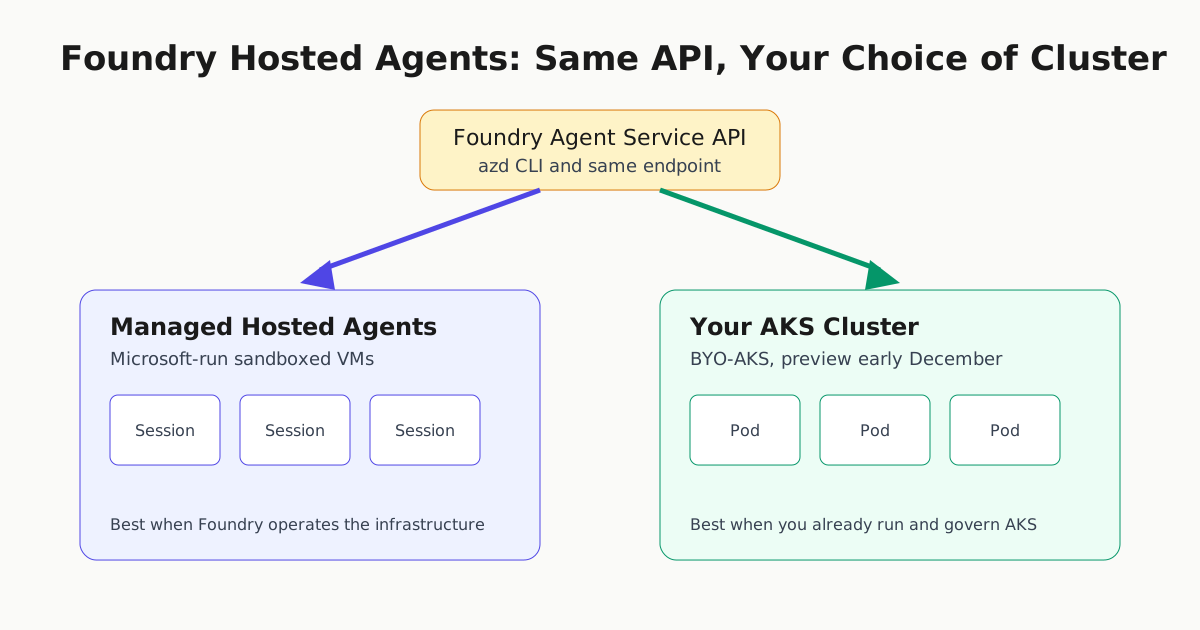
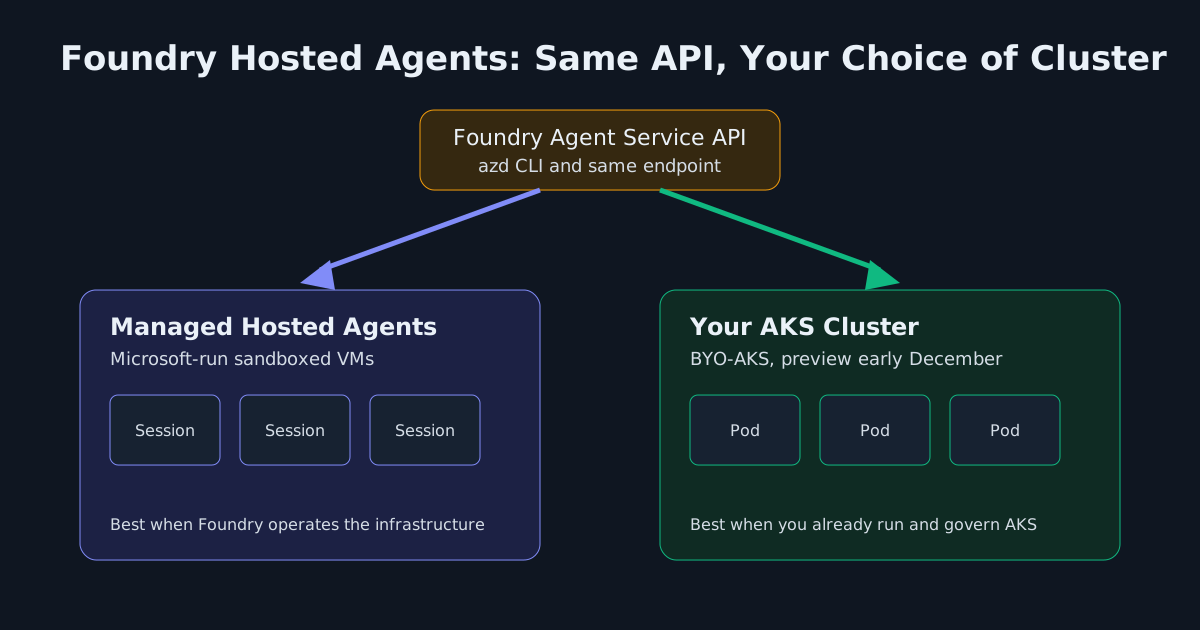
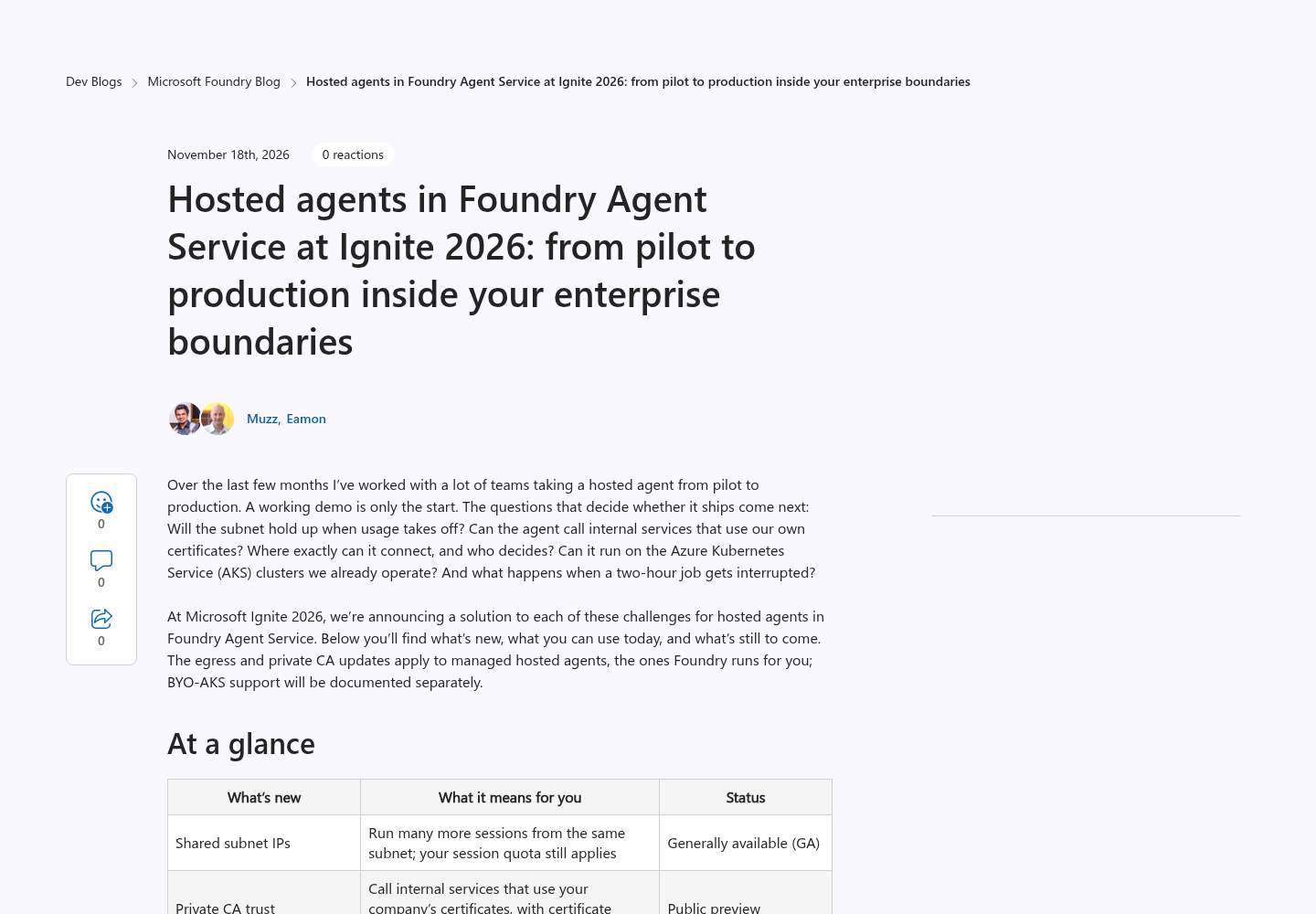
Microsoft used Ignite 2026 to answer a question enterprise platform teams keep asking about Foundry Agent Service: can hosted agents run on the Azure Kubernetes Service (AKS) clusters we already operate, instead of only on Microsoft-managed sandboxed VMs? As of this week, the answer is yes. In a Foundry devblog post, principal product manager Muzz Imam announced a new deployment option, in public preview targeted for early December, that runs Foundry’s agent runtime directly on a customer’s own AKS cluster.
Same API, a different place to run it
The pitch is that nothing changes for the people writing agent code. Developers still build, deploy and call agents through Foundry “the same way you do today, with the same APIs, azd flow and endpoint.” What moves is where the compute actually lives. Each session still runs as its own pod inside a lightweight VM, using AKS pod sandboxing, so sessions stay isolated from one another the same way they do in Microsoft’s managed environment. The difference is that the networking, container registry, policies and GPU or CPU capacity underneath that pod now belong to the customer’s own cluster, not to Microsoft.
Responsibility splits accordingly: Foundry keeps managing the agent lifecycle and its own integration components, while the customer’s platform team operates the AKS cluster, node pools, networking and storage. Microsoft frames the managed option as the default for teams that want Foundry to run the hosting infrastructure, and BYO-AKS as the option for “organizations that already operate AKS as a platform or need agent workloads to run within an infrastructure, network or compliance boundary they manage.”
That framing is echoed in Microsoft’s companion Azure Kubernetes Service announcement from Ignite, which packages the same capability as “AKS AI Manager for Foundry.” It lets teams deploy both open-weight models and Foundry hosted agents onto AKS clusters they already run, while developers keep the same Foundry workflow. OctopusOS, cited in the AKS post, gives a concrete read on why this matters: “our customers — like accounting firms handling sensitive client data — need agents to run where their data and compliance boundaries are… bringing our own AKS lets us extend that same experience into customer-controlled environments without rebuilding our platform,” said founder Ran Tao.
The rest of the pilot-to-production checklist
BYO-AKS is the headline, but Microsoft bundled it with several smaller changes that answer the other questions platform teams hit once a hosted agent leaves demo mode.
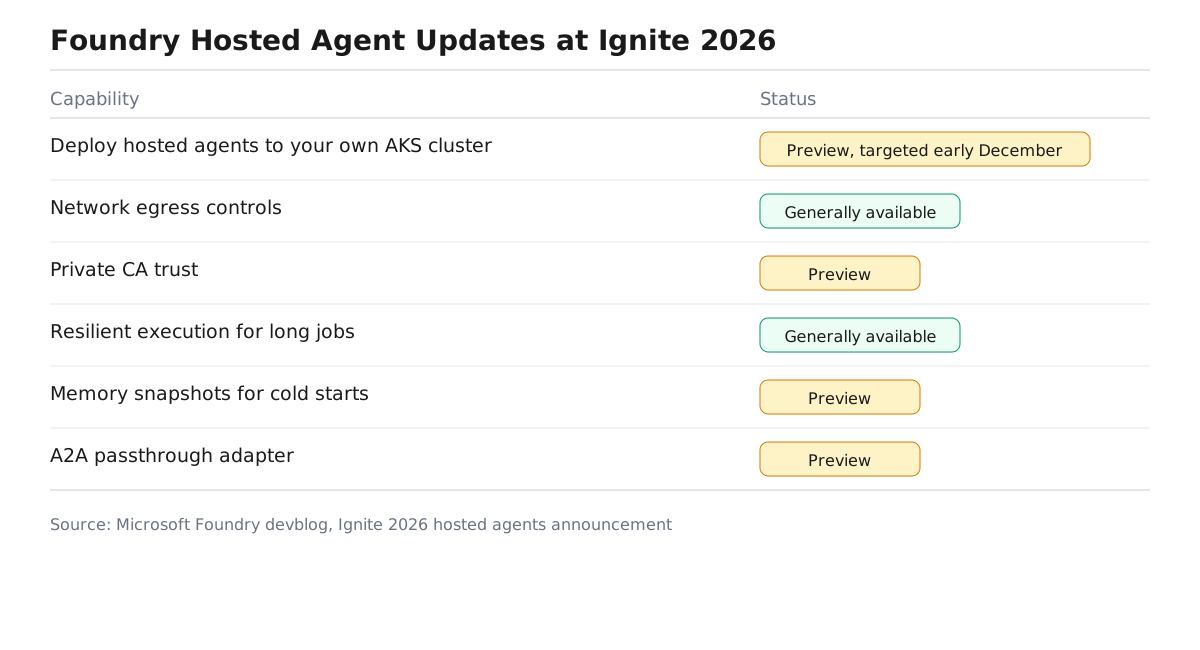
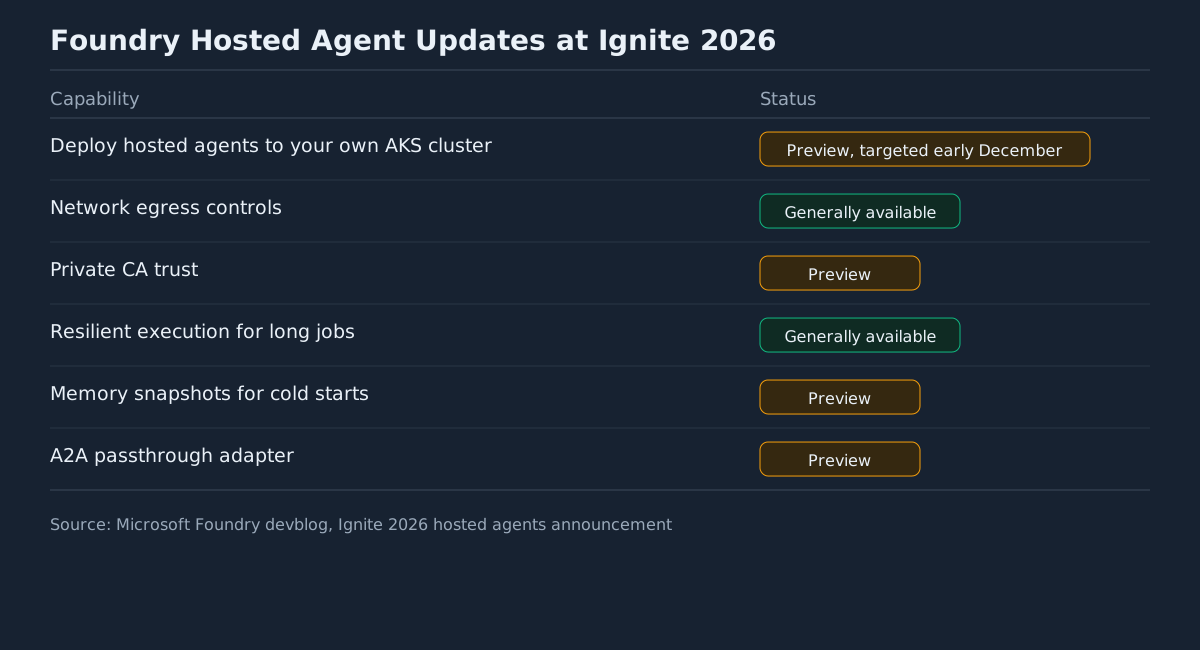
| Capability | What it means | Status |
|---|---|---|
| Deploy hosted agents to your own AKS clusters | Foundry’s agent runtime runs on your AKS cluster through the same APIs, azd flow and endpoint | Public preview, targeted for early December |
| Network egress controls | An ordered allow/deny host list enforced outside the agent’s sandbox, before requests leave | Generally available |
| Private CA trust | Agents can call internal services that use your company’s own certificates, with checks still on | Public preview |
| Resilient execution | Long-running jobs opt in to recover after a crash or redeploy instead of starting over | Generally available |
| Memory snapshots | Foundry captures a ready-to-run agent state so new sessions skip repeated startup work | Public preview |
| A2A passthrough | Host an existing Agent2Agent v1.0 agent on Foundry through a small Python adapter | Public preview |
Egress controls matter because, as Imam put it, “a tool list isn’t a network boundary” — agent code can start a subprocess or follow a redirect that a static allowlist never sees. The new controls are enforced by Foundry outside the agent’s own sandbox, with an audit-then-enforce workflow and an Azure Policy preview that lets admins require compliant egress settings across a subscription. Private CA trust addresses a specific failure mode: internal MCP servers and APIs that use a private certificate authority previously failed TLS checks, tempting teams to disable certificate validation entirely. Now a CA registered once in Azure Key Vault propagates to every project in the resource.
Why this is more than a feature list
For teams already past the demo stage, BYO-AKS changes what “choosing a hosted-agent vendor” means. A bank, accounting firm or any organization with data-residency or compliance requirements no longer has to choose between Foundry’s managed APIs and keeping agent compute inside infrastructure it already audits and pays for — it can have both, without rewriting agents built on Microsoft Agent Framework, GitHub Copilot SDK, LangGraph or other harnesses. That workflow sits alongside Microsoft’s broader push to standardize the developer side of Foundry agents, including the newly GA Foundry Dev Pack, which bundles the azd ai CLI, a VS Code toolkit and a Foundry skill for coding agents into one install.
The caveats are real: BYO-AKS is a public preview “targeted for” early December, not a shipped GA feature, and Microsoft says documentation for it will be published separately from the egress and private-CA updates, which apply only to managed hosted agents. Teams that want in have to sign up for the preview rather than flip a switch today. For platform teams that have spent the past year hearing “we’d use Foundry, but it has to run on our cluster,” though, this is the first concrete timeline for removing that objection.
For related groundwork on testing Foundry agents locally before any of this reaches production, see Automater’s walkthrough of Foundry’s azd-based local testing and inspector tools, and for Foundry’s other Ignite-week infrastructure news, see the GA of Foundry’s Browser Automation tool.
Sources
- Hosted agents in Foundry Agent Service at Ignite 2026: from pilot to production inside your enterprise boundaries | Microsoft Foundry Blog
- Run models and agents on your own Kubernetes clusters: AKS at Microsoft Ignite 2026 | Microsoft Community Hub
- The Foundry Dev Pack is here: build Foundry agents your way | Microsoft Foundry Blog