Bedrock AgentCore Memory Now Keeps 10 Years of Agent History — and a Full Summary of Every Session
AWS extended AgentCore Memory short-term retention from one year to ten and added automatic full session summaries, giving long-running coding and operations agents a durable record of past work. Here is what changes, what it costs, and the governance gaps to close.
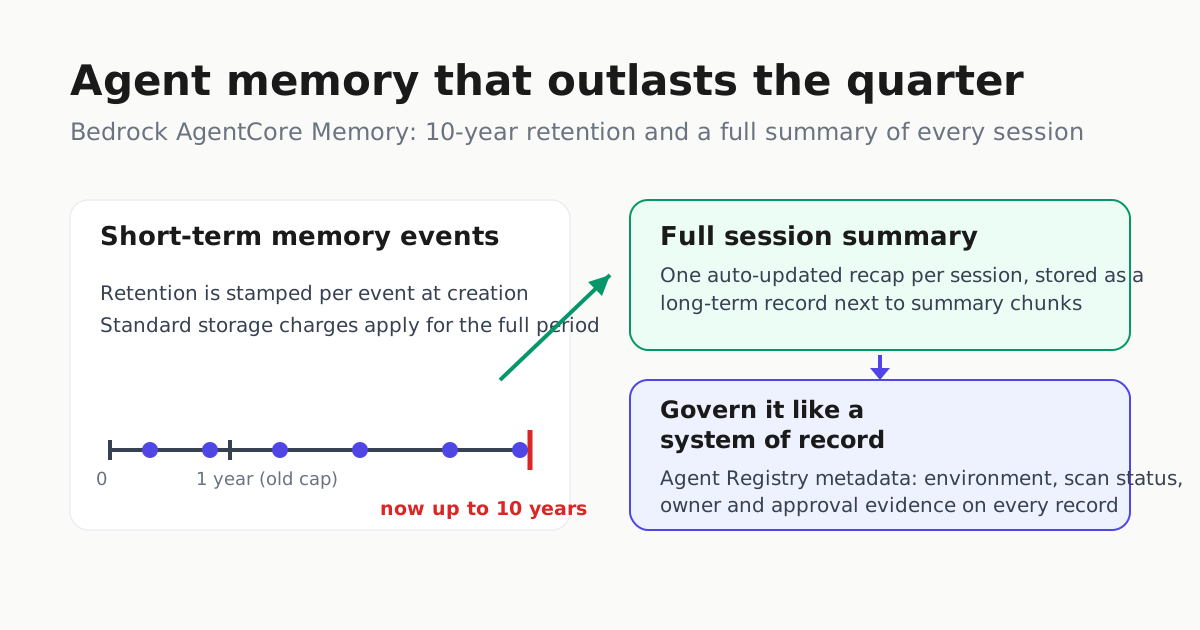
Amazon’s Bedrock AgentCore Memory got two consequential upgrades on the same day: short-term memory events can now be retained for up to ten years instead of one, and every session now gets an automatic full-session summary that reads like a recap rather than a transcript. Together they change what an agent can remember across months of work — and they move memory retention squarely into compliance and cost territory.
Retention goes from one year to ten
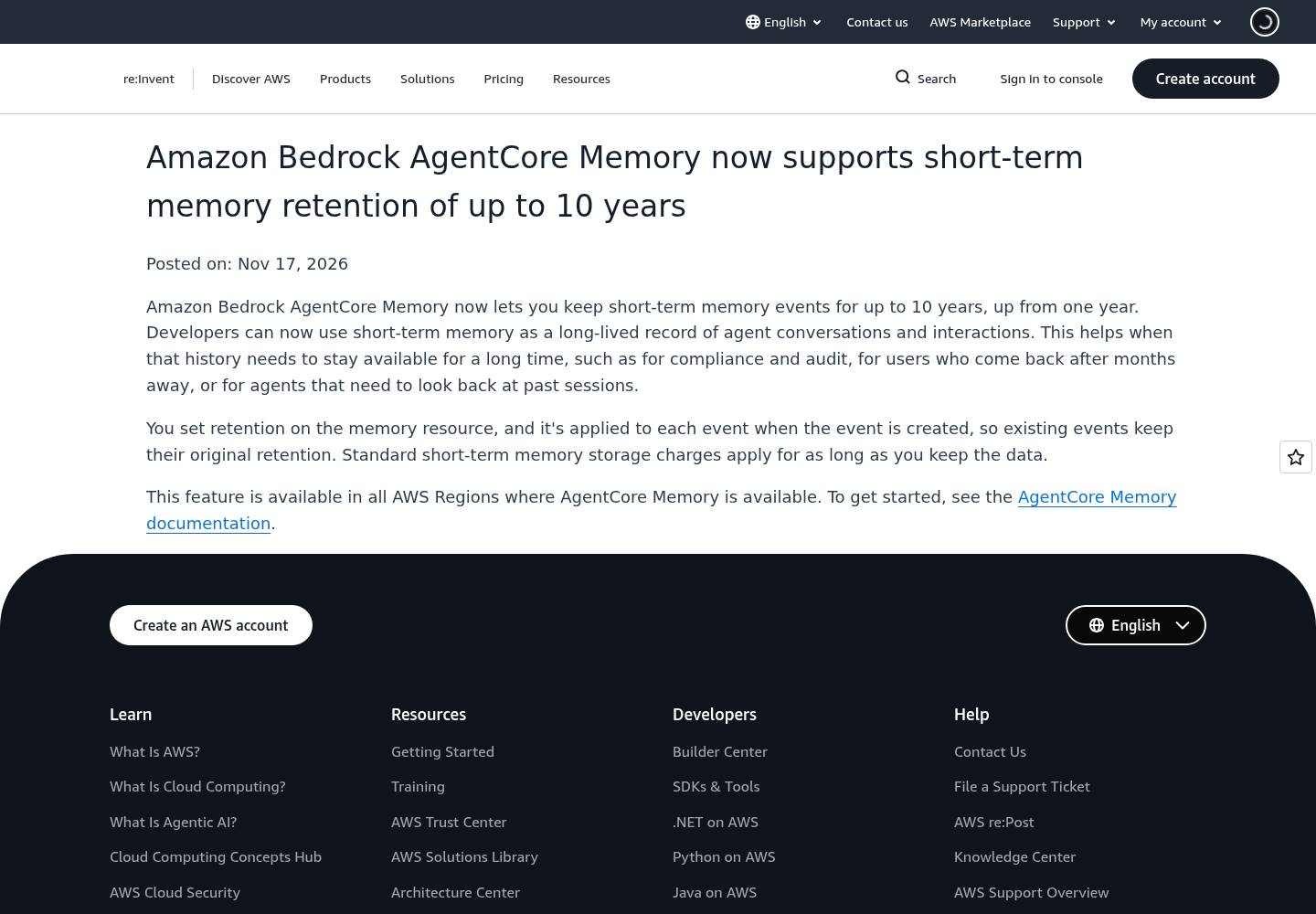
Per the AWS What’s New announcement, AgentCore Memory short-term events can now be kept for up to ten years. AWS positions this for three concrete cases: compliance and audit trails that must stay available for a long time, users who return after months away and expect the agent to remember them, and agents that need to look back at past sessions to continue earlier work.
The semantics matter for anyone already running agents:
- Retention is set on the memory resource and stamped onto each event when the event is created. Existing events keep their original retention — flipping a memory to ten years does not retroactively extend old events.
- Standard short-term memory storage charges apply for as long as you keep the data. A ten-year memory is a ten-year line item, not a free archive.
- The feature is available in all AWS Regions where AgentCore Memory is available.
For teams building long-running coding or operations agents, this is the difference between “the agent remembers last quarter” and “the agent remembers last year.” A triage agent that handled an incident in March can, in November, pull up what it actually did — assuming the events were written with long retention in the first place.
Every session now gets a full summary, automatically
The second AWS What’s New post adds a full session summary for every session: one record capturing where the session stands, distinct from the more granular summary chunks. AgentCore Memory updates the summary as new events arrive, so it always reflects the session so far.
Key details:
- Full session summaries come with the summary strategy and need no extra setup. Every memory that has a summary strategy gets them automatically, including existing sessions.
- Each summary is stored as a long-term memory record next to the session’s summary chunks.
- You retrieve it with the Memory operations you already use, and can filter by record type to return only full session summaries.
Practically, this gives developers a cheap “what happened” recap without replaying a full event stream — useful for handoffs, for an agent resuming yesterday’s session, and for humans auditing what an agent did before trusting its next move.
What this means for coding-agent operators
Memory longevity is a double-edged upgrade. Longer retention and automatic summaries make agents genuinely more useful over time, but they also expand the data you are obligated to govern:
| Question | Why it matters now |
|---|---|
| Which events carry long retention? | Retention is per-event at creation. Audit your writes before assuming old sessions are covered. |
| What does ten years of storage cost? | Standard short-term storage charges apply indefinitely. Model the bill at scale before enabling it fleet-wide. |
| Who can read a decade of agent history? | Memory now holds long-lived records of conversations and actions — scope read access accordingly. |
| Are summaries accurate enough to act on? | A recap is a compression. Verify it against events before letting an agent resume unattended work from a summary alone. |
This aligns with a pattern we have tracked all year: agent memory is becoming a managed, auditable system of record rather than a prompt-engineering trick. Bedrock itself added memory to managed knowledge bases earlier, and research like WikiTrace shows why linking memories to their evidence matters as recall horizons stretch. LangChain’s memory and check-in playbook makes the same point from the UX side: agents earn autonomy by demonstrating reliable recall, and reliability requires provenance.
Governance rides along: Agent Registry custom metadata
The same day, AWS published a technical walkthrough of custom metadata schemas in AWS Agent Registry. An administrator defines a schema — field names, types, allowed values, required or optional — and every record in the registry must validate against it. Records created without required metadata are saved as NON_COMPLIANT and cannot be submitted for approval; invalid values are rejected outright. Approval automation can then key off structured facts like environment=prod, securityScanStatus=PASSED, or a CMDB ID, and consumers and agents can filter discovery searches on the same fields through the registry’s MCP endpoint.
That matters more the moment memory lives for ten years. The agents whose histories you are now preserving are exactly the agents you want registered, classified, and approvable on structured evidence — not discovered by word of mouth. If you extend memory retention, extend registry discipline in the same change window, and treat agent session cleanup and retention settings as a standing audit item rather than a one-time configuration.
Bottom line
Ten-year retention plus automatic full session summaries make AgentCore Memory a plausible long-term store for agent work history — the closest managed equivalent of an operator’s logbook. The capability is live in all AgentCore Memory regions with no extra setup for summaries, but retention is per-event, storage is billed for the full period, and a decade of agent memory is a governance surface, not just a feature. Set retention deliberately at event creation, budget the storage line, and pair the change with registry metadata so the agents you remember are also the agents you can audit.