Perplexity Opens the Orchestrator API: One Multi-Model Endpoint With Automatic Provider Routing
Perplexity's Orchestrator API puts open-weight and proprietary models behind one endpoint with automatic provider routing and unified billing. What agent builders can do with it.
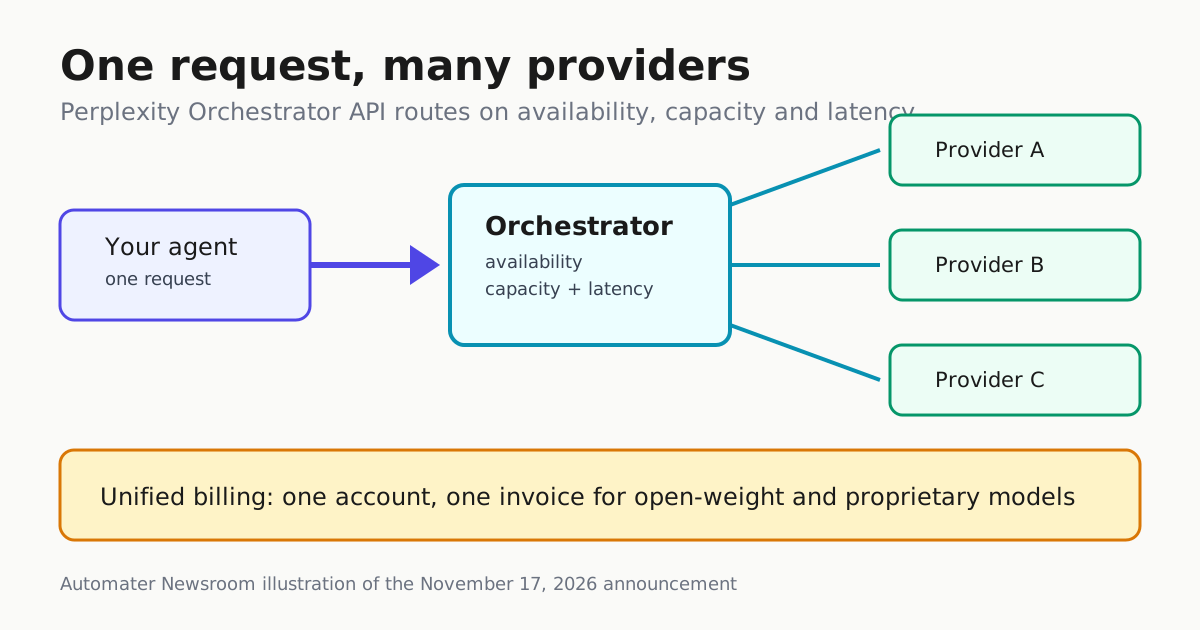
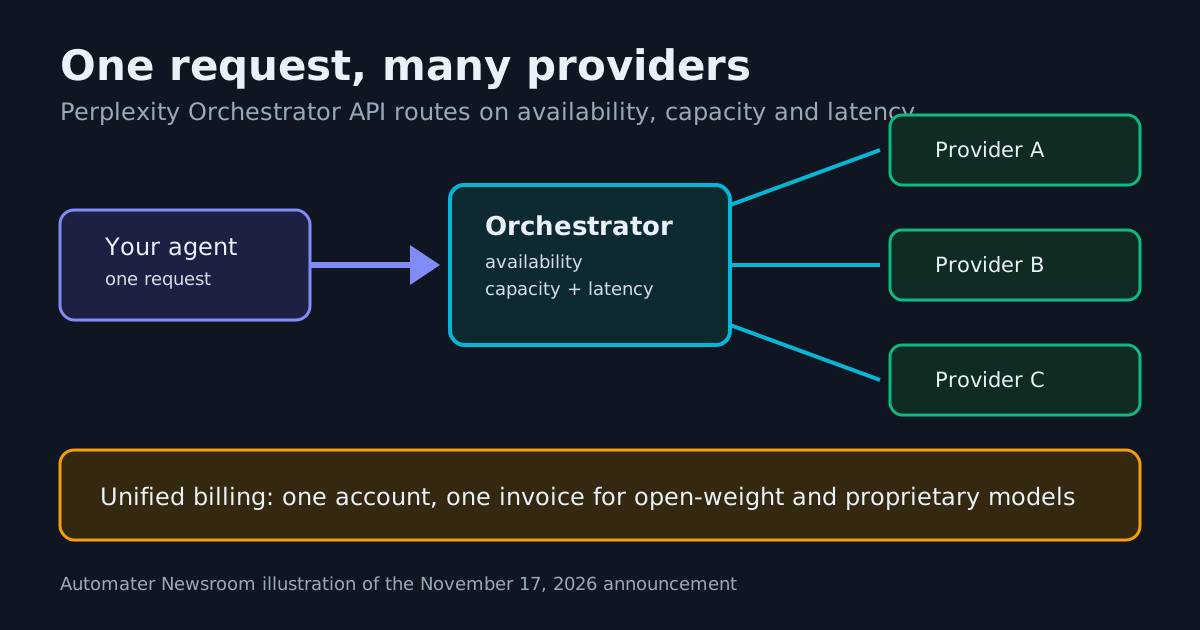
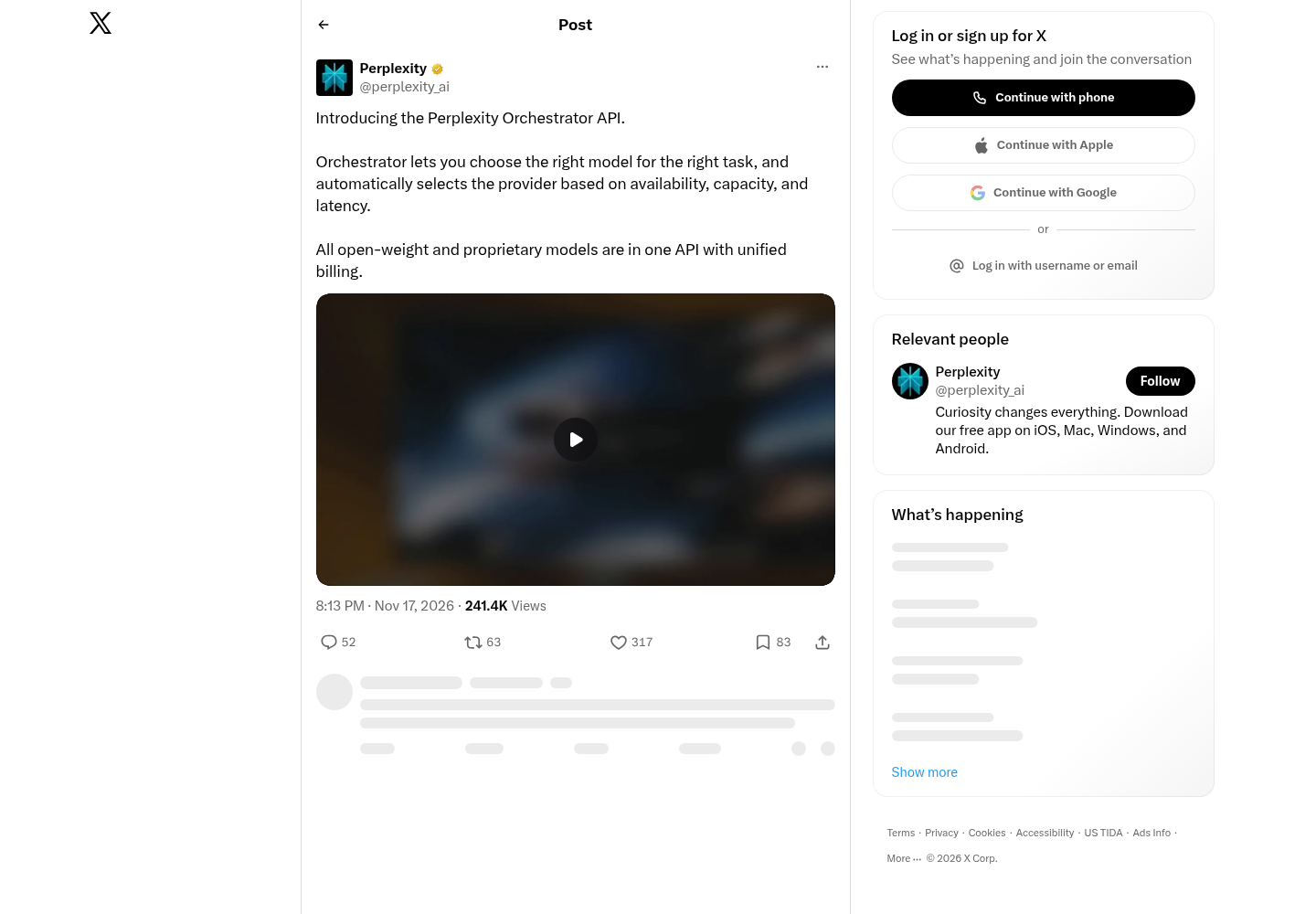
Perplexity has opened up the model layer behind its own products as a public API. In an announcement posted on X on November 17, 2026, the company introduced the Perplexity Orchestrator API, promising one API that serves both open-weight and proprietary models with unified billing, and that “automatically selects the provider based on availability, capacity, and latency” when you make a call.
For teams building coding agents and other agentic software, this is the interesting part: a multi-model endpoint with failover semantics baked in, from a company that already runs a large multi-provider inference fleet for its search and assistant products.
What Perplexity actually announced
The announcement makes three concrete claims:
- One API, many models. All open-weight and proprietary models are available through a single endpoint with unified billing — one account and one invoice instead of a provider per lab.
- Model selection per task. Orchestrator “lets you choose the right model for the right task,” so a harness can pin a cheap fast model for lint loops and a frontier model for planning.
- Automatic provider selection. When a model is served by more than one provider, Orchestrator picks the provider based on availability, capacity and latency — routing logic that Perplexity presumably already runs internally for its own products.
That is the full extent of the verified public detail at announcement time. Perplexity’s own documentation pages had not been independently fetched and verified for this article, so model counts, per-model pricing, rate limits, spend caps and allowlist controls should be confirmed on Perplexity’s developer documentation before you commit a fleet to it. Treat those specifics as unverified until you read them on the primary docs.
Why this pattern keeps winning
Orchestrator lands in a category that has consolidated fast in 2026. Hugging Face now routes Inference Providers requests through OpenRouter, as TLDR’s November 17 issue reports: the router picks the best provider for each call and a single HF token covers any served open-weight model. Vercel’s AI Gateway offers virtual models with one stable ID per task. The common bet is the same: the harness should not care which lab or which provider actually served the token.
For agent operators, the economics argument is real. Simon Willison’s analysis of GPT-6.2 pricing notes that Astra 6.2 costs $8 per million input tokens and $40 per million output tokens — 80% of its predecessor — and that cached input at $0.40 per million is “great news for longer running agentic sessions.” When your overnight agent loop re-sends a large prefix thousands of times, which endpoint you route through and what it charges for cache hits can matter more than the headline model price.
What you can do with it
If you run coding agents, the practical moves look like this:
- Try it as a failover lane. Because provider selection is automatic on availability and capacity, Orchestrator is a candidate second lane for harnesses that currently hard-depend on one lab’s API. Our provider-cutoff continuity drill applies unchanged: route a shadow percentage of traffic, compare latency and answer quality, and keep the rollback switch.
- Consolidate billing, not keys. Unified billing means one meter to reconcile. The operational discipline still applies: your client-side estimate, the orchestrator meter and the eventual invoice must agree before you charge anything back.
- Keep the model pin in your config. “Choose the right model for the right task” only helps if your harness states the task. Keep explicit model-per-lane assignments rather than trusting any router — including this one — to guess.
- Verify what actually served a request. Automatic provider selection means the serving provider can vary call to call. Log the served-model and provider identifiers in the response, because debugging a bad lane requires knowing which provider answered.
The caveats worth writing down
Routing decisions you cannot inspect are a known operator risk: when the router picks the provider, you inherit its latency and capacity judgments without the telemetry unless the API returns them. The same applies to data handling — before pointing agents with real code at any new gateway, confirm its retention policy and whether open-weight and proprietary routes differ.
There is also competitive context: Perplexity is simultaneously investing elsewhere, including the Frontier Research initiative disclosed the same day in TLDR’s coverage. An orchestrator endpoint is infrastructure, and infrastructure earns trust through uptime and invoice accuracy, not launch posts.
Bottom line
The Orchestrator API is a credible new entry in the multi-model gateway field, with one genuine differentiator at announcement: provider selection that weighs availability, capacity and latency automatically, from an operator that runs this machinery at scale for its own products. For agent builders, the right response is the boring one — put it in the failover rotation, meter it, and verify the pricing and control details on the primary documentation before it carries production traffic.
Sources
- Perplexity on X: "Introducing the Perplexity Orchestrator API. Orchestrator lets you choose the right model for the right task, and automatically selects the provider based on availability, capacity, and latency. All open-weight and proprietary models are in one API with unified billing." / X
- Perplexity Research, NVIDIA Rubin HPC, OpenAI safety assessments | TLDR AI
- GPT‑6.2 Astra and GPT‑6.2 Sol