Sourcegraph's 2026 Big Code Report: AI Writes the Code, Understanding It Is the Bottleneck
Sourcegraph's 2026 Big Code report: 79% of engineering teams face AI ROI pressure, 54% report major rework, and understanding code is the real bottleneck.
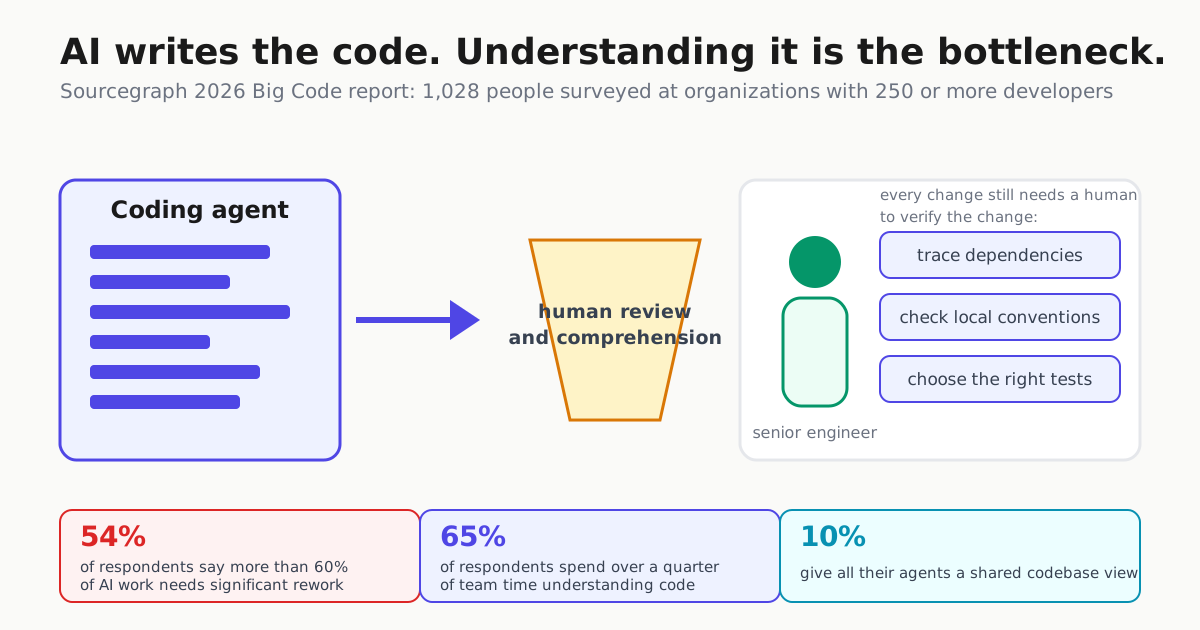
Sourcegraph’s 2026 Big Code report, published November 16, reframes the agent-coding debate in one line: AI writes the code, and engineers still have to understand it. The survey, fielded by Dimensional Research in September 2026, asked 1,028 people responsible for software development at organizations with more than 250 developers how their teams understand, review and change large codebases as AI writes more of the code.
The ROI pressure meets a rework reality
Among respondents at AI-using organizations, 79% report moderate, considerable or intense pressure to demonstrate a return on their AI investment. At the same time, 54% estimate that more than 60% of AI-generated engineering work needs significant human rework before release. Read together, those numbers describe the trap many teams are in: the investment is under scrutiny precisely because the output still consumes so much senior engineering time after the agent finishes.
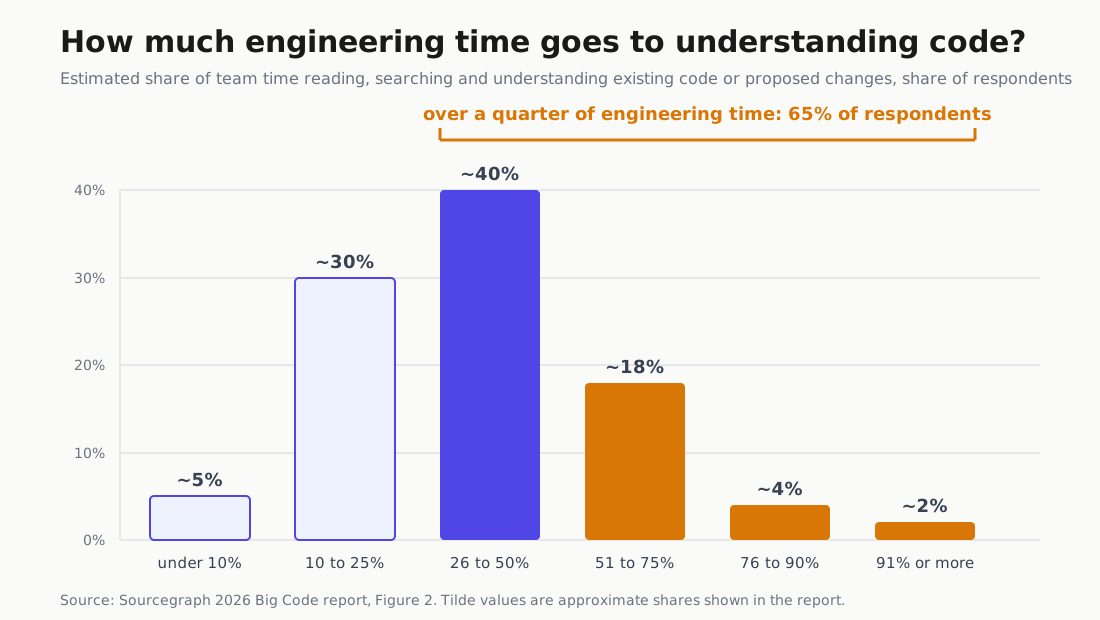
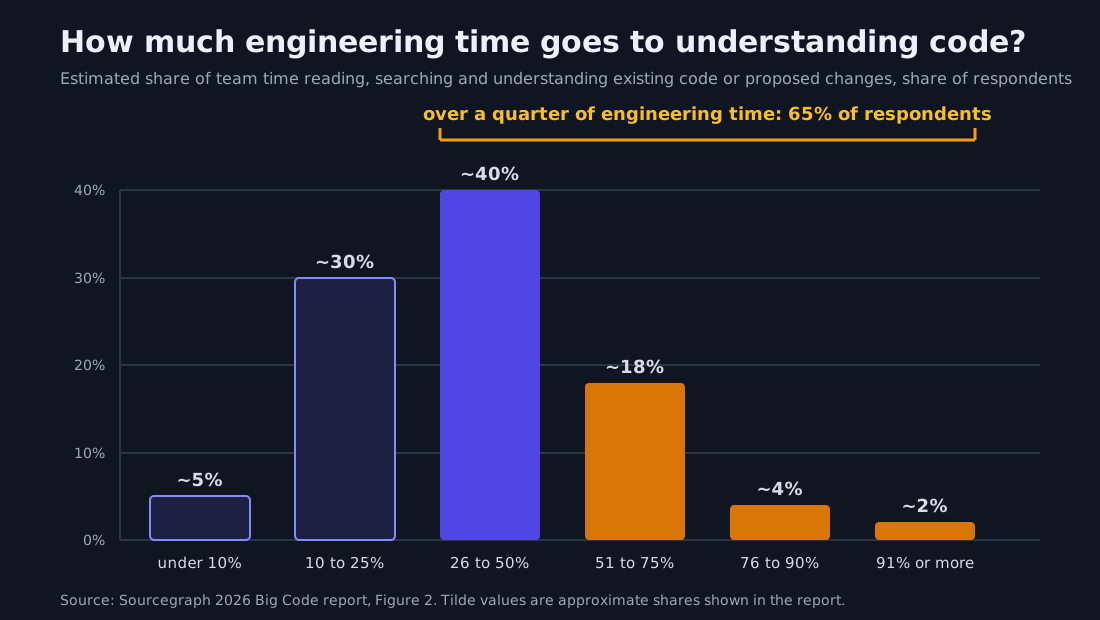
Understanding code is where that time goes. 65% of respondents estimate that reading, searching and understanding existing code or proposed changes takes more than a quarter of their team’s engineering time; for 25%, it takes more than half. Sourcegraph’s own scale math makes the point: a 1,000-developer organization spending a quarter of its time understanding code is committing the equivalent of 250 full-time developers to that work. And 41% say engineers regularly or frequently recreate functionality that already exists simply because they cannot find it.
Why coding agents amplify the bottleneck
An agent can produce a change in minutes. Reviewing it can take a senior engineer hours: tracing dependencies across repositories, checking local conventions and figuring out which tests would catch a regression. As more AI-generated patches arrive, review becomes the queue everything waits on.
The survey data backs that up:
- 51% of respondents report at least 1,000 repositories in their environment, so a question that starts in one repository rarely stays there.
- Asked how long it would take to find and fix every instance affected by a critical dependency vulnerability, 54% estimate days or longer, or say they could not complete it at all.
- The top challenges for large-scale changes are understanding dependencies and impact (43%), making changes consistently across repositories (42%), and testing and validation (42%).
There is also a context gap between agents themselves. Only 10% of respondents say all their agents share a common view of the codebase, dependencies and history, and 33% say developers must explain extensive background on architecture, dependencies, conventions or history before a tool or agent can work effectively on a new task.
What operators should do with these findings
Instrument review, not just generation. If 54% of respondents estimate that more than 60% of AI-generated work needs significant human rework, the metrics that matter are review latency, rework rate and post-release defects from agent-authored changes, not tokens generated. Sourcegraph’s post cites DORA’s 2025 finding that heavier-AI organizations ship faster and report better product performance but deliver less stable software: speed and instability move together, and only review-level instrumentation shows which side is winning.
Give agents shared, permissioned context. The report points to Sourcegraph’s MCP server, which lets compatible agents such as Claude Code, Codex and Cursor search the organization’s indexed code as questions arise during a task, with repository permissions applied. Open-source alternatives are emerging in the same layer; ClickHouse’s Loom, for example, gives Claude Code, Codex and Cursor shared memory tied to a live code index. That matters if you want agent context that is not a single vendor’s lock-in.
Make cross-repo changes reviewable as one unit. For dependency upgrades and migrations, the report highlights Sourcegraph’s Agentic Batch Changes for coordinating work across hundreds or thousands of repositories with a shared view of progress. Whether or not you adopt that product, the operational requirement is the same: a reviewer needs a single place to see which repositories were touched, which still need fixes and which tests cover the differences.
Build triage for agent sessions now. 77% of respondents expect AI-authored changes to merge with less human review in the future, which makes today’s human review the training signal for deciding which changes can eventually merge with less of it. Tooling is already moving this way: GitHub’s Copilot weekly release notes for VS Code 1.146 describe an experimental Inbox mode that tracks agent sessions across workspaces and surfaces the sessions that need your attention first: queue triage for the review bottleneck, built into the harness. GitHub’s Octoverse 2026 coverage points the same direction: more than 40% of pull requests now start with a coding agent, and review is the constraint.
Why Sourcegraph is making this argument now
It is worth reading the report alongside Sourcegraph’s other announcement this month: Cody, its RAG-era coding assistant, reaches end of life on January 31, 2027, as the company refocuses on code search, agentic search, MCP integrations and Agentic Batch Changes. The Big Code report is, in part, the evidence for that pivot: a pitch for retrieval infrastructure as the layer agents need. The survey findings stand on their own data regardless: the rework rates, time-to-understand figures and context gaps came from 1,028 practitioners, not from a product roadmap.
The practical takeaway for teams running Claude Code, Codex, Copilot or Cursor fleets is straightforward. Generation already scales. The scarce resource is the senior engineer who can look at an agent’s diff and know whether it is right, and the teams that instrument, feed and organize that judgment will be the ones that actually bank the ROI the 79% are being asked to show.