External Sandboxes Let Coding Agents Run Risky Code Outside the Machine
External sandboxes run risky agent code outside the machine. What Nov. 17 guides say about egress limits, secret isolation, and full-repo context for teams.
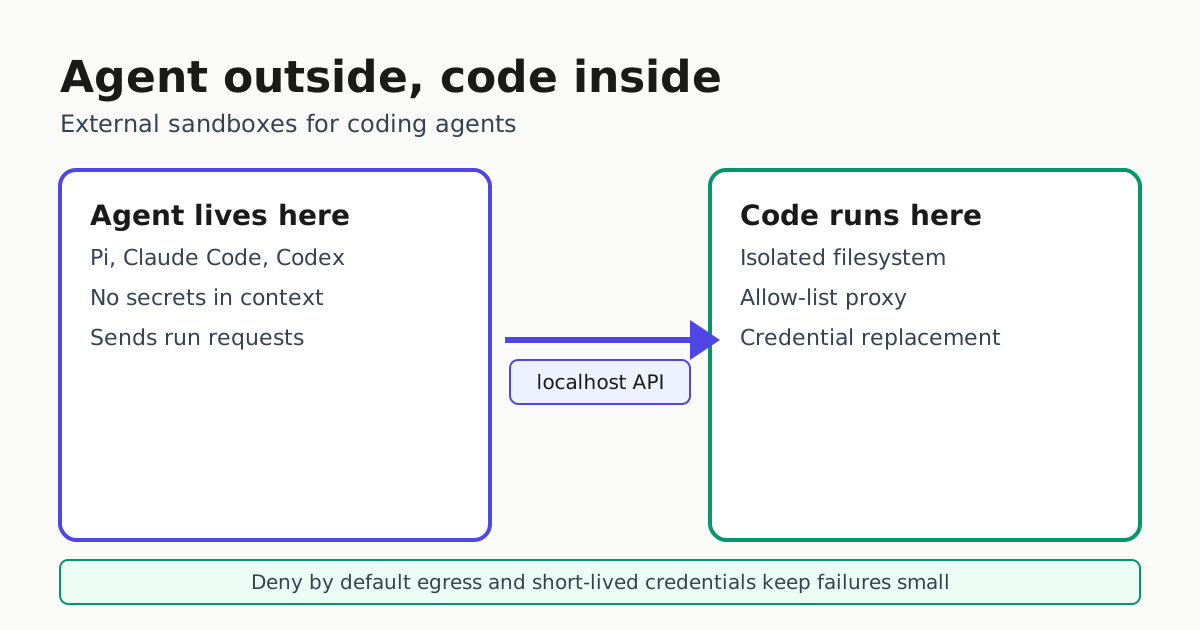
Running code is what makes a coding agent useful, and what makes it risky. When an agent can write and execute programs, it can analyze data, fix tests, and automate chores. The same loop can be steered by prompt injection into reading private data and sending it elsewhere.
Two Nov. 17 reports, alongside LangChain’s Oct. 1 guide, clarify a practical fix. Simon Willison described an external-sandbox pattern built with Prime Radiant, with three runnable servers that execute agent code outside the agent machine. Sourcegraph explained why monorepo agents need server-side search when the local checkout is only a slice. With LangChain’s sandbox selection guide, published Oct. 1, they give operators a posture: isolate execution, gate network and secrets, and supply precise context.
For background, see Automater’s securing AI agents guide and Docker Sandboxes setup for Claude Code.
External execution with guardrails
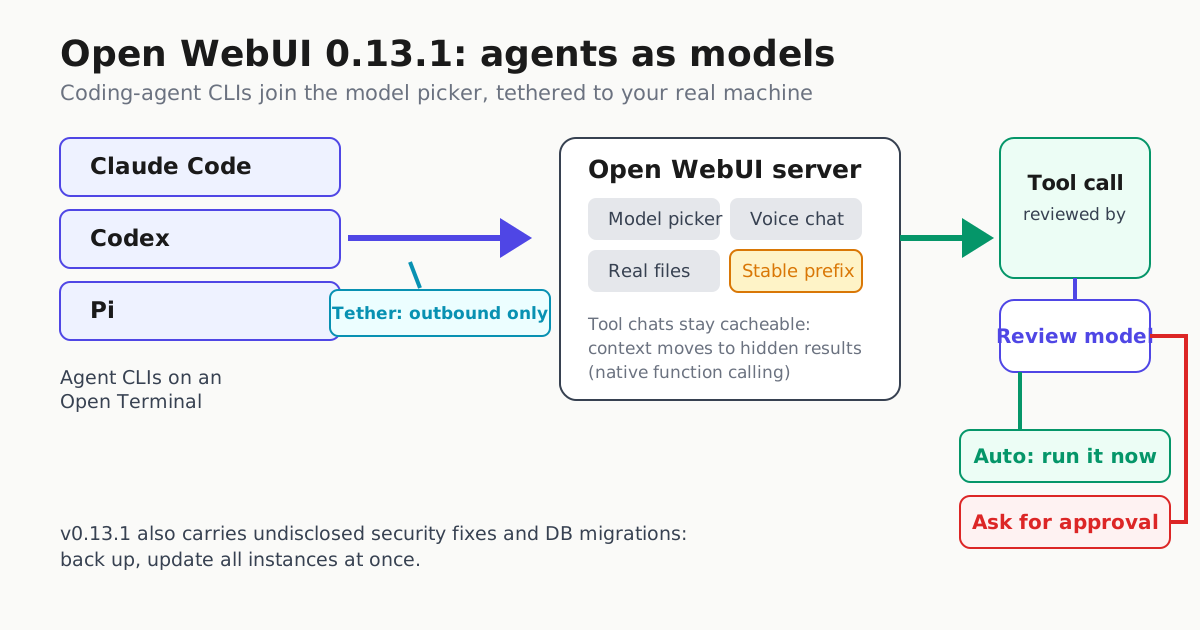
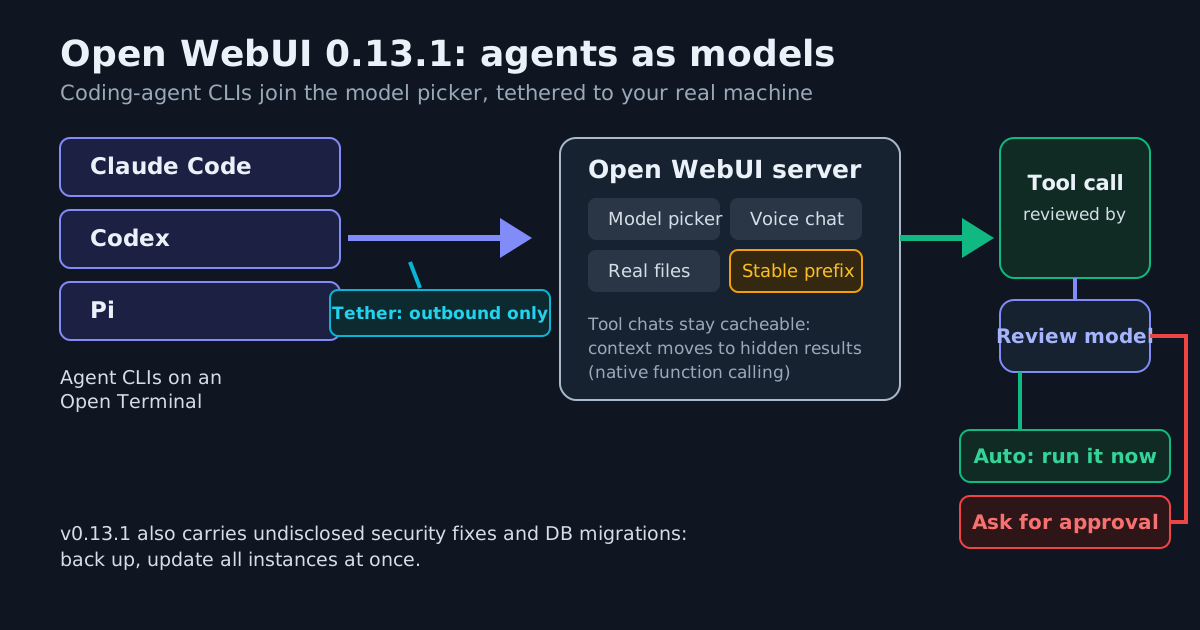
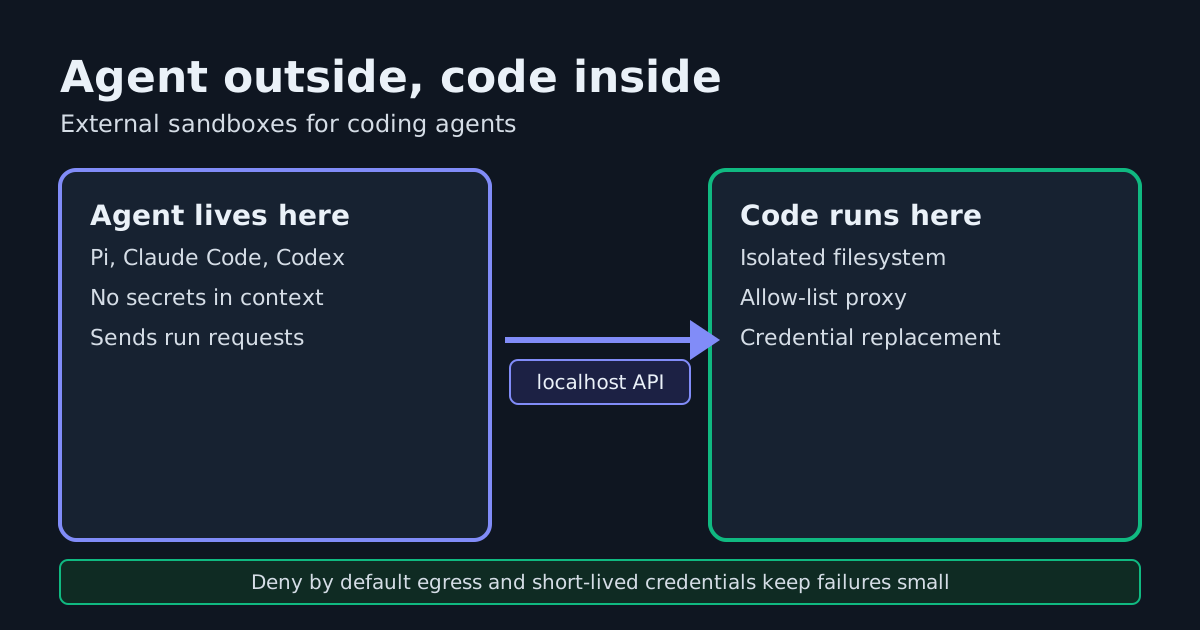
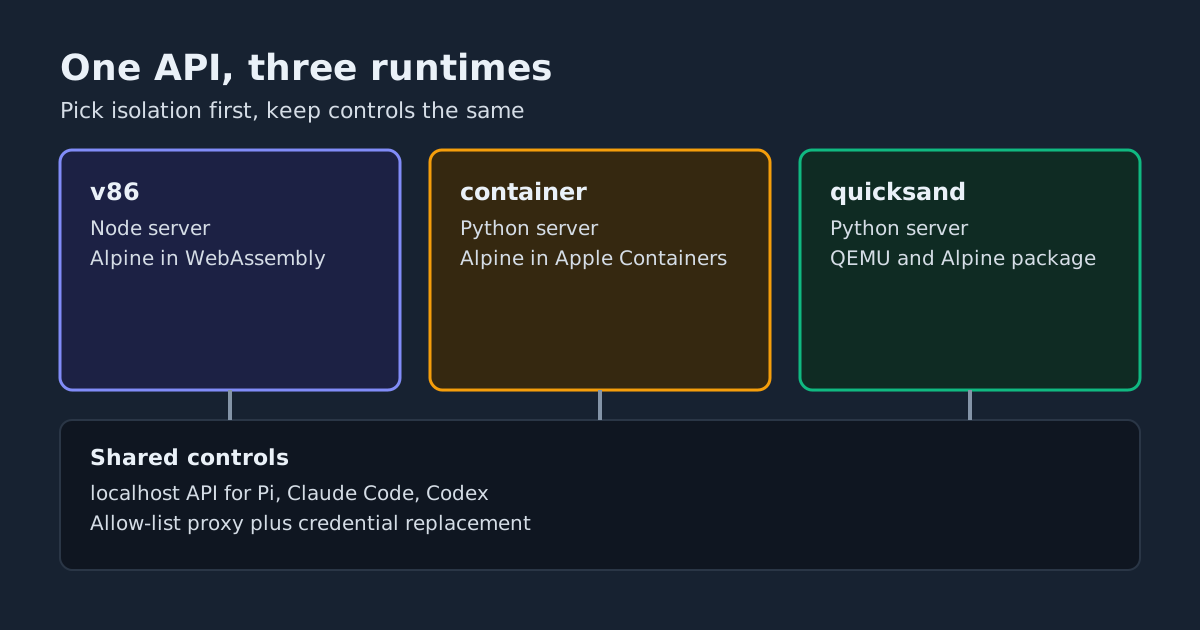
Willison frames the work as safer experimentation with local models: try models without letting a mistake or prompt-injection attack damage the main machine. The agent lives outside the sandbox. Code it wants to run is sent to a dedicated sandbox through the same localhost API in all three implementations. Operators can configure Pi, Claude Code, or Codex to use that API for execution.
The key controls are an optional HTTP and HTTPS allow-list proxy limiting which hosts agent code can contact, and credential replacement for authenticated calls without sharing secrets with the agent. The proxy can be reconfigured while the sandbox keeps running.
What to demand from a sandbox
LangChain’s guide, published Oct. 1, starts from the same threat. It cites Willison’s lethal trifecta — access to sensitive data, exposure to untrusted content, and ability to communicate externally — and Meta’s Agents Rule of Two. An email assistant reading unknown senders, accessing a private inbox, and sending replies is the canonical case where all three hold.
Sandboxes do not remove that risk. They shrink data access and external communication until prompt-injection risk becomes manageable. The guide lists five properties:
- Isolated filesystem with only the data the job needs
- Limited network access with explicit per-endpoint egress
- Resource limits on compute, memory, and lifetime
- Controlled reusability across runs
- Kernel-level isolation, ideally with microVMs on a separate kernel
It warns some products called sandboxes lack these properties, citing the open-source Kubernetes Agent Sandbox as secure only with kernel isolation most clusters do not enforce. It also contrasts agent in the sandbox with sandbox as a tool. The tool pattern keeps agent logic updatable, keys outside the sandbox, and state separate from execution, at the cost of network latency.
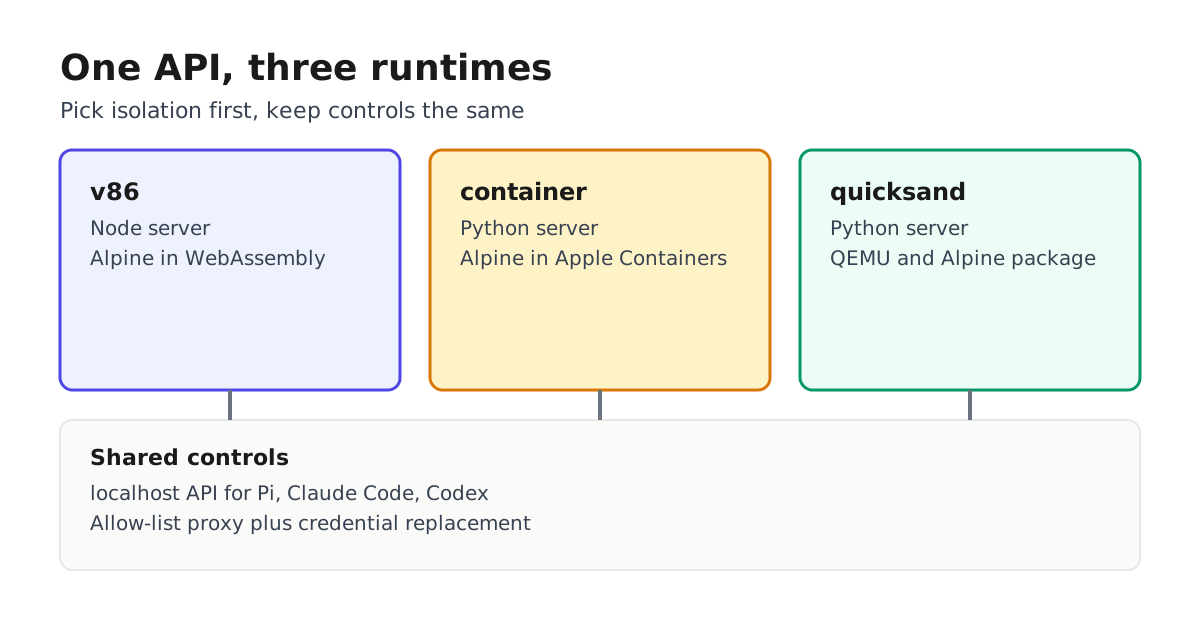
Three servers, one API
The new contribution is runnable code in the sandbox-as-tool shape:
| Implementation | Server | Execution inside |
|---|---|---|
| external-sandbox-v86 | Node.js | Alpine Linux in WebAssembly via v86 |
| external-sandbox-container | Python | Alpine Linux in Apple Containers |
| external-sandbox-quicksand | Python | Alpine Linux via Microsoft Quicksand with QEMU |
All three expose the same localhost API. Operators can swap isolation without changing how Pi, Claude Code, or Codex calls execution. Start with the container or Quicksand variant where native container or QEMU support is simplest, and keep v86 for portable WebAssembly trials.
Treat the allow-list as mandatory. List only the registry, model API, and Git hosts the task needs, then review blocked requests before widening:
registry.npmjs.org
api.anthropic.com
github.com
Do not paste long-lived tokens into agent context or sandbox environments. Prefer short-lived credentials injected after traffic leaves the sandbox, so a compromised run yields at most a scoped token.
Monorepo agents still need full context
Sourcegraph’s analysis covers the other half: agents often work half-blind. Grep, IDE find-references, and git status see only the laptop disk. Canva’s example of about half a million files where plain git status took about 10 seconds shows why teams use sparse checkouts. Each developer and agent then sees only a slice.
The post argues for a server-side index of the whole repository, on any branch, without a checkout. Precise navigation separates definitions from references and text matches. For agents, the Sourcegraph MCP server and Code Finder provide full-repo search, go-to-definition, and find-references with smaller and more precise results than raw text search, even with a partial checkout.
The pattern is therefore split: run untrusted code in an external sandbox with deny-by-default egress, but supply trusted context from a full-repo index rather than a wider checkout. Batch changes split by ownership extend the same idea from reading code to changing it safely.
Operator checklist
- Map the trifecta for your busiest agent: private data, untrusted inputs, and write or network reach.
- Apply the five sandbox checks before trusting any sandbox label.
- Pilot one external sandbox for local-model or untrusted-repo work, with the allow-list and credential replacement enabled.
- For monorepos, add precise server-side search instead of cloning more.
- Log tool calls, first-seen egress domains, sensitive-path reads, and token spikes.
Sandboxes do not solve prompt injection. No reliable prevention exists today. The verifiable gain is narrower: external API-driven execution with allow-listed egress and secret isolation makes failure cheaper, while full-repo search keeps the agent accurate without widening its filesystem.