OpenAI's Astra for Law 6.2 Tops Harvey LAB-AA, and Every ChatGPT Enterprise Customer Can Now Request It
OpenAI's updated legal model configuration leads Artificial Analysis's LAB-AA at 20.8% full credit with 0.03 material hallucinations per assignment, and access moves from a small firm pilot to a request program for all ChatGPT Enterprise customers.
OpenAI published an updated Astra for Law on November 17, 2026, and the two changes that matter to legal teams are a claimed first-place result on Harvey’s Legal Agent Benchmark as run by Artificial Analysis (LAB-AA) and a much wider door: every ChatGPT Enterprise customer can now request access through the Trusted Access Program, including API access. When Astra for Law first appeared in September, it went to a small group of firms — Cooley, Ropes & Gray, and Sullivan & Cromwell. Today’s update converts a pilot into an enterprise program.
What Astra for Law actually is
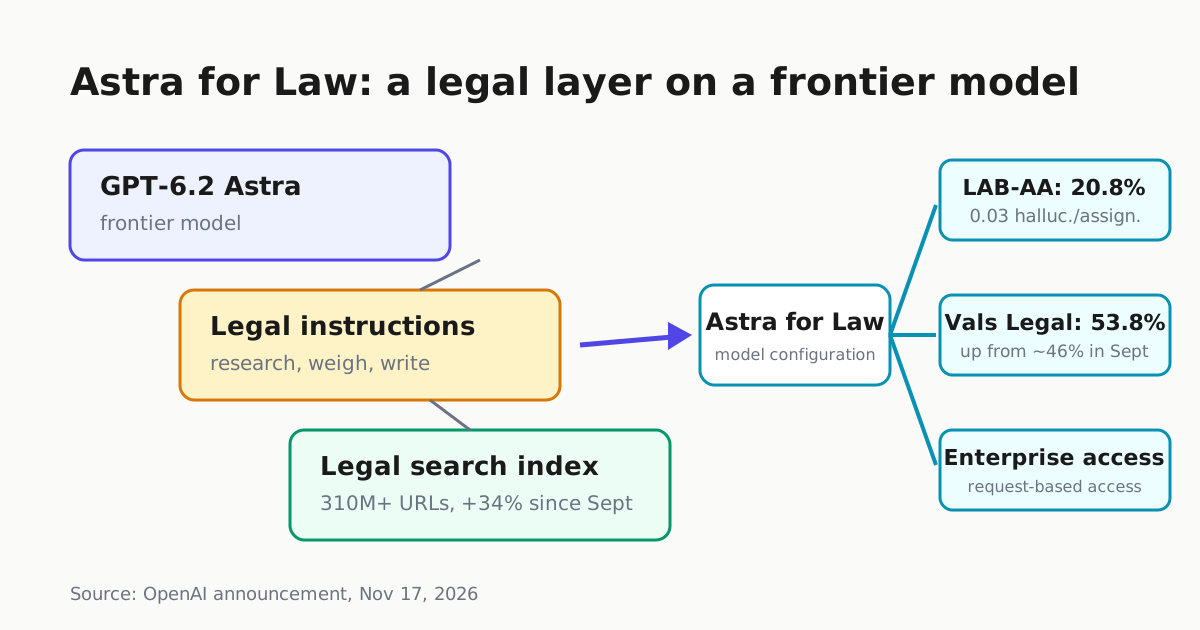
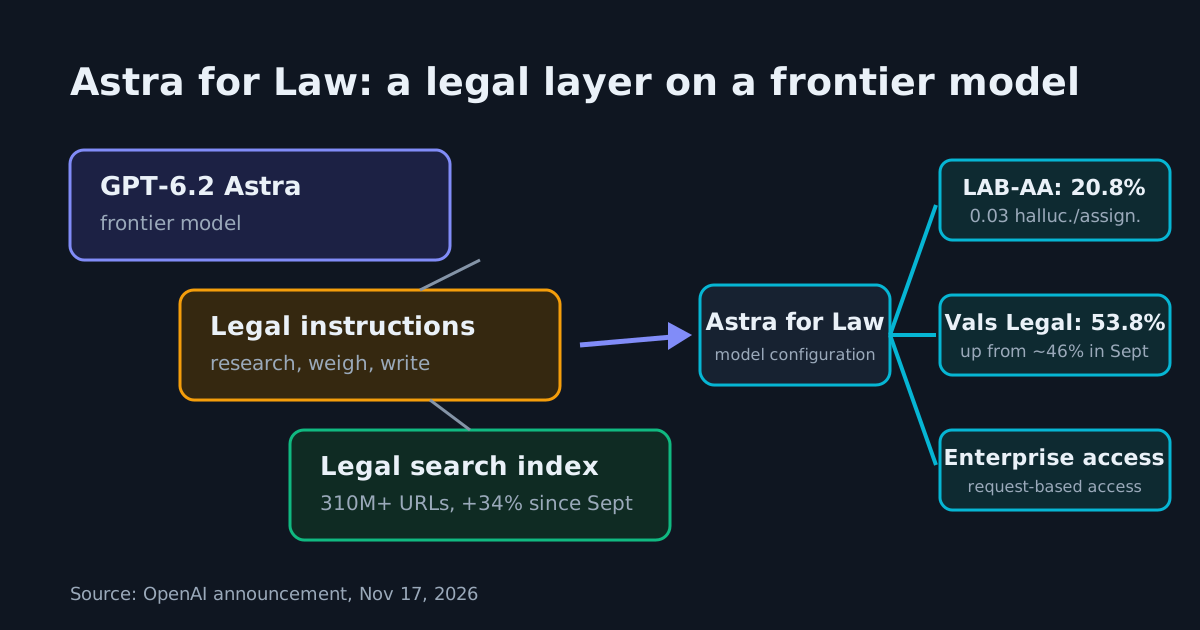
Astra for Law is not a new model. It is a model configuration of GPT-6.2 Astra — OpenAI’s latest frontier model, launched the same day alongside GPT-6.2 Sol — paired with an expanded legal search index and instructions for researching a question, weighing the authorities, and writing the answer. OpenAI says the legal search index has grown 34% since September, adding more than 80 million URLs across the UK, Australia and Canada, and now spans over 310 million URLs covering more than 99.9% of published U.S. precedential case law.
The configuration framing matters operationally. Because the legal layer sits on top of a frontier model rather than being frozen into one, OpenAI says it can keep rebuilding Astra for Law on each new frontier release and refine its instructions in response to practitioner feedback. The flip side: buyers are evaluating a moving target that changes whenever the underlying model does.
The LAB-AA result, and its limits
LAB-AA is Artificial Analysis’s version of Harvey’s Legal Agent Benchmark: 120 assignments developed by Harvey across 24 areas of law, from drafting deposition outlines to reviewing commercial leases. Full credit requires meeting every requirement without a material hallucination.
On that test, per OpenAI’s announcement, Astra for Law earned full credit on 20.8% of assignments, ahead of plain GPT-6.2 Astra at 15.0% and Muse Wonder Full at 13.1%. OpenAI says the configuration earned full credit nearly 40% more often than the runner-up GPT-6.2 Astra.
| Configuration | Full credit (LAB-AA) | Avg. output tokens per assignment | Material hallucinations per assignment |
|---|---|---|---|
| Astra for Law | 20.8% | ~64,000 | 0.03 |
| GPT-6.2 Astra | 15.0% | — | 0.06 |
| Muse Wonder Full | 13.1% | ~139,000 | — |
| Claude Opus 5.5 (next-best non-OpenAI on hallucinations) | — | — | 0.59 |
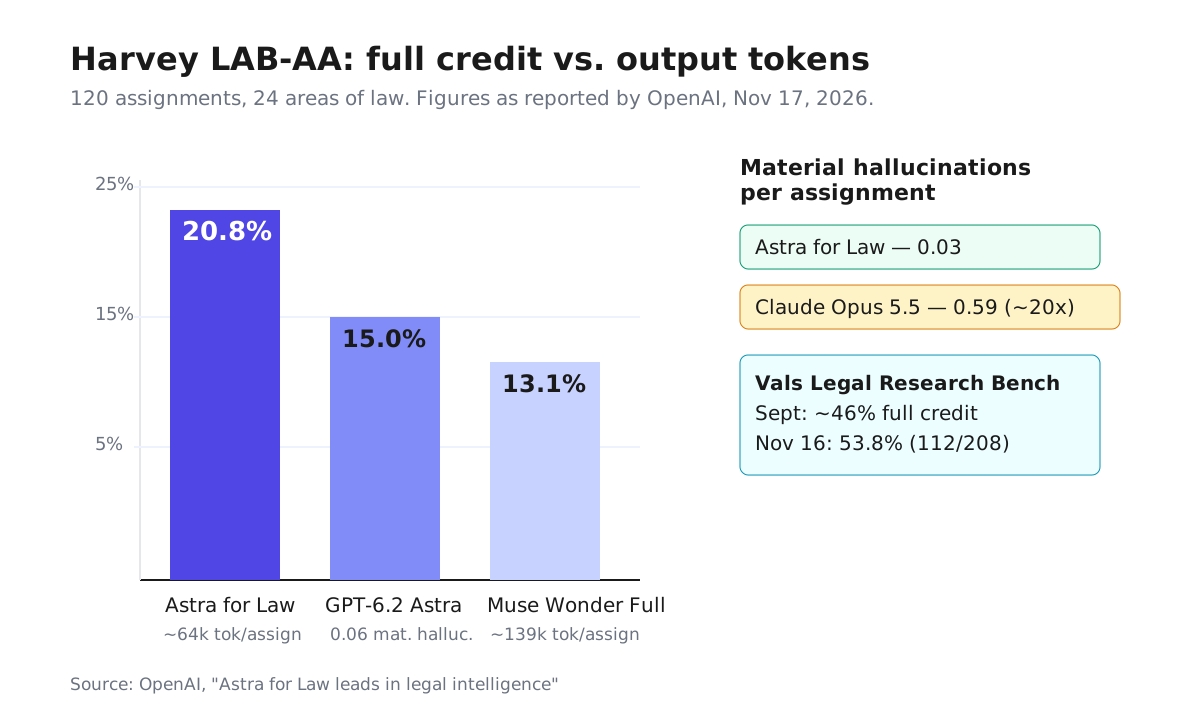
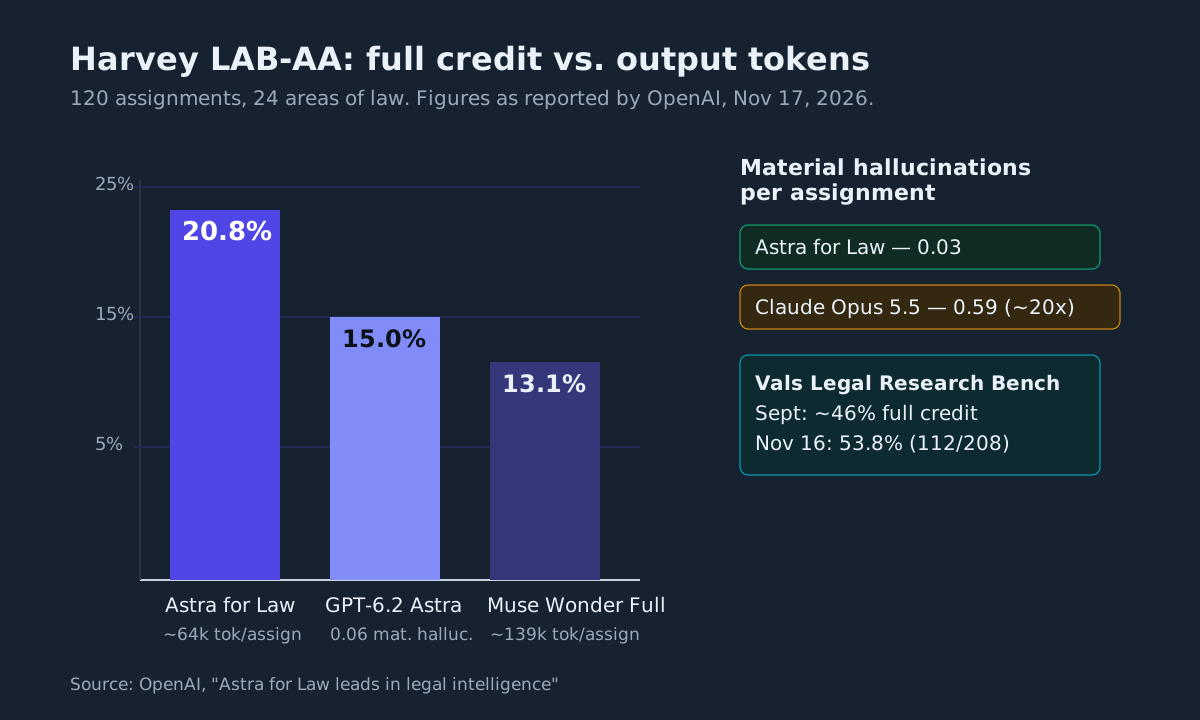
Two results deserve as much attention as the ranking. First, token cost: Astra for Law produced 54% fewer output tokens per assignment than Muse Wonder Full — roughly 64,000 versus 139,000. As we’ve argued in cost per completed task vs token price, the metric that decides whether a pilot survives procurement is the bill for the finished assignment, and for legal teams paying per token on long research assignments, output volume is that bill. Second, hallucinations: Artificial Analysis counted 0.03 material hallucinations per assignment for Astra for Law, tied with GPT-6 for the lowest rate in the comparison and about half the rate of plain GPT-6.2 Astra; Claude Opus 5.5, the best non-OpenAI result on that measure, averaged 0.59 — roughly 20 times as many.
On Vals AI’s Legal Research Bench, where practicing lawyers set questions on U.S. federal and state law, OpenAI reports the full-credit share rose from about 46% in September to 53.8% (112 of 208 questions) in Vals AI’s November 16 evaluation, with 90.9% of available points including partial credit.
Read the numbers with the sourcing in mind
Every headline figure here comes from OpenAI’s own announcement, quoting Harvey’s head of legal research and citing Artificial Analysis and Vals AI comparisons. The underlying leaderboards are third-party, but OpenAI selected the framing, and Harvey is simultaneously an OpenAI customer and benchmark author — the announcement quotes Harvey praising the model it helped test. None of that invalidates the numbers, but an enterprise buyer should treat “first place” as vendor-reported until the independent leaderboard pages are checked directly, and note that the LAB result cited from Harvey’s own benchmark (16.2% for the configuration, versus 4.6% for GPT-6 Astra) is a different test from the LAB-AA figure. Ranking claims also age fast in this cycle — the same day’s frontier model scorecard picture shifts whenever a lab ships, and GPT-6.2 Astra and Sol landed in ChatGPT Work, Codex and the API on the same day, per SiliconANGLE’s coverage.
The availability change is the real story
The September launch gated Astra for Law to a handful of marquee firms. Today, OpenAI says every ChatGPT Enterprise customer can request access through the Trusted Access Program in the admin console, teams that already have it can select gpt-6.2-astra-law in ChatGPT, and customers can request API access through a form. That is a meaningful shift from announcement to distribution: the model configuration becomes something a legal operations team can trial inside an existing ChatGPT Enterprise contract, rather than a bespoke engagement with OpenAI.
OpenAI’s own examples of early use are instructive about where the value sits: lawyers using the model as a sparring partner that argues the other side of a statute, mapping which regulations apply before the first call with outside counsel, and turning regulatory procedures into triage workflows for colleagues. In each case the model is doing grounded research against authorities — which is exactly what the expanded index and the hallucination numbers are supposed to support.
For operators watching frontier-model economics more broadly, the pattern repeats what GPT-6.2 Astra itself showed on launch day: the competitive claim is less about a new quality bar and more about quality per output token. The strategic read is that vertical configurations are becoming the way frontier pricing enters professions that bill by the hour, and the LAB-AA data is the internal sales argument — beating the base model by roughly five points while cutting output volume in half gives a legal operations lead a cost case to put in front of the partners, not just a leaderboard to cite.
Sources: OpenAI, “Astra for Law leads in legal intelligence” (Nov 17, 2026) (primary); OpenAI, “Introducing GPT-6.2 Astra and Sol”; SiliconANGLE, “OpenAI rolls out GPT-6.2 Astra for professional work and GPT-6.2 Sol for everyday work” (Nov 17, 2026).