Microsoft Blames the M365 Outage on a Network Capacity Upgrade — and AI Connectors Took the Same Fall
Microsoft attributes the ~24-hour M365 outage to a network capacity upgrade — not cyber or AI — as Anthropic's and OpenAI's M365 connectors recover. What connector-dependent agent teams should take from it.
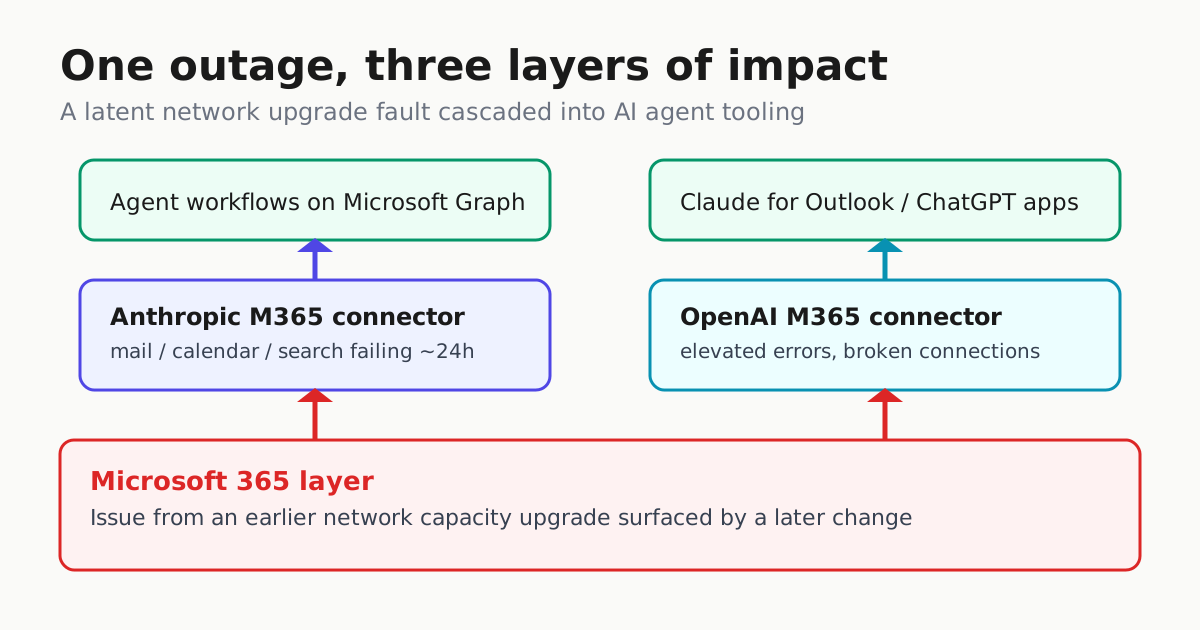
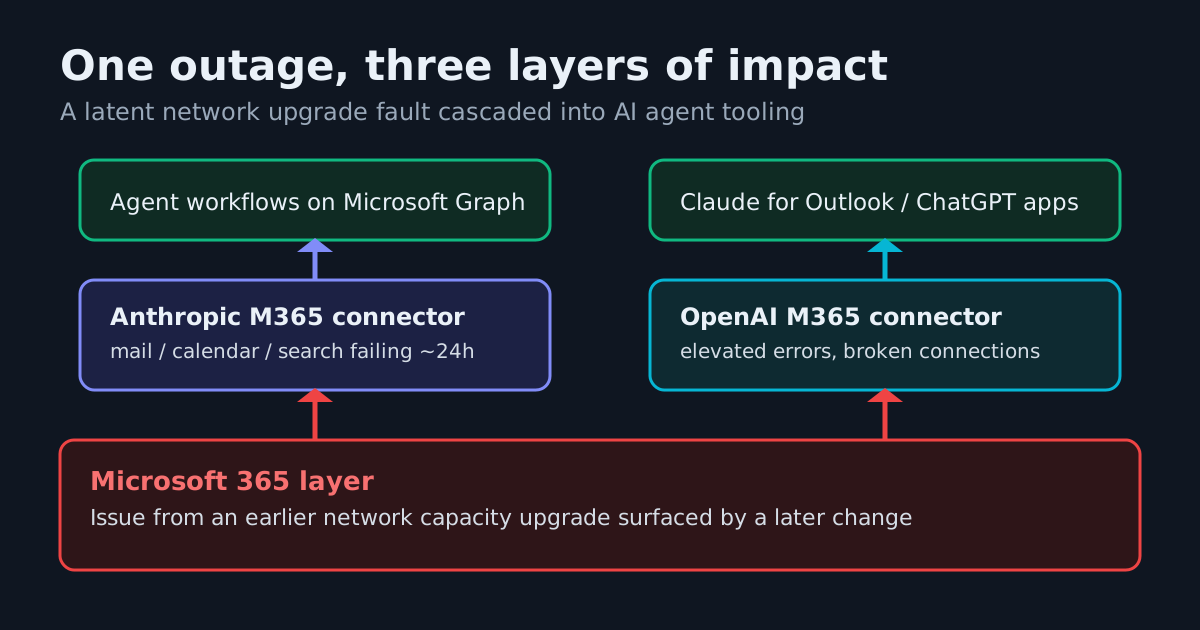
Microsoft has publicly apologized for the global Microsoft 365 outage and attributed it to a technical fault introduced during an earlier network capacity upgrade — explicitly ruling out both a cyberattack and any role for AI or AI agents. The statement, posted on X at 4:40 PM on Nov. 13, is the company’s first root-cause account of an incident that degraded Outlook, Teams and Copilot for tens of millions of users across more than 70 countries.
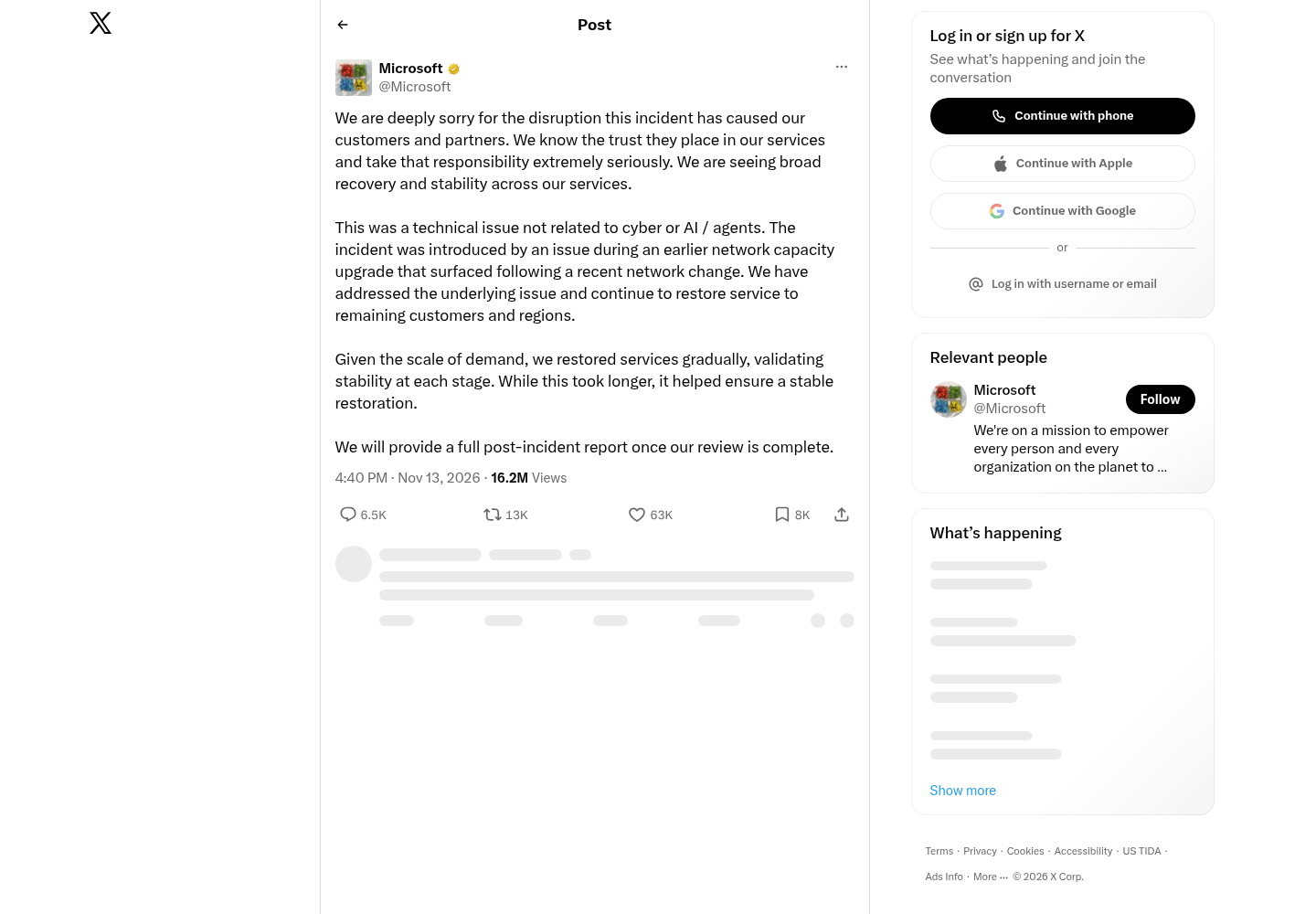
What Microsoft actually said
“We are deeply sorry for the disruption this incident has caused our customers and partners,” the company wrote, adding: “This was a technical issue not related to cyber or AI / agents. The incident was introduced by an issue during an earlier network capacity upgrade that surfaced following a recent network change. We have addressed the underlying issue and continue to restore service to remaining customers and regions.”
Two details matter for operators. First, the trigger was latent: a flaw planted during a previous capacity upgrade only surfaced when a later, routine network change exposed it. That is a classic time-bomb failure mode, and it means the recent network change was the detonator, not the cause. Second, Microsoft said it restored services gradually, “validating stability at each stage,” which explains why full recovery took roughly 24 hours rather than a single flip-back. A full post-incident report is promised once the review completes — that report, not the apology, is the artifact to watch.
WIRED’s recovery coverage corroborates the timeline: user reports began just after noon ET on Thursday, Microsoft initially scoped the incident to North America, and within an hour it had spread worldwide. Governments, airlines, emergency services and hospitals all reported disruptions. Microsoft raised email queue times to 48 hours so messages sent during the outage would still be delivered — meaning delayed mail and a flood of backlogged notifications continued landing after services came back.
The cascade into AI tooling
For teams building on Microsoft Graph, the more consequential story is how the outage propagated straight through two independent AI vendors’ connector stacks.
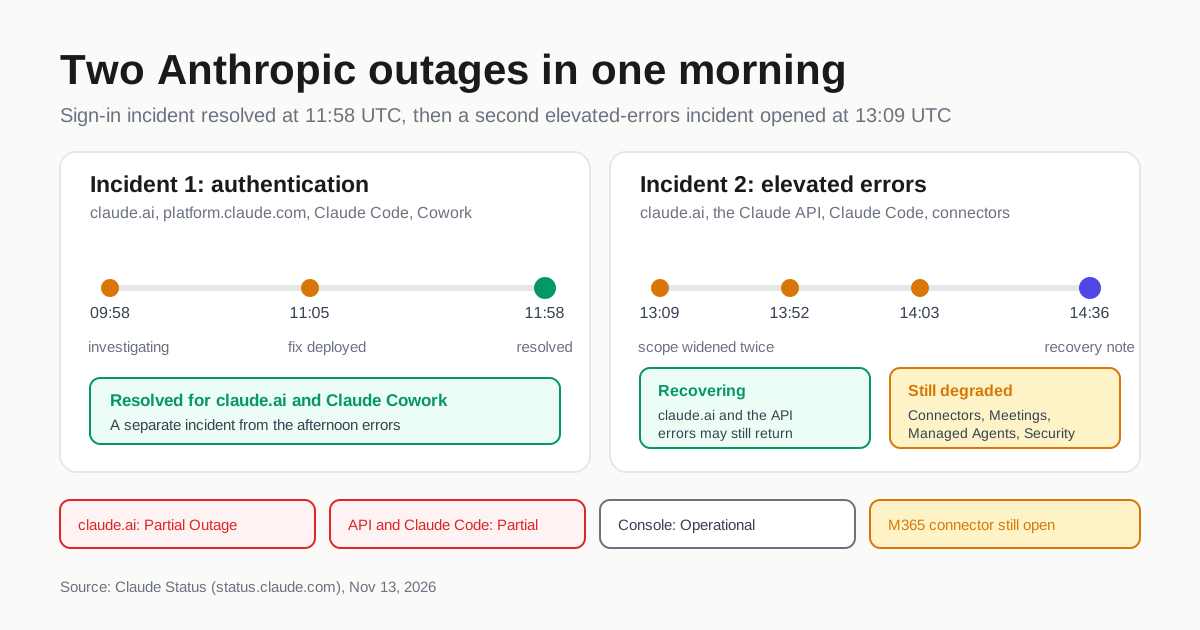
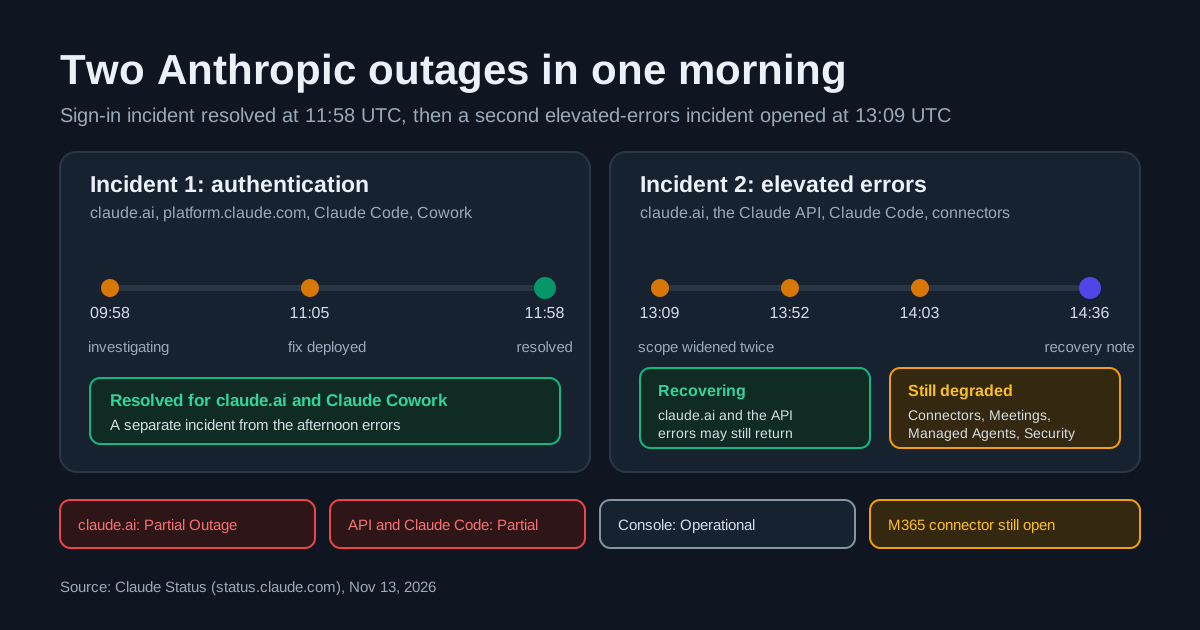
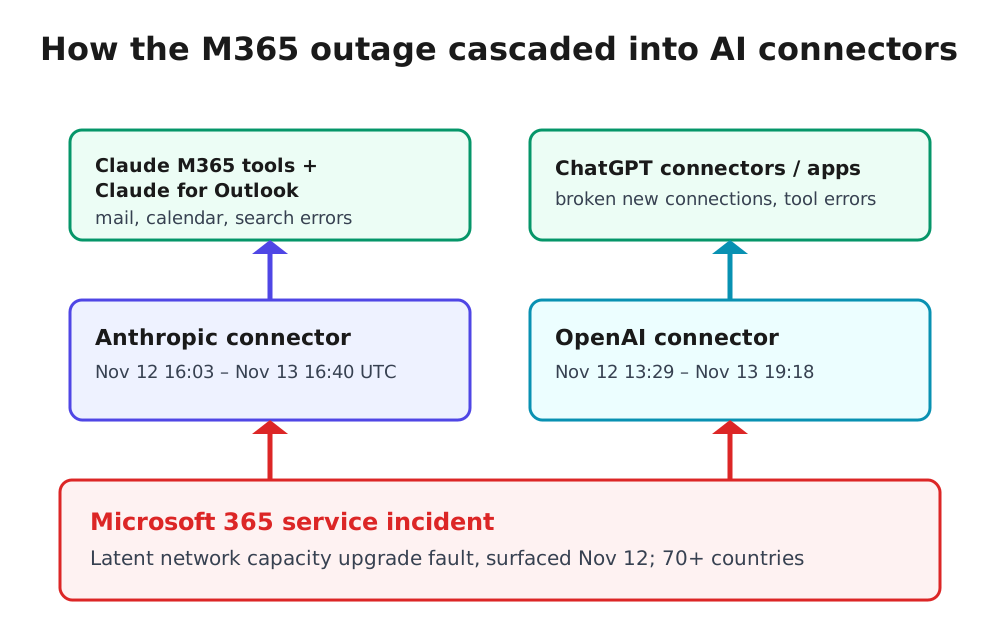
Anthropic’s status page incident report shows the Microsoft 365 connector was effectively down for a full day: from 16:03 UTC on Nov. 12 to 16:40 UTC on Nov. 13, “mail, calendar and search tools in the Microsoft 365 connector and Claude for Outlook returned errors for many requests because of a Microsoft 365 service incident,” with tools “failing for most requests” through the middle of the window. Anthropic repeatedly pointed customers at Microsoft’s status page — correctly, because the fault was never theirs.
OpenAI hit the same wall. Its connector incident page logged “elevated errors affecting the Microsoft 365 connector” starting 13:29 on Nov. 12, noting that “new connections may be broken and tools are not working as expected,” before declaring all affected services normal at 19:18 on Nov. 13.
Two vendors, two independent agent products, one shared upstream dependency — and near-identical failure windows. When the SaaS layer beneath a connector goes down, every agent workflow built on that connector goes down with it, regardless of which model or harness sits on top.
What this changes for connector-dependent agents
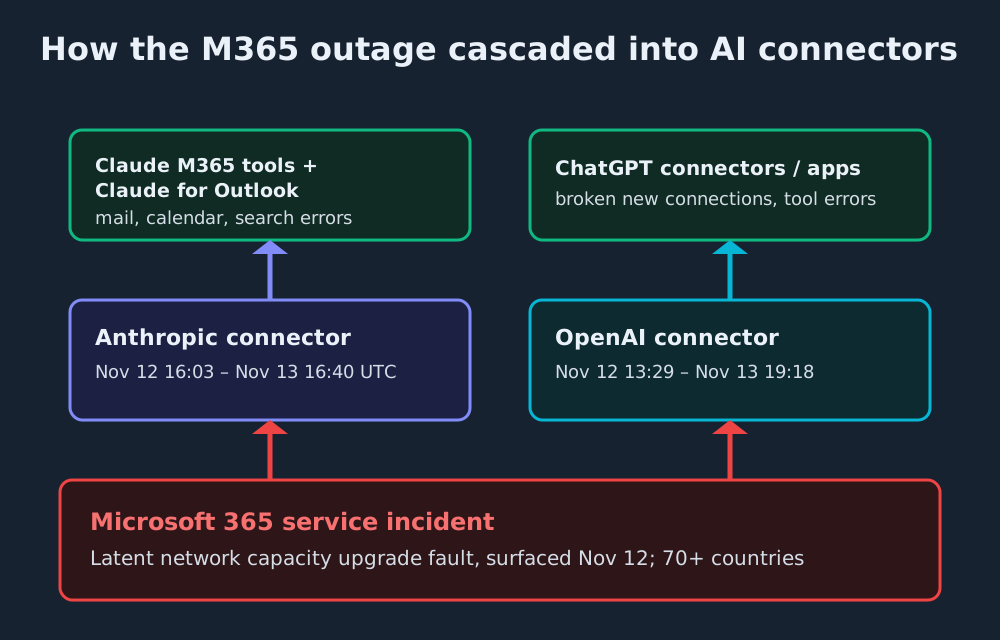
The architectural lesson is not new, but this incident is a clean, well-documented demonstration of it:
- Your vendor’s status page is not your incident surface. Teams running Claude or ChatGPT agents against M365 data spent Nov. 12–13 debugging symptoms that originated entirely upstream. Monitoring Microsoft’s service health — not just your model vendor’s — is part of operating a connector-based agent.
- Connector lanes have no independent failover. Neither Anthropic nor OpenAI could mitigate; they could only wait. If mail, calendar or SharePoint data is mission-critical to an agent, plan a degraded mode (queue actions, fall back to cached or exported data) rather than assuming the connector will be available.
- Recovery is staggered. Anthropic still warned of “occasional errors or delays” after marking its incident resolved, because Microsoft’s recovery was still completing. Agent retry logic should expect partial recovery, not a clean boundary.
- Latent change risk is real. A capacity upgrade that passed at deploy time surfaced later. The same applies to any dependency your agent stack shares: a change you didn’t make, on a schedule you don’t control, can break your lane days or weeks later.
Microsoft’s framing also settles a question that circulated during the outage: this was not a security incident, and AI agents were not a contributing cause. But the incident still landed hardest on agent workflows, because connectors concentrate a single point of failure behind an increasingly popular abstraction. Until the post-incident report lands, the actionable takeaway is dependency hygiene: know which upstream SaaS your agent’s tools ultimately call, and monitor that layer directly.
Related reading: we covered the Anthropic-side degradations on Nov. 13, and our provider-cutoff continuity drill and vendor-lane last-hop register cover how to prepare lanes like these before the next upstream outage.
Sources
- Microsoft on X: "We are deeply sorry for the disruption this incident has caused our customers and partners. We know the trust they place in our services and take that responsibility extremely seriously. We are seeing broad recovery and stability across our services. This was a technical issue not…
- Microsoft 365 Crawls Back to Life After a 24-Hour Outage | WIRED
- Claude Status - Elevated errors affecting the Microsoft 365 connector
- Elevated errors affecting the Microsoft 365 connector - OpenAI Status