Edge0-145B Puts a 145B-Parameter Coding Model on One Consumer GPU, Claims to Beat Claude Opus 4.6 on Terminal-Bench
Edge0's 145B and 120B open-weight coding models run on one consumer GPU via OpenAI/Anthropic-compatible APIs — the benchmarks and license, explained.
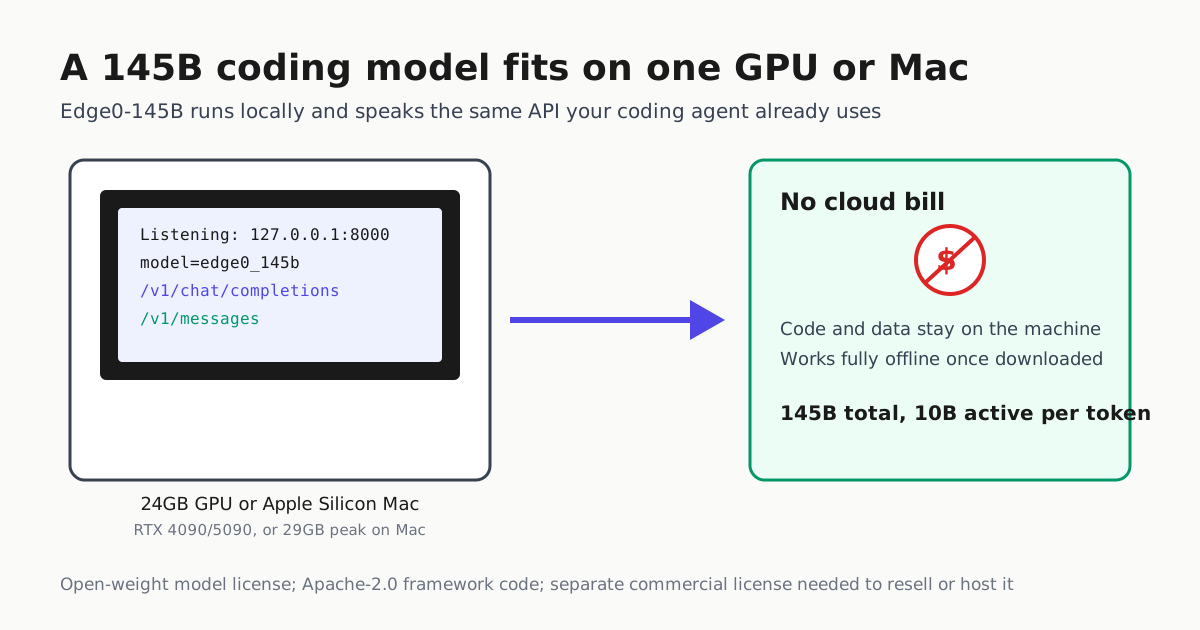
Edge0, the startup behind September’s Edge0-35B phone model, released two much larger open-weight models on November 12-13: Edge0-145B and Edge0-120B. Both are latent mixture-of-experts models built to run agentic coding workloads on a single consumer GPU or an Apple Silicon Mac, with day-one support for OpenAI- and Anthropic-compatible local API endpoints — meaning they can be pointed at an existing coding-agent harness without rewriting its client code.
That compatibility, plus a vendor claim of beating Claude Opus 4.6 on an agentic coding benchmark, is what makes this worth a close read rather than a changelog note. But the memory and speed numbers vary depending on which Edge0 document you read, and the license is open-weight with a commercial carve-out, not plain open-source. Both details matter before anyone budgets a GPU around this.
What actually shipped
Edge0-145B has 145B total parameters with roughly 10.12B active per token, using a latent MoE design: 48 layers, 512 experts per layer, 10 routed plus one shared expert active per token, and a 256K token context window, according to Edge0’s Hugging Face model card. Edge0-120B is a smaller sibling at 120B total parameters. Both were trained natively at 4 bits rather than distilled or quantized down from a larger cloud model after the fact.
The inference stack — edge0-infer, built on a fork of the Strata engine called edge0-strata — is Apache-2.0 licensed and lives on GitHub. Running edge0-infer serve --model /path/to/Edge0-145B-q3k starts a local server that prints a listening address and then exposes OpenAI- and Anthropic-compatible chat endpoints:
curl localhost:8000/v1/chat/completions -H 'content-type: application/json' \
 -d '{"model":"edge0_145b","messages":[{"role":"user","content":"hi"}],"max_tokens":64}'
That’s the practical hook for coding-agent operators: any harness that already talks to an OpenAI- or Anthropic-shaped API can be repointed at a local Edge0 server instead of a cloud subscription, with no token bill and no network dependency once the weights are downloaded.
The memory and speed numbers don’t all agree
Edge0 published the same model through at least three channels, and the headline figures differ by venue — worth flagging before anyone sizes hardware around a single number.
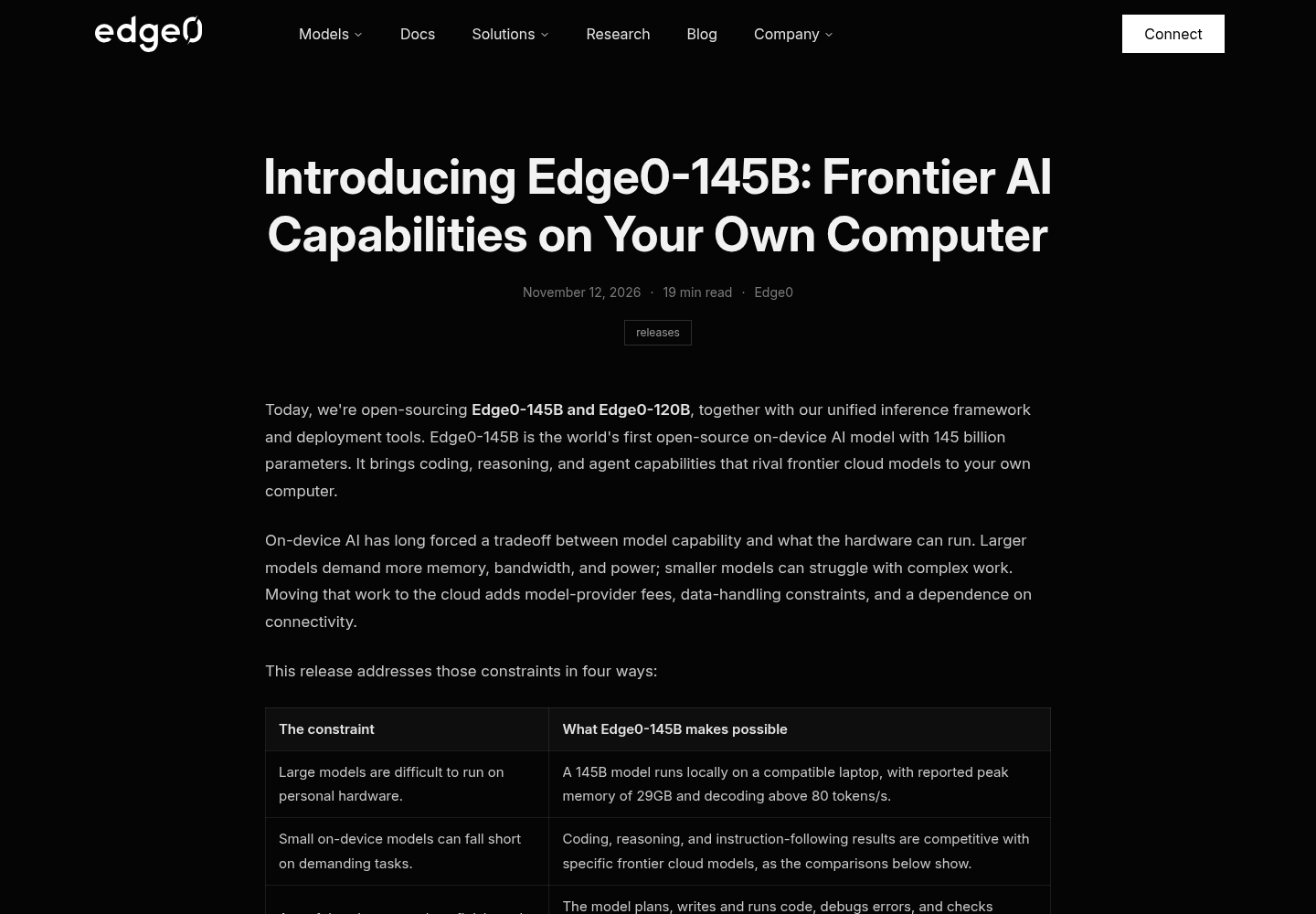
- Edge0’s launch blog post reports 29GB peak memory and 80+ tokens/s decode for a “compatible laptop,” without naming a specific machine.
- The Hugging Face model card is more precise and more conditional. On an RTX 5090 D 24GB with the Q3_K build, it reports 121.2 tok/s agent decode and 3554.9 tok/s 16K-token prefill — the number behind the Terminal-Bench headline. A separate row on the same card tests the same RTX 5090 card deliberately throttled to a 16GB VRAM + 20GB host RAM budget via cgroup limits, and that constrained configuration drops to 44.9 tok/s agent decode. Edge0 is explicit that this is “a test limit, not a minimum system requirement.”
- Co-founder Samuel Zeng’s launch post on X gives yet another figure: “needs just 29G memory” and “decodes 75+ toks/s, prefills 1050+ toks/s on RTX Spark and Mac.”
The practical read: a full-power 24GB RTX 5090 or 4090 gets you triple-digit decode speed; a tighter 16GB-VRAM budget still runs the model but at roughly a third of the throughput. Apple Silicon and NVIDIA’s RTX Spark land somewhere in between. Operators should test on their own hardware rather than plan around whichever number appears in the marketing copy.
The benchmark claim, with its asterisks
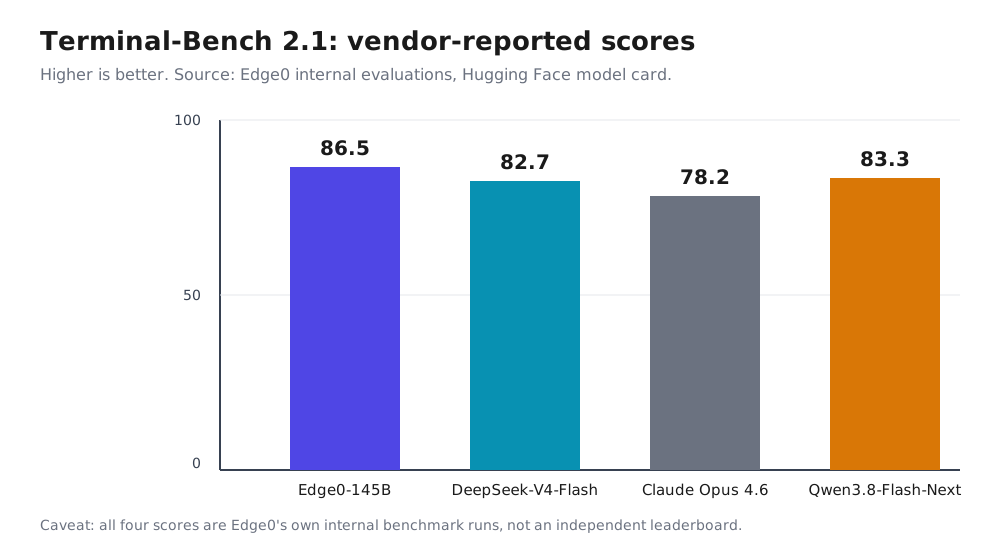
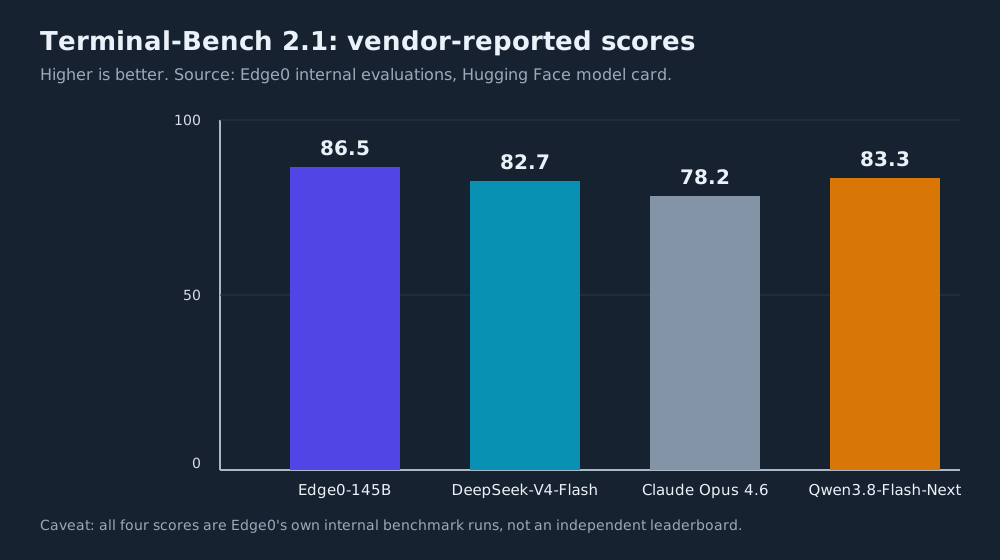
On Edge0’s own evaluation suite, Edge0-145B scores 86.5% on Terminal-Bench 2.1, ahead of DeepSeek-V4-Flash-0731’s 82.7% and Claude-Opus-4.6 (Max)'s 78.2%. It also leads on DeepSWE 1.1 coding (64.6 vs 54.4 for DeepSeek) and IFBench instruction-following (80.6 vs 62.5 for Claude). Those are real wins on agentic coding and instruction tasks specifically.
| Benchmark | Edge0-145B | DeepSeek-V4-Flash-0731 | Claude-Opus-4.6 (Max) |
|---|---|---|---|
| Terminal-Bench 2.1 | 86.5 | 82.7 | 78.2 |
| DeepSWE 1.1 | 64.6 | 54.4 | no public score |
| GPQA-Diamond | 90.4 | 90.8 | 91.3 |
| IFBench | 80.6 | 79.2 | 62.5 |
Claude still edges ahead on GPQA-Diamond (general knowledge/reasoning) and leads on HLE, a reminder that “beats Claude on Terminal-Bench” is a narrower claim than “beats Claude.” All of these figures come from Edge0’s own internal testing, not a third-party leaderboard, so they’re a vendor’s self-reported comparison rather than an independently reproduced one.
Open weights, not open source — and not free for every use
Edge0’s GitHub repository spells out the license split clearly: the framework code (edge0-infer, edge0-strata) is Apache-2.0. The model weights ship under the Edge0 Community Model License 1.0, layered on top of the underlying Qwen Community License 1.0 (Edge0-145B is built on Qwen3.8-Flash-Next). That license permits personal use, research, modification, noncommercial sharing, and commercial use of generated outputs — but selling the model, running a commercial inference service, or shipping an independent commercial coding or office assistant built on it requires a separate written license from Edge0. Calling this “open-source,” as Edge0’s own blog and FAQ do, overstates it; open-weight with a commercial carve-out is the accurate description.
What this means for operators
If you have a 24GB RTX 4090/5090 or an Apple Silicon Mac with enough RAM, Edge0-145B is a genuinely new tier of local model to try against your existing OpenAI- or Anthropic-shaped coding agent client, with no per-token cloud bill once it’s downloaded. If your hardware tops out at 16GB VRAM, expect roughly a third of the published decode speed in the best case, per Edge0’s own constrained-budget test. And if you plan to resell or host this as a service, read the Edge0 Community Model License before you do — it’s not a blanket open-source grant. For broader context on running open-weight models inside an agent harness, see our guides on open-weight models that can drive a harness and on picking a local AI workstation. It also follows the same on-device pattern as Meta’s recent Muse Glimmer 30B release, though at a much larger parameter count.
Sources
- Edge0-145B: Open-Source On-Device AI with 145B Parameters - edge0
- Edge0/Edge0-145B-q3k · Hugging Face
- GitHub - Edge0-AI/Edge0: Device-native foundation models: 145B on a laptop, 35B on a phone. Latent MoE, SSD-streamed weights, a router that predicts loads a step ahead. Mac, iPhone, Android, Windows. · GitHub
- Samuel Zeng on X: "Introducing Edge0-145B and Edge0-120B, @Edge0_AI’s first device-native 100B-class foundation models with open weights. Cloud-level intelligence on your laptop. Free, offline, and fast enough for real vibe coding. - Smart: beats Claude Opus 4.6 on Terminal-Bench 2.1 (86.5% vs. 7…