Recursive's Flint Lands in Ollama: An Apache-2.0, 40B MoE Coding Model Built for Agent Work
Ollama's v0.40.8-rc0 pre-release adds Recursive's Flint: an Apache-2.0, 39.8B-parameter MoE with about 2.5B parameters active per token, a 262K-token context and day-zero launch lines for Claude Code and OpenCode. What local agent operators should verify before giving it a default slot.
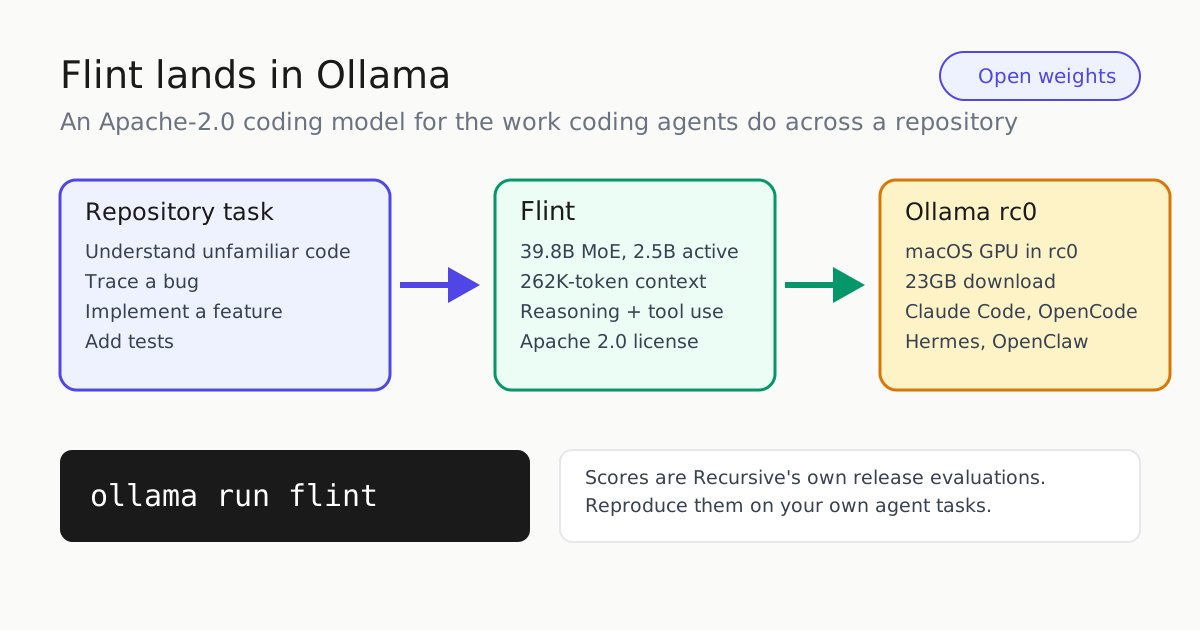
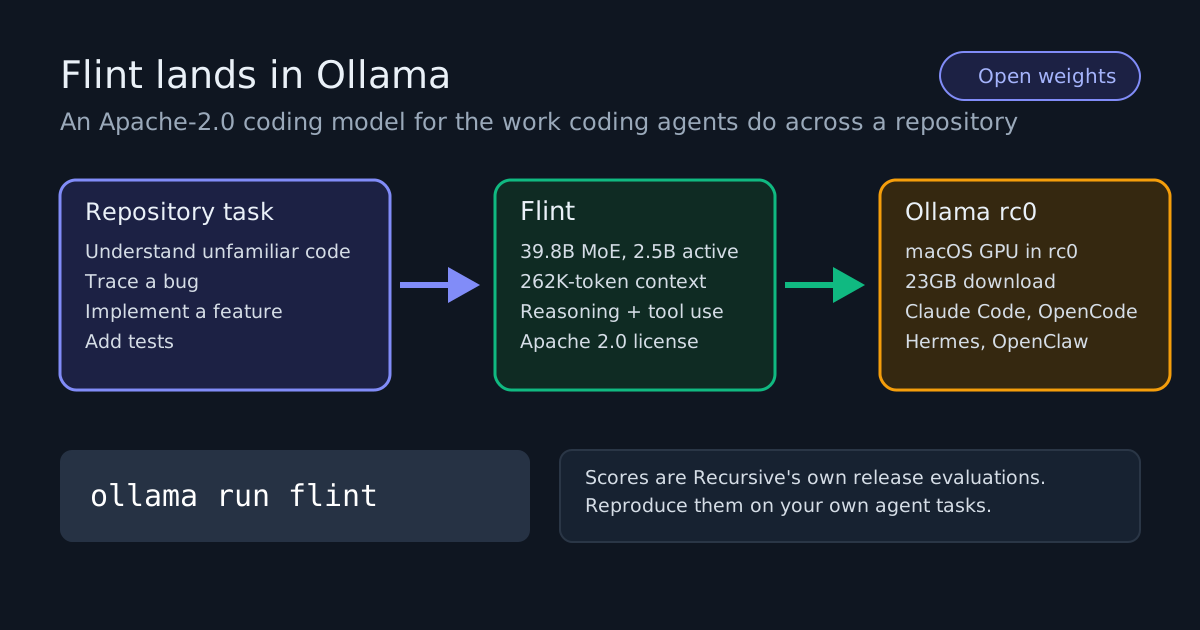
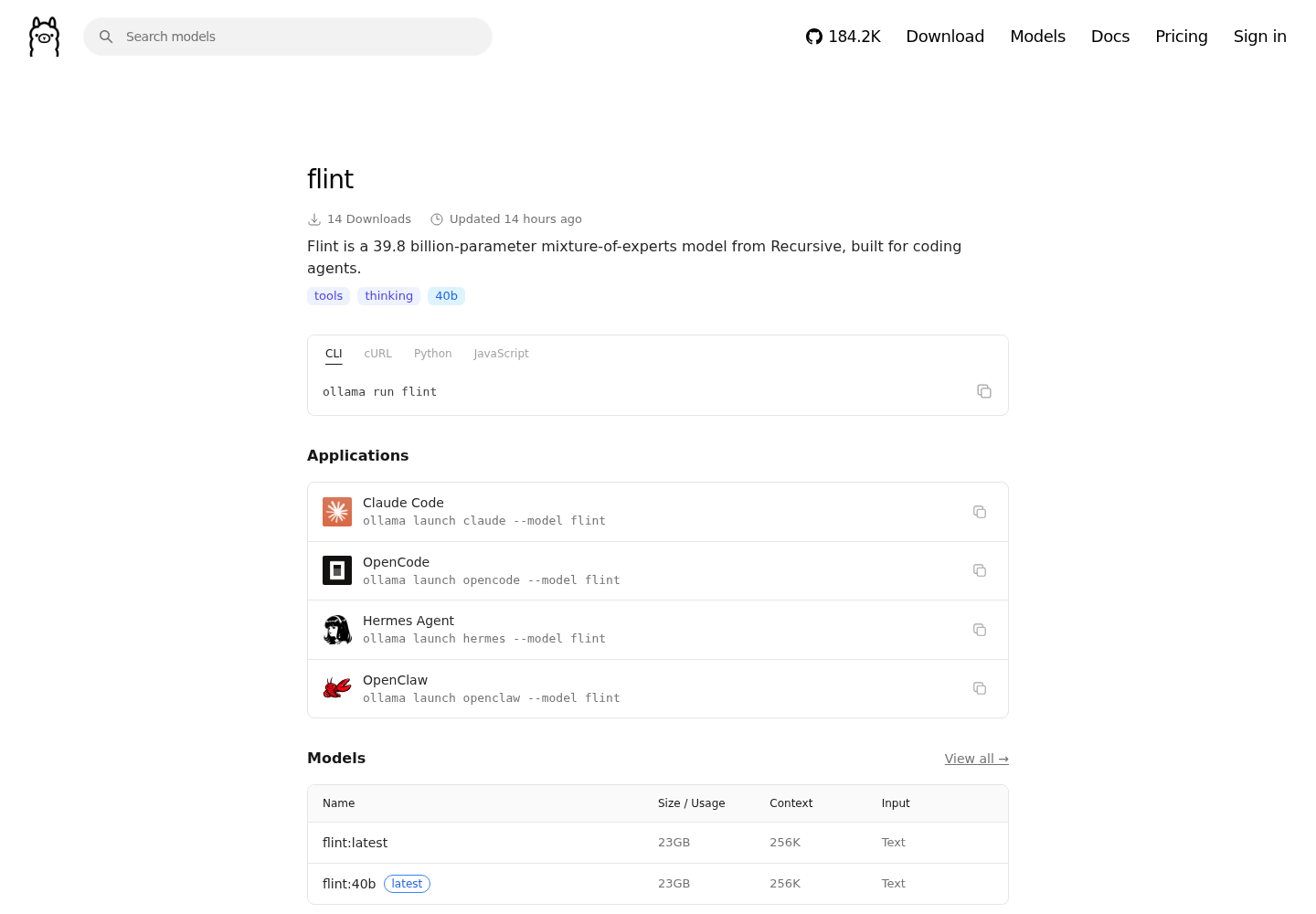
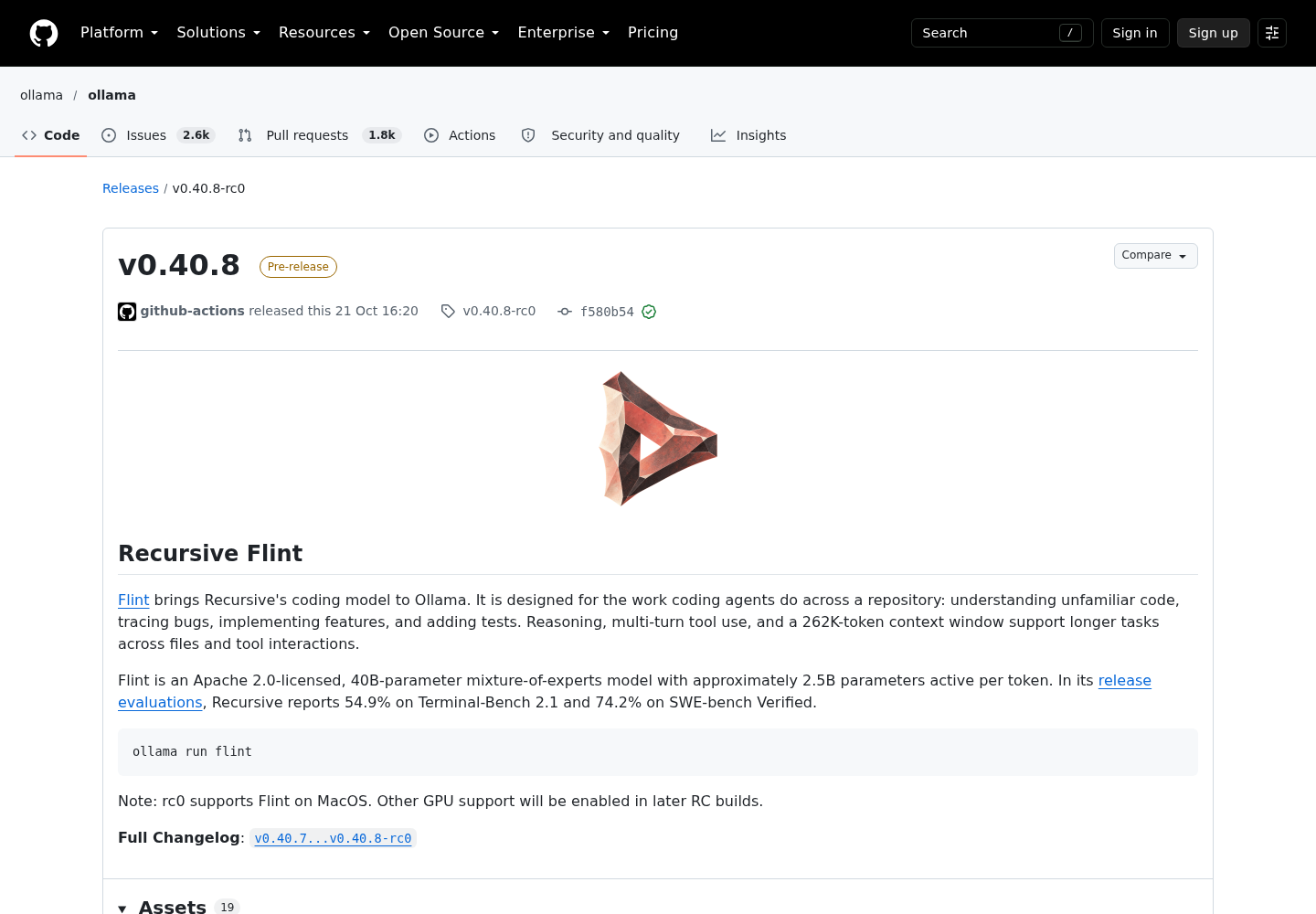
Recursive’s first coding model became publicly available through Ollama today, and it went straight to local machines. At 16:20 UTC on October 21, Ollama published v0.40.8-rc0, a pre-release that adds Flint, a coding model from the newly surfaced lab Recursive. Flint is Apache 2.0-licensed, a 39.8 billion-parameter mixture-of-experts with roughly 2.5 billion parameters active per token, and a 262K-token context window. One command — ollama run flint — pulls a 23GB build that advertises tool use and thinking, and Ollama’s library page documents one-line launch commands that point Claude Code, OpenCode, Hermes Agent and OpenClaw at it.
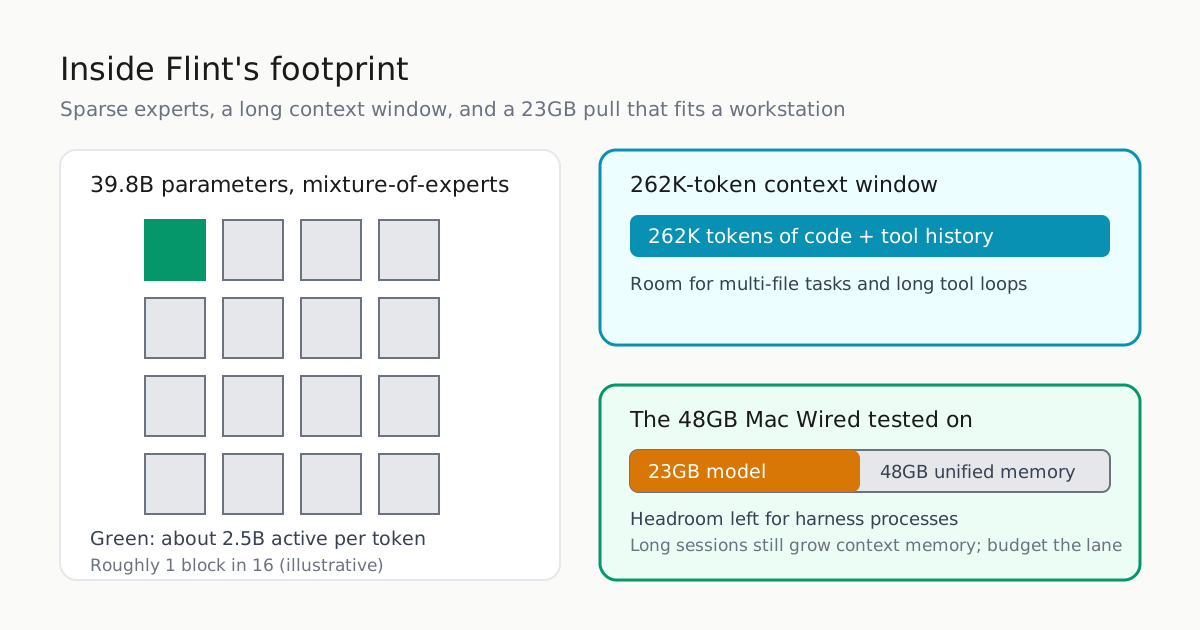
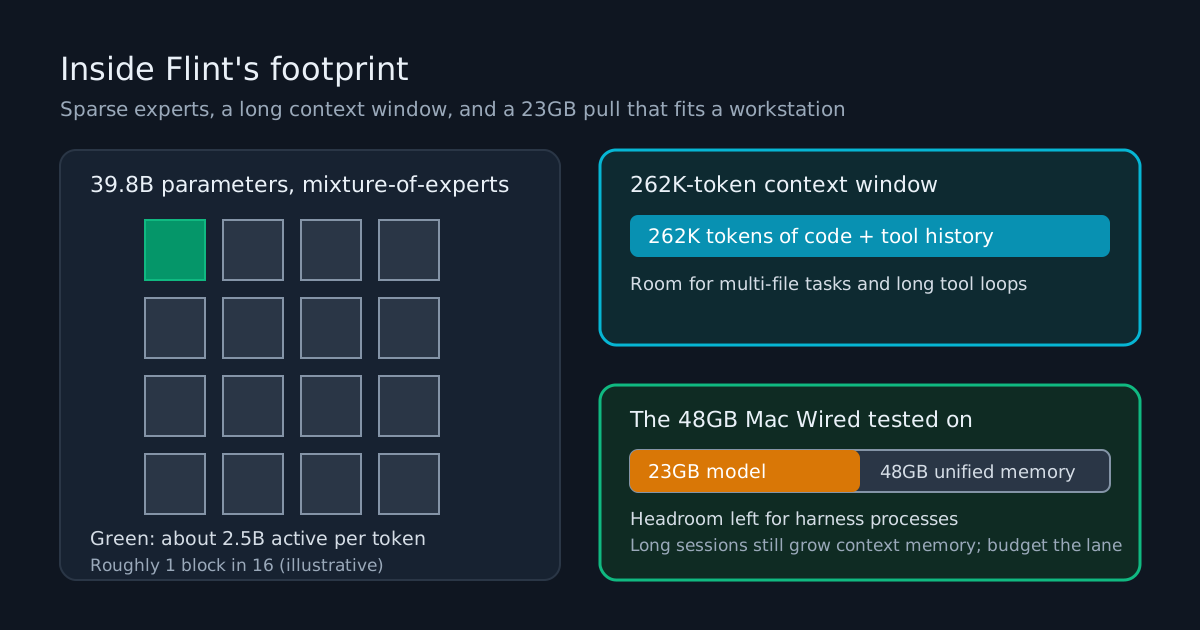
That combination is genuinely new: a permissively licensed agentic coding model that a 48GB Mac can hold, in third-party packaging the same week its lab appeared in Wired. It is also an rc-tagged release with macOS-only GPU support, and every quality claim attached to it is Recursive’s own. Here is what shipped, what is verified, and what a self-hosted agent operator should check before it earns a default slot.
What actually shipped
| Attribute | Detail |
|---|---|
| Model | Flint, Recursive’s coding model for local coding agents |
| License | Apache 2.0 |
| Architecture | 39.8B-parameter mixture-of-experts, ~2.5B active per token |
| Context | 262K tokens |
| Capabilities | Reasoning, multi-turn tool use |
| Footprint | 23GB pull (flint:latest, flint:40b); quantized builds for Apple Silicon and other GPUs |
| Packaging | Ollama v0.40.8-rc0 pre-release; rc0 supports macOS, other GPU support in later RC builds |
The release notes describe the intended workload precisely: “understanding unfamiliar code, tracing bugs, implementing features, and adding tests” across a repository — the loop a coding agent actually runs, not single-shot autocomplete. The library page carries tools and thinking badges and an Applications section with day-zero launch lines such as ollama launch claude --model flint.
The scores are the vendor’s own
Recursive’s release evaluations report 54.9% on Terminal-Bench 2.1, 89.7% on SWE-bench Pro v2 and 74.2% on SWE-bench Verified. Ollama’s library page reprints those numbers with the right warning attached: “These are publisher-reported results; evaluation setups and runtimes can affect scores.”
Treat them accordingly. SWE-bench-adjacent scores are sensitive to harness details — scaffold, test patching, tool budget — which is the core lesson of reading agent benchmarks in 2026. Wired’s Will Knight had been testing Flint for the past few days and reported that it “nailed my coding requests every time” on a 48GB Mac, building a CLI to-do list, a research-scouring program and a small website. That is one reporter’s anecdote, not a controlled evaluation you can plan capacity around. The only scores you can bill against are the ones your own agent runs produce.
Who built it, and the claim that travels with it
Flint is the first offering from Recursive, founded by Richard Socher, previously chief scientist at Salesforce, with University of British Columbia professor Jeff Clune among the cofounders. The company has raised $650 million at a $4.65 billion valuation from Google Ventures, Greycroft, Nvidia and AMD Ventures.
The provocative part is how Recursive says it was built. Socher told Wired that “nearly every aspect of the entire model pipeline was actually done and improved upon by AI,” using the company’s Eureka Machine — a recursive self-improvement (RSI) claim about a technique several bills in Congress propose to ban, and one an Anthropic researcher cited in a public extinction warning when they quit in September. Two things to keep straight: those development claims are Recursive’s statements about its own private system, not something outsiders verified; and nothing in the shipped artifact depends on them. What you can actually check is the license, the weights, the context window and the scores on your own tasks.
What local agent operators should check first
ollama run flint
ollama launch claude --model flint
ollama launch opencode --model flint
- The rc gate is real. rc0 supports Flint on macOS; other GPU support arrives “in later RC builds.” A Linux or CUDA fleet should wait for a later RC or the stable v0.40.8 rather than rebuilding today.
- It is Ollama’s pre-release, not just the model’s. Adopting rc0 means adopting a pre-release runtime. Pin the version and keep a rollback path, as with any CLI upgrade canary.
- Do the memory math before the pull. The 23GB download fits a 48GB Mac with headroom, but a 262K window means context memory grows with long sessions — budget the lane for the harness, not just the weights (The Local AI Workstation, 2026 Edition).
- Wire it into a lane, not the default slot. Put Flint on a bounded task lane, run your own eval set, and let that evidence earn promotion — the same bar we set for any open-weight model driving a harness.
- If exfiltration matters, enforce locality. Apache 2.0 weights on your own hardware only help if the surrounding agent stays local; see enforcing Ollama’s local-only mode.
The bottom line
Availability is the story today. An Apache-2.0, tool-using, 262K-context coding model that runs on a single workstation is a real addition to the short list of open weights that can drive a harness, and Ollama’s day-zero packaging means Apple Silicon operators can test it tonight. The RSI narrative will dominate the surrounding coverage; the shipped evidence is the license, the context window, the 23GB pull and publisher-reported scores you should reproduce yourself. Telling those two apart is the whole job.