
Reflection AI Ships Beam 1.0: A 501B-Parameter Open-Weight Model for Coding Agents
Reflection AI's first model is a 501B-parameter, 23B-active Apache 2.0 MoE with a 1M-token context, built for coding agents. What shipped, what it takes to host, and the four fastest ways to run it today.
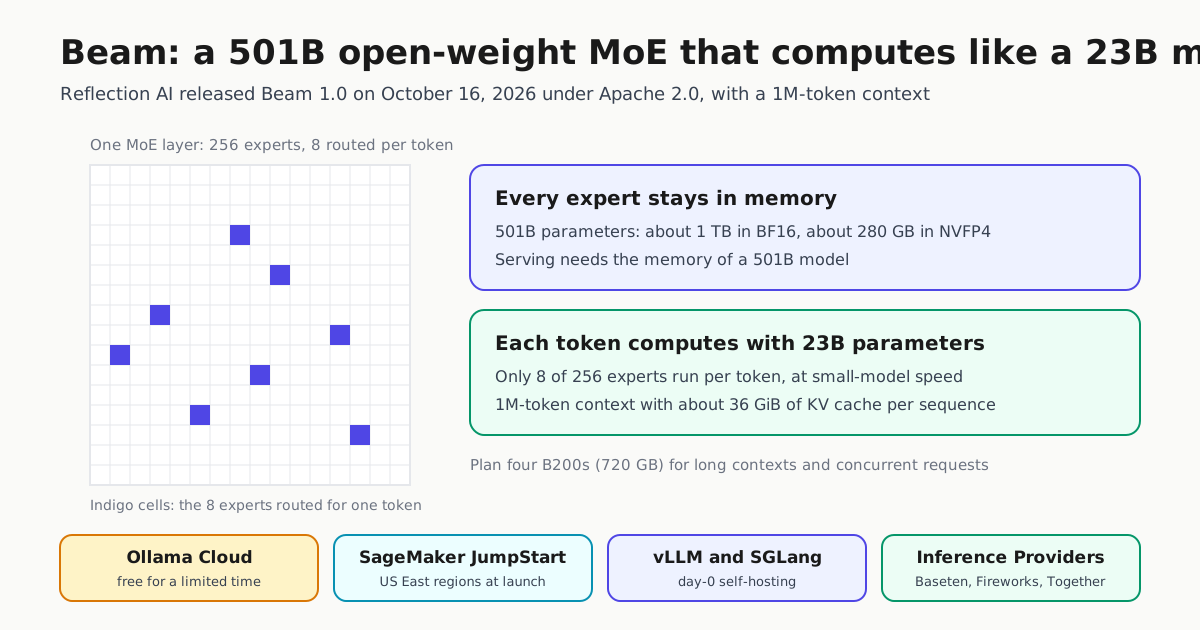
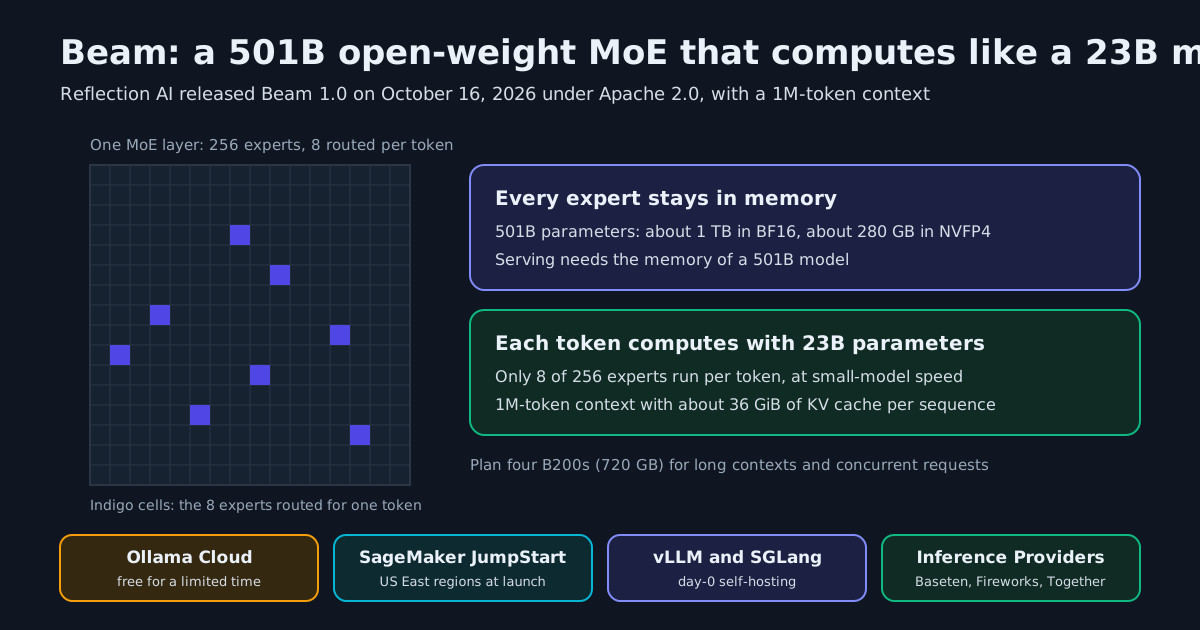
Reflection AI shipped Beam, the new US lab’s first model, on October 16, 2026 — and it is not a mid-size checkpoint with a press release. Beam 1.0 is a 501-billion-parameter sparse mixture-of-experts (MoE) model with 23B parameters active per token, a 1M-token context window and an Apache 2.0 license, built for coding and long-horizon agentic work. It landed with day-0 support in transformers, SGLang and vLLM, managed endpoints in Amazon SageMaker JumpStart, and free limited-time access on Ollama Cloud.
The model in plain numbers
Beam is a 52-layer decoder with a hidden size of 5,120. The first three layers are dense; the other 49 route every token to 8 of 256 SwiGLU experts, which hold 98.4 percent of the model’s parameters. The router follows DeepSeek-V3’s group-limited scheme, with no shared expert. Attention is hybrid: 43 layers use a 512-token sliding window with RoPE, while 9 global layers — every sixth layer plus the last — attend over the full context with no positional encoding and a scalable-softmax query scaler.
The design deliberately splits memory from compute. All 256 experts stay resident, so serving needs the memory of a 501B model: the BF16 checkpoint is about 1 TB and the NVFP4 checkpoint about 280 GB. But each token computes with roughly 23B parameters, so it generates at the speed of a much smaller model. Only the 9 global layers keep keys and values for the whole sequence, which is what makes the 1M-token window affordable:
| Context length | All-global cache | Beam |
|---|---|---|
| 32K tokens | 6.5 GiB | 1.2 GiB |
| 128K tokens | 26 GiB | 4.6 GiB |
| 1M tokens | 208 GiB | 36.08 GiB |
Those are per-sequence BF16 figures from the Hugging Face post. Reasoning effort is a first-class knob — low, medium (the default), high, xhigh and max — reasoning can persist across turns, tool calls use a dedicated grammar, and a response template ships in the tokenizer so clients split reasoning, answers and tool calls without regex. Beam also carries a DFlash2 drafter for speculative decoding and its own open-source Rust harness.
What Reflection reports
On Reflection’s own numbers, Beam scores 81.6 percent on SWE Bench Verified (BF16), 80.1 percent on Terminal Bench v2.1, 76.5 percent on SWE Bench Pro v2-Hard, 97.7 percent on AIME 2026, 90.6 percent on GPQA Diamond and 76.8 percent on BrowseComp with context management. Quantization is cheap: the NVFP4 checkpoint still scores 80.7 percent on SWE Bench Verified. These are vendor-reported, so treat them accordingly until independent results appear.
Four ways to run it today
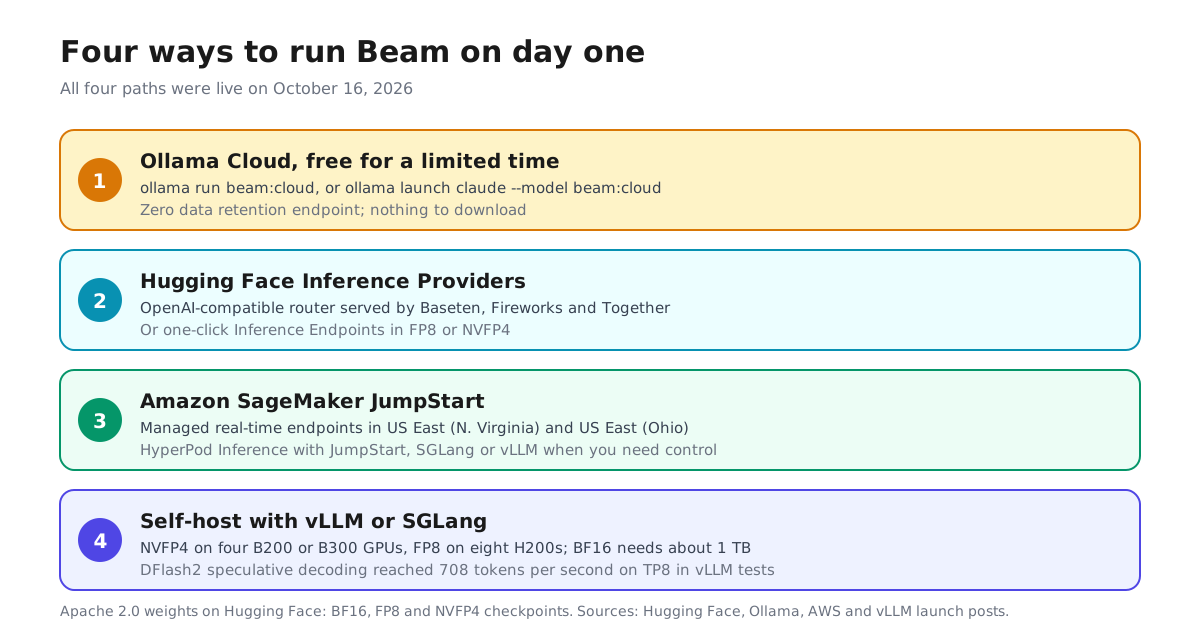
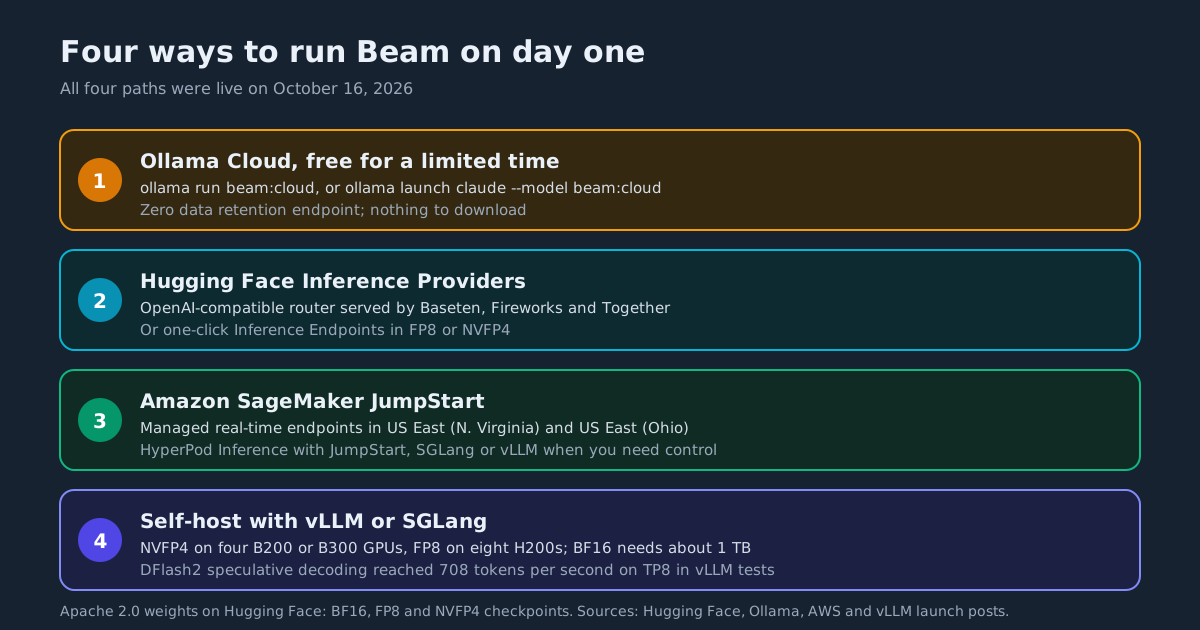
Ollama Cloud, free for a limited time. Ollama is a day-zero partner, the endpoint runs with full zero data retention, and there is nothing to download:
ollama run beam:cloud
ollama launch claude --model beam:cloud
The same ollama launch pattern works for Codex and OpenCode.
Hugging Face Inference Providers. Beam is served by Baseten, Fireworks and Together behind the standard OpenAI-compatible router, or as a one-click Inference Endpoint in FP8 or NVFP4.
Amazon SageMaker JumpStart. At launch, Beam is in the JumpStart catalog in US East (N. Virginia) and US East (Ohio). AWS offers three paths: a managed real-time endpoint, JumpStart on HyperPod Inference for Kubernetes-native control, or your own SGLang or vLLM runtime on HyperPod. AWS maps FP8 to P5, P5e and P5en instances (H100 and H200) and NVFP4 to ml.p6-b200.48xlarge.
Self-host with vLLM or SGLang. The vLLM day-0 post ships a ready serving command:
docker run --gpus all --ipc=host -p 8000:8000 \
  vllm/vllm-openai:reflection-beam \
  reflection/Beam-1.0-501B-A23B-NVFP4 \
  -tp 4 --reasoning-parser beam --tool-call-parser beam \
  --enable-auto-tool-choice --kv-cache-dtype fp8 \
  --speculative-config '{"method":"dflash","model":"reflection/Beam-1.0-501B-A23B-DFlash2","num_speculative_tokens":7}'
SGLang serves the NVFP4 checkpoint on four B300s or the FP8 checkpoint on eight H200s, with DFlash2 speculative decoding enabled.
The serving story is the interesting part
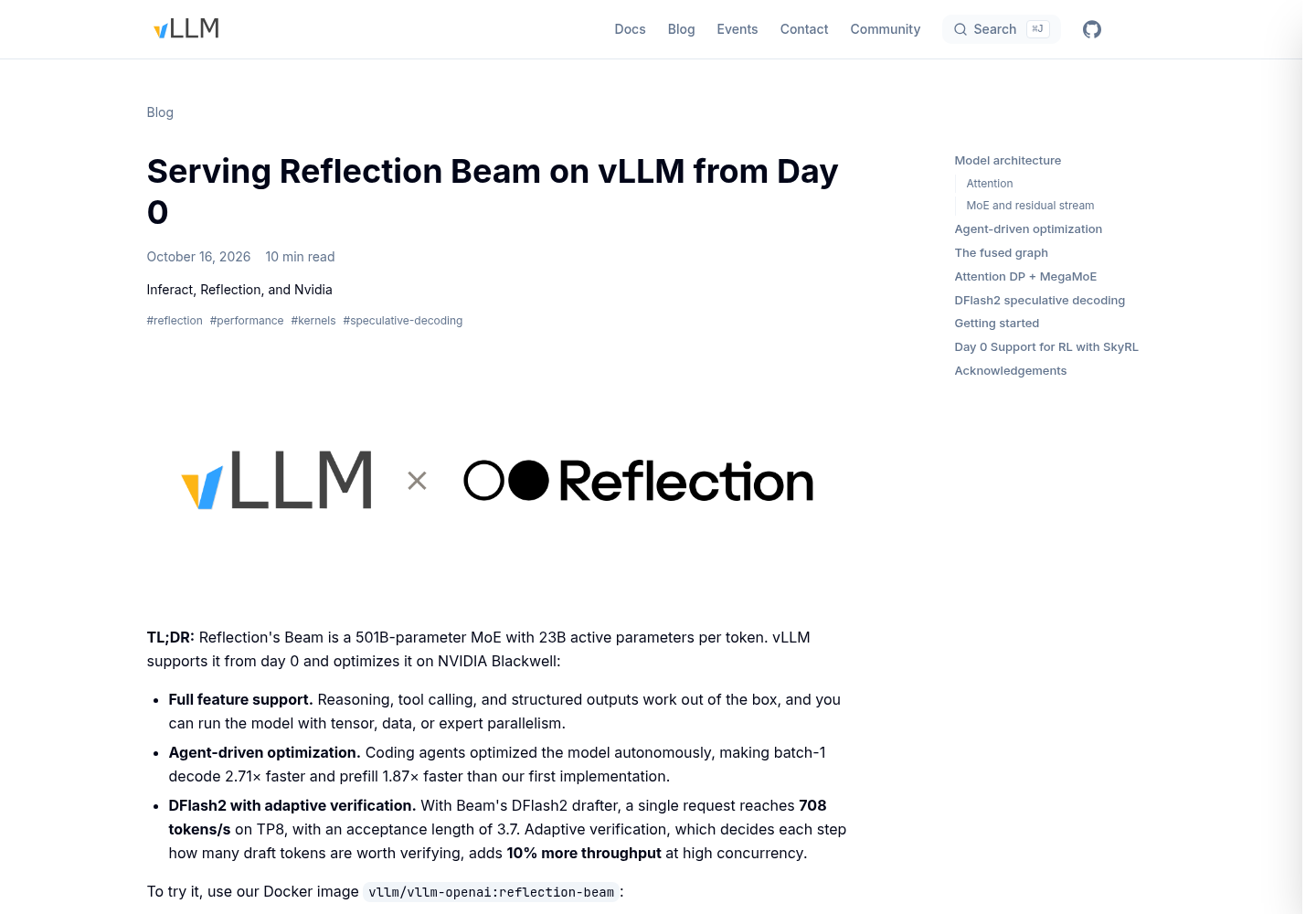
The most consequential detail for operators: the vLLM team says it optimized Beam autonomously with coding agents, which profiled the model, wrote kernels and benchmarked each change. The result is batch-1 decode 2.71 times faster and prefill 1.87 times faster than the first implementation. With the DFlash2 drafter, a single request reaches 708 tokens per second on TP8 with an acceptance length of 3.7, and adaptive verification adds about 10 percent throughput at concurrency 128. For prefill-heavy work, attention data parallelism plus MegaMoE delivered 1.71 times the peak prefill throughput of tensor parallelism on four GB300s.
For capacity planning, two B200s can hold the NVFP4 weights with little room for anything else, so the Hugging Face team recommends four B200s when you want long contexts and concurrent requests; two B300s or eight RTX Pro 6000s also work, and FP8 is the checkpoint for Hopper and Ampere GPUs.
You can train it, too
Beam is post-trainable from day one. TRL’s SFTTrainer with LoRA fits on a single 8-GPU B300 node at roughly 19,000 tokens per second, and a GRPO recipe built with RadixArk in Miles scales from 32 H200s for LoRA to 96 H200s for full-parameter RL. SkyRL shipped day-0 RL support as well, reporting a move from about 61 to 79 percent avg@8 on AIME25 in 50 training steps.
Why it matters
The frontier end of the open-weight field has lately been dominated by Chinese labs, with Meta’s Muse Spark Open as the notable US exception. Beam adds a 501B, permissively licensed US-lab model behind a single ollama run command, which resets the evaluation baseline for anyone already self-hosting coding agents. If the agentic-coding numbers survive independent benchmarking, Beam becomes a credible default lane for every harness that speaks an OpenAI-compatible endpoint.
Before you commit GPUs, price the completed task rather than the token (Free Weights, Paid Tasks), and compare Beam against the current field in the open-weight scorecard. For background on which open models can actually drive a harness, see Open-Weight Models That Can Actually Drive a Harness, and for the earlier 1M-token open-weight coding release from Meta, see our Muse Spark Open coverage.
Sources
- Welcome Beam: a 501B open model you can own, customize, and scale
- Introducing Reflection Beam: an open-weight model for agentic coding on AWS | Artificial Intelligence
- Reflection's Beam is freely available on Ollama for a limited time · Ollama Blog
- Serving Reflection Beam on vLLM from Day 0 | vLLM Blog