
Devin Fusion Pairs Opus 5.5 With GPT-6 Luna, Claims Leading Coding Agent Benchmark Score at 31% Lower Cost
Cognition's Devin Fusion scored 68 on Artificial Analysis' Coding Agent Index using an Opus 5.5 lead and GPT-6 Luna sidekick, claiming 31% lower cost per task than Claude Code alone.
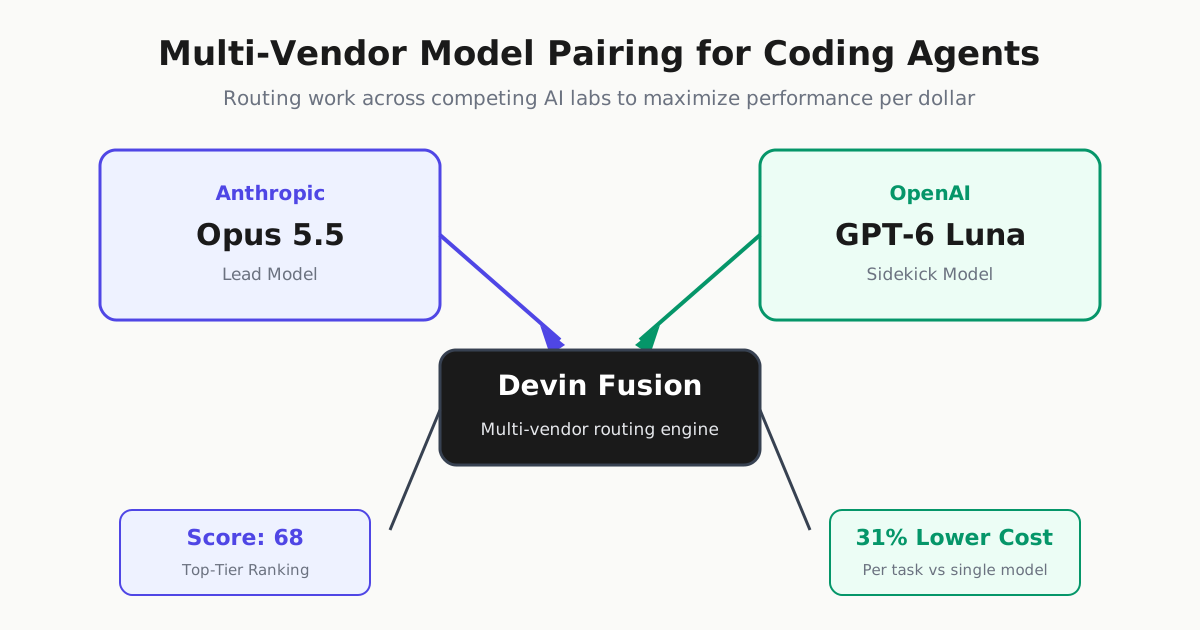
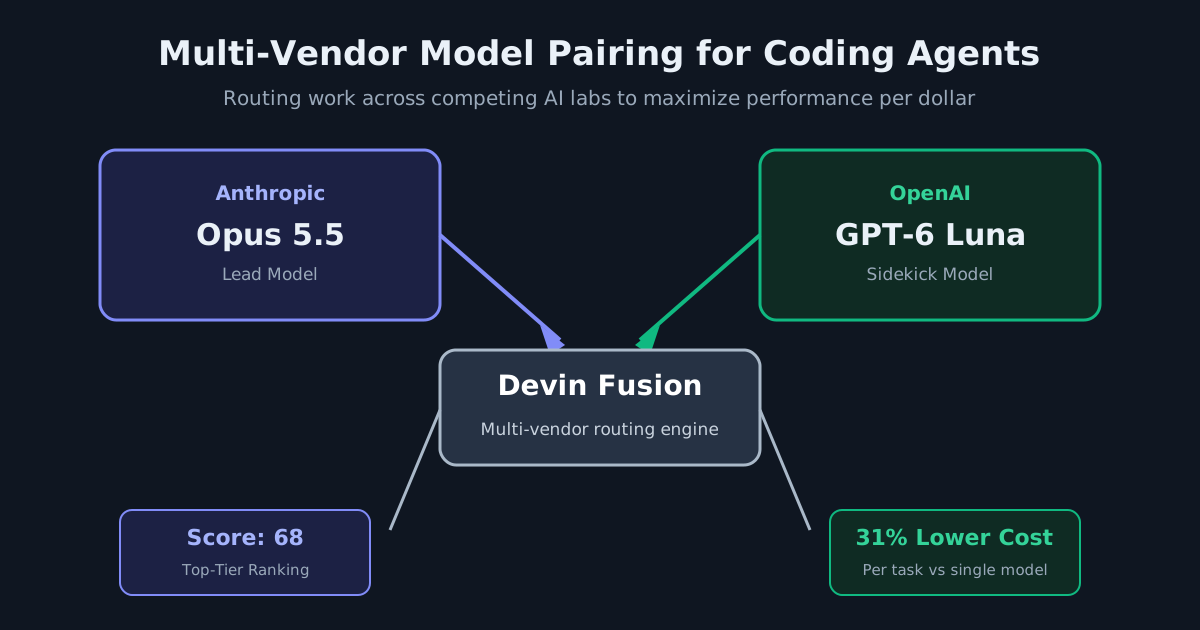
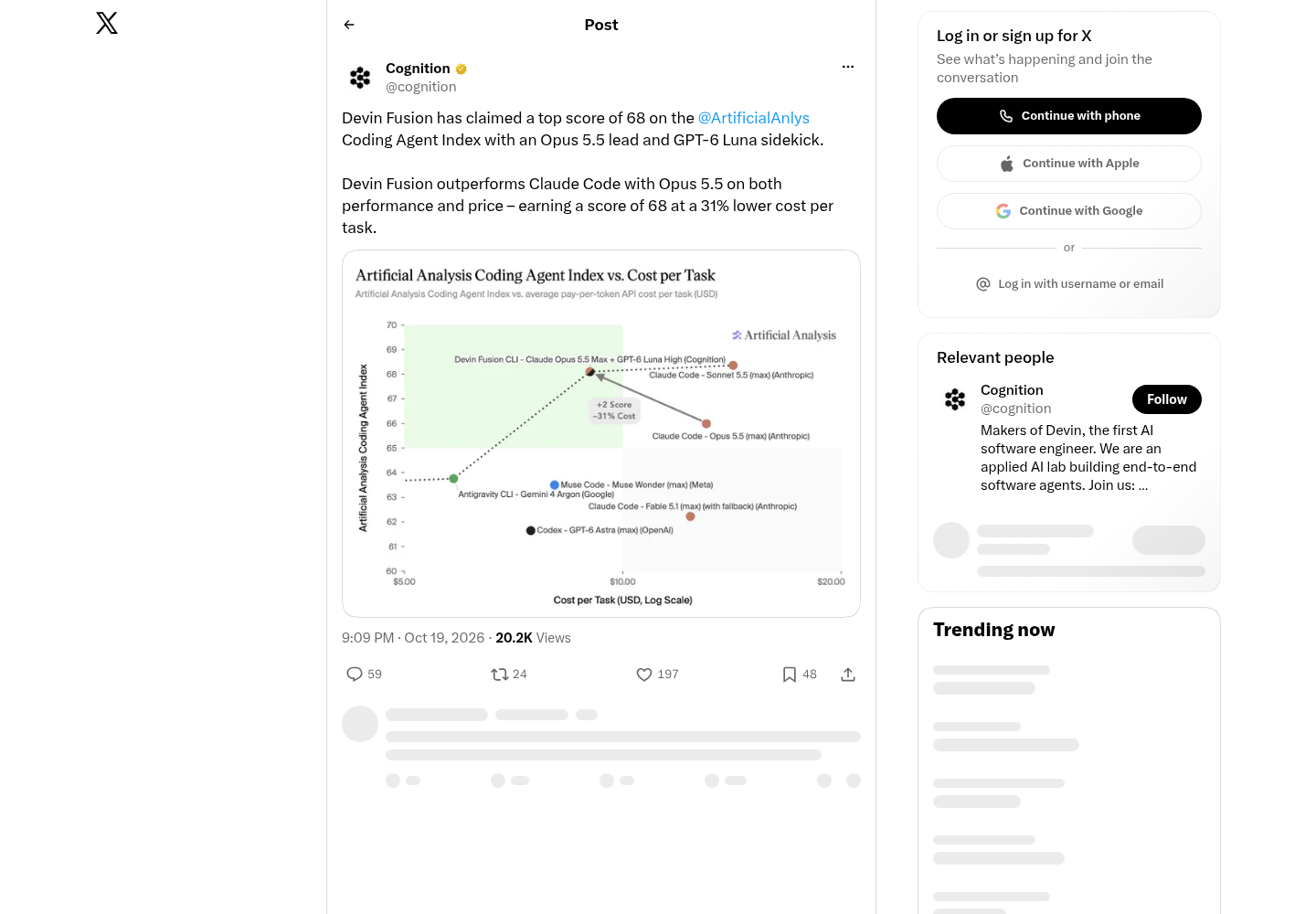
Cognition announced that Devin Fusion has claimed a score of 68 on the Artificial Analysis Coding Agent Index by pairing models from two different vendors: Anthropic’s Opus 5.5 as the lead and OpenAI’s GPT-6 Luna as the sidekick. The company claims the combination outperforms Claude Code running Opus 5.5 on both performance and price, earning a score of 68 at 31% lower cost per task, as posted on Cognition’s X account on October 19, 2026.
The First Cross-Vendor Pairing at the Top
What makes this result unusual is not just the score. Coding agent benchmarks have been climbing for months, and a score of 68 represents a top-tier result on the Artificial Analysis index, which evaluates agents across DeepSWE v1.1, Terminal-Bench 4.0, and SWE-Atlas-QnA. The novelty is that the leaderboard position was achieved by routing work between models built by competing AI labs.
Historically, coding agents have leaned on a single model family. Claude Code runs Anthropic models. Codex defaults to OpenAI models. Cursor Auto, Fugu Max and Copilot Auto offer opaque hosted routing. Devin Fusion’s approach — an Opus 5.5 lead backed by a GPT-6 Luna sidekick — is the first time a publicly reported top-tier benchmark score has come from a multi-vendor model pairing.
This matters because it shifts the conversation around agent architecture from “which single model is best” to “which combination of models produces the best result per dollar.” As agent benchmarks saturate and the gap between frontier models narrows, routing decisions become the primary lever for both performance and cost.
The Cost Angle
Cognition’s 31% lower cost claim is the more consequential number. Devin Fusion’s score of 68 matches what the top tier of the index delivers, but the cost per completed task is where the multi-vendor approach pays off. GPT-6 Luna is positioned as a more cost-efficient option than Opus 5.5, and routing simpler subtasks to the lower-cost model while reserving Opus 5.5 for the hardest problems is a pattern that cost-per-completed-task analysis has been pointing toward for months.
This is not just a Devin story. The same economics apply to any team operating a fleet of coding agents. When a lead model costs multiple times what a capable sidekick costs, splitting work intelligently can cut the operating bill without cutting the quality of the finished task.
What Fusion Actually Does
Devin Fusion is Cognition’s multi-model routing approach, introduced in June 2026 and extended to Devin Desktop and CLI in September 2026. The benchmark configuration pairs Anthropic’s Opus 5.5 as the lead model with OpenAI’s GPT-6 Luna as the sidekick, earning a score of 68 on the Artificial Analysis Coding Agent Index at 31% lower cost per task than Claude Code running Opus 5.5 alone. The benchmark result suggests the pairing works: combining a top-flight reasoning model with a lower-cost sidekick produced a score two points higher than the single-model baseline at a lower operating cost.
Cognition operates Devin as an autonomous software engineer deployed at large enterprises, and the company has been pushing cost efficiency as a differentiator. Earlier this year it announced an AI Productivity Guarantee, and the Fusion architecture is the technical foundation for delivering on a price-performance promise at scale.
What It Means for the Market
The multi-vendor pairing result arrives at a moment when model routing is maturing rapidly. Vercel’s AI Gateway Index recently showed open-weight models hitting 71.5% of tokens, and operators are increasingly mixing models across providers. Devin Fusion placing a cross-vendor pair among the top entries on a public benchmark validates the architecture for teams that have been hesitant to run multi-provider agent fleets.
For Anthropic, the result is a double-edged signal: Opus 5.5 remains the lead model of choice for top-tier coding agent performance, but the win is shared — and the cost story belongs to the sidekick. For OpenAI, GPT-6 Luna appearing in a winning agent configuration may help position it as a capable lower-cost option even when it is not the primary reasoning engine.
None of these claims have been independently verified beyond the published benchmark results, and the Artificial Analysis index is one of several coding agent evaluations in use. But the practical takeaway for teams running coding agents is clear: your next cost reduction may not come from negotiating a better model price. It may come from pairing the right two models and routing tasks intelligently between them.
Sources
- Cognition on X: "Devin Fusion has claimed a top score of 68 on the @ArtificialAnlys Coding Agent Index with an Opus 5.5 lead and GPT-6 Luna sidekick. Devin Fusion outperforms Claude Code with Opus 5.5 on both performance and price – earning a score of 68 at a 31% lower cost per task." / X
- AI Model & API Providers Analysis | Artificial Analysis
- Cognition