
Ant Group's inclusionAI Ships Ling-3.1-flash: 560B Open-Weight MoE With 1M-Token Context and a Vercel AI Gateway Lane
Ling-3.1-flash pairs 560B total and 25B active parameters with a 1M-token native context window, an MIT license badge on its model card, day-0 SGLang and vLLM support, and a Vercel AI Gateway model ID callable from Claude Code and Codex. Verified specs, recipes and chronology.
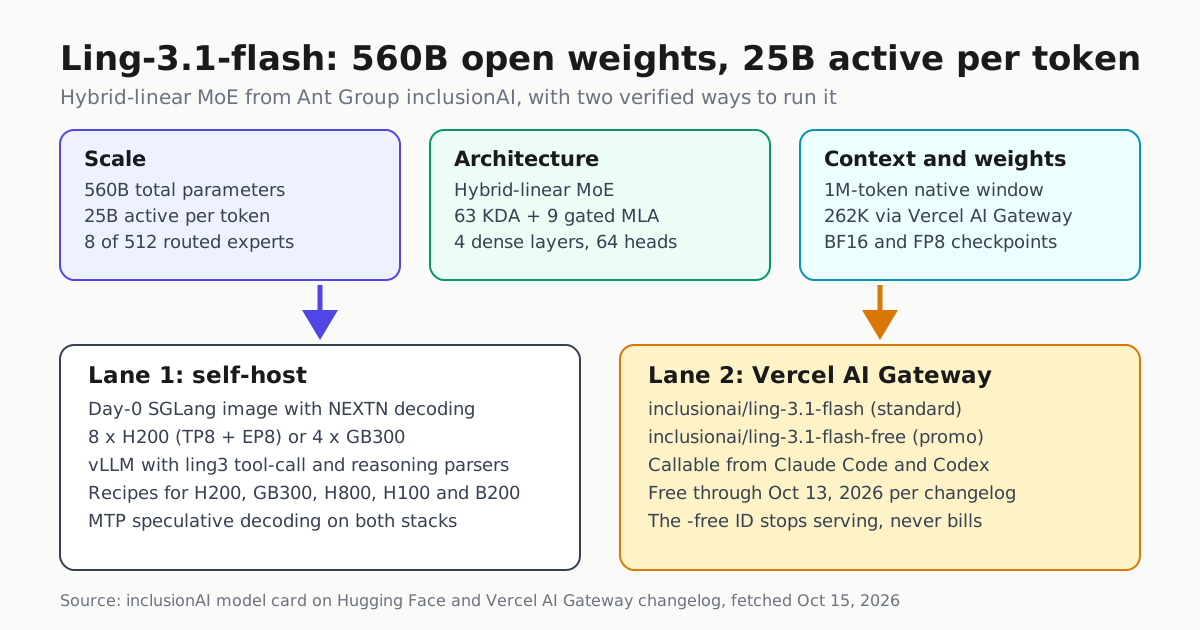
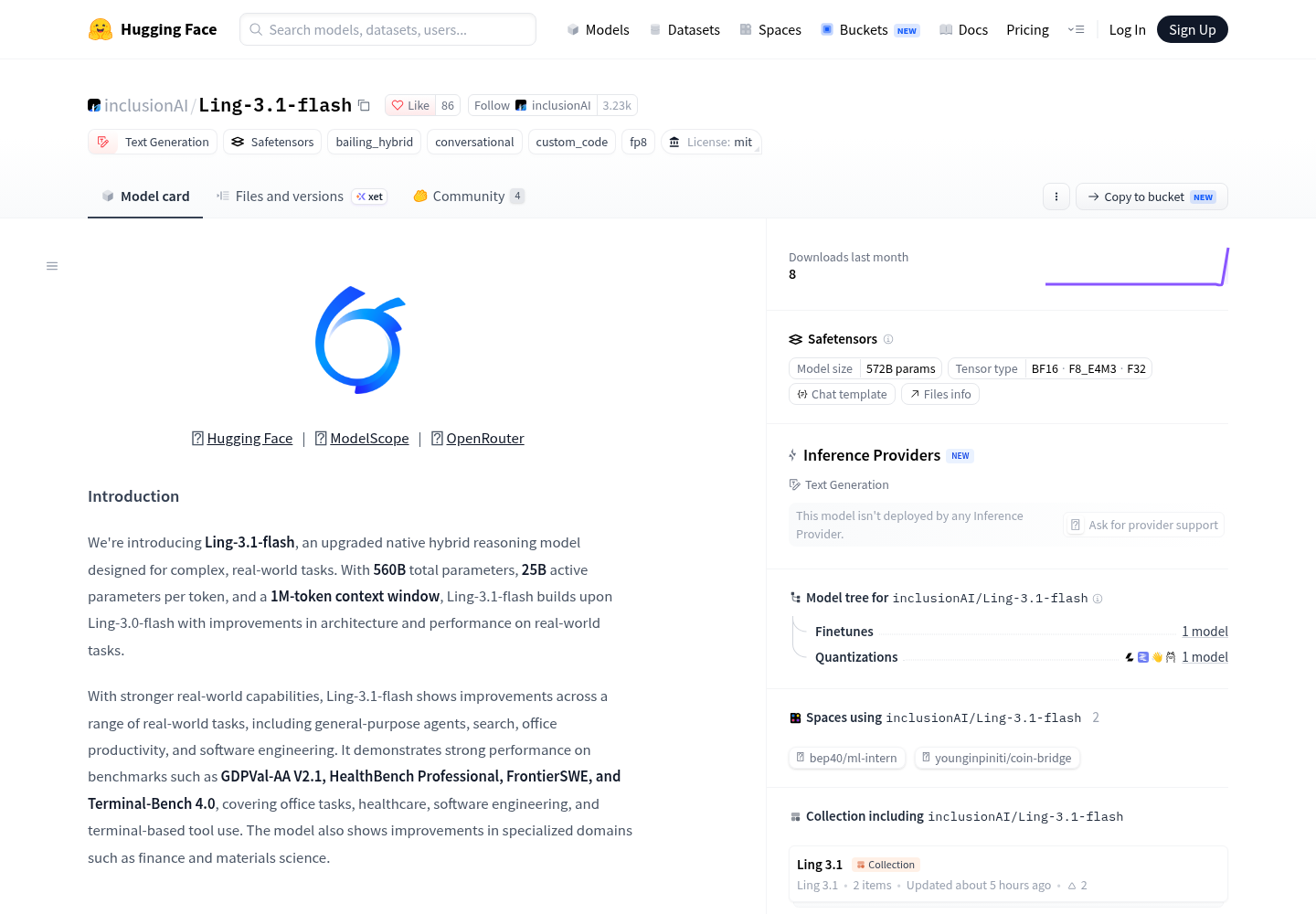
Ant Group’s open-source AGI arm inclusionAI has published Ling-3.1-flash, a hybrid reasoning model with 560 billion total parameters that activates only 25 billion per token and ships with a 1-million-token native context window. The model card on Hugging Face lists safetensors checkpoints in BF16, F8_E4M3 and F32 and carries a “License: mit” badge in the tag row under the repository title, and the organization’s activity feed shows the page updated within hours of our October 15, 2026 fetch. The gateway side of the story is older: the Vercel AI Gateway changelog entry listing the model as inclusionai/ling-3.1-flash, ready to call from Claude Code and Codex, carries a publish date of 30 Sep 2026 - about two weeks before this week’s weights and card update.
That combination gives fleet operators two verified lanes: rent the model behind a gateway for benchmarking, or self-host it on multi-GPU nodes with day-0 SGLang and vLLM support.
The spec sheet
| Property | Value |
|---|---|
| Architecture | Hybrid-linear MoE |
| Parameters | 560B total, 25B active per token |
| Attention layers | 63 KDA + 9 gated MLA (7:1), plus 4 dense layers |
| Experts | 512 routed, 8 activated, 1 shared |
| Heads and hidden size | 64 attention heads, hidden size 4096 |
| Vocabulary | 157184 |
| Context | 1M native; 262K on Vercel AI Gateway |
| Weights | Safetensors in BF16, F8_E4M3, F32 (page lists 572B params) |
| License | MIT per the model card badge |
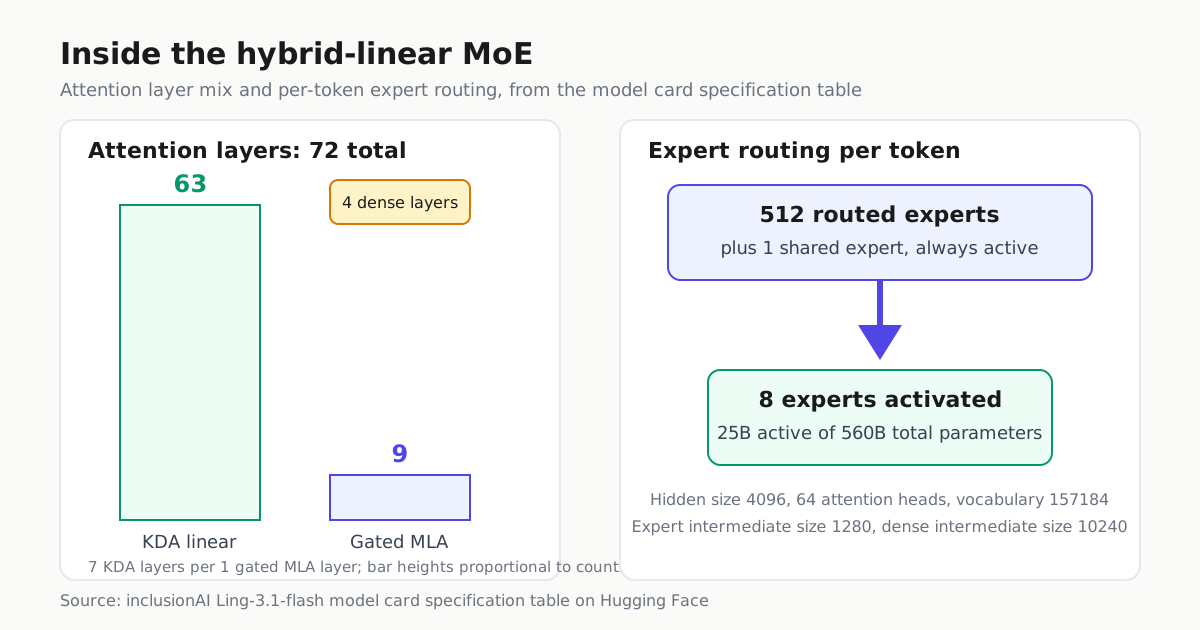
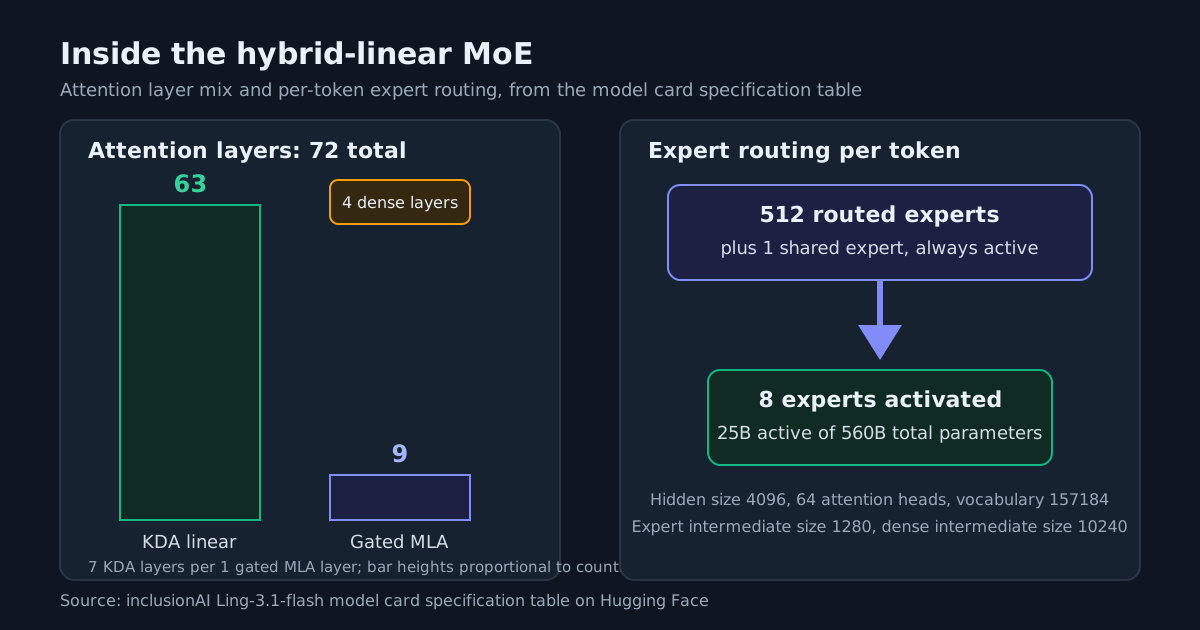
The 7:1 mix of KDA linear-attention layers to gated MLA layers is the cost lever: linear layers keep per-token attention cheap across long histories, while periodic full MLA layers preserve precise retrieval. On the MoE side, only 8 of 512 routed experts plus one shared expert fire per token, which is how a 560B-parameter repo runs at flash-class active compute. That reading is our analysis of the published specification, not a vendor claim.
Benchmarks, harnesses and LingCode
The card says Ling-3.1-flash performs strongly on Terminal-Bench 4.0, SWE-bench Pro, FrontierSWE, GDPVal-AA V2.1, Automationbench, MCP-Atlas and SkillsBench, and that it delivers a strong user experience across Claude Code, Kilo Code, Qwen Code, Hermes Agent and OpenClaw. The fetched page text did not include numeric scores, so treat any specific figures circulating on social platforms as unverified until you read the evaluation tables yourself.
More operationally interesting is LingCode, a harness the team built on the open-source coding agent Pi. It targets long-horizon coding runs that last for hours, involve hundreds of rounds of tool calls and require repeated context compaction, and inclusionAI says it is considering open-sourcing it. That pairs directly with the 1M-token window: the pitch is repo-scale agent runs that survive compaction instead of collapsing under it.
How to run it
SGLang is the recommended stack, with a day-0 image, MTP (NEXTN) speculative decoding and optional Hopper decode optimizations claimed to add roughly 10 percent to batch-1 decode speed:
docker pull lmsysorg/sglang:dev-ling-3.1-flash

docker run --gpus all --network host --ipc=host --rm \
  lmsysorg/sglang:dev-ling-3.1-flash \
  python3 -m sglang.launch_server \
    --model-path inclusionAI/Ling-3.1-flash \
    --tp 8 --ep 8 \
    --speculative-algorithm NEXTN \
    --host 0.0.0.0 --port 30000
That recipe targets 8 x H200; on 4 x GB300 you use --tp 4 --ep 4. Verified recipes also cover H800, H100 and B200, plus HiCache and reasoning on/off modes. The vLLM path runs from a precompiled editable install and needs the model’s dialect flags:
--tool-call-parser ling3 \
--reasoning-parser ling3 \
--mamba-cache-mode align \
--speculative-config '{"method":"mtp","num_speculative_tokens":3}'
Both stacks recommend the same sampling profile - temperature 1.0, top_p 0.95, top_k 20 - with enable_thinking set to true in chat_template_kwargs.
The gateway lane, and its two catches
Vercel lists Ling 3.1 Flash on AI Gateway for coding, multi-step analysis and tool-using agents that work over long documents and extended task histories. The model IDs are inclusionai/ling-3.1-flash and inclusionai/ling-3.1-flash-free. The changelog entry itself is dated 30 Sep 2026, so the gateway lane predates this week’s weights refresh by roughly two weeks - and two details matter before you route traffic:
- The free window has a date, and it has passed. The changelog states the model is free through October 13, 2026; the standard ID begins billing when the promotion ends, while the
-freeID stops serving instead of billing. We fetched the page on October 15, after that stated date, so confirm current pricing before pointing paid workloads at the standard ID. - The context shrinks. On AI Gateway the window is 262K tokens, not the native 1M. That is still roomy for repo-scale tasks, but the long-context headline does not transfer to the gateway lane.
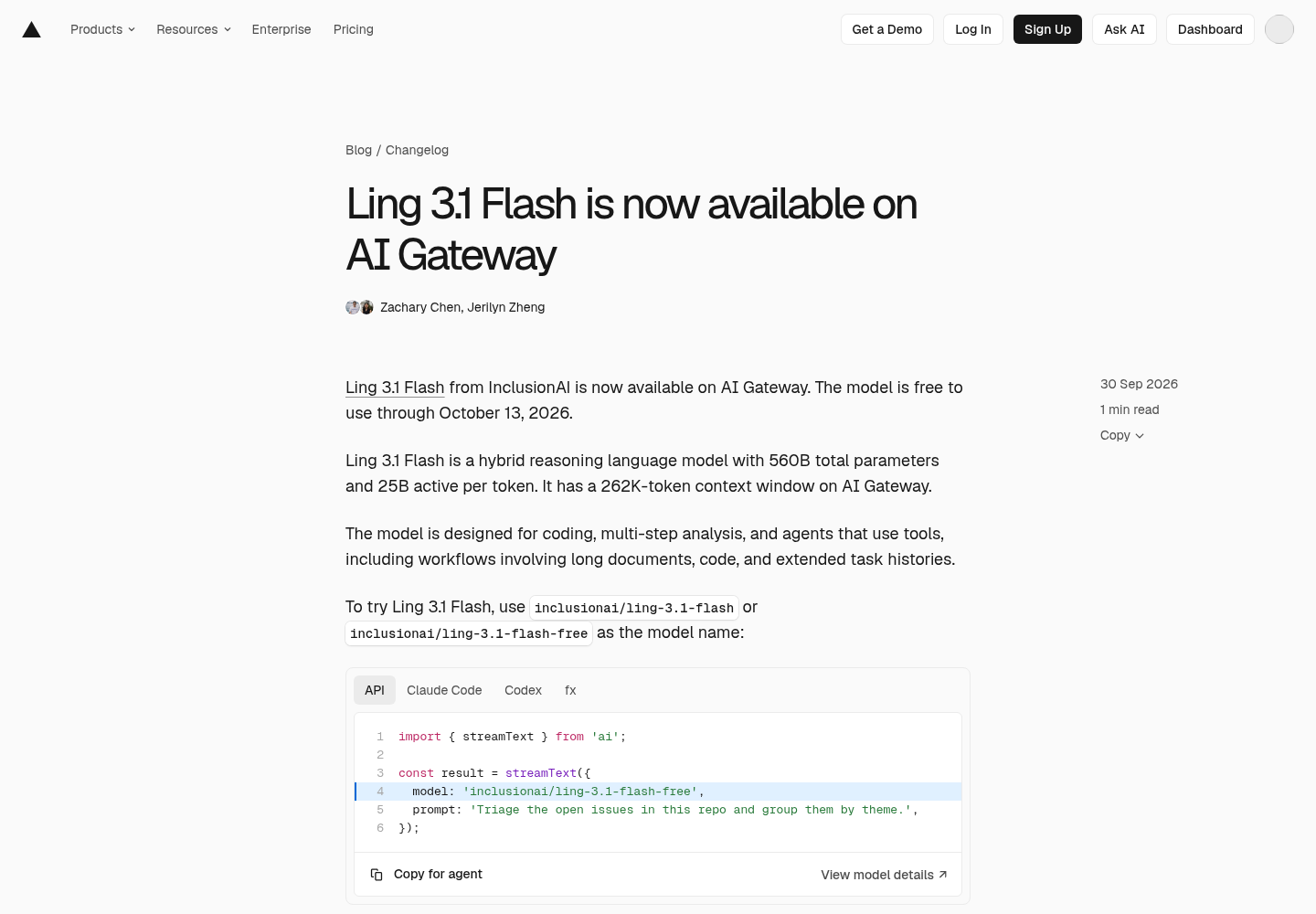
Wiring is the same pattern we covered when Gemini 4 Argon landed on AI Gateway: point a coding agent at the gateway via the AI Gateway coding agents guide, select the model, and let the gateway layer handle usage tracking, routing, retries and failover - with either an AI Gateway API key or your own provider key.
Licensing and provenance
The inclusionAI organization page describes it as the home of Ant Group’s AGI initiative and states that all models in the organization are based on MIT or Apache licenses. For this repository the choice is explicit on the page itself: the model card carries a “License: mit” badge in its tag row, visible in our capture above, so Ling-3.1-flash ships under MIT - the more permissive of the two licenses the organization names. Read the repository’s LICENSE file for the exact terms before commercial deployment, and keep the provenance caveat in view: the page showed only 8 downloads in the previous month at fetch time. This is a day-zero release, not a battle-tested artifact.
What to do with it
- Benchmark the gateway lane first. Before anyone rents GPUs, run your own task suite against
inclusionai/ling-3.1-flashin Claude Code or Codex and price the results per completed task rather than per million tokens - the method in our free-weights cost analysis. - Reserve self-hosting for sustained volume. The verified recipes start at 4 x GB300 or 8 x H200. This is not a desk-side model; compare it against genuinely small open MoE options like Liquid’s LFM2.5-24B-A2B before assuming open weights mean local.
- Slot it into your open-weight rotation. If it holds up on your workloads, it belongs on the same shortlist as the other frontier-scale open models in our guide to open-weight models that can drive a harness.