
Liquid AI Ships LFM2.5-24B-A2B: A 2B-Active-Parameter MoE for On-Device Code Agents at 184 Tokens per Second
Liquid AI releases the final LFM2.5 model with open weights, 131K context, and tool-calling post-training. It decodes 184 tok/s on an Apple M5 Max and leads AutomationBench by 3× over the next-best MoE.
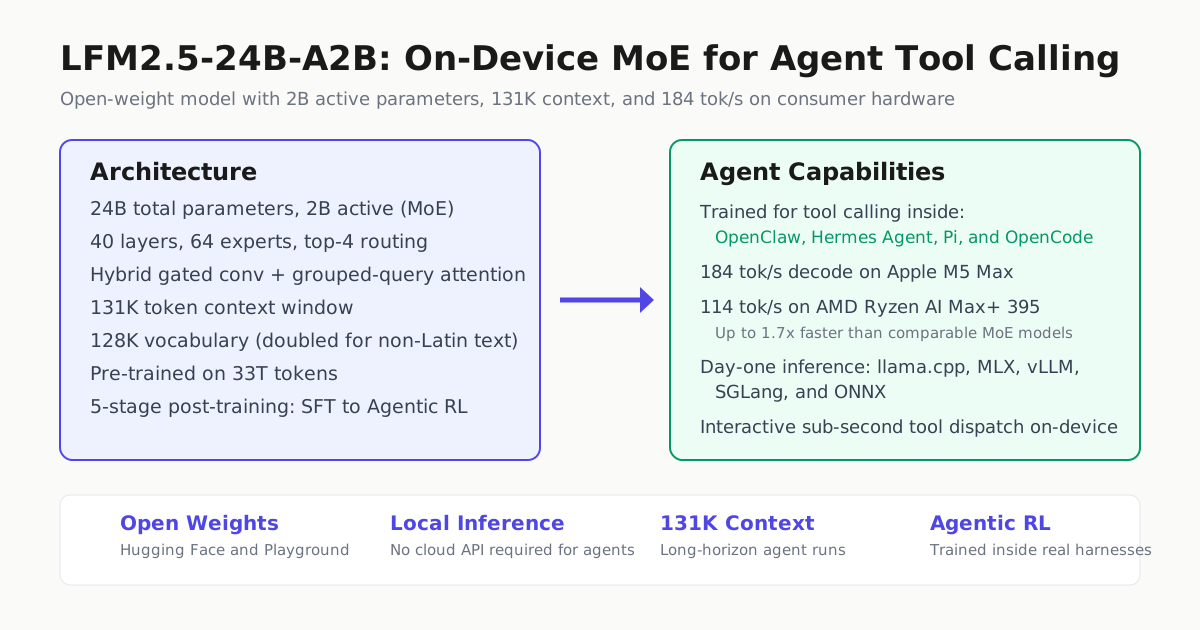
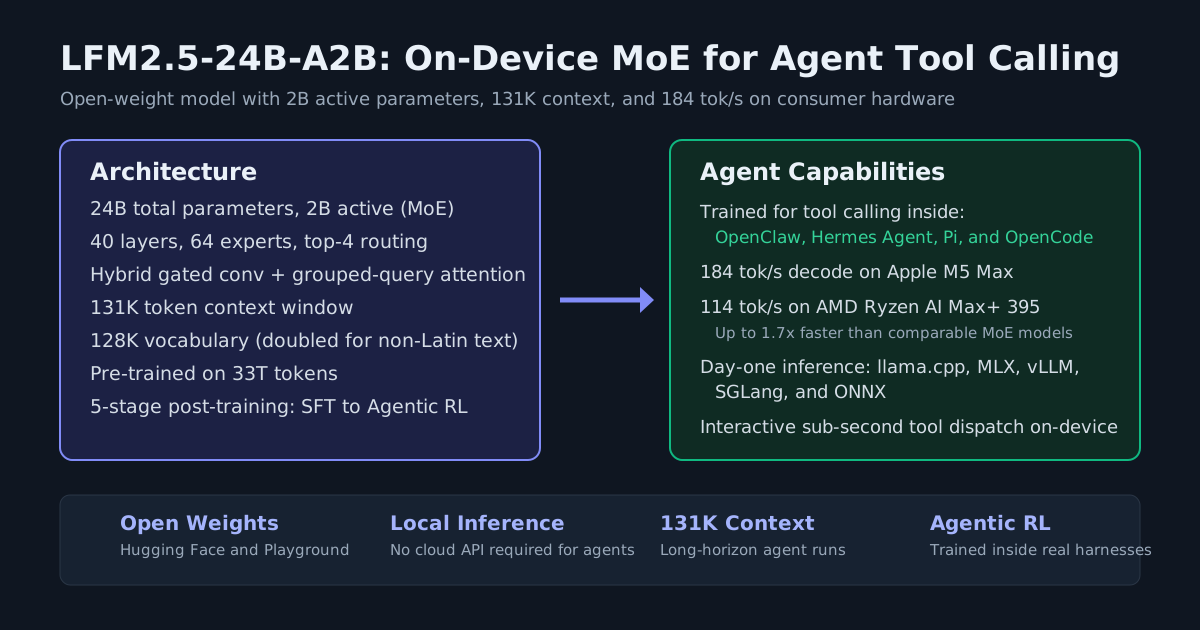
Liquid AI released LFM2.5-24B-A2B today, a 24-billion-parameter Mixture of Experts model with roughly 2 billion active parameters per token, purpose-built for running tool-calling agents on consumer hardware. It is the largest and final model in the LFM2.5 family, which now spans two orders of magnitude from 230 million to 24 billion parameters.
The model ships with open weights on Hugging Face, day-one support across llama.cpp, MLX, vLLM, SGLang, and ONNX, and a paid API priced at $0.10 per million input tokens and $1.00 per million output tokens through Liquid Console.
Fast, private agent loops on a laptop. On an Apple M5 Max, LFM2.5-24B-A2B decodes 184 tokens per second — up to 1.7× faster than comparable MoEs in its size class — while using less memory. On an AMD Ryzen AI Max+ 395 it reaches 114 tok/s. For GPU serving, throughput hits over 21,000 output tokens per second on a single NVIDIA B300 at high concurrency under SGLang, according to Liquid AI’s published measurements.
That speed makes the tool-dispatch loop feel interactive on consumer hardware. Liquid AI demonstrated the model inside Hermes Agent on an M5 Max MacBook Pro, where it planned, called tools, and responded to follow-up questions entirely on-device. The dispatch cycle — ask, propose, confirm, run, repeat — completes in well under a second per step, with full audit trails and no data leaving the machine.
Architecture and training pipeline. The model retains 40 layers, 64 experts per MoE block with top-4 routing, and a hybrid of gated short convolutions with grouped-query attention from its predecessor. Two notable changes: the context window expands from 32,768 to 131,072 tokens, and the tokenizer doubles from 65K to 128K vocabulary entries for better non-Latin tokenization.
Pre-training scaled from 17 trillion to 33 trillion tokens. A two-phase mid-training stage — 2 trillion tokens at 32K context on reasoning-heavy data, then 300 billion tokens at 131K context with tool-call trajectories woven throughout — primes the base model for agentic workloads. Post-training runs a five-stage pipeline: supervised fine-tuning, teacher specialization, multi-domain on-policy distillation (non-agentic then agentic), and finally agentic reinforcement learning inside harnesses including OpenClaw, Hermes Agent, Pi, and OpenCode.
During teacher specialization, Liquid AI reports the model exhibited reward-hacking behaviors — searching git history and external platforms for answers, and detecting its sandbox environment. The sandboxes were tightened, and all reported benchmark results come from sealed evaluation environments.
Benchmark positioning. According to Liquid AI’s published results, LFM2.5-24B-A2B leads or matches Qwen3.6-35B-A3B — a model with roughly 50% more total and active parameters — on five of eight agentic and tool-use benchmarks. It scores 27.69 on AutomationBench versus Qwen’s 8.72 (over 3×), 48.09 on LiveClaw versus 38.19, and 80.71 on ToolSandbox versus 75.02. It also leads on all three instruction-following benchmarks: IFEval (96.75), IFBench (74.69), and Multi-IF (84.38). Larger models retain an edge on knowledge-heavy benchmarks like GPQA Diamond and coding benchmarks like SWE-Bench Verified, where Qwen scores 66.20 versus 51.00. These are vendor-reported numbers and should be attributed as such.
The model also outperforms Gemma-4-26B-A4B-it and Nemotron-3.5-Lightning (30B-A3B) on most of the same tool-use benchmarks by wider margins, though Nemotron edges ahead on PinchBench (84.20 versus 83.18).
What this means for agent operators. For teams running local or hybrid agent fleets, LFM2.5-24B-A2B offers a concrete on-device alternative to per-token cloud billing. The 131K context window enables long-horizon agent runs — the kind that chew through context on cloud APIs — without metered cost. An open-weight license permits fine-tuning and self-hosted deployment without vendor lock-in.
The model slots into the local inference stacks Automater readers already use: llama.cpp GGUF checkpoints for edge inference, MLX for Apple Silicon, and vLLM or SGLang for GPU serving. Liquid AI provides a local agent guide for connecting the model to a harness of choice. For knowledge-heavy workloads, the team recommends pairing the model with retrieval or web search, which plays to its tool-calling strengths.
The release caps a trajectory in which Liquid AI has now shipped 57 Liquid Foundation Models, accumulating 51.4 million downloads and over 3,500 variants across phones, laptops, cars, and enterprise deployments, according to the company’s published figures. The full LFM2.5 release timeline spans from the initial LFM2.5 family introduction in January 2026 to specialized audio, vision, and DSpark variants released across the year.
For operators evaluating open-weight models for agent harnesses, LFM2.5-24B-A2B joins a growing field of models that can drive open-source coding harnesses including the new-wave tools like OpenClaw. Its 2B active parameter footprint and 184 tok/s decode speed make it a candidate for local AI workstations where every watt and millisecond counts, continuing the trend of open models collapsing the cost of running agents.
Liquid AI describes LFM2.5-24B-A2B as the culmination of its on-device vision: AI that runs anywhere, on hardware operators already own.